5. Veterinary services
Guiding Principle
Veterinarians must deliver evidence-based veterinary services of a high standard, appropriate to meet the needs of their clients and the welfare health care needs of the animals under their care, and ensure these animals have access to emergency care.
Section 5.1
Veterinarians must keep their skills and knowledge up to date by taking part in relevant continuing professional development activities that maintain and develop their competence and performance.
Section 5.2
Veterinarians must recognise when either their competence or the resources available to them place limits on their ability to perform to an acceptable standard. All reasonable steps must be taken to avoid exceeding those limits.
Section 5.3
All veterinarians must take reasonable care to ensure that the practice that they are working in is operated to the standard expected in this Code.
Section 5.4
Veterinarians must maintain clear and accurate clinical records. The records must:
- be of such detail that another veterinarian could take over the management of the case at any time
- be retained for periods of time as required by statute or for the duration of time for which they remain relevant to the purpose for which they were recorded
- not be altered retrospectively unless the changes are marked chronologically on the record, and the additions are dated and noted as being added retrospectively; and
- be made accessible to clients on request, unless there are justifiable legal reasons to withhold.
Section 5.5
Veterinarians employed by government or involved in industry, education or research must:
- ensure that employer requirements and contractual obligations do not compromise or override professional standards
- inform clinical practitioners before providing services affecting their clients. This includes public presentations, trial work and investigating aspects relating to products.
- ensure all professional and regulatory requirements are satisfied when undertaking trial, research or investigatory work for an employer.
Section 5.6
In considering the use of alternative or complementary methods of diagnosis or treatment the welfare of the animal is paramount. Where a veterinarian chooses to use alternative or complementary methods of diagnosis or treatment the client must be able to make an informed decision about whether to proceed. Therefore the veterinarian making this choice must inform the client of:
- the nature of the alternative treatment offered; and
- the extent to which it is consistent with conventional medicine.
Section 5.7
Veterinarians in clinical practice must make an emergency service available at all times. This service is required so that animals under their care can receive essential veterinary treatment in order to relieve unreasonable or unnecessary pain or distress.
The emergency service must be sufficiently resourced, so that except in extraordinary circumstances all veterinary emergencies involving the animals under their care are attended in reasonable time to ensure the welfare of the animals.
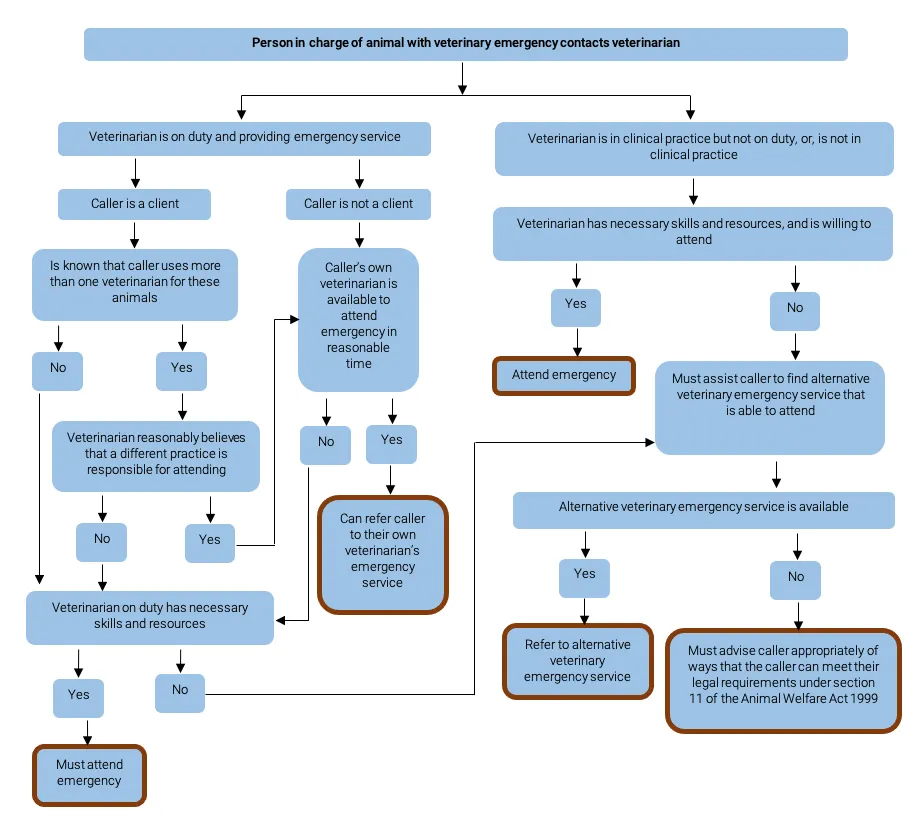
Those veterinarians on duty and directly responsible for providing the emergency service can refer callers who are not clients to the emergency service provided by the caller's own veterinarian. However, if that alternative service is not available and if the veterinarian has the necessary skills and resources required for the particular emergency, the veterinarian must attend the emergency and provide essential treatment.
Veterinarians are the health care professionals for animals. The Animal Welfare Act 1999 places legal obligations on the owners and persons in charge of animals requiring them to ensure that ill or injured animals receive, where practicable, treatment that alleviates any unreasonable or unnecessary pain or distress. In order that owners and persons in charge can reasonably meet those requirements they need access to veterinary care.
The Animal Welfare Act 1999 definition of the 'person in charge' is very broad and encompasses every person who is seen to have the animal under their care, control or supervision. This definition extends to the animal's veterinarian in situations where the animal is being treated or managed under the specific instructions of the veterinarian, creating a potential legal obligation to respond in an emergency.
Over and above any legal obligation that might exist, veterinarians have an ethical obligation to provide an emergency service in order to protect the welfare of animals whether those animals are under the veterinarian's care or not.
A veterinary emergency is defined as 'any sudden, unforeseen injury, illness or complication in an animal, demanding immediate or early veterinary treatment to save life or to provide timely relief from unreasonable or unnecessary pain or distress'. An emergency is considered to exist when described as such by the person in charge of the affected animal(s) until there has been an opportunity for veterinary assessment. Assessment may take place over the phone but the veterinarian must be confident that if they decide that the situation is not an emergency they have sufficient information in order to make that assessment accurately. When the veterinarian determines the situation is not a veterinary emergency, they should document their decision and reasons.
A veterinary emergency is not considered to exist and therefore does not need to be attended by a veterinarian if:
- following veterinary assessment the veterinarian decides that in their professional judgement the situation is not a veterinary emergency
- following discussion between the caller and the veterinarian mutual agreement is reached that emergency veterinary treatment is not required to manage the situation and protect the welfare of the animal.
For an emergency service to be sufficiently resourced veterinary emergencies must be able to be attended within a reasonable time frame to ensure that affected animals do not suffer unnecessary or unreasonable pain or distress. There must be an adequate number of veterinarians and support staff to meet the demand for emergency services that could reasonably be expected from the practice's clients taking into account the size and type of practice. For example the number of veterinarians required to be on call in a multi veterinarian dairy practice during calving season might need to be different to what is required in the same practice outside calving season. The locality of the practice might also influence what is expected regarding a reasonable time for the veterinarian to attend to the animal. Those persons providing the service must be adequately supplied and equipped, and have the necessary competence to be able to attend the types of emergencies that could reasonably be expected to arise involving the species and classes of animals normally treated by the practice.
In a veterinary emergency a veterinarian's involvement should be tailored relative to his or her own competence and to the resources available to deal with the particular situation. When a veterinarian personally attends an animal in an emergency, and the particular clinical skills required are outside the veterinarian's competence, this must be identified to the person in charge of the animal(s). If an alternative veterinary service is available which can offer the necessary skills and resources this should be offered. Alternatively, obtaining the appropriate informed consent of the person in charge of the animal before proceeding with treatment will reduce the vulnerability of the veterinarian if the outcome of the emergency is not as expected. In an emergency it may not be appropriate or feasible to document the informed consent process at the time, but veterinarians in this situation are advised to document their involvement and the process by which they gained consent as soon as possible when the circumstances permit.
The emergency service provided by a practice may involve the services of appropriately trained persons (for example technicians and veterinary nurses) who are not veterinarians. However, a veterinarian must be readily and directly available at all times to provide the necessary veterinary clinical support and undertake the work legally required to be completed by a veterinarian.
When planning an emergency afterhours procedure Council expects veterinarians to consider:
- the number of trained support staff, including other veterinarians in the practice, that would normally be needed to assist; and
- whether they can be available in a sufficient timeframe.
If deciding to proceed without competent support, the person in charge of the animal needs to be advised of this as part of the informed consent process. Consideration should also be given to whether the animal's welfare warrants referral to another practice which is available and capable of providing the necessary resources.
Practices should consider in advance how these cases will be managed and have a policy in place detailing how appropriate afterhours support can be accessed.
This Code recognises that there will be times when a veterinarian on duty will not be able to attend every emergency in a reasonable time. Extraordinary circumstances which might potentially prevent the veterinarian from attending (or delay attending) an emergency might include but are not limited to:
- the veterinarian on duty being unexpectedly overloaded with emergency call(s) of a similar or higher priority to the emergency which cannot be attended
- the veterinarian on duty becoming incapacitated by injury, ill health or excessive fatigue while on duty to a level that compromises his or her ability to provide the level of care expected
- the veterinarian on duty holding the reasonable belief that attending the particular emergency would place his or her own personal safety or health at risk.
When extraordinary circumstances prevent a veterinarian on duty from being able to attend an emergency, they must assist the caller (or where that is not possible, arrange for someone else to assist the caller) to access an alternative veterinary service.
In an emergency where the caller is not a client, the veterinarian on duty is entitled to refer the caller to the emergency service provided by the caller's own veterinarian. If that service is not readily available and if the veterinarian on duty has the necessary skills and resources required for the particular emergency, they must attend the animal and provide essential treatment. Examples of the types of situations where this might apply include: when the caller's own veterinarian on duty is busy with another emergency or the caller does not already use the services of another veterinarian, or the caller is travelling and out of the district of their own veterinarian.
There will be times when it is known by the veterinarian on duty that the caller uses the services of more than one veterinary practice (including specialist referral practices).
Where the emergency specifically relates to the veterinary services that have been provided by a different practice to that of the veterinarian on duty, the caller can legitimately be referred to the emergency service of that practice.
Examples might include:
- the caller has a dog that had an operation performed by a specialist surgeon and now the dog has developed complications associated with the surgery. The veterinarian on duty can refer the caller to the emergency service of the surgeon.
- the caller has a horse that has reacted to medication prescribed by a veterinarian. The caller has rung a different practice about the problem. The veterinarian is entitled to refer the call to the veterinarian that prescribed the medication.
- the caller has a bull calf that was castrated by a veterinarian and the wound is now infected. The veterinarian is entitled to refer the call to the practice that did the surgery.
It is likely that a caller will have one usual veterinarian who can be considered to be the provider of regular veterinary services (the general veterinary practitioner) for an animal or a particular group of animals owned by the caller. The general veterinary practitioner must accept the major responsibility for providing emergency care for those animals. Where a different practice to that of the veterinarian on duty could reasonably be described as the general veterinary practice of the caller then the veterinarian on duty is entitled to refer the caller to the emergency service of that practice. (Refer to sections 1 and 2 of the 3. Professional relationships for more explanation).
If the caller is a client and is known to use the services of more than one veterinary practice, the veterinarian on duty must attend the animal and provide essential treatment. This assumes the call is a veterinary emergency and the veterinarian has the necessary skills and resources.
In all cases if the caller is referred to the emergency service of another veterinary practice and that service is not readily available and if the veterinarian on duty has the necessary skills and resources required for the particular emergency, then they must attend the animal(s) and provide essential treatment.
In an emergency where the caller identifies that they have economic restraints (or where the client has a poor credit history with the practice), the obligations of the veterinarian remain the same. The welfare of the animal is the first priority. However, attending the welfare needs of the animal does not commit the veterinarian to undertake treatment beyond ensuring the animal is not suffering unreasonable or unnecessary pain or distress.
When attending a veterinary emergency, the over-riding concern must be the welfare of the animal and the relief of unreasonable or unnecessary pain or distress. Following initial assessment and first aid, the veterinarian should provide the owner with an assessment of the extent of any problems, a realistic prognosis and the various treatment options available. Further treatment should be agreed upon taking into account the necessary and available resources, as well as the economic and emotional needs of the owner and the particular circumstances of the animal. Veterinarians are not obliged to undertake ongoing treatments that cannot be paid for by the owner/person in charge. Where the necessary ongoing treatment cannot be agreed upon and the animal is deemed to be suffering unreasonably, further treatment may be limited to euthanasia or where appropriate, stabilisation of the animal's clinical condition prior to transport to another source of veterinary care.
All veterinarians providing clinical services must make provision for an emergency service. Clients must be informed about the availability of this service by means of a telephone answering service and a notice at the unattended clinic. Other means can also be used, for example notices in newspapers.
With the advent of specific emergency after hours clinics it is accepted that some animal owners may have to travel further to receive service. The disadvantages of longer travel may be offset by the advantages (eg constant veterinary supervision) associated with the type of veterinary service offered by such clinics. The same issue can apply when veterinary practices work together co-operatively to share the provision of emergency services. When considering referring clients to another clinic for emergencies veterinarians should give thought to what is a reasonable/ acceptable time or distance for their clients to travel taking into account local factors and conditions.
Veterinarians offering particular services (eg embryo transplant) to geographically distant clients must observe the requirement to ensure provision of a continuous emergency service. Where circumstances are such that the veterinarian cannot personally provide this, specific prior arrangements must be made with colleagues who can do so and provide their colleagues in the area and the mutual client with a specifically arranged emergency service locally.
This Code recognises that people living in remote and inaccessible geographic areas are unlikely to receive the same level of emergency veterinary service as people living in more populated areas. In this context remote and inaccessible means areas with low population density where there are few options for veterinary service and where travel may be logistically difficult because of distances required to be travelled, terrain, or weather. The more isolated the client/patient is from the veterinarian, the more impracticable it may be to provide comprehensive 24-hour emergency cover, and the more difficult it may be for a veterinarian on duty providing that cover to attend to the needs of an animal that may require immediate first aid or pain relief.
From time to time in certain districts particular types of veterinary service may not be readily available. For example, there may not be enough equine veterinarians in a district to be able to meet the demand for routine equine veterinary services let alone emergency services. Or there might be a sole veterinary practitioner providing the only veterinary services to a particular geographic district. In these circumstances a pragmatic approach is needed in order to protect animal welfare standards and common sense must prevail when interpreting this Code in relation to the local veterinarian's obligations regarding the provision of emergency veterinary services.
In a district where these problems are specifically recognised by the Vet Council to occur and where a veterinarian in that district is not able to comply with this Code in relation to providing emergency services, he/she must seek clarification from the Vet Council about how their service might be tailored to the particular circumstances in order to meet acceptable standards.
For those times when an emergency service cannot be provided, either at night, weekend or other off duty periods, or by reason of holidays, sickness or emergencies of any kind, specific prior arrangements must be made with colleagues for an emergency service to be provided. It is recommended that this is formalised in a written agreement.
The obligation on the veterinarian is not therefore, to remain constantly on duty but to ensure that, when off duty, clients are directed to another member of the profession with whom prior arrangements have been made. The redirection of out of hours calls to other veterinarians without their prior knowledge and consent is unacceptable.
Veterinarians should when attending veterinary emergencies consider carefully the potential personal risks involved, and take steps to manage those risks. There is no expectation that veterinarians should place their personal safety at risk.
Providing an emergency veterinary service outside normal business hours can be more expensive. Those costs may be fairly passed on to the users of the service.
24 hour emergency response flowchart
Section 5.8
There will be times when a veterinarian who is not currently working in clinical practice, or who is not on duty, is called upon in a veterinary emergency. On these occasions, if the veterinarian is unable to attend the animal personally to provide emergency treatment, he/she must make a reasonable effort to assist the caller to locate an alternative source of emergency veterinary care.
Instances will occur where there is no available veterinary service. In any such case the veterinarian must provide appropriate advice in order that the person in charge of the animal is able to take the necessary steps to alleviate any unreasonable or unnecessary pain or distress being suffered by the animal.
Section 5.9
Veterinarians must make provision for the care of animals currently receiving in-patient treatment. This must be at a level appropriate to the clinical problem being managed and must be communicated to the client.
Section 5.10
When veterinarians provide a specific and limited range of veterinary services to the animals under their care, the following general conditions must be met:
- The veterinarian has verifiable advanced skills in the specific area of practice covered by the service.
- The service is limited in its scope so as not to be confused with the services provided by a General Veterinary Practitioner.
- The veterinarian offers no more than one of the specific range of services, for example, embryo transplants, equine dentistry, or lameness examinations. A veterinarian that offers one service to a selection of clients, but more than one to others is not a specific and limited service provider as more than one service is offered overall.
- The service is not, and is not likely to be seen as, a substitute to the client developing a relationship with a General Veterinary Practitioner. Hence this scope excludes a number of veterinary service models ( e.g. vaccination-only clinics, companion-animal-desexing-only clinics, mobile equine gelding clinics etc).
- The specific and limited service veterinarian consistently provides those services to all their clients. The veterinarian must not selectively provide a general veterinary services to certain clients and ‘specific and limited range of veterinary services’ to others unless the following are met:
- The veterinarian must have explicit, written terms of service with clients that makes it clear whether they are being provided with general veterinary services or a Specific and Limited service.
- For Specific and Limited clients, the veterinarian must be able to demonstrate that they have confirmed, before providing services, that the client has a General Veterinary Practitioner, has obtained to consent to share info, and confirmed with the practice that the client has access to 24-7 emergency care.
- For general veterinary services clients, the veterinarian must be able to demonstrate that they have made arrangements for adequate emergency care for those clients at all times, including when they are unavailable because they are providing Specific and Limited services.
- The veterinarian must still meet full requirements of the Code for Specific and Limited clients including personally making arrangements for emergency care in relation to the services they provide.
Section 5.11
When providing Unique Services to the animals under their care, veterinarians must comply with the following conditions:
- The veterinarian must only authorise the use of RVMs for immediate use on specific clinical matters they have consulted on.
- The veterinarian must, with the client’s permission, contact the client’s General Veterinary Practitioner. Communication between the veterinarians is required because if the total veterinary input is fragmented it may be difficult to achieve the best possible veterinary care outcomes for the animal(s) and the client.
Section 5.12
When providing Advanced Services to the animals under their care, veterinarians must comply with the following conditions:
- The veterinarian must only authorise the use of RVMs for immediate use on specific clinical matters they have consulted on. This includes the authorisation and supply of RVMs that require special circumstances approval for the ongoing management of a specific condition. The following are specifically excluded:
- The authorisation for future supply in order to hold specific RVMs in anticipation of use.
- The authorisation of companion animal vaccines and other RVMs not required for the matter consulted on.
- The authorisation of RVMs for the following dairy and beef cattle Disease Control Programs:
- Milk Quality programs including dry cow antibiotic treatment authorisations
- Mobility programs including general lameness treatments
- Fertility programs including reproduction hormones
- Calf and heifer nutrition programs
- Nutrition programs
- Infectious disease control programs
- Parasite management control programs
- The veterinarian must only provide the service after confirming the involvement of a General Veterinary Practitioner and communicating directly with them about the service they are providing. This must include access to existing patient records and the sharing of the records relating to the treatment the Advanced Services veterinarian provides. This means that, if the client does not have a General Veterinary Practitioner or declines consent to contact their General Veterinary Practitioner and the sharing of records, the advanced service must not be provided.
- The veterinarian must make arrangements for 24-hour emergency cover that is proportionate to the services they provide and RVMs they authorise. This emergency cover must be provided by themselves or, if agreed to, by the General Veterinary Practitioner.
Section 5.13
When providing Consultancy Services to the animals under their care, veterinarians must comply with the following conditions:
- The veterinarian must only authorise the use of RVMs for diagnostic purposes, i.e. RVMs must not be authorised for therapeutic purposes.
- The veterinarian must only provide the service after confirming the involvement of a General Veterinary Practitioner and communicating directly with them about the service they are providing. This must include access to existing patient records and the sharing of the records relating to the treatment the Consultancy Service veterinarian provides. This means that, if the client does not have a General Veterinary Practitioner or declines consent to contact their GVP and the sharing of records, the consultancy service must not be provided.
- The veterinarian must make arrangements for 24-hour emergency cover that is proportionate to the RVMs they authorise (i.e. diagnostic RVMs). This emergency cover may be provided, if agreed to, by the General Veterinary Practitioner.