Veterinary Guidance for Managing Public Presentations of Sick or Dead Wild Birds During an HPAI Outbreak
Background
High Pathogenicity Avian Influenza (HPAI) is a serious disease affecting birds, with high mortality rates and significant biosecurity implications. The H5N1 strain of HPAI may spread to New Zealand through the movement of wild birds. If it does, members of the public may encounter sick or dead wild birds and bring them to veterinary clinics. Veterinarians play a critical role in managing these situations while balancing public health, animal welfare, and professional responsibilities.
If HPAI H5N1 arrives in New Zealand and establishes in the wild bird population, it can't be eradicated. New Zealand will need to learn to live with the disease present in wild birds. Veterinary practices will need to ensure plans are in place to manage the risk of H5N1 on an ongoing basis.
This guidance has been developed for situations where there are reasonable grounds to believe that wild birds are likely to be infected with HPAI H5N1.
Pre-Incursion Surveillance
Before HPAI H5N1 is formally identified in New Zealand, veterinarians play an important role in early detection and surveillance. While HPAI may not yet be confirmed, awareness is essential when particularly avian patients present with symptoms consistent with avian influenza.
Preparation and Health and Safety
Veterinarians and veterinary businesses should follow strict health and safety measures, including being properly trained, regular and proper washing of hands and wearing full Personal Protective Equipment (PPE), including a facemask, eye cover, and gloves, when handling ill or dead wild birds or where there is a high index of suspicion of an HPAI infection.
Public guidance
Members of the public should be directed to the Ministry for Primary Industries (MPI) advice for reporting suspected bird flu: 🔗How to report suspected bird flu
Notification of an outbreak
MPI is responsible for coordinating New Zealand’s response to an HPAI H5N1 outbreak in partnership with the Department of Conservation, the Ministry of Health, and Health New Zealand | Te Whatu Ora.
Local and regional councils, iwi and hapū, industry and community groups will also have important roles following a detection of HPAI H5N1. Landowners, or those responsible for managing the property, will be responsible for birds and animals that are sick or dead on their land.
MPI has a communications plan for the arrival of H5N1, as well as a notification protocol. This will include both a public announcement and notification of key stakeholders.
Public advice re sick birds
Leaving birds that are sick, or possibly infected with HPAI H5N1, alone will give them the best chance of survival and reduce the risk of further spread of HPAI H5N1. Disturbing birds that might be recovering or nesting can cause stress or lead to worse outcomes for the animal.
Also, avian influenza can spread to people who have close unprotected contact with HPAI-infected birds.
Do not take a sick bird to a veterinarian or wildlife rehabilitation centre (or similar) unannounced. If you choose to seek advice from a vet or wildlife rehabilitation centre, make sure to contact them by phone first. Be aware that for animal welfare and health and safety reasons, birds with HPAI H5N1 may need to be euthanised if they cannot be cared for and rehabilitated at such facilities.
Do not actively cull or disperse wild birds on your property, as this can spread the disease.
Keep domestic animals and people away from wild birds to prevent disturbance and potential infection.
Veterinary clinic considerations during an HPAI outbreak
Veterinarians should use their judgment when deciding to examine wild or unowned sick birds that may be infected with HPAI. Veterinarians should refer to New Zealand’s current incursion status, current veterinary standards, industry guidelines and government advice.
When deciding whether to accept or examine a sick wild bird, veterinarians should consider the following:
1. History
Assess the presenting signs of the bird/s. The most obvious sign of HPAI is sudden death in several birds. Other signs in birds can include:
- weakness and trembling
- paralysis
- breathing difficulties
- lack of coordination
- blindness
- diarrhoea
2. Avian Medicine Capability
- Assess whether your clinic has the necessary expertise and equipment to safely and effectively manage avian patients.
- NOTE: Clinics that routinely accept injured or sick wild birds, often for transfer to a wildlife facility or, more commonly, for euthanasia, do not require a particular capability or expertise in avian medicine to meet the welfare needs of these animals i.e. to perform euthanasia.
- Consider whether protocols can be established to prevent transmission of HPAI to other avian patients.
- Consider the use of Remote Triage where appropriate for suspected HPAI cases.
- Consider having an arrangement with another practice that does see suspected cases of HPAI.
3. Health and Safety Risks
- HPAI poses a zoonotic risk. Assess the ability to successfully manage this risk and ensure staff are trained in appropriate PPE use and infection control protocols (refer to Health and safety guidance).
- Evaluate the risk to staff, clients, and other animals in the clinic.
4. Biosecurity and Transmission Risk
- Consider the potential for HPAI to spread to healthy patients or contaminate the clinic environment.
- Implement strict isolation and disinfection procedures if handling is necessary and you elect to examine or admit the bird.
5. Cost Implications
- Determine whether the clinic can absorb or pass on the costs of diagnostics, PPE, treatment, euthanasia, and biosecurity measures.
- Communicate clearly with the public about any fees or limitations.
6. Welfare of the sick bird
- Handling may cause significant stress and worsen the bird’s condition.
- While HPAI can cause severe clinical signs in wild birds, handling and treatment is likely to cause additional stress, especially in wild birds unaccustomed to human contact.
- There are no specific treatments for HPAI in wild birds, and euthanasia may be the most humane option if the bird is suffering and unlikely to recover.
- Attempting to rescue, transport, or treat an infected bird may increase the risk of spreading HPAI to:
- Other birds (wild or domestic)
- Humans (though rare, zoonotic transmission is possible)
- Pets or other animals.
- Leaving, or if presented, returning the bird to its original location may limit human contact, and reduce transmission risk. Importantly, a proportion of birds showing clinical signs do recover. Leaving HPAI-infected wild birds where they are is consistent with the government advice to not handle or move the birds.
- Returning an HPAI-infected wild bird to its original site would not be considered unreasonable, provided it is within your local Territorial Authority guidelines.
7. Local Authority Responsibilities
- Councils maintain important connections with their communities and will be able to share information to prepare and support their constituents when HPAI H5N1 arrives.
- Regional councils have obligations regarding domestic biosecurity and will play a central role in how regions respond to HPAI H5N1. This is expected to be predominantly focused on wild birds in public spaces.
Veterinarian Responsibilities During Suspected HPAI H5N1 Incursion in Wild Birds
- Animal Welfare Obligations Veterinarians must act promptly to address situations where animals may be experiencing unreasonable or unnecessary pain or distress, or where there may be breaches of animal welfare legislation.
- Risk Assessment and Management
- Veterinarians should assess risks on a case-by-case basis and implement appropriate personal and practice-level risk management procedures.
- Practices are encouraged to have a documented plan to minimise risks associated with handling higher-risk animals, including wild birds.
- Health and Safety Priority While animal welfare is important, personal and team safety take precedence. Veterinarians are not expected to put their health or safety at undue risk to provide veterinary services.
- Handling Suspected HPAI Cases
- If there is a credible risk that a wild bird may be infected with HPAI H5N1, it is acceptable for veterinarians and clinics to
- Instruct the public to return the bird to its original location without treatment.
- Refer the public to clinics you have an arrangement with if they are seeing wild birds with possible HPAI infections.
- Veterinarians should provide clear instructions to minimise further contact and encourage reporting to relevant authorities (e.g. MPI hotline).
Public Assistance The Veterinary Council expects veterinarians to assist members of the public in finding appropriate guidance or alternative support, while prioritising their own health and safety.
Recommended actions
- Encourage the public to leave wild birds where they find them and NOT to bring them to the clinic. Instead, direct them to MPI’s reporting channels.
- If a bird is already presented, veterinarians should:
- Consider whether to accept the bird. It is acceptable to instruct the person presenting it to return it to its original location.
- Use their judgment to decide whether immediate euthanasia is appropriate. If it is suspected of having HPAI and is at the clinic, then euthanasia is also an acceptable course of action if it can be done safely.
- Minimize contact. For example, advising to avoid direct handling if possible, or to use barriers like a container or cage without reaching in.
- Isolate the bird immediately.
- Use appropriate PPE (e.g., disposable gloves, N95 respirator, eye protection, and a disposable gown or coveralls).
- Refer to the MPI website for further information.
- Refer the member of the public who presented the bird to their health provider for advice.
- Document the encounter including site where the bird was found, whether other birds are also affected etc and any actions taken for traceability.
- Take steps to avoid spillover – spillover events into other species are associated with cohabitation or direct consumption of infected animals and/or faecal matter. Overseas, infected mammals have included dairy cattle, goats, cats and dogs, as well as wildlife species.
Addendum
Carcass disposal options
There are a variety of safe methods for carcass disposal of HPAI-infected birds. These methods include composting, onsite burial, incineration, and landfilling. The veterinarian should evaluate disposal methods based on a variety of factors, including the size of the flock, space requirements, associated costs, local conditions, and applicable laws/regulations.
Post-Incursion Diagnostic Considerations
Once HPAI H5N1 has been confirmed in New Zealand, veterinarians should include this as a differential diagnosis in any case involving birds with symptoms consistent with HPAI. This is particularly important for:
- Wild birds found sick or dead in areas known to have HPAI activity.
- Domestic poultry with unexplained illness or mortality.
- Cats, due to their predatory behaviour and potential exposure through consumption or contact with infected birds.
Avian Influenza Health and Safety Guidance for Workplaces
Veterinarians are an at-risk occupational group. This includes those in contact with potentially infected birds and other animals, their products and contaminated materials, or their environments and habitats.
The Avian Influenza Health and Safety Guidance for Workplaces is for workplace managers and people who work with birds and other animals at risk of avian influenza in Aotearoa New Zealand. They provide advice for at-risk occupational groups on how to protect their health against avian influenza. It is intended to complement other available guidance and does not alter employers’ or workers’ obligations to follow appropriate Health and Safety practices.
Veterinary healthcare team immunisation
While a standard seasonal influenza vaccine is not designed to directly prevent highly pathogenic avian influenza (HPAI), vaccination can indirectly reduce the risk of HPAI by minimizing the potential for viral recombination and genetic drift in co-circulating viruses [1]. This is because a more robust human immune response, even if not perfectly matched to a specific HPAI strain, can reduce the likelihood of co-infections and subsequent reassortment events.
Te Whatu Ora Recommended immunisation schedule
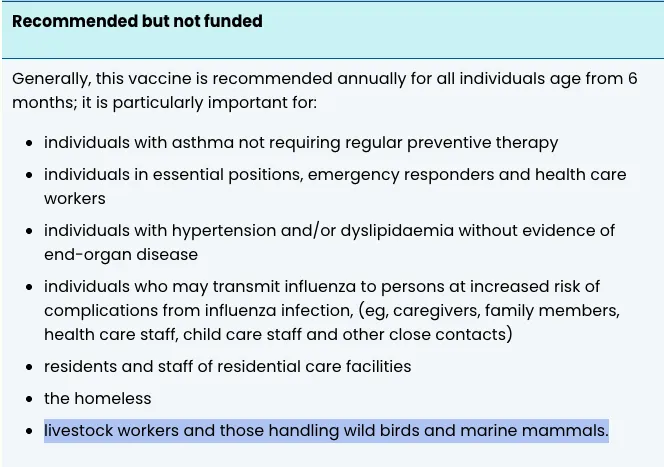
Vaccination against influenza is recommended annually for everyone from the age of six months to reduce the spread of the influenza virus and to protect against influenza-related complications. It is particularly important to vaccinate contacts of high-risk individuals, such as family and caregivers, and those working in certain occupations. See Table 11.2
Further information for veterinarians
Guidance is available from MPI for veterinarians
Guidance is available from MPI for Wildlife rescue and rehabilitation facilities
Guidance is available from DOC on Avian Influenza
Guidance is available from NZVA on High Pathogenicity Avian Influenza (HPAI)
[1] - National Center for Immunization and Respiratory Diseases (NCIRD) - How Flu Viruses Can Change: "Drift" and "Shift"