[space] The Hub
[title] Professional standards and guidance
[path] /
This part of the Hub is a repository for all of our standards and guidance for veterinarians. You can use the navigation and search box on the left of this page to find a particular document or topic.
There are PDF versions of most documents available for download and printing. We recommend you use the online version where possible to ensure you get the most up to date information.
## Standards
Our standards set out what is expected of veterinarians. All veterinarians in New Zealand must meet these standards.
The high-level standards we have set are the:
[Code of Professional Conduct](docId\:H_LaUUT6kRSCM2qcOOKNT)
[Competency Standards and Performance Indicators for Veterinarians](docId\:anEjoINYJlRZBvHeO2tC7)
## Statements
Statements are part of our standards and provide more detailed requirements for veterinarians on specific issues. Veterinarians must comply with them.
## Guidance
Guidance is prepared to help veterinarians deal with specific issues in practice. It presents a good way of applying professional standards but this may not be the only way. Veterinarians can safely rely on our guidance but they do not have to follow it if they believe another approach is better, provided it complies with our standards and statements and they apply good professional judgment. Because our guidance is specific, it won’t apply in every situation.
## Technical advice
Technical advice is our interpretation of how professional standards apply in a particular situation. It is designed to help veterinarians deal with common issues in practice, using their professional judgement to apply the advice to their own situation.
## Practice guidance
Practice guidance is our interpretation of how legal and professional requirements apply in a particular situation. It is designed to help practices deal with common issues, using judgement to apply the advice to their own situation.
[title] Competency Standards and Performance Indicators for Veterinarians
[path] Professional standards and guidance/
# Introduction
The Veterinarians Act 2005 requires the Veterinary Council to:
- register persons and assess whether veterinarians meet the requirements for continued registration or eligibility for a practising certificate
- set and implement standards for veterinary performance
- prescribe minimum practising standards relating to the maintenance, examination or improvement of the overall competence of a veterinarian to practise
The Act also provides the Council with the ability to review veterinarians’ competence to practise.
The purpose of this document is to:
- set out the competencies Council expects veterinarians to meet at the point of registration and on an ongoing basis
- provide criteria against which an individual veterinarian’s performance may be measured
These standards and performance indicators are based on the current graduating competencies of BVSc (Massey) students and as such are subject to change.
The Council recognises that veterinary practice is complex and encompasses clinical and non clinical activities. The “Competency Standards and Performance Indicators for Veterinarians”:
- do not necessarily cover all aspects and areas of a veterinarian’s practice; and
- some of the competency standards will not be relevant to the work of veterinarians engaged in non clinical practice.
In considering an individual veterinarian’s competence the Council will also take into account the performance standards considered reasonable by informed peers.
The Council considers that a competent veterinarian is one who applies knowledge, skills, attitudes, communication and judgement to the delivery of appropriate veterinary services in accordance with their field of veterinary practice. In considering how well a veterinarian is working, consideration must be given to the demonstration of competence through performing the tasks required in their field of veterinary practice, to an acceptable standard and to be able to do this on a consistent basis.
# Competency Standards and Indicators
**The veterinarian must:**
## 1: Understand the scientific and evidence basis for veterinary medicine and integrate this knowledge into current practice
### Indicators
- Demonstrates an understanding of the preclinical and paraclinical factors in veterinary practice
- Demonstrates an understanding of recent developments in veterinary practice, the evidential base of veterinary practice and new treatment modalities based on research
- Demonstrates an understanding of relevant pharmacology, drug interactions and adverse reactions
- Demonstrates the ability to find, utilise and manage information
- Uses this to inform effective practice
- Makes valid judgements and deductions on the basis of scientific evidence and information available
- Communicates this knowledge to clients and the wider community
## 2: Obtain and record relevant information sufficient for analysis, diagnosis and retrieval
Obtain by interview and examination a relevant, accurate and detailed history of animals presented and record this information logically, legibly and securely.
Carry out a thorough systematic physical and clinical examination of the animal presented
Where indicated, carry out or arrange such diagnostic tests and procedures (such as haematology, pathology, radiology and imaging) as are needed to make a diagnosis
Know when to investigate the environment in which the animals under investigation are kept
### Indicators
Records:
- show an adequate and accurate history
- contain an adequate record of the physical and clinical examination
- are legible, time bound and retrievable
- are treated as confidential to the owner or agent and are not divulged to others without consent, unless there is a legal obligation to do so
- contain results of diagnostic tests and procedures as appropriate to diagnose and manage the individual case
- appropriate radiographs or images taken of adequate diagnostic quality
- contain detail, where indicated, on the environment in which the animals under investigation are kept
- contain evidence of adopted treatment strategies
- retain evidence of consent to the treatment plan strategies.
- should be of such detail that another veterinarian could take over the management of the case at any time
## 3: Analyse information to enable accurate diagnosis and develop appropriate treatment strategies
Assess the history, physical and clinical examination outcomes and diagnostic tests.
Evaluate the effect of the environment in which the animals are kept, if indicated Identify problems and their causes.
Develop a diagnosis or diagnostic hypothesis
Identify contra-indications and consequences of intervention
Develop appropriate evidence based strategies for dealing effectively with commonly diagnosed conditions and diseases.
Fully inform the client of treatment options, likely outcomes, risks and costs and obtain their informed consent to proceed with treatment or undertake post mortems
Recognise personal limitations in dealing with unfamiliar, complicated or technically difficult cases and seek further advice and assistance, or refer such cases to others
### Indicators
Demonstrates and records:
- adequate analysis of information collected
- accurate diagnosis
- adequate, evidence based treatment strategies, including the appropriate use of veterinary medicines
- client’s informed consent
- advice sought from other veterinarians, where appropriate
## 4: Know when and how to refer
Recognises the limitations of knowledge and experience and refers for advice and/or treatment in situations where the animal requires a greater level of knowledge and/or skills
### Indicators
- Obtains advice from other veterinarians where necessary
- Makes appropriate referrals
- Completes and provides relevant documentation
## 5: Implement safe and effective veterinary procedures and therapeutic strategies
### Indicators
- Approaches, handles and restrains animals in an effective, safe, humane and ethical way which is appropriate to the circumstances
- Reaches sound conclusions following routine post mortem examination of common domestic animals
- Carries out therapeutic procedures on animals to maximise the likelihood of a satisfactory outcome and minimise the risks of untoward effects for the animals themselves and public health and safety, food safety and quality
- Demonstrates appropriate and responsible use of veterinary medicines
- Records and monitors therapeutic procedures
- Follows up therapeutic responses and modifies approach where appropriate
- Recognises and records requirements for analgesia and/or anaesthesia
- Safely induces, maintains and monitors analgesia and anaesthesia and takes steps to ensure safe and humane recovery
- Carries out surgical procedures using appropriate techniques and procedures before, during and after surgery that minimise the risk to the animal and maximise the likelihood of a successful outcome
- Undertakes accurate pre-operative assessment, uses correct techniques to minimise trauma and gives adequate post operative instructions and follow up care
- Deals effectively with the immediate emergency needs of animals and ensures the relief of pain and suffering
- Evaluates the need for euthanasia and when required carries it out safely and humanely, with the informed consent of the owner (where known) and using procedures appropriate for the species concerned and the circumstances
## 6: Use veterinary skills and knowledge to prevent and relieve animal suffering; maintain and enhance the health, productivity and well being of animals; and promote and protect public health, animal product safety and certification and New Zealand biosecurity
### Indicators
- Demonstrates understanding of the importance of the unique disease status of New Zealand
- Recognises exotic and/or notifiable diseases and takes appropriate action, including communicating to those with a need to know
- Understands the principles and practice involved in controlling the spread of diseases
- Provides appropriate first level advice on the public health implications of animal diseases
- Assesses the need for and advises on the implementation of programmes to promote the health, well being and productivity and performance of animals through such means as dietary management and feeding, vaccination, preventive and curative treatments for common diseases, housing and general management, training and behavioural management and modification.
- Understands animal welfare issues and recognises the special responsibilities of veterinarians in safeguarding and promoting animal welfare, including communicating to those with a need to know in the event of concerns
- Understands, advises on, and complies with the procedures and animal welfare, ethical and statutory requirements relating to the transport and hygienic production and processing of animals for food and other animal products
- Understands the regulatory and professional requirements for the inspection and certification of animals and animal products (including germplasm and those products intended for human consumption)
- Understands the basic requirements for the production of safe food and other products of animal origin including the compliance verification and quality assurance procedures involved
- Maintains the integrity of veterinary certification by complying with all legal and professional requirements, ensuring that certified statements are accurate and that there are no conflicts of interest which could impact on professional judgement.
## 7: Communicate effectively
### Indicators
Demonstrates:
- effective oral and written communication skills
- an understanding of verbal and non verbal means of communication and cultural differences
- good listening skills
- avoidance of jargon
- effective conflict management techniques
With clients demonstrates:
- rapport, sensitivity, empathy, courtesy and respect
- clear and accurate explanations of findings, treatment options and likely outcomes in easily understood language
- client’s understanding of the information provided is confirmed
- the need for sensitivity and support for grieving clients in situations of euthanasia
With other veterinarians
- refers where necessary
- seeks advice where necessary
- provides advice on diagnoses, treatment and prognoses to referring veterinarians in a timely manner
- works collaboratively and avoids negative public comment about others
## 8: Practise in a professional, ethical and legal manner
### Indicators
Demonstrates understanding of, and complies with the professional and legislative requirements relating to veterinary practice in New Zealand including:
- the Veterinarians Act 2005
- the VCNZ Code of Professional Conduct
- the Agricultural Compounds and Veterinary Medicines (ACVM) Act and related requirements
- Medicine and Misuse of Drugs Act
- Legislative requirements regarding the safe and secure storage of drugs and the recording of their use
- the Animal Welfare Act, relevant Codes of Welfare and in research situations, the Code of Ethical Conduct for the Use of Animals in Research of the organisations responsible for the research
- Health and Safety at Work Act 2015
- Radiation Protection Act
- Employment Relations Act
- Relevant rules of the Racing or Harness Racing Conferences, Greyhound Association or similar bodies
- Nationwide schemes, relevant to their practice, such as the Bobby Calf Antibacterial Residues Prevention Scheme, Tb Quality Assurance Scheme, National Velvetting Standards Body Accreditation Programme and the National Bovine Tuberculosis Pest Management Strategy.
- The Resource Management Act 1993 in relation to the disposal of dead animals
Practises ethically and upholds the public’s trust in, and integrity of the profession by:
- using knowledge and skills for the benefit of society
- maintaining an appropriate standard of personal and professional behaviour
- ensuring the continuity of clinical services for bona fide clients
- administering emergency first aid and pain relief to sick or injured animals when called upon
- cooperating with and working collaboratively with colleagues, support staff and clients
- maintaining knowledge and skills through continuing professional development
- practising within the boundaries of competence (except in an emergency where immediate relief of pain is required)
- ensuring that newly registered or inexperienced veterinarians are supervised and supported
- reporting to the Veterinary Council in situations where a colleague’s competence or health condition appears to be placing the public interest at risk
***
# Download
Download a PDF version of this document:
::File{src="https://archbee-doc-uploads.s3.amazonaws.com/5ZTpSgccSDCXbym7d-uMH/9cR0keKG9P7z3TEcYHEPN_competency-standards-and-performance-indicators-for-veterinarians.pdf" label="Competency Standards and Performance Indicators for veterinarians.pdf"}
:::Changelog{title="Updates"}
::ChangelogItem{type="added" description="Updated October 2015"}
:::
[title] Dispensing human medication for animals
[path] Professional standards and guidance/Technical advice/Stewardship/
:::hint{type="info"}
*Technical advice is our interpretation of how professional standards apply in a particular situation. It is designed to help veterinarians deal with common issues in practice, using their professional judgement to apply the advice to their own situation. It represents our best efforts at the time of publication but standards and expectations change over time and particular care should be used when reading old advice.*
:::
***
***What is the maximum period of supply when prescribing human medication for animals?***
***
The maximum period of supply for prescription medicines is three months. This is outlined in Section three of the Veterinary Medicines part of the Code of Professional Conduct.
This means that you could authorise a prescription for a human medicine for one month, with two repeats. The Code expects veterinarians to use their professional judgement and discretion to decide the appropriate period of supply. This will depend on the dosage, animal type and weight, and any associated risks that need to be managed.
***
***What about adding repeats to a script for controlled drugs?***
***
The Veterinary Council’s understanding of the Misuse of Drugs Act is that veterinarians cannot prescribe repeats for controlled drugs, and can only prescribe enough of the controlled drug for one month. The requirements for supplying controlled drugs were amended in December 2022, and the part of the legislation that supports our understanding of the regulations is [cl 31(1) (a)-(d)](https://aus01.safelinks.protection.outlook.com/?url=https%3A%2F%2Fwww.legislation.govt.nz%2Fregulation%2Fpublic%2F1977%2F0037%2Flatest%2FDLM55920.html%3Fsearch%3Dsw_096be8ed81dcf0e3_Class_25_se%26p%3D1\&data=05%7C01%7Cjohn%40prioritycomms.co.nz%7C81ca1080650447d23e9808dbf5e83144%7Cb2653b648f694bb09c25a5abacc6a8da%7C0%7C0%7C638374150046715850%7CUnknown%7CTWFpbGZsb3d8eyJWIjoiMC4wLjAwMDAiLCJQIjoiV2luMzIiLCJBTiI6Ik1haWwiLCJXVCI6Mn0%3D%7C3000%7C%7C%7C\&sdata=pgrB3%2FegicAgQKS2Tn37MXAtoWOjw%2Fiv2v8PBGygBv8%3D\&reserved=0).
Under a recent amendment to [cl 31A](https://aus01.safelinks.protection.outlook.com/?url=https%3A%2F%2Fwww.legislation.govt.nz%2Fregulation%2Fpublic%2F1977%2F0037%2Flatest%2FDLM6198227.html%3Fsearch%3Dsw_096be8ed81dcf0e3_Class_25_se%26p%3D1\&data=05%7C01%7Cjohn%40prioritycomms.co.nz%7C81ca1080650447d23e9808dbf5e83144%7Cb2653b648f694bb09c25a5abacc6a8da%7C0%7C0%7C638374150046715850%7CUnknown%7CTWFpbGZsb3d8eyJWIjoiMC4wLjAwMDAiLCJQIjoiV2luMzIiLCJBTiI6Ik1haWwiLCJXVCI6Mn0%3D%7C3000%7C%7C%7C\&sdata=eGMSp9cwt9Pq3CPVnFrvCFheBy2BD%2B6hfHCRI%2BlZVbc%3D\&reserved=0), non-opioid Class C controlled drugs can be supplied by some prescribers, on three or more occasions at monthly or shorter intervals, for a maximum of three months. However, veterinarians are not included in the list of practitioners who can issue these prescriptions.
***
:::Changelog{title="Updates"}
::ChangelogItem{type="added" description="Published 19 December 2023"}
:::
[title] Policy on qualifications and post nominal titles for inclusion on the Register of Veterinarians
[path] Policies/Registration policies/
# Definitions
**Additional qualifications** are qualifications which have been approved by the Veterinary Council for entry on the Register of Veterinarians.
**Post nominal titles** are letters placed after the name of an individual to indicate that they hold qualifications, offices and honours or are members of organisations.
# Criteria for the inclusion of additional qualifications on the Register of Veterinarians
A qualification will be approved for entry on the Register if:
- it has relevance to veterinary practice; and
- has been awarded following successful completion of a course of training or study by a body recognised by the Council.[\[1\]](#)
A wide interpretation of relevance to veterinary practice will be taken.
A pass in a licensing/registration examination is not considered an additional qualification and is only included on the Register if this was the basis for New Zealand registration.
Civilian and military decorations and Fellowships of the Royal Society of New Zealand will also be approved for inclusion on the Register of Veterinarians.
# Format for recording qualifications on the Register
The Council’s practice is to:
- record the abbreviated name of the qualification, the date of the award and issuing authority, together with any distinctions or honours gained, for the primary qualification by which registration has been gained e.g. BVSc Massey 2002 (Dist)
- record only the abbreviated name of any additional qualifications together with any distinctions or honours gained e.g. BSc (Hons).
# Guidance on the use of post nominal titles
The Code of Professional Conduct requires veterinarians to act in a manner that promotes the public’s trust and confidence in the profession. In promoting services and products, veterinarians must act fairly, represent their capability and competence accurately, not exaggerate the claim or comparison of the service or product over another or overstate their skills and knowledge by using misleading descriptors.
The overuse of post nominals can be confusing to the public and create an inflated view of a veterinarian’s skills and knowledge.
As such the Council recommends to veterinarians when considering the public display of post nominal qualifications and honorary titles to limit these to:
Undergraduate or postgraduate veterinary qualifications and Registration Examinations by virtue of which registration or specialist registration is awarded eg BVSc Massey 2004 or BVSc Belgrade 1993, NZNVE 2005.
Qualifications approved by the Veterinary Council as additional qualifications for inclusion on the Register of Veterinarians.
Civilian and military decorations and Fellowships of the Royal Society of New Zealand.
Veterinarians choosing not to limit the public display of information in this way must ensure that qualifications are separated from other post nominal titles. For example, with letterhead paper, by placing qualifications at the top of the page and memberships and affiliations at the bottom.
# What this guidance means
Membership of professional bodies (such as MRCVS) is not approved for inclusion on the register, unless achieved by examination.
Memberships and ‘non approved’ additional qualifications will not appear on the public register and veterinarians are encouraged to refrain from advertising them in their own material. Veterinarians choosing not to limit the public display of post nominal titles in this way must separate approved qualifications and civilian/military decorations from other titles.
***
:::Changelog{title="Updates"}
::ChangelogItem{type="added" description="Issued November 2008"}
::ChangelogItem{type="added" description="Policy reviewed and confirmed February 2012"}
::ChangelogItem{type="added" description="Updated August 2015"}
:::
Download a PDF version of this policy:
::File{src="https://archbee-doc-uploads.s3.amazonaws.com/Mlj4EEShZmQX2zIciB9bN-PcvnBMWewfrobFboR5llV-20250709-231810.pdf" label="Policy on qualifications and post nominal titles for inclusion on the Register of Veterinarians.pdf"}
1. Note that for veterinary technical qualifications to be recognised the body concerned normally must be a vet school; veterinary college (eg ANZCVS); veterinary regulator with a training arm (e.g RCVS); or the qualification has been reviewed and accepted by a comparable regulator (such as RCVS). [↑](#)
[title] Can a veterinarian send expired RVMs to charities offshore
[path] Professional standards and guidance/Guidance/
The professional obligations for veterinarians registered in New Zealand do not change because the owner of an animal is a charity, or if the animal is not resident in New Zealand.
Veterinarians should consider the following:
### A veterinarian can authorise the Restricted Veterinary Medicines (RVMs)
Veterinarians cannot supply (or sell or give away) an RVM to another veterinarian (with the exception of Approved Sellers with ACVM).
Veterinarians can **only** authorise RVMs following a consultation for **animals under their care,** and would need to meet the expectations set out in the Code, including:
A veterinary consultation must include the veterinarian:
1\. Interviewing the client (or a legitimate and authorised representative of the client)
2\. Collecting and recording sufficient information relevant to the individual circumstances to ensure the proposed course of action (including treatment) is appropriate to meet the needs and best interests of the animal(s) and the client
3\. Obtaining appropriate consent to the proposed course of action
4\. Being given, and accepting responsibility for, the ongoing health and welfare of the animal(s) concerned in relation to the consultation. This includes arranging emergency care after considering the circumstances and the potential for adverse effects from, or failure of, the agreed course of action
5\. Determining and providing the appropriate level of advice and training to ensure that the agreed course of action can proceed as planned.
A veterinary consultation will usually involve the veterinarian seeing the animal(s) at the time of the consultation. If not, the animals must have been seen recently or often enough for the veterinarian to have sufficient personal knowledge of the condition/health status of the animal(s).
Veterinarians must also meet the expectations regarding Product Stewardship outlined in the Code.
### Authorisation of an expired RVM
Just because an RVM has expired does not mean it can be 'given away'. The appropriate process would be to dispose of it safely (i.e., the expiry of a product does not eliminate risk).
The authorisation of an expired RVM would be technically regarded as off-label use, so the authorising vet will need to ensure that all potential risks are managed.
Some of the key risks here would be:
- potential safety issues (if the active ingredients or formulations are such that impurities and/or degradation products may develop in the formulation and affect the animal)
- inefficacy (if the active ingredient content degrades below what would be necessary to achieve the therapeutic effect)
- risks related to potential residues where they are used in food-producing animals.
The veterinarian would be expected to manage these risks should they decide to authorise an expired RVM.
### Exportation and importation of an RVM
The veterinarian could consider exporting the RVM and would need to meet the MPI requirements and comply with any other export controls, such as NZ Customs requirements.
When exporting veterinary medicines from New Zealand, you're responsible for:
- meeting the manufacturing and marketing requirements of the destination country
- reporting to MPI if your products become unfit for their intended use
- keeping the right records
- paying any applicable fees and charges.
Who to contact - If you have questions about exporting veterinary medicines, email approvals\@mpi.govt.nz
The veterinarian would also need to consider that they would be importing the RVMs into the destination country. As a result, they would need to meet any regulatory requirements of the destination country, including the licensing or border clearance requirements.
### In summary
Exporting expired restricted veterinary medicines from New Zealand for charitable purposes is a complex activity that requires careful consideration of legal, ethical, and regulatory factors. Veterinarians must ensure compliance with the ACVM Act, the Veterinary Council of New Zealand’s Code of Professional Conduct, seek appropriate approvals, and uphold professional standards to protect animal welfare and public trust.
:::Changelog{title="Updates"}
::ChangelogItem{type="added" description="Published 18 September 2025"}
:::
[title] Code of Professional Conduct
[path] Professional standards and guidance/
The Code sets out the professional standards the public, the profession and VCNZ expect veterinarians to meet and to be measured against.
All veterinarians should read the Code and become familiar with its main principles. The principles are intended to be broad enough to set expectations for veterinarians in any area of veterinary practice.
Members of the public can also check the Code to find out the standards expected of veterinarians.
The Code is reviewed constantly on a section-by-section basis. Always check to make sure you are reading the most up to date version (simply scroll down and click "Next").
Download the latest PDF version of the Code of Professional Conduct:
::File{src="https://api.archbee.com/api/presign/5ZTpSgccSDCXbym7d-uMH/q2UNy4R65iW1AWQAQEjwK_10-26-veterinary-council-of-nz-code-of-professional-conduct.pdf" label="10_26 Veterinary Council of NZ Code of Professional Conduct.pdf"}
***
:::Changelog{title="Updates"}
::ChangelogItem{type="added" description="New version published January 2020 (new Veterinary Medicines section)"}
::ChangelogItem{type="improved" description="New Code principles included and minor edits January 2023"}
::ChangelogItem{type="added" description="New numbering system introduced July 2025"}
::ChangelogItem{type="added" description="Changes relating to the definitions of "Under the care of a veterinarian" and "specific and limited range of veterinary services" added March 2026"}
:::
[title] Policy on registration under the Trans Tasman Mutual Recognition Act
[path] Policies/Registration policies/
# Legislation
In August 1997 the New Zealand Parliament enacted the Trans-Tasman Mutual Recognition Act (TTMRA). This Act came into force by Order-in-Council on 1 May 1998. It recognises the regulatory standards adopted in Australia regarding goods and occupations.
# Occupations
Under the Trans-Tasman Mutual Recognition Act:
- a person who is registered to practise an occupation under a law of an Australian participating State will be entitled to practise an equivalent occupation under the law of New Zealand, and
- a person who is registered to practise an occupation under a law of New Zealand will be entitled to practise an equivalent occupation under the law of an Australian participating State.
# Registration under TTMRA
The TTMRA is an arrangement between the Government of New Zealand and the Commonwealth, State and Territory Governments of Australia. It is an extension of the Closer Economic Relations Trade Agreement (CER) and enhances the freedom of individuals to work in either country.
Under the TTMR Act, 1997, a person who is registered as a veterinarian in a participating jurisdiction in Australia is entitled, after applying to the Veterinary Council of New Zealand, to be registered as a veterinarian in New Zealand.
All Australian jurisdictions are parties to the Trans Tasman Mutual recognition agreement
TTMRA is based on the principle that all parties have confidence in each other’s regulatory systems and decision-making process. Accordingly, the agreement does not directly recognise qualifications as such, but instead recognises each party’s registration policy.
Registration under the TTMRA Act is not related to requirements for the possession of particular qualifications or experience. It is based on the equivalence of the practice of the occupation.
The mutual recognition principle only applies to registered occupations, which are “equivalent”. Two occupations are deemed to be equivalent when the activities authorised to be practised under registration are substantially similar. Equivalence can be achieved through the imposition of conditions on registration by a registration authority or, on appeal, by the relevant appeals body.
# Application Process under the TTMRA
Within one month of written notice, details, and fee being received by the Veterinary Council, an application for registration under the Trans-Tasman Mutual Recognition Act must be granted, postponed, or refused.
Incomplete applications will not be accepted by the Council. Payment of the application fee in New Zealand dollars must accompany every application.
Applicants must arrange for a letter of good standing to be sent directly to the Council from every overseas registration body that they are currently or have been registered with in the last 10 years.
The Registrar has delegated authority to approve applications for registration made under the TTMR provisions including TTMRA specialist registration applications subject to the following conditions:
- where any concerns are raised with regard to the applicant’s qualifications or fitness to be registered, this is done in consultation with the Registration Advisory Group
- appropriate internal checking and quality assurance processes are in place
- regular report back to the Council on registration activities.
The Registrar will refer applications to the Council for a final decision if they are proposing to postpone or decline them.
The Council may refuse registration under the TTMRA provisions if:
- any of the statements or information in the notice required by section 19 are materially false or misleading
- any document or information required by section 19 is materially false or misleading
- any document required by section 19 has not been provided
- the occupation in which registration is sought is determined not to be an equivalent occupation; and that equivalence can’t be achieved by the imposition of conditions
- the circumstances of the applicant have materially changed since the date of the notice or the date it was given
- the applicant’s occupation in Australia does not appear to have an equivalent that is regulated by VCNZ.
Pending the decision on an application for registration, the applicant is deemed to be registered and is entitled to practise as a veterinarian in New Zealand. The Council may impose conditions on deemed registration to match conditions that apply to the applicant’s registration in an Australian jurisdiction. The Council may also impose conditions on registration.
Deemed registrants will be notified of the Council's decision within one month of their completed application being lodged with the Council and commencement of deemed registration. There is a right of review of any Council decision to impose conditions on any applicant for registration.
Once granted, registration takes effect as if it had been granted immediately on the giving of the written notice.
Veterinarians registered under TTMRA are subject to the same statutory provisions as other registered veterinarians which include the requirement to hold an annual practising certificate, in order to be able to practise.
***
:::Changelog{title="Updates"}
::ChangelogItem{type="added" description="Policy reviewed and confirmed with minor amendments February 2012"}
::ChangelogItem{type="added" description="Policy reviewed and confirmed February 2014"}
::ChangelogItem{type="added" description="Updated November 2017"}
:::
Downloand a PDF version of this policy:
::File{src="https://archbee-doc-uploads.s3.amazonaws.com/Mlj4EEShZmQX2zIciB9bN-5KSy_tU4VHLXEE9FUFlco-20250709-230824.pdf" label="Policy on registration under the Trans Tasman Mutual Recognition Act.pdf"}
**
[title] 2. Client relationships
[path] Professional standards and guidance/Code of Professional Conduct/
# Guiding principle
**Veterinarians must act reasonably to protect their clients' privacy and communicate in a way that educates and empowers their clients to make informed decisions about their animals.**
# Section 2.1
Veterinarians must interact with [clients](https://hub.vetcouncil.org.nz/glossary#CwjQL) in a way that promotes effective communication and trust. This includes:
1. listening to clients, respecting their views, responding to their concerns and preferences and treating them with courtesy
2. not exploiting a client's lack of veterinary knowledge
3. treating all client information and information related to the provision of veterinary services as the private information of the client except in circumstances where:
1. the client has given consent for the information to be shared; or
2. the information is disclosed in accordance with the [Privacy Act 2020](https://www.legislation.govt.nz/act/public/2020/0031/latest/LMS23342.html); or
3. disclosure is required under the [Veterinarians Act 2005](https://www.legislation.govt.nz/act/public/2005/0126/latest/DLM363859.html).
:::ExpandableHeading
## Understanding section 2.1
Trust is essential to a positive client-veterinarian relationship. Clients trust that veterinarians are competent and honest. Veterinarians' knowledge and training allows them to potentially
influence clients' decisions. Because of this, veterinarians have a greater responsibility to be trustworthy. Veterinarians must not abuse this position or exploit a client's relative lack of knowledge by encouraging them to undertake veterinary treatment or make healthcare decisions that are not in their or their animals' best interest.
### Communication
Veterinarians must be able to communicate effectively with clients. This includes:
1. listening to clients and identifying their concerns
2. finding out from clients what their veterinary needs and expectations are
3. explaining treatment choices and options in a way clients can understand.
Most of the Vet Council's expectations around the quality of veterinarians' communications with clients are set out in its [Competency Standards and Performance Indicators for Veterinarians](docId\:anEjoINYJlRZBvHeO2tC7). This section of the Code focuses on the ethical aspects of communication including consent issues and the confidentiality of information.
### Confidentiality
Veterinarians must ensure the privacy and confidentiality of information collected and stored during the provision of veterinary services.
Veterinarians have professional responsibilities under the [3. Professional relationships](docId\:g7UmY1lHaKnZ5U4kNO-yw) section of the Code to share the relevant information they hold with other treating veterinarians or those who need to know.
However unless it is an emergency situation or there are valid grounds for disclosure, clients have the right to decide/consent to who should have access to this information.
The [Privacy Act 2020](https://www.legislation.govt.nz/act/public/2020/0031/latest/LMS23342.html) governs how personal information must be managed. Privacy principles 10 and 11 place restrictions on how organisations can use or disclose personal information.
Privacy principle 11 provides guidance on when it is acceptable to disclose information without client consent. For example:
- when asked to disclose information about a client or their animals as part of an investigation by a recognised and authorised investigator into alleged breaches of the [Animal Welfare Act](https://www.legislation.govt.nz/act/public/1999/0142/latest/DLM49664.html)
- when required to provide information to the Vet Council as part of a Complaints Assessment Committee investigation.
Further advice can be sought from the Privacy Commissioner's office, 0800 803 909.
:::
# Section 2.2
Veterinarians must obtain the client's informed consent before proceeding with a proposed treatment or course of action, including post-mortems. This includes:
1. making sure clients have enough relevant information to make an informed choice about treatment options
2. giving clients the information they need in a way they can understand
3. checking clients' understanding of the information, and ensuring they have the ability and authority to give informed consent
4. ensuring the informed consent process is adequately documented.
:::ExpandableHeading
## Understanding section 2.2
### Informed consent
While veterinarians are obliged to obtain clients' informed consent to a proposed treatment/course of action this may not be possible in an animal welfare emergency. For example, when the client/owner can't be contacted and there is an immediate threat to the life of the animal, or an immediate need to relieve unreasonable or unnecessary pain (refer to the [1. Animal welfare](docId\:gr85iChRVF-W2r-SSpYY7) section of this Code).
Informed consent is an interactive process between the veterinarian and client. It's not just a single approval for a treatment plan or a signed consent form. For example, further consent is required where the condition of the animal and/or treatment options change.
Client understanding is enhanced when:
1. information is given in lay terms (without technical jargon)
2. clients are given the opportunity to ask questions or request additional information
3. clients can relay their understanding of the information given back to the veterinarian
4. (where appropriate) clients are given enough time to make an informed decision.
'**Enough relevant information**' means sufficient, relevant information being given to a 'reasonable' person in the client's position to make a considered decision on whether to accept or reject the recommended treatment/course of action. In general:
1. a simple procedure involving minimal risk and using current well-recognised options will require minimal detail
2. a complex procedure will require detailed information, especially if less common/routine options are recommended and/or the risk is high or unknown.
The following information must be provided:
1. the likely diagnosis where appropriate and the reason for the proposed course of action
2. treatment options including expected outcomes, risks, side effects, benefits and costs (this can be a range of likely costs)
3. the veterinarian's experience and skills to undertake the treatment, where appropriate
4. referral options, where appropriate
5. post treatment requirements and likely costs.
A client's experience and knowledge can influence the degree of detail they need to make an informed choice. Veterinarians should not pre-judge clients' ability to take in the information conveyed/treatment recommendations and should use appropriate questions to check understanding.
The process of obtaining informed consent is ideally documented by a signed, consent form attached to the clinical record. Sample forms are available from the Veterinary Professional Insurance Society (VPIS) through NZVA. When verbal consent is given this must be noted in the clinical record.
The clinical record should also include:
1. a summary of relevant discussions that took place to arrive at the treatment decision/s
2. a client's decision not to proceed with the veterinarian's recommendation (for example declining a second opinion or referral).
The veterinarian responsible for the case must ensure that informed consent has been given before proceeding. Delegating some or all of the process to other staff (such as a veterinary nurse or receptionist) may be appropriate when:
1. the proposed treatment is a common procedure, especially when requested by the client eg de-sexing operations
2. the staff have been appropriately trained and protocols are in place and followed.
The accountability for the process remains with the veterinarian in charge of the case and there must be the opportunity for clients to talk with the veterinarian if they have expressed any concerns or request it.
Veterinarians should consider how to best communicate information to the client. It can be helpful to support verbal explanations with written information, use of white boards, anatomical atlas to illustrate procedures etc. This is especially important for post-operative home care information.
Veterinarians are expected to exercise sound professional judgement in determining who is able to consent to treatment. The client may be the owner of the animal, someone acting with the authority of the owner, or someone with statutory or other appropriate authority. If the person providing consent is not the owner, and has not confirmed their authority to act on behalf of the owner, procedures should only be carried out in exceptional circumstances. If there is any question about the person not being the owner or being an authorised representative, this must be documented.
If the owner is less than 16 years of age or has limited capacity to provide consent, veterinarians should consider whether someone else can assist in providing informed consent.
A person under the age of 18 (a minor) can provide informed consent to the treatment or procedure. However, the veterinarian should assess whether they think that person is competent to make such a decision, taking into account factors such as the complexity of the procedure and their apparent level of understanding.
The agreement to pay for the service (procedure or treatment) should be treated as a separate process to obtaining informed consent. An agreement to pay for the service may not be legally enforceable if the person is under the age of 18 years, even though it is acceptable for them to provide consent to proceed. Veterinarians will need to consider whether someone else can assist when setting up arrangements to pay for the work. This could be a parent, guardian, employer or friend.
If the owner is less than 18 years and cannot pay for the service at the time and if an older person is not available to take responsibility for payment, the veterinarian will need to make a judgement on how to proceed taking into account the animal's welfare. Questions which the veterinarian might need to consider include, for example:
1. what is the minimum amount of treatment needed which addresses the welfare of the animal at the time eg treating a fracture with a Robert Jones bandage, sedation and analgesia?
2. would the SPCA or another animal welfare charity accept responsibility for payment or part payment?
3. depending on the circumstances should euthanasia be considered?
4. is the practice prepared to take a risk to cover the cost and proceed on the basis that they believe the owner intends to pay?
It is recommended that the practice develop a policy setting out how their veterinarians can deal with these situations.
In discussing alternative treatment options veterinarians must not tailor the discussion because of their evaluation of the client's financial status. Failing to inform clients of reasonable medical alternatives (for example referral) breaches the Code.
Part of the discussion to obtain informed consent should include how the veterinarian can contact the client during the procedure to discuss unexpected outcomes. Veterinarians should also gain the client's agreement to act without further consent if it becomes necessary in the interests of the animal.
:::
# Section 2.3
Veterinarians must respect clients' rights to:
1. use the services of more than one veterinarian
2. seek a second opinion or referral
3. decline or choose an alternate course of action to the one recommended by the veterinarian, provided the animal's welfare is not compromised.
:::ExpandableHeading
## Understanding section 2.3
Clients are entitled to use the services of more than one veterinarian or to seek a second opinion or referral. Clients may also choose to use multiple veterinarians to provide different and particular skills in order to meet their specific veterinary needs. For example reproductive services, nutrition, and herd health consultancy. When it is known that a number of veterinarians are involved with the same client, the veterinarians concerned have particular responsibilities to communicate with each other as set out in the [3. Professional relationships](docId\:g7UmY1lHaKnZ5U4kNO-yw) section of the Code.
When clients decline, or choose a course of action to the one recommended, veterinarians must be satisfied that animal welfare requirements are met (refer to the [1. Animal welfare](docId\:gr85iChRVF-W2r-SSpYY7) section of the Code and sections 10–12 and 138 of the [Animal Welfare Act](https://www.legislation.govt.nz/act/public/1999/0142/latest/DLM49664.html)).
:::
# Section 2.4
When a veterinarian accepts an animal or group of animals to be under their care, they must:
1. Document the agreement to provide veterinary services to the specified animal(s) and this must be signed by the client.
2. Record the agreement in the clinical record.
:::ExpandableHeading
## Understanding section 2.4
A working relationship is established when the person in charge of an animal registers and becomes a [client](https://hub.vetcouncil.org.nz/glossary#client) of the Veterinary Business, and the Veterinary Business has agreed to provide veterinary services for the specified animal/s. This must be included in the client records and confirmed in writing and signed by the client as part of the conditions of service agreed between the parties.
As part of the agreement for services, and in relation to the animal/s described in the agreement, the veterinarian will have:
- been given and will have accepted responsibility for veterinary services related to the ongoing health and welfare of the specified animal/s including a herd, flock or group of animals.
- agreed to provide emergency care or have a formalised arrangement with another veterinary business to provide emergency care, after considering the circumstances and the potential for adverse effects from, or failure of, the agreed course of action.
The written agreement should:
- Describe the services being provided by the veterinarian.
- Include the availability of emergency and after-hours care or details where an arrangement has been made for another Veterinary Business to provide these services.
- Include an expiry clause after which time, and where the animals have not been seen, the terms of the relationship including the responsibility for providing emergency care services terminate.
- Be reviewed and renewed annually or whenever there is a material change to the nature or circumstances of the relationship.
- Include a dispute and a termination clause.
- For production animals:
- Include a description of the farm business and the farm location (where the animal/s usually lives), the farm infrastructure including farm size, stock type and the type and number of each class of animal under the veterinarian’s care.
- Include an undertaking that all people administering [RVMs](https://hub.vetcouncil.org.nz/glossary#restricted-veterinary-medicine-rvm) will be appropriately trained.
- The client must also be asked to disclose other veterinarians who provide services to the farm and if the farm is under the care of more than one veterinary business. Where more than one veterinary business provides services to the farm, they must be asked to give consent for information on authorised treatments to be shared between the veterinarians . This is expected to include information about the RVMs already available to the farm either as existing stock or as an authorisation for future supply.
:::
# Section 2.5
Veterinarians are not obliged to accept new clients, continue to provide services to existing clients, or provide a requested treatment, providing animal welfare and professional standards are met.
:::ExpandableHeading
## Understanding section 2.5
As long as animal welfare isn't compromised, veterinarians should use their professional judgement, and take into account all relevant circumstances, when considering whether to:
1. provide a particular requested veterinary treatment (surgical or medical)
2. undertake any requested diagnostic investigation.
Veterinarians can end their relationship with a client as long as this decision doesn't conflict with any animal welfare responsibilities under a current treatment plan. Veterinarians should notify the client in writing of this decision.
:::
***
:::Changelog{title="Updates"}
::ChangelogItem{type="added" description="Updated October 2019"}
::ChangelogItem{type="fixed" description="References to Privacy Act updated January 2023"}
::ChangelogItem{type="added" description="New guiding principle added March 2023"}
::ChangelogItem{type="added" description="Changed numbering scheme July 2025"}
::ChangelogItem{type="added" description="New section 2.4 and added, former section 2.4 relabelled as section 2.5 March 2026"}
:::
[title] Registration standards
[path] Professional standards and guidance/
[title] Specific and Limited Services
[path] Professional standards and guidance/Guidance/
The Vet Council's April 2026 amendments to the Code of Professional Conduct introduced two significant changes: a formal definition of what it means for an animal to be "under the care of a veterinarian", and a three-tier framework for veterinarians who provide a specific and limited range of veterinary services. Both changes are now in effect.
Here is some guidance to help vets understand the changes and how they apply.
A document that explains some frequently asked questions about these changes is [available here](https://www.vetcouncil.org.nz/common/Uploaded%20files/Web/UtC_Feedback.pdf).
## [Under the Care and specific and limited guidance](https://hub.vetcouncil.org.nz/under-the-care-and-specific-and-limited-guidance)
Cheat sheet summarising the changes to the Code.
## [Advanced Services decision tool and explanatory notes working document](docId\:mOJaAS3YGnKx4RcioUOC7)
This guidance is designed to help veterinarians determine whether they qualify to provide Advanced Services under the Specific and Limited Framework in section 5.12 of the Code of Professional Conduct (April 2026), and to understand what obligations apply when they do.
## [Privacy guidance (working document)](docId\:YzwVQJ0TYj9z1qx_-TSqN)
This guidance is intended to help veterinary practices understand their obligations under the Privacy Act 2020, and to provide practical support for meeting those obligations. It is not a substitute for legal advice.
## [Definition of a Veterinary Practice / Veterinary Business (working document)](docId:9Hzs22aNlTAt_DsKgSTBU)
The Vet Council has defined what a veterinary practice (also referred to as a veterinary business) is to help vets understand the different practice categories and the obligations associated with them.
This advice particularly clarifies the distinction between a General Veterinary Practice and a Specific and Limited practice and outlines what this means for emergency care provisions.
## [Terms of Service Agreements: Guidance for Veterinary Businesses (working document)](https://hub.vetcouncil.org.nz/client-service-agreements-guidance-for-veterinary-businesses-working-document)
This guidance helps veterinary businesses understand what should be included in a written agreement with clients when accepting animals under their care. It supports compliance with the Veterinary Council of New Zealand's Code of Professional Conduct (Code), which, from April 2026, requires veterinarians to document the agreement to provide veterinary services to a client's animals (Code, Section 2.4).
[title] Statement on Veterinary Emergency Care
[path] Professional standards and guidance/Statements/
This statement outlines the requirements on the provision of veterinary emergency care after hours in New Zealand, based on the standards set by the Veterinary Council of New Zealand (Vet Council). Its purpose is to provide clarity for veterinarians, veterinary practices (including new establishments), and animal owners on what is required.
This statement is intended to foster a clear understanding of the provision of after-hours veterinary emergency care in New Zealand, promoting animal welfare, biosecurity, maintaining trust in the veterinary profession, and supporting the veterinary profession in delivering these essential services.
Practices should note that the Vet Council can be contacted for advice if there is any uncertainty about these requirements.
:::ExpandableHeading
## 1. Adequate Emergency Care
Adequate emergency veterinary care is crucial for animal welfare, biosecurity and maintaining trust in the veterinary profession. It involves the following key aspects:
- **Universal application, from day one:** The requirement to provide emergency care applies to all practices. Adequate emergency service arrangements must be in place from the first day of operation. Robust planning for these services must be undertaken before the practice opens its doors. This is a fundamental requirement and not optional.
- **24-7 coverage:** Veterinarians in clinical practice must make an emergency service available at all times.
- **Purpose: **An emergency care service is required so that a practice’s clients’ animals can receive essential veterinary treatment in order to relieve unreasonable or unnecessary pain or distress.
- **Resources and Timeliness:** The emergency service must be sufficiently resourced to ensure that, except in extraordinary circumstances, all veterinary emergencies involving clients' animals are attended to in a reasonable timeframe. What constitutes a "reasonable time" can vary based on factors such as:
- the nature and severity of the emergency,
- local geographical conditions,
- the potential benefits of referral to a specialised emergency facility, and
- any temporary resource constraints. E.g. unforeseen staff constraints or natural disasters.
- **Emergency service arrangements:** To support their veterinarians to meet the expectations of the Code veterinary clinics must have a documented agreement for any emergency service arrangement they have with an external provider. They must also have a clear back-up provision for situations where the emergency service, whether their own or externally provided, is unavailable.
- **Scope of Care:** At a minimum, emergency care includes providing first aid, adequate pain relief, and, where necessary, euthanasia. Veterinarians must act to ensure an animal's pain and suffering are managed. While the level of service or range of diagnostic and treatment options available after hours may differ from those available during normal clinic hours, the fundamental need to alleviate suffering remains paramount.
- **Veterinarian Safety:** Veterinarians, when attending emergencies, should carefully consider potential personal risks and take appropriate steps to manage these risks. There is no expectation that veterinarians should place their personal safety in jeopardy. Veterinary businesses have an obligation under health and safety legislation to consider and manage these risks.
- **Support Staff:** Emergency care provided by a practice may involve the services of appropriately trained non-veterinarian staff (e.g., veterinary nurses or technicians) acting under the supervision and direction of a veterinarian. However, a veterinarian must be readily available to provide clinical care and undertake work legally required to be completed by a veterinarian.
- **Client Communication: **Clear communication with clients is essential. Practices must proactively inform their clients from the outset about their after-hours emergency service arrangements. This includes how to access care, what services can be expected, and details of any arrangements for referral to other practices or dedicated emergency clinics, including potential travel times. This helps set realistic expectations and allows animal owners to plan accordingly.
- **Internal Practice Policies:** Veterinary practices are strongly encouraged to develop and implement clear internal policies or Standard Operating Procedures (SOPs) for managing after-hours calls. These SOPs should guide all staff (veterinarians and support staff) on triaging calls, communicating with clients, defining what the practice considers an emergency versus an urgent case to assist with triage decisions - ensuring consistency in the level of care and advice provided. This helps manage client expectations, supports staff in making these often-challenging decisions, and can help avoid some members of the team feeling undermined by the actions of others.
:::
::::ExpandableHeading
## 2. What Constitutes a Veterinary Emergency
Understanding what constitutes a veterinary emergency is vital for both animal owners and veterinary professionals.
- **Initial Perception of an Emergency:** An emergency is often initially perceived based on the report and concern of the person in charge of the animal. This perception stands until an appropriately trained veterinary professional has had the opportunity to conduct an assessment. It's acknowledged that a client's perspective can be influenced by factors such as inexperience, emotional connection, previous experiences, or personal values regarding pain and distress, making it difficult for them to understand the level of seriousness or urgency from a clinical standpoint. It is also not uncommon for emergencies to arise at least in part due to delays by the person in charge in accessing veterinary care – a delay such as this does not change the urgency of the case which must be based on the triage of the reported history and symptoms.
- **Vet Council Definition:** A veterinary emergency is defined by the Vet Council as: "*Any sudden, unforeseen injury, illness or complication in an animal, demanding immediate or early veterinary treatment to save life or to provide timely relief from unreasonable or unnecessary pain or distress*". This would include any significant worsening of a known/current problem.
- **Veterinary Assessment and Professional Judgment**: Veterinarians are expected to use their professional judgment, which may involve an assessment conducted over the phone (remote triage), to determine if a situation constitutes an emergency requiring immediate attention. If deciding via phone that a situation is not an emergency, the veterinarian must be confident they have sufficient information to make that assessment accurately.
- **Seeing non-emergencies**: In some cases, a veterinarian may choose to see non-emergency cases immediately and their decision-making in these cases may be influenced by factors such as clinic culture or policy, personal values regarding pain and distress, current workload, and the time of day.
- **When an Emergency is Not Deemed to Exist After Assessment**: Following an assessment, a veterinarian may decide an emergency does not exist if:
- The veterinarian, in their professional judgment, determines the situation is not a veterinary emergency requiring immediate after-hours intervention.
- The veterinarian informs the caller that emergency veterinary treatment is not immediately required, and alternative arrangements (e.g., monitoring, an appointment during normal hours) are appropriate.
:::Paragraph{indent="1"}
(Veterinarians have an obligation to maintain medical records and these should contain relevant clinical history and findings, decisions made, treatments provided, and information provided to clients. Medical records should be created at the time of the events being recorded or shortly after.)
:::
- **Triage: Distinguishing "Emergency" vs. "Urgent" Care:** Triage involves differentiating between:
- **Emergency cases:** Those that are immediately life-threatening or involve severe, unmanageable pain or distress requiring prompt after-hours intervention to stabilise the animal's condition. While not an exhaustive list, conditions that are generally considered emergencies include:
- severe trauma (e.g., road traffic accidents, falls, attacks),
- respiratory distress or obstruction,
- sudden collapse or cardiac issues,
- severe uncontrolled bleeding,
- known or suspected toxin ingestion,
- prolonged or multiple seizures,
- unconsciousness or recumbency (especially in large animals), and
- complications during birth.
- Severe infections and septicaemia.
:::Paragraph{indent="3"}
Generally, anything that is emergent needs immediate veterinary care.
:::
- **Urgent cases:** These include medical issues that require prompt attention but do not pose an immediate threat to the animal's life. While urgent cases still require timely intervention (which may reasonably range from 6 to 48 hours depending on the case), they are generally less critical than true emergencies. These cases might potentially be managed with advice, pain relief, and an appointment during normal clinic hours if the animal is considered stable and can be kept comfortable. Examples could include a dog with sore ears, a cat that has vomited but is otherwise stable, or a lame horse where pain is manageable. Cases assessed as urgent can often wait until normal business hours.
:::Paragraph{indent="1"}
Emergency cases are often prioritized over urgent care cases, but the latter still require professional attention.
:::
:::Paragraph{indent="1"}
:::
| ### Guiding Principles in Triage: |
| ----------------------------------------------------------------------------------------------------------------------------------------------------------------------------------------------------------------------------------------------------------------------------------------------------------------------------------------------------------------------------------------------------------------------------------------------------------------------------------------------------------------------------------------------------------------------------------------------------------------------------------------------------------------------------------------------------------------------------------------------------------------------------------------------------------------------------------------------------------------------------------------------------------------------------------------------------------------------------------------------------------------------------------------------------------------------------------------------------------------------------------------------------------------------------------------------------------------------------------------------------------------------------------------------------------------------------------------------------------------------------------------------------------------------- |
| - Apply clinical judgment to triage after-hours cases, ensuring that true emergencies receive immediate care while urgent but non-critical cases may be, with interim advice and pain management, safely deferred until regular hours, provided this does not compromise animal welfare.
- Veterinarians have a role to triage the case and schedule a time with the client if it's an emergency or provide reassurance and a plan if the situation is urgent and can be safely seen at a future time. Considered and thorough triaging of after-hours calls is one step veterinarians can take to better utilise available veterinary resources.
- The emergency triage service provided by a practice may involve the services of appropriately trained persons (for example technicians and veterinary nurses) who are not veterinarians. However, a veterinarian must be readily and directly available at all times to provide the necessary veterinary clinical support and undertake the work legally required to be completed by a veterinarian.
- Guidance *(coming soon)* can assist veterinarians to navigate a complex interplay of clinical urgency, ethical principles, client dynamics, and regulatory expectations when deciding whether to respond to an after-hours emergency. |
::::
::::ExpandableHeading
## 3. Expectations on Who is Required to Provide Emergency Care
The responsibility for providing emergency care is distributed as follows:
- **Primary Veterinarian/Practice (General Veterinary Practitioner - GVP):**
- Veterinarians in clinical practice have a professional obligation to make emergency services available for *their own registered clients' animals*. This is a cornerstone of the veterinarian-client-patient relationship.
- The GVP is considered the provider of regular and general veterinary services and accepts the major responsibility for providing or arranging emergency care for those animals under their care. This can be achieved by the practice providing the service itself, formally agreeing to share services with a nearby practice, or formally engaging a dedicated after-hours provider.
- Where GVPs share clients, **each** GVP is equally responsible for providing or arranging for emergency care for those animals under their care.
- **After-Hours Emergency and Urgent Care Practices**
:::Paragraph{indent="1"}
The responsibility for providing emergency care when operating as an after-hours emergency service or urgent care practice is distributed as follows:
:::
:::Paragraph{listStyleType="disc" indent="2"}
Practices that provide emergency services exclusively outside regular hours enter into a veterinary-client-patient relationship by default when treating animals. They therefore have a professional obligation to ensure continuity of care and appropriate referral.
:::
:::Paragraph{listStyleType="disc" listStart="2" indent="2"}
These practices must have documented protocols to:
:::
:::Paragraph{listStyleType="disc" indent="3"}
Identify the animal owner’s primary GVP veterinarian at the time of presentation and communicate with them as appropriate.
:::
:::Paragraph{listStyleType="disc" listStart="2" indent="3"}
Manage cases where the animal does not have a GVP, including advising the owner on establishing a relationship with a daytime practice.
:::
:::Paragraph{listStyleType="disc" listStart="3" indent="3"}
Arrange referral of the animal to a nominated daytime practice or an referral care facility when the emergency service closes, ensuring that ongoing care is not compromised.
:::
:::Paragraph{listStyleType="disc" listStart="3" indent="2"}
There must be a formal, documented understanding between the after-hours emergency care or Urgent Care practice and the local daytime GVP practices whose clients they serve. This agreement should outline responsibilities for the acceptance of animals under their care, communication, record transfer, and follow-up care.
:::
- **Care for Non-Clients:**
- If an animal owner contacts a veterinarian who is not their regular GVP, and their own GVP's emergency service is unavailable, the veterinarian receiving the call has a professional duty, if they possess the necessary skills and resources for the particular emergency, to attend. i.e. The veterinarian *must attend the emergency and provide essential treatment* to relieve unreasonable or unnecessary pain or distress. The decision to provide more than *essential treatment* is at the discretion of the veterinarian.
- The same principle applies to a situation where a veterinarian has ended a relationship with a client, and they have not registered with a new GVP. i.e. The veterinarian *must attend the emergency and provide essential treatment.*
- However, the primary expectation is that animal owners should be registered with a GVP who must be their first point of contact for emergencies.
- Where a veterinarian believes another veterinarian is not meeting their obligations in relation to the provision of emergency services the Vet Council can deal with the matter informally, outside of a complaint process. We can refer the concern to our Alternative Resolution Pathway (“ARP”). The ARP is an informal pathway for gathering information. The role of the ARP is to ensure that veterinarians are aware of, and are meeting, their professional obligations. The ARP pathway does allow for escalation to the formal complaints process.
- **Veterinarian Competence:**
- Veterinarians must practice within their sphere of competence. This includes competence related to species, conditions, and available equipment/facilities.
- If an emergency case falls outside a veterinarian's current competence, they are expected to provide advice and facilitate referral to another veterinarian or facility that can provide the necessary care, if such an option is reasonably available.
- In emergencies where attendance by another veterinarian is not an option, veterinarians should assist a client to determine the best course of action, which may include the veterinarian attending the animal. The expectations of the veterinarian where the emergency is outside the their competence are context specific – veterinarians can find guidance on how to navigate these *here*.
- **Veterinarians Offering a **["Specific and Limited Range of Veterinary Services"](https://hub.vetcouncil.org.nz/glossary#specific-and-limited-range-of-veterinary-services)**:**
- Veterinarians or practices that offer a specific and limited range of services (e.g., specialist referral services, house-call euthanasia services) must arrange for 24-hour emergency cover *in relation to the matters consulted on* or for complications that could arise from the procedures or treatments they have provided.
- Clear communication with the client and their GVP must take place and is essential to delineate responsibilities for ongoing and emergency care.
- **Emergency Care Provision Arrangements, Shared Services, and Contingency Planning:**
- Veterinary practices may meet their obligations by entering into formal arrangements with other practices or dedicated after-hours emergency clinics to provide emergency services.
- **Crucially these arrangements must be formalised through written agreements.** These agreements should clearly detail responsibilities, communication protocols, and ensure the referred service is adequate and capable of meeting the needs of the referring practice's clients.
- If a practice refers its clients elsewhere for after-hours care, the referring veterinarian retains a responsibility to ensure that the service to which they have an arrangement with can provide an appropriate level of care in terms of skills, facilities, and reasonable accessibility (including travel time) for their client base.
- Practices must also engage in **contingency planning** to address situations where their primary after-hours arrangement might unexpectedly become unavailable.
- **Animal Owner Responsibility:**
- Animal owners have a legal and ethical responsibility under the Animal Welfare Act 1999 to ensure the health and welfare needs of their animals are met. This includes seeking veterinary attention when an animal is sick or injured.
:::Paragraph{indent="4"}
*The owner of an animal that is ill or injured, and every person in charge of such an animal, must ensure that the animal receives treatment that alleviates any unreasonable or unnecessary pain or distress being suffered by the animal.*
:::
:::Paragraph{listStyleType="disc" listStart="2" indent="2"}
The Vet Council’s view is that this also includes maintaining an ongoing relationship with a veterinarian or veterinary practice.
:::
:::Paragraph{listStyleType="disc" listStart="3" indent="2"}
Owners are strongly encouraged to register their animals with a veterinary practice to ensure their animals are under the care of a veterinarian and to understand the emergency service arrangements of that practice *before* an emergency occurs.
:::
::::
::::ExpandableHeading
## 4. Emergency Care Requirements for New Veterinary Practices
New veterinary practices have a unique responsibility to ensure emergency care arrangements are robust, transparent, and operational from the outset. The Vet Council expects all new practices to meet the same emergency care standards as established practices, with additional emphasis on proactive planning and communication.
- **Mandatory Emergency Service Planning Before Opening: **Emergency care obligations apply from the first day of operation. New practices must:
- Establish formal emergency service arrangements prior to opening.
- Ensure these arrangements are documented through written agreements with any third-party providers.
- Confirm that the emergency services provider is adequately resourced, accessible, and capable of meeting the needs of the practice’s client base.
- **Clear Client Communication: **New practices must proactively inform clients about:
- The nature and scope of their emergency service arrangements.
- How and when emergency care can be accessed.
- Any referral pathways, including expected travel times and limitations.
:::Paragraph{indent="1"}
This communication should be embedded in client onboarding materials and reinforced through signage, websites, and verbal explanations.
:::
- **Contingency Planning: **New practices must develop contingency plans to address potential disruptions in emergency service availability. These plans should include:
- Backup providers or shared service agreements.
- Internal protocols for managing overflow or unexpected demand.
- Clear escalation pathways for staff.
- **Integration with Practice Policies: **Emergency care protocols must be integrated into the practice’s Standard Operating Procedures (SOPs), covering:
- Triage processes.
- Staff roles and responsibilities.
- Definitions of emergency versus urgent cases.
- Communication standards for after-hours calls.
- **Vet Council Support: **New practices are encouraged to seek guidance from the Vet Council if they are uncertain about emergency care requirements. The Council provides technical advice and can assist in interpreting professional standards in the context of new practice operations
::::
:::Changelog{title="Updates"}
::ChangelogItem{type="added" description="19 June 2026"}
:::
[title] Guidance
[path] Professional standards and guidance/
[title] Induction of Calving in Cattle
[path] Professional standards and guidance/Statements/
# Background
The Code of Welfare: Dairy Cattle states:[\[1\]](#footnote-1)
:::BlockQuote
Where early termination of pregnancy is warranted on welfare grounds, veterinarians may use induction on individual cows to treat particular extreme health problems.
However, \[the National Animal Welfare Advisory Committee] does not support the use of induction of otherwise healthy cows in order to manipulate calving patterns because it has the potential to affect the welfare of both cow and calf adversely.
:::
The Agricultural Compounds and Veterinary Medicines unit with the Ministry for Primary Industries has advised that all products registered with a claim for induction are classed as Restricted Veterinary Medicines for the use of therapeutic induction. This means that nontherapeutic induction would be an off-label use of a medicine, requiring vet authorisation for use.
# VCNZ position
Non-therapeutic induction of parturition in (dairy and beef) cattle is prohibited. It is not acceptable to induce otherwise healthy cows for economic and/or herd management purposes (e.g. to manipulate calving patterns).
Veterinarians must only undertake induction of parturition in cattle in therapeutic situations (i.e. where an individual animal is diagnosed with a condition that necessitates premature delivery of the calf in order to protect the welfare of the cow and/or calf).
# Notes
- “Therapeutic” in this statement means “of, or relating to, the health and welfare of an animal”.
- The use of the word “must” in VCNZ standards indicates the minimum standard that all veterinarians are required to adhere to, and which they may be measured against.
# See also
- [Technical Advice: Cattle pregnancy termination considerations](https://vetcouncil.org.nz/Web/4.News/Technical_advice_News/Technical_advice__Cattle_pregnancy_termination_considerations.aspx)
***
1. [Code of Welfare: Dairy Cattle 2019](https://www.mpi.govt.nz/animals/animal-welfare/codes/all-animal-welfare-codes/) The National Animal Welfare Advisory Committee [↑](#footnote-ref-1)
***
Download a PDF version of the statement:
::File{src="https://archbee-doc-uploads.s3.amazonaws.com/5ZTpSgccSDCXbym7d-uMH/_HWxRPiCUabvuy11847a8_cattle-induction.pdf" label="Cattle induction.pdf"}
:::Changelog{title="Updates"}
::ChangelogItem{type="added" description="Published April 2022"}
::ChangelogItem{type="improved" description="Added reference to Technical advice January 2023"}
:::
[title] Policy on Specialist Registration
[path] Policies/Registration policies/
# Legislation
Refer to [section 7](https://www.legislation.govt.nz/act/public/2005/0126/latest/DLM364234.html) of the Veterinarians Act 2005.
# Rationale and Purpose
Registered veterinary specialists are those with higher qualifications and skill levels in a particular branch of veterinary medicine who have undergone recognised advanced and supervised training and passed recognised specialist examinations.
Under section 33 of the Act, only registered specialists may claim specialist status.
The Council introduced specialist registration to ensure that the public has access to advanced veterinary expertise. Veterinarians who wish to be registered as specialists must meet the requirements Council has defined in relation to qualifications, experience and training before specialist registration will be granted.
# Procedures and Guidelines
New Zealand specialist registration is part of an Australian and New Zealand initiative, which enables New Zealand specialists to be automatically recognised for registration as Australian specialists under the Trans-Tasman Mutual Recognition provisions (and vice versa and provided the applicant satisfies the legal requirements of the local registration authority).
To ensure consistency of specialist registration standards, all applicants for specialist registration in New Zealand and Australia have their qualifications, training and experience assessed by the Australasian Veterinary Boards Council (AVBC) Advisory Committee on Registration of Veterinary Specialists (ACRVS). ACRVS undertakes this role on behalf of the eight Australian veterinary boards and the Veterinary Council of New Zealand. The Vet Council is represented on ACRVS.
ACRVS assesses the qualifications and experience of the applicant concerned and recommends to the Council whether registration should be granted.
There is a pathway for suitably qualified founding members of *new *veterinary specialties to gain specialist registration. The AVBC has set minimum standards which apply to founding members of new specialities, and these form part of the requirements for registration in the new speciality.
To avoid confusion with the general specialist application form which is accessible on the Vet Council website, founding member applicants will need to contact the Registrar for a founding member application form.
Applicants for specialist registration are required to make a separate application to the Veterinary Council for specialist registration on receipt of the ACRVS assessment.
The Council has delegated the power to approve specialist registration applications to the Registrar who reports back to Council. Any debatable applications or those where the ACRVS has recommended that the application be declined are referred to Council.
Only Council has the power to decline specialist registration applications.
# Specialist Practices
Unless every veterinary practitioner working in a practice is a registered veterinary specialist or is undergoing a recognised specialist training programme under the direct supervision of a registered veterinary specialist, the trading name of the practice may not contain the word ‘specialist’ or derivation of it. Such a practice may, for instance, be designated a Referral Centre.
For guidance on the use of the term “specialist” and its derivatives, see the Vet Council Policy on Use of Titles.
***
:::Changelog{title="Updates"}
::ChangelogItem{type="added" description="Policy reviewed and confirmed February 2012"}
::ChangelogItem{type="added" description="Updated August 2015"}
::ChangelogItem{type="added" description="Updated July 2017"}
:::
Download a PDF version of this policy:
::File{src="https://archbee-doc-uploads.s3.amazonaws.com/Mlj4EEShZmQX2zIciB9bN-yQCMcA55NoiqbzNmYqgYJ-20250709-230207.pdf" label="Policy on Specialist Registration.pdf"}
[title] Meat Processing in New Zealand
[path] Professional standards and guidance/Guidance/
Please note the contact numbers provided for the MPI vet’s office on-site are for veterinary queries only.
For stock procurement/bookings please contact the premises number.
***Things to Note: ***
- Certificates **MUST** name the destination premises; “nearest works” is not suitable.
- Certificates are only valid for seven days and as per vet instructions.
- No alterations can be made, except by a veterinarian.
- The supplier is responsible for all notifications and logistics, but you should be aware of the arrangements and remind suppliers. If required by the company, suppliers should contact the plant using the premises' phone number, not the vet’s office.
- As a rule, processors need to know when animals with a vet certificate are being sent to their plant.
- The certifying vet should ask the supplier which processor they normally send their animals to. Some processors will not accept animals with a vet certificate if they are not regular clients. This information may be relevant to veterinary decision-making.


# North Island
:::ExpandableHeading
## Northland
**ME47 AFFCO Moerewa – only accept AFFCO clients**
| VS Contact Number | Premises Number | Shutdown Periods | Shift Pattern | Plant Constraints |
| ----------------- | ---------------------- | -------------------------------- | ------------------------------------------------------------------------------------- | ----------------------------------------------------------------------------------------------- |
| 09 404 3030 | 09 404 3002 ext. 47723 | Last week Sept to last week Oct. | Beef day and night shift Oct-June.
Beef day shift **only **June-Sept. | **Race does NOT fit sire bulls or cattle with long horns. Sire Bulls should go to ME23. ** |
**ME23 AFFCO Horoitu – only accept AFFCO clients**
| VS Contact Number | Premises Number | Shutdown Periods | Shift Pattern | Plant Constraints |
| ----------------- | --------------- | -------------------------------------------------------- | ------------------------------------------------------------------------------------------------------------------------------------------------------- | ------------------------------------------------------------------------------------------ |
| 07 829 9630 | 021 791 326 | No beef processing from mid-July to late Sept/early Oct. | Day shift operates Oct to early July.
The night shift operates at the season's peak, from Nov to June (this may vary).
Calves only July-Aug. | **No long horns. The site has a long steep ramp that is unsuitable for lame stock. ** |
**ME103 Auckland Meat Processors Ltd**
| VS Contact Number | Premises Number | Shutdown Periods | Shift Pattern | Plant Constraints |
| ----------------- | --------------------------- | ---------------- | ----------------------------------------------------------------------- | ---------------------------------------------------------------------------- |
| 09 259 0573 | 027 501 1822 or 09 259 8680 | N/A | Only day shift. Boning of large bulls or wide stock cannot be done. | **Nothing >840mm wide at the hips, no excessive horns/past the ear length.** |
**ME125 SFF Dargaville – supplier MUST inform agent of cert to arrange logistics**
| VS Contact Number | Premises Number | Shutdown Periods | Shift Pattern | Plant Constraints |
| ----------------- | ------------------------------------------- | --------------------------------------------- | --------------------- | --------------------------------------------- |
| 09 439 3041 | Livestock Allocation Scheduler 027 223 9659 | 2nd-4th week Sept. Occasionally all of Sept. | No night shift Aug. | **Cannot accept animals over 1100kgs. ** |
:::
:::ExpandableHeading
## Waikato & Bay of Plenty
**ME124 Greenlea Premier Meats Hamilton – All animals must be booked via agent **
| VS Contact Number | Premises Number | Shutdown Periods | Shift Pattern | Plant Constraints |
| ----------------- | --------------------- | ----------------------------------------------------------------------------------- | ------------- | ---------------------------------------------------------------------------------------------- |
| 07 847 2056 | 07 957 8125 ext. 739 | Operating all year excluding Christmas/New Year and the first three weeks of Oct. | N/A | **Cannot process large bulls. Cannot accept animals under two years or under 250 kgs. ** |
**ME82 Greenlea Premier Meats Morrinsville – All animals must be booked via agent **
| VS Contact Number | Premises Number | Shutdown Periods | Shift Pattern | Plant Constraints |
| ----------------- | -------------------- | -------------------------------------------------------------------------------------- | ------------- | --------------------------------------------------------------------------------------------------------- |
| 07 889 8091 | 07 889 8066 ext. 612 | No adult beef last week of June - the first week of Oct and over Christmas/New Year. | N/A | **Cannot process large bulls, unless arranged. Cannot accept animals under two years or under 250 kgs.** |
**ME84 SFF Te Aroha – supplier MUST inform agent of cert to arrange logistics**
| VS Contact Number | Premises Number | Shutdown Periods | Shift Pattern | Plant Constraints |
| ----------------- | ------------------------------------------- | ------------------ | ---------------------------------- | ---------------------------------------------------------------------- |
| 07 884 0466 | Livestock Allocation Scheduler 027 245 4081 | July - mid Sept. | No nightshift mid Sept -mid Nov. | **No excessively large animals and/or animals with long horns. ** |
**ME127 Universal Beef Packers Te Kuiti **
| VS Contact Number | Premises Number | Shutdown Periods | Shift Pattern | Plant Constraints |
| ----------------- | -------------------- | ------------------------- | ------------- | ------------------------------------------------------------------------------------------------------ |
| 07 878 1068 | 07 878 8926 ext. 605 | Late Sept – early Oct. | N/A | **Cannot process large cattle, nothing over >800 kgs. No animals with excessively long horns. ** |
:::
:::ExpandableHeading
## Whanganui/Taranaki
**ME131 AFFCO Castlecliff – only accept AFFCO clients**
| VS Contact Number | Premises Number | Shutdown Periods | Shift Pattern | Plant Constraints |
| ----------------------- | ---------------------- | ------------------------------------------------- | ------------------ | --------------------------------------------------------------------------------------------------------------------------------------- |
| 06 344 3851 ext. 31755 | 06 349 1069 ext. 31714 | Seasonal shutdown. typically late July - Sept. | Dayshift only. | **Slaughter prime stock only. Cannot process excessively large animals or those with long horns. Do not normally accept bulls. ** |
**ME168 Ample Group Ltd Stratford **
| VS Contact Number | Premises Number | Shutdown Periods | Shift Pattern | Plant Constraints |
| ----------------- | --------------- | -------------------------------------- | -------------------------------------------------------------------------------------------------------- | --------------------------------------------------------------- |
| 06 765 6904 | 06 765 6617 | 2-3 weeks in Sept, month may vary. | Dayshift only, Monday-Friday, can accommodate certified animals on short notice during processing. | **Cannot process large cattle. Bulls are not accepted. ** |
**ME43 ANZCO Eltham – in the first instance suppliers contact ANZCO rep to arrange booking. Suppliers not registered with ANZCO can be set up to enable animal intake**
| VS Contact Number | Premises Number | Shutdown Periods | Shift Pattern | Plant Constraints |
| ----------------- | --------------- | ---------------------------------------- | --------------------------- | --------------------------------------------------------------------------------------------------------------- |
| 06 764 5357 | 06 764 5871 | 1 July – 20 Oct (process bobby calves). | Double shift day and night. | **No horns greater than 550mm. No animals >900 kg. Accept animals closest to works on welfare grounds. ** |
**ME9 SFF Hawera – supplier MUST inform agent of cert to arrange logistics**
| VS Contact Number | Premises Number | Shutdown Periods | Shift Pattern | Plant Constraints |
| ----------------------------- | --------------- | ---------------------- | ------------------------------------ | ---------------------------------------------------------------------------------------------------------------------------------------------------------------------------------------- |
| 06 278 0160 or 027 756 0765 | 027 231 4094 | End Sept - end Oct. | No night shift mid-July - late Nov. | **No excessively large animals >850 kg. If larger, provide estimates of height and width. No horns past the ears. No steers/heifers on night shift, unless emergency slaughter. ** |
:::
:::ExpandableHeading
## Hawke's Bay
**ME42 AFFCO Wairoa – only accept AFFCO clients**
| VS Contact Number | Premises Number | Shutdown Periods | Shift Pattern | Plant Constraints |
| ------------------------------ | --------------- | ----------------------------------------- | --------------------------- | ---------------------------------------------------------------------------------------------- |
| 06 838 3245 or 021 255 1345 | 027 300 3892 | End of Aug, approx. four weeks per year. | Day shift only Sept-July. | **Cannot process large sire bulls due to the height of the chain. Long ramp and steps. ** |
**ME52 SFF Pacific – supplier MUST inform agent of cert to arrange logistics **
| VS Contact Number | Premises Number | Shutdown Periods | Shift Pattern | Plant Constraints |
| ----------------- | --------------- | ------------------- | --------------------------------------------------------- | ------------------------------------------------------------------------------------------- |
| 06 878 9868 | 027 231 4094 | 2-3 weeks in Aug. | Nightshift generally 11 months. No night shift in Sept. | **No bulls over >100kgs. No horns past the ears. Height no more than approx. 200cm. ** |
**ME87 PML Progressive Meats Hastings – prior communication with premises when booking for any certified animal**
| VS Contact Number | Premises Number | Shutdown Periods | Shift Pattern | Plant Constraints |
| --------------------- | --------------- | ------------------------------------------- | ------------------------------- | --------------------------------------------------------------------- |
| 06 873 9022 ext. 732 | 021 414 165 | Christmas and New Year. Public holidays. | Seven days a week 5:45am-4pm. | **Cattle between 300-1100kgs. No horns longer than the ears. ** |
:::
:::ExpandableHeading
## Palmerston North
**ME32 AFFCO Feilding – only accept AFFCO clients**
| VS Contact Number | Premises Number | Shutdown Periods | Shift Pattern | Plant Constraints |
| ---------------------------- | --------------- | ------------------------------------------------------------------- | ------------------------------ | ------------------------------------------------------------------------------------------------------------------------------------------------------------------------- |
| 06 323 6959 or 027 424 0083 | 021 807 256 | Seasonal shutdown usually between June -July for about four weeks. | Double shift most of the year. | **Cannot process large animals (e.g. >900 kgs, too long or >750 cm widest point) or animals with long horns. Only accept bulls when other stock is not available. ** |
**ME136 Alliance Levin **
| VS Contact Number | Premises Number | Shutdown Periods | Shift Pattern | Plant Constraints |
| ----------------- | --------------- | ----------------------- | ------------------------------------------------------------------------------------------------------------------------------------ | --------------------------------------------------------------------------------------------------------------------------------------------------------------------------------------------- |
| 06 367 2419 | 06 366 0394 | Late Aug - early Sept. | Day and night shift June-March. Extra shift Apr -June including weekends, contact plant for confirmation of kill days in this time. | **Cannot accept any cattle over 1000kgs. A limited number of large bulls are processed per shift. Horns must be inside ears and as a guide have a total horn span of more than 550mm. ** |
**ME119 ANZCO Manawatu – in the first instance, suppliers contact ANZCO rep to arrange booking. Suppliers not registered with ANZCO can be set up to enable animal intake required**
| VS Contact Number | Premises Number | Shutdown Periods | Shift Pattern | Plant Constraints |
| ----------------- | --------------------- | ---------------------------------------------------------- | --------------- | --------------------------------------------------------------------------------------------------------------- |
| 06 322 2008 | 06 322 0184 ext. 8110 | Mid-June to end of June.
Mid Oct to mid Nov.
| Single shift. | **No horns greater than 550mm. No animals >900 kg. Accept animals closest to works on welfare grounds. ** |
**ME86 Taylor Preston Limited – The company must be contacted for vet certs**
| VS Contact Number | Premises Number | Shutdown Periods | Shift Pattern | Plant Constraints |
| ----------------- | -------------------------------------------------------- | ------------------ | ----------------------------------------------------------- | ----------------------------------------------------------------------- |
| 04 499 2725 | Yards 021 723 670
Processing manager 0122 962 503 | 16 Aug – 21 Aug. | Beef day shift all year, double shift March - end of June. | **Cannot accept any cattle over 1000kgs or long-horned animals. ** |
:::
# South Island
:::ExpandableHeading
## Nelson
**ME66 ANZCO Kokiri – in the first instance suppliers contact ANZCO rep to arrange booking, suppliers not registered with ANZCO can be set up to enable animal intake**
| VS Contact Number | Premises Number | Shutdown Periods | Shift Pattern | Plant Constraints |
| ----------------- | --------------- | ------------------------ | --------------- | --------------------------------------------------------------------------------------------------------------- |
| 03 762 5413 | 03 762 5505 | Mid-July – end of July. | Single shift. | **No horns greater than 550mm. No animals >900 kg. Accept animals closest to works on welfare grounds. ** |
**ME70 ANZCO Marlborough – in the first instance suppliers contact ANZCO rep to arrange booking, suppliers not registered with ANZCO can be set up to enable animal intake**
| VS Contact Number | Premises Number | Shutdown Periods | Shift Pattern | Plant Constraints |
| ----------------- | --------------- | ---------------- | -------------------------------------------------------------- | --------------------------------------------------------------------------------------------------------------- |
| 03 520 9383 | 03 520 9380 | 1 Aug - 20 Nov. | Single shift seven days for 10 weeks from second week in Apr. | **No horns greater than 550mm. No animals >900 kg. Accept animals closest to works on welfare grounds. ** |
**PH206 SFF Hokitika **
| VS Contact Number | Premises Number | Shutdown Periods | Shift Pattern | Plant Constraints |
| --------------------------- | --------------- | ---------------------------------------------------- | ---------------- | ---------------------------------------------------------------------------------------------------- |
| 03 756 9002 or 021 031 2072 | 0274 201 158 | No beef processing July-Oct. Occasionally Nov-Jan. | Day shift only. | **No excessively large animals. Smaller cattle e.g. dairy cattle and young bulls preferred. ** |
:::
:::ExpandableHeading
## Christchurch
**SPM135 AFFCO Malvern – only accept AFFCO clients**
| VS Contact Number | Premises Number | Shutdown Periods | Shift Pattern | Plant Constraints |
| --------------------------- | --------------- | ---------------- | ------------------------------------------------------------- | -------------------------------------------------------------------------- |
| 03 347 6462 or 021 347 642 | 03 347 6961 | June. | Day and night shift Oct-May.
Day shift only July-Sept. | **Race does not fit extra-large stock and cattle with long horns. ** |
**ME78 ANZCO Canterbury – in the first instance suppliers contact ANZCO rep to arrange booking, suppliers not registered with ANZCO can be set up to enable animal intake**
| VS Contact Number | Premises Number | Shutdown Periods | Shift Pattern | Plant Constraints |
| ----------------- | --------------------- | -------------------------------------- | ------------------------------------------------------------------- | ----------------------------------------------------------------------------------------------------------------------------------------------------------------------------------------- |
| 03 302 7735 | 03 302 7723 ext. 7023 | Beginning of July to the end of July. | Double shift day and night. FIVE star only processed on day shift. | **No horns greater than 550mm. No animals >900 kg. Accept animals closest to works on welfare grounds. Do not process R1s or vealers. Yard design is difficult for lame animals. ** |
**ME15 SFF Belfast – supplier MUST inform agent of cert to arrange logistics**
| VS Contact Number | Premises Number | Shutdown Periods | Shift Pattern | Plant Constraints |
| ----------------- | --------------- | ------------------- | ------------- | ------------------------------------------------ |
| 03 323 7999 | 0274 201 158 | July but can vary. | N/A | **Max width 780mm and max height 1500mm. ** |
**ME34 SFF Pareora – supplier MUST inform agent of cert to arrange logistics**
| VS Contact Number | Premises Number | Shutdown Periods | Shift Pattern | Plant Constraints |
| ----------------- | --------------- | -------------------- | ------------- | ------------------------------------------------------------------------------------------------------------------------- |
| 022 009 0299 | 0274 201 158 | Process Feb- June. | N/A | **Can't process large animals. Lame cows can’t go up the ramp it’s too steep. Wide hips will not fit up the race. ** |
:::
:::ExpandableHeading
## Dunedin
**ME18 Alliance Pukeuri **
| VS Contact Number | Premises Number | Shutdown Periods | Shift Pattern | Plant Constraints |
| ----------------- | --------------- | ---------------- | --------------------------------------------------------------------------------------------------------------------------------------------------------------- | --------------------------------------------------------------------------------------------------------------------------------------------- |
| 03 437 3807 | 03 437 3846 | July/Aug | Day and night shifts Mon-Fri, Sept-July. Extra shift March/Apr (Easter) to July. Includes weekends - contact plant for confirmation of kill days in this time. | **Cannot accept sire bulls. Cattle over >750kg. Horns must be inside ears and as a guide have a total horn span of more than 550mm. ** |
**ME137 Lean Meats Oamaru **
| VS Contact Number | Premises Number | Shutdown Periods | Shift Pattern | Plant Constraints |
| ----------------- | --------------- | ---------------- | ------------------------------------------------------------------------ | -------------------------------------------------------- |
| N/A | 027 235 0322 | N/A | Variable, night shift being arranged to process cattle five days a week. | **No cattle over >700kg. No wide animals or long horns** |
**ME26 SFF Finegand – supplier MUST inform agent of cert to arrange logistics **
| VS Contact Number | Premises Number | Shutdown Periods | Shift Pattern | Plant Constraints |
| -------------------------- | --------------- | -------------------------------------------- | --------------------------------- | --------------------------------------------------------------------------------------------------------------------- |
| 03 418 3273 or 021 712 561 | 0274 201 158 | Four weeks around Sept but can be variable. | Nightshift usually ends in Aug. | **No horns wider than the ears. Long steep rase to slaughter board. Vet cert animals must arrive before 11am. ** |
:::
:::ExpandableHeading
## Invercargill
**ME21 Alliance Mataura**
| VS Contact Number | Premises Number | Shutdown Periods | Shift Pattern | Plant Constraints |
| ----------------- | --------------- | -------------------- | ------------------------------------------------------------- | ---------------------------------------------------------------------------------------------------------------------------------------- |
| 03 203 6513 | 03 203 6520 | Mid-Sept - mid-Oct. | Dayshift mid-Oct - mid-Sept. Nightshift late Oct - late Aug. | **Can take sire bulls. Cattle over >750kg. Horns must be inside ears and as a guide have a total horn span of more than 550mm. ** |
**ME50 Alliance Lorneville – Cannot accept Vet Certs**
| VS Contact Number | Premises Number | Shutdown Periods | Shift Pattern | Plant Constraints |
| ----------------- | --------------- | ------------------------------------- | ---------------------------------------- | ----------------------------------------------------------------------------- |
| 03 215 6419 | 03 215 6424 | Main season only processing venison. | Small beef season Apr-May for cull cows. | **Cannot accept animals on Vet Certs, send to Mataura where suitable. ** |
**ME132 Prime Range Invercargill **
| VS Contact Number | Premises Number | Shutdown Periods | Shift Pattern | Plant Constraints |
| ----------------- | --------------- | ------------------- | ------------------------------------- | ----------------------------------------------------------------------------------------------------------------------------------- |
| 03 215 9750 | 027 230 4816 | 15 July – 28 July. | Single shift, Monday to Friday only. | **No animals over 300kg dead weight. The offloading ramp has a significant slope which may be unsuitable for lame animals. ** |
:::
[title] Policy on English Competence and English Tests
[path] Professional standards and guidance/Registration standards/
# Introduction
Under s6(2) of the Veterinarians Act 2005 the Veterinary Council must be satisfied that applicants for registration are able to “communicate in and understand English to an appropriate standard for practising as a veterinarian in New Zealand”.
Effective English and communication skills are required to practise as a veterinarian in New Zealand. The Council considers that an objective test of English language skills is the best way of ensuring that applicants for registration can comprehend and communicate to the required level.
# Policy Guideline
Applicants for registration are normally considered to have met the s6(2) requirements if:
- English is their first language; or
- they have passed a Council approved English test to the required level; or
- they hold a primary veterinary degree or specialist qualifications from programmes recognised by the Council for registration purposes and they gained these qualifications in a country where English is the first and prime language and where English was the sole language of their instruction and assessment and they have worked or studied in a country where English is the first and prime language for at least 4 of the previous 5 years; or
- they have passed a Veterinary Council prescribed assessment programme ( for example ECFVG or PAVE) in English and they have worked or studied in a country where English is the first and prime language for at least 4 of the previous 5 years.
Note that applicants may be required to provide evidence of having continuously worked as veterinarian in a country where English is the first and prime language for a period of 4 years within the previous 5 years immediately prior to the application.
# Approved English Tests
The Council recognises a pass in one of the following four English tests:
## International English Language Testing System (IELTS)
Applicants need to
- sit the academic band
- score at least 7 in each of the 4 individual components of listening, reading, writing and speaking
- pass all 4 components of IELTS (academic) at 1 sitting.
## Occupational English Test (OET)
For tests taken in or before August 2018, applicants need to achieve a pass with A or B grades in each of the 4 sections at 1 sitting.
For tests taken in or after September 2018, applicants must achieve a score of at least **350** in **each** of the 4 sections at 1 sitting.
The Council requires applicants to arrange for English test results to be sent directly from the examining body to the Veterinary Council.
## Test of English as a Foreign Language Internet Based Test (TOEFL iBT)
Applicants need to achieve the following scores or above in each of the components, at 1 sitting:
Listening 24
Speaking 23
Reading 24
Writing 27
## Pearson Test of English Academic (PTE Academic)
Applicants must achieve a score of at least 65 in each of the 4 communicative skills assessed in the test.
Applicants need to log into their account and arrange for their score to be sent to the Council through the PTE secure portal. The Council will not accept paper or pdf versions of PTE Academic score reports.
# Sending results to the Vet Council
The Council requires applicants to arrange for English test results to be sent directly from the examining body to the Veterinary Council; or
- in the case of IELTS, advise Council staff of the date and venue of the test and their test report form number
- in the case of the OET, advise Council staff of the date and venue of their test
- in the case of the TOEFL iBT, advise Council staff of their registration number
# Validity of tests
Applicants must meet the Council’s English language requirements at the time they apply for registration.
A pass in an approved English test is valid for 2 years, but the validity of this pass may be extended for up to 5 years for applicants who can demonstrate that they have continuously lived and worked in a country where English is the first and prime language for at least 4 years of the previous 5 years.
***
:::Changelog{title="Updates"}
::ChangelogItem{type="added" description="Policy last reviewed May 2018"}
:::
Download a PDF version of this policy:
::File{src="https://archbee-doc-uploads.s3.amazonaws.com/Mlj4EEShZmQX2zIciB9bN--VWbBhfyZvcJiv60peiHs-20250709-233658.pdf" label="Policy on English Competence and English Tests.pdf"}
[title] Summary: The 7 principles
[path] Professional standards and guidance/Code of Professional Conduct/
The Code is structured around 7 broad principles that guide professional veterinary practice. The principles are:
1. Veterinarians have a duty to promote positive animal welfare and alleviate animal suffering
2. Veterinarians must act reasonably to protect their clients' privacy and communicate in a way that educates and empowers their clients to make informed decisions about their animals.
3. Veterinarians must communicate effectively with colleagues in a way that fosters respect and professionalism in the interests of clients, their animals, and the profession.
4. Veterinarians must act in a way that protects and promotes the public's trust and confidence in the profession.
5. Veterinarians must deliver evidence-based veterinary services of a high standard, appropriate to meet the needs of their clients and the welfare health care needs of the animals under their care, and ensure these animals have access to emergency care.
6. Veterinarians must act as responsible stewards of veterinary medicines. They must use sound professional judgment to protect animal health and welfare, the environment and public health and consider both short and long-term impacts.
7. Veterinarians must comply with the law, this Code and other Vet Council professional standards.
***
:::Changelog{title="Updates"}
::ChangelogItem{type="added" description="8 Feb 2023"}
::ChangelogItem{type="improved" description="Wording change to principle 5 from “their client’s animals” to “these animals” May 2026"}
:::
[title] Manufacturing Veterinary Medicines
[path] Professional standards and guidance/Statements/
# Introduction
There are three kinds of exemptions from registration in the [Agricultural Compounds and Veterinary Medicines (Exemptions and Prohibited Substances) Regulations 2011](https://www.legislation.govt.nz/regulation/public/2011/0327/latest/DLM3982848.html) based on:
1. profession
2. kind of product
3. scope of claims.
The first relates only to veterinarians (using human medicines, compounding preparations, or using under Ministry for Primary Industries permit).
The second relates to the way the product is made or the ingredients used (ie homeopathic and herbal preparations).
The third relates to the claims made about the product (eg to treat a kind of condition, coughing, diarrhoea, minor injuries and skin abnormalities, etc).
The three exemptions are not mutually exclusive. A veterinarian could be compounding a herbal preparation for the topical treatment of a minor injury in an animal.
Three separate entries in the Regulations provide exemption from registration.
However there must be at least one relevant entry in the Regulations relevant to what a veterinarian is doing (or making) or else the resulting preparation must be registered.
# Compounding vs manufacturing
A number of the activities involved in compounding and manufacturing are the same (eg developing the master formulation, formulation, packaging and labelling, quality testing).
The distinction between the two is that the outcome of manufacturing is a trade name product destined for general sale, while the outcome of compounding is a preparation designed to treat a particular animal (or group of animals) in a particular case.
By virtue of a prescribed exemption from registration, veterinarians can **compound** a preparation that would otherwise require registration. The preparation must be for a particular animal (group of animals) in a particular case. For example, a veterinarian can prepare a solution for treating corneal ulcers for an animal under his or her care. The other condition that must be met is that any approved operating plan must be complied with. That second condition will be deleted in the next amendment to the Regulations, and replaced with a reference to the [Code of Professional Conduct](docId\:H_LaUUT6kRSCM2qcOOKNT).
Conversely, a veterinarian cannot **manufacture** a preparation for general sale as a trade name product under the same prescribed exemption from registration for compounded preparations. The same solution for treating corneal ulcers would require registration before it could be manufactured and offered for sale as a trade name product. A veterinarian would have to meet the same requirements for registration as any other registrant/manufacturer.
# Other exemptions from registration
A veterinarian, like anyone else, can manufacture a trade name product that fits any of the product groups (based on scope of claims) specified in schedule 1 or 2 of the ACVM Regulations 2011. For example, a veterinarian can manufacture, without registration, a saddle sore trade name products to be applied topically, as long as the ingredients are not absorbed systemically, and do not include prescription medicines (ref Medicines Act), antibiotics, hormones or any substance prohibited by countries importing NZ primary produce. The directions for use must make it clear that it is for the treatment of minor injuries or to prevent dermatological abnormalities. **Claims to treat more serious problems would nullify the exemption from registration**.
***
Download a PDF version of this statement:
::File{src="https://archbee-doc-uploads.s3.amazonaws.com/5ZTpSgccSDCXbym7d-uMH/W-wvrPqfP5nyOB6FGhUqc_veterinarians-and-manufacturing-veterinary-medicines.pdf" label="Veterinarians and Manufacturing Veterinary Medicines.pdf"}
:::Changelog{title="Updates"}
::ChangelogItem{type="added" description="Published May 2011"}
::ChangelogItem{type="improved" description="Minor updates (adding hyperlinks and correcting reference to Regulations) January 2023"}
:::
[title] Authorising between clinics
[path] Professional standards and guidance/Technical advice/Stewardship/
:::hint{type="info"}
*Technical advice is our interpretation of how professional standards apply in a particular situation. It is designed to help veterinarians deal with common issues in practice, using their professional judgement to apply the advice to their own situation. It represents our best efforts at the time of publication but standards and expectations change over time and particular care should be used when reading old advice.*
:::
***
***We sometimes get clients from one of our other clinics but from the same business wanting to collect medications from us because ‘they cannot get to their regular clinic’ or they are nearer to us. Is it appropriate for me to dispense restricted veterinary medicines in this situation?***
***
It would be inappropriate for a veterinarian to dispense restricted veterinary medicines (RVMs) authorised by another veterinarian not in the same practice location as themselves unless in an emergency one-off situation as outlined in [section 11](https://app.archbee.com/public/PREVIEW-wrBJXyHoscpUG72h2-7zt/PREVIEW-uUCHsu_9cXggI8oOuNAG_#tY5ok) of the [6. Veterinary medicines](docId\:uUCHsu_9cXggI8oOuNAG_) section of the Code or if they are an MPI Approved Seller.
However, the veterinarian may, using their professional judgement, authorise an RVM for a patient if they are satisfied that they have sufficient information to support it.
We take this to mean that a veterinarian can **authorise and then dispense** an RVM for a patient that has been seen by another veterinarian in a different physical location but from the same business entity. They would need to be able to justify their decision and considerations would include (note this is not an exhaustive list):
- Whether there is sufficient information on the patient’s clinical record from the other vet clinic
- Whether the patient was seen recently enough by the veterinarian at the other clinic
- Whether there are sufficient instructions on the clinical record at the other clinic regarding a treatment plan
- Whether they are satisfied, through their own investigation, about the current health and wellbeing of the patient and their needs.
***
:::Changelog{title="Changes"}
::ChangelogItem{type="added" description="13 October 2021"}
:::
[title] Authorisation During Major Disruptive Events and Emergencies
[path] Professional standards and guidance/Statements/
## Introduction
This document sets standards on the authorisation of restricted veterinary medicines and prescription medicines during major disruptive events, disasters, or emergencies. These include minimum requirements that we expect all veterinarians to meet.
During major events, disasters, or emergencies (generally regarded as situations that poses an immediate risk to health, life, safety, property, or environment) and the subsequent recovery and response period veterinarians may not be able to attend a clinic, a property, or see animals.
Some parts of this document relax the normal standards, as set out in the [Code of Professional Conduct](docId\:H_LaUUT6kRSCM2qcOOKNT), to help manage risks to animal health and welfare.
The normal standards will apply again when the individual veterinarians are able to resume normal interaction with clients.
Veterinarians are expected to apply reasonable judgement when encountering these situations.
## Using Veterinary Remote Medicine (VRM) to authorise Restricted Veterinary Medicines (RVMs) and Prescription Medicines (PMs)
The expectations for authorising and good stewardship of RVMs are set out in the [Code of Professional Conduct](docId\:H_LaUUT6kRSCM2qcOOKNT) and the [ACVM Notice: Requirements for Authorising veterinarians](https://www.mpi.govt.nz/animals/veterinary-medicines-acvm/acvm-guidance-veterinarians/).
Under normal circumstances, veterinary authorisation of RVMs and PMs involves examining the patient (or having recently seen the patient themselves or by another veterinarian from the same practice - see [Authorising between clinics](docId\:BELWuz1w2L5ZpSCmhFCBC)) as part of a [Veterinary Consultation](https://hub.vetcouncil.org.nz/glossary#f3bh7) and practices such as authorisation via VRM are the exception, rather than the rule. In this context, VRM means the use of technology, including phone, email, photos and video, to provide veterinary care without being physically present with the animal or client. See also our Guidance [Remote Veterinary Care (Telehealth and Telemedicine)](docId\:kuK4gIBfr8QsjPEEzuFrX).
In the unique circumstances of a major disruptive event, the associated challenges and the inability of veterinarians or clinics to safely provide veterinary services to their clients, VCNZ and MPI have agreed to temporarily allow the impacted veterinarians use of VRM to authorise RVMs and PMs. This departure from normal will continue to apply during the disaster recovery and response period.
During this period, RVMs and PMs can be authorised using VRM alone providing the veterinarian meets the requirements set out in this document. This allowance will enable veterinarians to continue to prioritise animal welfare, while minimising the risks to themselves, their colleagues and the wider public.
The use of VRM to authorise RVMs is not a default setting and may only be used by veterinarians during the catastrophic/major event.
## Risk assessment
Where it is physically possible to attend, veterinarians must not substitute VRM for a physical examination when a physical examination is necessary and where they could not reasonably make an appropriate diagnosis or create a treatment plan without one.
Before authorising an RVM or PM by VRM, the veterinarian(s) must be satisfied and should include in their clinical record that it is appropriate to do so. To make that decision, veterinarians must use their professional judgment and consider risk factors including:
- Do you have an existing and trusted relationship with this person (Or are they a new client)?
- Do you have a prior understanding of the patient’s health (Or is this a new patient)?
- Is the condition you are being asked to consult on ongoing and familiar to you (Or is it new)?
- Is any immediate action necessary in the interests of animal welfare (Or can the treatment be delayed until a physical examination is possible)?
- Is it possible to gather enough information via VRM to make a safe decision to authorise the RVM/PM (or is it possible that a physical exam could make a material or significant difference to your assessment)?
- Is there another veterinarian within the practice that can examine the patient and authorise an RVM/PM?
- Is there an alternative service that can provide relatively easy access to suitable veterinary care?
- Is the owner or person in charge able to competently (safely and effectively) administer the RVM/PM (Or are there risks involved that may impact the safety of the person or animal or reduce the efficacy of the product including the absence of appropriate (i.e. in person) training)?
- What are the natures of, and risks associated with, the medication (e.g. [controlled drugs](https://hub.vetcouncil.org.nz/glossary#LWhOX))? This includes thinking about residues and withholding periods in production and racing animals.
If a veterinarian has considered the risks and decides NOT to authorise an RVM or a PM by VRM the veterinarian can decline to treat the animal and may then organise for an examination of the animal to be performed or refer the client to another veterinarian for this purpose
If a veterinarian has considered the risks and decides to authorise an RVM or a PM by VRM, they MUST ensure that:
- Any consent given by the client is fully informed and with an understanding of the risks involved including those associated with the absence of a physical exam.
- There is a detailed clinical record, including the:
- reasons for using VRM and evidence in the record that the veterinarian has considered the risks
- products prescribed, and appropriate advice given to meet the requirements above.
- They can justify their decision, in the context of the current major event and associated response.
## RVM information and adverse events
All other aspects of the requirements upon authorising veterinarians which includes providing owners with all the information they need to administer RVMs and PMs safely and ensure that they have access to veterinary care in the event of an emergency or adverse event still apply. Veterinarians should refer to ACVM Notice: Requirements for Authorising Veterinarians for further information.
While accepting that emergency care is likely to look very different and current standards might be reduced, veterinarians authorising RVMs using VRM must first make sure that there is provision for emergency care for the animal if things go wrong.
***
:::Changelog{title="Updates"}
::ChangelogItem{type="added" description="Published May 2023"}
:::
[title] Guidance on Veterinary Care for Farm Dogs
[path] Professional standards and guidance/Guidance/
# Introduction
Veterinary clinics dedicated exclusively to production animals may receive requests to attend to farm dogs. Farm dogs are often treated as part of the farm and can be found on herd/flock health programmes (e.g. NZFAP).
Small-animal services may be provided at the individual veterinarian's discretion. The decision of what level of service to provide should consider the veterinarian’s:
- Clinical abilities and experience
- Ongoing professional development
- Availability of appropriate facilities and equipment
Veterinarians may provide an appropriately narrow on-farm service, such as vaccinations, and limit on-farm examinations to farm dogs with minor conditions.
When veterinarians provide services for farm dogs in these circumstances, they inherently assume the role of the General Veterinary Practitioner (GVP) for these animals, thereby establishing a professional responsibility for the animals’ broader ongoing health needs and emergency care, including after-hours care as outlined in the Code of Professional Conduct (CoPC). Importantly, the provision of veterinary care for farm dogs is not considered to be a Specific and Limited Veterinary Service.
# Understanding the Context
Farmers often own multiple dogs and may live a considerable distance from the nearest dedicated companion animal veterinary clinic. Subsequently, some farmers may be reluctant to bring their dogs to a companion animal clinic for vaccinations or minor concerns when they have access to another veterinarian on the farm. The on-farm veterinarian is uniquely positioned to observe the dog in its ‘home’ environment.
In these situations, the on-farm veterinarian may provide the GVP services themselves. If there are deficits in their service matrix, they are expected to make arrangements with another veterinary clinic equipped with comprehensive companion animal facilities to ensure they meet the obligations set out in the Code.
# Proactive measures
Where farm dog health is concerned, there are two main areas:
- it is essential that routine health care is not neglected and that vaccinations, worming programmes and regular examinations are performed.
- it is also crucial to prepare for emergency care in advance rather than attempting to negotiate arrangements during a critical moment, such as when a valuable dog requires urgent surgery.
In addition, there are non-emergent health needs that may require extensive companion animal facilities and knowledge to investigate and treat effectively.
# Vaccination run
The vaccination run is a significant feature of farm dog practice and can be the origin of conflicts. Production animal veterinarians may explore options to collaborate with clinics equipped to handle companion animal care.
Several approaches may be considered, including:
- A companion animal (CA) clinic may partner with the production animal (PA) veterinarian to give vaccinations on the farm in a combined vaccination run. The CA clinic will then take responsibility for emergency and after-hours care.
- The CA clinic may contract the PA veterinarian to perform vaccinations on its behalf.
- The CA clinic may agree to provide comprehensive level care for all dogs vaccinated by the PA veterinarian, as needed. This agreement and understanding must be communicated to the clients.
- The CA veterinarian may conduct the on-farm vaccination program themselves, and they directly become clients of the CA veterinarian.
# Clinical Records
[Section 5.4 of the Code of Professional Conduct](https://hub.vetcouncil.org.nz/5-veterinary-services#section-54) states that Veterinarians must maintain clear and accurate clinical records. The records must have enough detail that another veterinarian could take over the management of the case at any time.
Farm dogs are not different from other dogs, so they should be recorded as individuals. The need for this is even more apparent when veterinary care is transferred to a different clinic.
Note: Client consent is required for sharing clinical records. It is worth considering a method where consent has been given and documented for the sharing of records from the start (i.e. the companion animal clinic is sent the vaccination records and any minor treatment the production animal veterinarian has given and vice versa), which would stop any delay in obtaining records if needed.
# Communication
Communication and informed consent are fundamentals of professional care. The capabilities and responsibilities of the different veterinarians should be clearly communicated to the farm dog owners. Clients should be provided with clear information and details of where they can to obtain emergency and after-hours care for their animal/s.
# Veterinary Staff
If non-veterinarians (nurses or technicians) are being used in the care of farm dogs, this should be clearly communicated and consented to by the farm owner. In the case of vaccination administration, this must follow the current information in the CoPC. There is a lot of detail in the linked documents that must be read and followed carefully.
[General guidance for Nurses administering vaccinations to companion animals - The Hub](https://hub.vetcouncil.org.nz/nurses-administering-vaccinations-to-companion-animals)
The following statement currently (November 2025) also applies: [Authorisation of adult cat and dog vaccinations for administration by veterinary nurses during the current veterinary workforce shortage - The Hub](https://hub.vetcouncil.org.nz/authorisation-of-adult-cat-and-dog-vaccinations-for-administration-by-veterinary-nurses-during-the-current-veterinary-workforce-shortage)
# Competence and CPD
Although the PA veterinarians may be restricting the work they do with companion animals, they must be competent if they are performing any companion animal work, including vaccinations. They will be in a unique position to identify early issues, and they must be competent enough to know when a dog requires a more comprehensive work-up. They must also keep up-to-date with relevant veterinary developments that can be aided by allocating a proportion of their CPD time to this.
# Shared Clients
Client information-sharing involves two or more veterinarians providing services, advice and/or treatment for a clinical case/s. However, this overlapping care requires effective communication between the veterinarians to ensure clarity in who is responsible for responding to adverse events and emergencies. It can increase the risk of conflicting or concurrent treatment programmes compromising animal welfare/safety; therefore, communication and collaboration are critical.
# Formal agreement
The Code requires veterinarians to ensure there is an [emergency service](https://hub.vetcouncil.org.nz/5-veterinary-services#section-57) available for their clients at all times. Veterinary practices may make arrangements with another veterinarian or veterinary clinic to provide a broader scope of veterinary services and emergency services. From a practical sense, it is the veterinary clinic’s responsibility to make these formal arrangements. A **written agreement** is strongly recommended to avoid misunderstandings later.
# Other non-production animals on the farm
This guidance is also applicable to other non-production animals that a production veterinarian may be asked to examine when on farm, e.g. cats or horses. The veterinarian must clearly communicate their capabilities, ensure they are competent in doing what is requested, know when to refer to another veterinarian, and ensure there are firm arrangements in place for emergency and after-hours care.
# Conclusion
Navigating the provision of care for farm dogs requires thoughtful collaboration and proactive planning. Veterinarians must anticipate potential challenges and establish clear arrangements that serve both the business interests of veterinary clinics, clients, and, most importantly, the welfare of the animals under their care.
[title] Health practitioners undertaking non-surgical procedures on animals
[path] Professional standards and guidance/Guidance/
# Purpose
The Veterinarian Council of New Zealand (VCNZ) has prepared this guidance for veterinarians on the acceptability, circumstances, and necessary conditions around a human health practitioner (Practitioner) undertaking a non-surgical procedure on an animal under the supervision of a veterinarian.
See [Health Practitioners Undertaking Surgical Procedures on Animals](docId\:qkXaJUaqH3CxEmUWgea4V) for guidance on Practitioners undertaking surgery on animals.
# Legislation
The [Animal Welfare Act](https://www.legislation.govt.nz/act/public/1999/0142/latest/DLM49664.html) and its regulations set requirements for the physical health and behavioural needs of an animal, including limitations on who may perform surgical procedures on it.
The [Health Practitioners Competency Assurance Act 2003](https://www.legislation.govt.nz/act/public/2003/0048/latest/DLM203312.html) defines “health practitioner” and sets out the regulatory regime for various health professions.
# Guidance
There are circumstances where it could be acceptable for human health practitioners to perform non-surgical diagnostic or therapeutic procedures on animals.
Criteria for the veterinarian and Practitioner to consider include:
- The veterinarian does not have the skills to undertake the procedure and there are no veterinary referral options readily available.
- The Practitioner is reasonably considered to have the necessary skills to safely carry out the procedure.
- The procedure is done under the supervision of the veterinarian.
- The procedure is in the animal’s best interests and is justified on animal welfare grounds (according to the Animal Welfare Act and the VCNZ Code of Professional Conduct).
- The work is not just cosmetic or done for the convenience of the owner.
- The Practitioner and veterinarian are aware that if there is an adverse outcome they could be subject to litigation and liability, and are unlikely to be indemnified.
- The owner has provided their informed consent, preferably in writing, with full knowledge of the above points and the risks of the procedure(s).
- All parties involved understand their respective roles, and the Practitioner is careful not to represent themself as a veterinarian.
Importantly, this advice does not explicitly permit human health practitioners or any other service provider to practice their skills on an animal, and they should consider their situation independently to this advice. This might include reference to their registration body and any relevant legislation.
# Indemnity insurance
Undertaking these activities may impact your insurance cover. While VCNZ cannot comment on this, it is recommended that you contact your insurer before engaging in these activities.
***
:::Changelog{title="Updates"}
::ChangelogItem{type="added" description="Published September 2023"}
:::
[title] Statements
[path] Professional standards and guidance/
[title] 4. Professional integrity
[path] Professional standards and guidance/Code of Professional Conduct/
# Guiding principle
**Veterinarians must act in a manner that promotes the public's trust and confidence in the profession.**
:::ExpandableHeading
## Understanding the guiding principle
Public trust and confidence in the veterinary profession are vital pre-requisites if veterinarians are to carry out their expected roles and functions in society. Public perceptions about veterinarians are influenced by the actions of veterinarians as well as the standards of integrity and competence that veterinarians are held accountable to.
Registration as a veterinarian conveys certain rights and responsibilities but these will only last as long as the exercise of professional duties is carried out with appropriate diligence. Any loss of public confidence could result in removal of the profession's rights and a diminution of responsibilities.
:::
# Section 4.1
Veterinarians must display high standards of integrity and accountability and must not engage in fraud, misrepresentation or deception.
:::ExpandableHeading
## Understanding section 4.1
Integrity means adherence to professional and ethical standards. It is a personal quality that is characterised by consistency of conduct, honesty and incorruptibility. As such, integrity is an essential and defining element of professionalism.
Accountability is the professional obligation on veterinarians to be able to justify and be held responsible for their actions.
:::
# Section 4.2
Veterinarians must maintain the integrity of certification.
:::ExpandableHeading
## Understanding section 4.2
Integrity of certification is central to the national interest, continuity of trading access, and public confidence in the profession. Any action by a veterinarian which contributes to bringing the integrity of veterinary certification into disrepute is considered very seriously by the Vet Council. While this section of the Code refers mainly to written signed certificates, the principles apply equally to systems using electronic means of certification.
Subject to the variations described below, the following basic principles apply to all forms of certification by veterinarians.
- It is unacceptable for veterinarians to sign certificates which they know or should have known are untrue, misleading, or inaccurate.
- Certifying veterinarians are personally responsible for their signature on a certificate and therefore must ensure they retain the sole and indisputable right to issue or to refuse to issue a certificate (unless instructed not to issue it by an appropriate authority).
- Certifying veterinarians must familiarise themselves with the form of certificate and any accompanying instructions, guidelines etc and consider carefully all the implications of issuing it bearing in mind the individual circumstances of each case.
- Certifying veterinarians must only attest to matters which:
- are within their current knowledge; or
- can readily be ascertained personally; or
- are the subject of a supporting document of attestation from another individual who does have personal knowledge of the matter in question and is officially recognised (eg Government appointed or accredited) as competent to provide such a supporting document or statement; or
- are supported by regularly updated advice provided by another veterinarian or an officially recognised person who has personal knowledge of the matters in question, and whose name and contact details are recorded on an electronic database accessible to the certifying veterinarian.
- Matters outside the current knowledge of the veterinarian, and not the subject of a supporting document but known to other persons (eg farmer, breeder, truck driver) should be the subject of a declaration by those persons only. The form of declaration may vary from a simple signed statement to a sworn affidavit depending on the significance of what is being certified. Care should be taken to ensure that the person supplying the supporting document has no real or perceived conflict of interest in the matter.
- Certifying veterinarians must only attest to compliance with law if they are familiar with the matters of law concerned; or the matters are set out on the certificate; or the designer of the certificate has provided clear guidance in relation to the law concerned.
- In the event of any real, possible or perceived conflict between their own interests (including those of their professional clients) and the interests of the person or organisation to whom the certificate is directed, the certifying veterinarian must not issue a certificate without:
- identifying the conflict, or possibility of conflict, to the person/s or organisation concerned
- abiding by the decision on how this should be managed.
Refer to the Explanatory Notes for [section 3](https://app.archbee.com/public/PREVIEW-wrBJXyHoscpUG72h2-7zt/PREVIEW-99ucuL1h6H7IZzoVq1EGl#4rw9A) of this part of the Code for further guidance on what to do in these situations.
The animal(s) or products being certified must be clearly identifiable from the details on the certificate.
The veterinarian must not sign and issue a blank or incompletely filled certificate form to be completed later by another party.
The veterinarian must complete the certificate with care and accuracy and in a manner and using a means which does not lend itself to alteration, or additions, by a second party after the certificate has been issued ie all required information must be entered before the certificate is signed.
The certificate must bear not only the veterinarian's signature but also clearly identify their name, qualifications and address or organisation and (where appropriate) bear official or practice stamps. Veterinarians might also give consideration to using their unique Vet Council registration number on the certificate. This provides an easy means of identifying the certifying veterinarian and their contact details should this be required (via checking with Vet Council staff – [contact us](https://vetcouncil.org.nz/Web/Web/Contact-Us.aspx?hkey=81c76d9d-fc40-4667-ac37-f0286a8ce5d3)).
The certificate must bear the date on which the certificate was signed and issued (pre-dating and post-dating is not permissible) and (where appropriate) the time for which the certificate remains valid. The certificate should not attest to future events beyond the control of the veterinarian.
Only one original certificate must be issued. Where a copy or replacement is provided or retained it must be clearly marked COPY or DUPLICATE or REPLACEMENT as the case may be. Where practicable the veterinarian should ensure that the certificate being replaced is surrendered or withdrawn and either destroyed or clearly identified as to its revised status.
Where, after issuing a certificate, veterinarians become aware that the certificate should not have been issued or is no longer true, they must withdraw or cancel the certificate, identify the copies accordingly, and inform the affected parties of their action forthwith.
Where veterinarians compile and complete their own form of certificate (or one compiled on their behalf) they must ensure that:
- the certificate is written in terms which are as simple and easy to understand (by a non-veterinarian) as possible and which are not capable of more than one interpretation.
- the certificate is written in the language(s) of which they have a thorough understanding. If a translation into another language is required it should be provided and certified by a professional translator and be attached to the veterinarian's original certificate.
- a copy must be retained and/or be accessible to the certifying veterinarian.
- preferably, each certificate should be given a unique identifier to distinguish it from other certificates.
Veterinarians completing and signing a standardised form other than an official certificate:
- must not add to, or alter, or delete parts of the certificate form unless the certificate indicates that it is permissible to do so.
- must clarify any statements they do not fully understand or consider to be of questionable integrity and, where appropriate, should seek explanation from the form's designers and, if necessary, advice from the Vet Council.
Veterinarians issuing official assurances must first familiarise themselves with all regulatory requirements, instructions and guidelines pertaining to the particular category of official assurance being dealt with and:
- ensure they have the necessary prior authority (eg appointment, accreditation, delegation) and knowledge before issuing any particular category of official assurances. (As a general rule only MPI-employed veterinarians are so authorised)
- must not add to, or alter, or delete parts of the form of assurance provided unless given specific authority to do so
- should seek further advice from a MPI (or other Government) official with the appropriate authority and knowledge, if in doubt about issuing an official assurance
- subject to the qualifications set out below, must adhere to the principles listed above
- may accept a supporting document of attestation signed by a person who is not an officially recognised individual provided that they, as the certifying veterinarian, are satisfied the person is in a position to sign the attestation accurately and honestly, and there is no reason to doubt the person's integrity; and
- may sign an official assurance which invites them to certify 'after due enquiry and to the best of my knowledge' (or similar phrasing) where satisfied as to the authenticity and validity of the document.
It is important that veterinarians distinguish between official assurances explicitly requiring veterinary involvement, and official assurances not requiring veterinary involvement. As a result of international demand the scope of official assurances is now broad, covering: agriculture, horticulture, food, wine, and in recent years 'commercial' claims such as organics and halal. As such, veterinarians are involved in regulatory systems for products with no essential veterinary connection. Under these circumstances veterinarians should exercise their professional judgement soundly and apply the standards and principles of this Code as guidelines when operating in a non-veterinary official assurance environment.
Personal responsibility for one's signature as described above does not preclude the use of electronic signatures. The conditions for use of electronic signatures (including the digitised image of one's actual signature) must include:
- security and controls (system encryption, passwords, etc) of the hardware and software systems which are the repositories of the veterinarian's electronic identity.
- controls sufficient to ensure that no one other than the veterinarian him/herself has access to their electronic identity. The individual veterinarian must ensure they do not compromise the integrity of an electronic system through, among other things, sharing passwords, or remaining logged in to a system while not in attendance, or having the computer they routinely use auto-remember passwords.
- practising in accordance with the [Contract and Commercial Law Act 2017](https://www.legislation.govt.nz/act/public/2017/0005/latest/DLM6844033.html), administered by the Ministry of Business, Innovation & Employment. To achieve this veterinarians engaged in providing certification or other formal correspondence solely through electronic means should familiarise themselves with the relevant provisions of this Act.
:::
# Section 4.3
Veterinarians must identify, declare and manage conflicts of interest so as to demonstrate that they are acting with impartiality and independence.
:::ExpandableHeading
## Understanding section 4.3
### Conflicts of interest
A conflict of interest arises when a veterinarian's duties and responsibilities may be affected by some other interest that the veterinarian has, usually a personal or commercial interest. The test for a conflict of interest is not whether the veterinarian thinks that such an interest may affect their ability or actions but rather the perceptions of other people as to whether the conflict may have an effect on the ability or actions of the veterinarian.
A veterinarian must declare a conflict of interest, or a possible conflict, at the earliest possible time that they become aware of circumstances that exist, or that may arise, as to a conflict. Conflicts of interest may arise at any time and the obligation to declare a conflict of interest, or a possible conflict, is ongoing.
The first step in dealing with a conflict of interest is to identify and declare the conflict, or possible conflict. Veterinarians need to consider the nature of their relationship with the person(s) or organisation(s) concerned and also the nature of their duty or obligation. One test is to ask the question - would a reasonable person, aware of all of the facts, consider that the relationship between the veterinarian and the person(s)/organisation(s) concerned would affect the way in which the veterinarian acted? If the answer is 'yes' or 'maybe', then the circumstances of the conflict, or possible conflict, should be disclosed to the person(s) affected. If the answer is 'no', then it is appropriate to proceed.
The second step in dealing with a conflict of interest is to manage the conflict, or possible conflict, and decide what action to take. This would usually involve discussing the matter with the affected person(s) or organisation. Veterinarians should use their judgement in making a decision whether to proceed. In many circumstances it may be more appropriate to withdraw and to refer the person or matter to another veterinarian.
The existence of a conflict of interest does not necessarily mean that a veterinarian cannot be involved in an activity and must withdraw. However if the veterinarian decides to proceed then a procedure needs to be followed to ensure that the person(s) who may be affected by the conflict is fully informed of the circumstances of the conflict, or possible conflict, and gives consent to the veterinarian continuing to act. If there is any doubt as to what action should be taken, it is better to withdraw.
Veterinarians may have access to workplace policies and procedures for managing conflicts of interest. In the absence of such policies the Flowchart for Managing Conflicts of Interest offers some guidance on how to manage conflicts.
Veterinarians are advised to keep records in all situations where conflicts, or possible conflicts, of interest arise. These should include:
1. the nature of the conflict
2. the process by which the conflict is managed
3. situations where they identified that a possible conflict might exist, but decided that no conflict existed and they proceeded to provide services.
Where a veterinarian is asked for an opinion, or to issue a certificate in an area where the veterinarian has a conflict of interest, then it is advisable to notify the conflict and withdraw. However, if the requester still wishes the veterinarian to provide an opinion or issue a certificate then the veterinarian should declare the conflict as part of the opinion or certificate so that the reader of the certificate or opinion is aware of any associated interest that the veterinarian may have.
### Flowchart for managing conflicts of interest

:::
# Section 4.4
Veterinarians must not seek or accept [inducements](https://hub.vetcouncil.org.nz/glossary#Qvq5h) that can be shown to influence their treatment or sales decisions.
:::ExpandableHeading
## Understanding section 4.4
### Inducements
Veterinarians are expected to make conscientious and judicious use of current best evidence and integrate this with their own clinical expertise and experience when making decisions about the treatment of animals. Veterinarians must also be satisfied that the choice of veterinary medicine used to treat an animal(s) is justified, and that use is appropriate to achieve the intended effect. Veterinarians in a practice are expected to be satisfied that their staff follow the same standards when making sales recommendations.
The perception that a veterinarian or a practice staff personnel member is making treatment decisions or recommendations on the basis of commercial influence will undermine the public's trust in the profession.
The potential for commercial influence is relevant for decisions involving the authorisation and/or sale of both restricted and unrestricted veterinary medicines.
Veterinarians should use their judgement when offered inducements. Those which are low in monetary value, provide negligible personal benefit, or which are directly relevant to veterinary practice (eg text books, veterinary equipment etc) are likely to be acceptable. Ultimately the test the veterinarian should apply is whether they believe the gift has the potential to influence their professional judgement. Even though the potential for influence may seem low in a given situation it is likely to be more obvious to members of the public than to the veterinarians. Questions worth considering when faced with the offer of an inducement include:
1. Would my clients consider that my treatment recommendations might be influenced if I accept?
2. How would the media respond if the inducement was disclosed?
Standard commercial arrangements between suppliers and veterinary practices around the purchase of products such as rebate structures, volume discounts, loyalty programmes and marketing/promotion agreements are acceptable, provided:
1. they reasonably reflect the level and type of business transacted between the practice and the supplier; and
2. any commercial benefits are directed to the business (not the individuals who are responsible for making the treatment or sales decision).
The veterinary supply industry often contributes to the financing of veterinary continuing professional development activities through sponsorship. This valuable contribution promotes advances in the clinical and professional standards of individual veterinarians and staff as well as of veterinary practices. Such individual and group sponsorship should be publicly disclosed in order to minimise perceptions of a conflict of interest, and to encourage the conscious avoidance of improper influence.
:::
# Section 4.5
Veterinarians must immediately [notify MPI](http://report.mpi.govt.nz/pest/) when they suspect the presence of any organism (disease, parasite etc.) not usually seen in New Zealand, and any notifiable organism and then comply with the instructions of MPI.
:::ExpandableHeading
## Understanding section 4.5
In the event of an exotic pest or disease incursion or notifiable disease outbreak most animal owners can be expected to seek veterinary advice. In both situations early disease recognition and containment offer the best opportunity for effective pest or disease control and eradication.
Veterinarians are expected to be able to distinguish 'normal' endemic pests and diseases from the abnormal notifiable or exotic. When they suspect a notifiable or exotic disease they must remain on the property and immediately phone the suspected exotic disease hotline 0800 809966 to notify. The Investigation and Diagnostic Centre (IDC) veterinarian on call is required to respond within 15 minutes and determine the next steps of the investigation. The onsite veterinarian should request that all movements on and off the property cease until the IDC veterinarian responds.
The veterinarian must follow the instructions given by the IDC veterinarian.
:::
# Section 4.6
Veterinarians called as either a witness or an expert witness in a court or tribunal must give their evidence honestly and accurately. When presenting expert evidence, veterinarians must do so impartially and within their areas of expertise.
:::ExpandableHeading
## Understanding section 4.6
### Presenting evidence in Court
Veterinarians may on occasions be asked to prepare or present evidence for a court or tribunal. This could be either as a witness as to the facts of a case or as an expert witness. All witnesses must give their evidence accurately and honestly. Expert witnesses have extra responsibilities conferred on them by rules of evidence and codes of conduct required by the courts.
Where a veterinarian is called as a witness as to the facts the purpose of their evidence is to set out the factual circumstances. It is not the role of a veterinarian to give an opinion but rather to report the facts accurately in their evidence.
An expert witness may be called either by a party or by the court or tribunal. When a veterinarian is called as an expert witness to give expert evidence in a court or tribunal they must give their evidence impartially and within their area of expertise. The veterinarian may be asked to give an opinion and in doing so they have an over-riding duty to assist the court or tribunal. They are not an advocate for the party that engages them, whether that person is a client or not.
When a veterinarian gives their expert evidence in the courts they are required to comply with the code of conduct for expert witnesses under the [High Court Rules](https://legislation.govt.nz/regulation/public/2016/0225/latest/DLM6953324.html). The Rules require that the expert witness has read the code of conduct and agrees to comply with it.
Veterinarians acting as expert witnesses must state:
1. their qualifications as an expert
2. the issues that the evidence addresses; and
3. that the evidence is within their area of expertise.
When giving an expert opinion to the court veterinarians acting as expert witnesses must state the facts, the assumptions on which the opinion is based, and the reasons for the opinion. They must also identify any literature, examinations, tests or other investigations, or any other material used or relied on in support of the expert opinion. Where third party information is relied upon the veterinarian must give details of the qualifications of that person.
Where the court directs the veterinarian to confer with another expert witness to try to reach agreement as to the expert opinions, the veterinarian must comply with the direction of the court. In doing so, the veterinarian must exercise independent and professional judgement and must not act on the instructions and direction of any person to withhold or avoid disagreement.
:::
# Section 4.7
Veterinarians officiating in a professional capacity at animal based events such as races, shows or competitions must:
1. declare any conflict of interest relevant to their official duties to the appropriate authority at the earliest opportunity
2. behave in accordance with the principles and rules of the competition and those of its organisers
3. use their professional judgement to prevent any situation which is likely to compromise an animal's welfare
4. avoid any act which unfairly influences any animal's performance.
:::ExpandableHeading
## Understanding section 4.7
Whether veterinarians are paid, or not, for officiating at animal based events such as races, shows or competitions their obligations are the same.
It is expected that when acting as official veterinarians at animal based events veterinarians will carry out their role in a manner which is competent, correct, fair, and impartial.
Because of the competitive nature of such events and the potential for commercial gain, it is imperative that veterinarians do not officiate in situations where the perception of a conflict of interest might exist, without that conflict being managed appropriately. Refer to the Explanatory Notes for section 3 of this part of the Code for further guidance.
Before undertaking any official duties veterinarians must ensure they have a full knowledge of the expected duties and associated rules.
Where veterinarians' official duties at such events include the performance of veterinary clinical assessments and treatments, they must ensure that they possess the necessary competency, equipment and materials expected.
When making clinical assessments veterinarians must ensure that the welfare of the animals involved is protected and their decisions are not related to the value of the animal or any betting related impact.
:::
# Section 4.8
When treating or prescribing for any animal before a race, show or event, veterinarians must ensure that the relevant rules of the Racing, or Harness Racing Conferences, Greyhound Association or similar bodies are followed.
:::ExpandableHeading
## Understanding section 4.8
When attending an animal known to be competing in any event, veterinarians must ensure that they are aware of and comply with the relevant rules of the body responsible for organising the event providing such rules are lawful and do not contradict the requirements of this Code.
Where available, veterinarians must be aware of, and take account of, relevant published guidelines which provide authoritative advice on detection times for therapeutic substances used when treating competing animals.
When veterinarians are considering the administration of therapeutic substances, the welfare of the animal must take precedence over decisions based purely on clearance times and the desire to have the animals competing in a particular event.
Veterinarians must not administer treatments which will unfairly influence the performance of the animal.
:::
# Section 4.9
When promoting services and products:
1. veterinarians must act fairly representing their capability and competence accurately
2. veterinarians must not exaggerate any claim or comparison of the service or product over another or overstate their skills and knowledge by using misleading descriptors.
:::ExpandableHeading
## Understanding section 4.9
### Promotion of services and products
The promotion of services and products offered by the profession occurs in various ways. Sometimes promotion occurs through direct contact between veterinarians and existing or potential clients. Other forms of promotion are indirect through electronic or written communications, promotional activities, advertising, and media.
When promoting services and products veterinarians need to take care not to claim or imply any personal superiority of professional attributes relative to other veterinarians and must not act in a manner that may impair public confidence in the profession, such as to discredit other veterinary services or products.
Veterinarians need to be accurate when promoting services and products. They must not mislead or deceive the public directly nor by implication, omission, ambiguity, or exaggerated claim or comparison of their service or product over another. When comparing products, veterinarians must only make comparison between products with a similar intended purpose of use.
Promotion involving scientific terminology should be appropriate but also able to be readily understood by the audience to whom it is directed.
When advertising their services and products, veterinarians must act in accordance with the advertising codes of practice. The Advertising Codes of Practice are overseen by the Advertising Standards Authority and establish the following five basic principles.
1. All advertisements must comply with the law of New Zealand
2. No advertisement should impair public confidence in advertising
3. No advertisement should be misleading or deceptive or likely to mislead or deceive the consumer
4. All advertisements should be prepared with a due sense of social responsibility to consumers and to society; and
5. All advertisements should respect the principles of free and fair competition generally accepted in business.
The various codes of practice for advertising can be found at [www.asa.co.nz](https://www.asa.co.nz).
When advertising a registered veterinary Medicine, veterinarians must act in accordance with MPI guidance. The [MPI Advertising guidelines](https://www.mpi.govt.nz/animals/veterinary-medicines-acvm/selling-veterinary-medicines/) for products registered under the ACVM Act sets out MPI expectations under the ACVM Act regarding the standards to be maintained by veterinarians when advertising and promoting veterinary medicines.
Endorsements and testimonials involve the public declaration or personal approval by a veterinarian for a product or service. Such activities are a form of advertising and must comply with the guidelines above. In addition any veterinarian providing an endorsement or testimonial must:
1. be a bona fide user of the product or service;
2. disclose any financial, business or other relationship they have with the seller/supplier; and
3. be able to substantiate any claims they make in relation to the product or service.
The Vet Council [Policy on Use of Titles](https://vetcouncil.org.nz/common/Uploaded%20files/Web/Publications/Policies%20and%20Statements/UseOfTitles.pdf) provides further guidance and covers:
1. restrictions on the use of the title specialist
2. advertising areas of particular interest
3. use of the courtesy title 'doctor'
4. recommendations on advertising qualifications, offices and honours and membership of organisations.
:::
# Section 4.10
Veterinarians must use their professional judgement in deciding whether to notify Vet Council where they have reason to believe that the health, conduct or competence of a colleague is adversely affecting patient care or undermining the public’s trust in the profession.
::::ExpandableHeading
## Understanding section 4.10
### Notifying health concerns
Under the [Veterinarians Act 2005](https://www.legislation.govt.nz/act/public/2005/0126/latest/DLM363859.html) a person is not entitled to be registered, or to continue to practise subsequent to registration, if they cannot practise satisfactorily because of a mental or physical condition.
Conditions that may affect a veterinarian's ability to practise include:
1. alcohol or drug abuse or dependence
2. mental health issues
3. stress related impairment
4. declining competence due to loss of motor skills or the early stages of dementia
5. other illnesses and injuries.
The Vet Council [Policy on Health Impaired Veterinarians](https://vetcouncil.org.nz/common/Uploaded%20files/Web/Publications/Policies%20and%20Statements/ManagementHealthImpaired.pdf) sets out how the Vet Council manages unwell practitioners.
Veterinarians who face up to a problem and report their difficulty to the Vet Council take the first important step towards recovery. Some veterinarians are not aware they have problems, and resist any offers of support. If professional help is not sought, it is often only a matter of time before serious problems occur. The Vet Council's experience is that where an illness is treatable, early intervention usually enables veterinarians to continue practising while receiving treatment. However where this is not the case it is vital, in the public interest, that the veterinarian is closely monitored if that is appropriate and safe, or discontinues work if necessary.
Covering up for a colleague is counterproductive. Without help and support, an unfit veterinarian risks putting patients, the profession and his or her reputation in jeopardy.
Questions to consider in deciding whether to notify the Vet Council.
- Are my reasons for believing the veterinarian is unwell valid?
- Are my reasons for believing their health is adversely affecting their practice valid?
- Should I be discussing my concerns with my employer/colleagues?
- Have I discussed my concerns with the veterinarian concerned?
- Have I, or should I, advise the veterinarian that I am considering reporting to the Vet Council?
- Is the veterinarian aware of the problems and willing to address them?
- Have local measures been put in place which assure me that the veterinarian is now practising safely?
- Have I encouraged the veterinarian to report their difficulties to the Vet Council? Has this occurred?
It is strongly recommended that veterinarians notify the Vet Council in circumstances when:
- direct approaches and/or local interventions have not worked
- the veterinarian is not aware they have problems and/or resists offers of support or help
- the veterinarian has resisted recommendations to report their health issues to the Vet Council
- the illness or condition is impacting on the veterinarian's practice to the extent that s/he poses a significant risk of harm to their patients, to the public interest or themselves.
### Notifying competence concerns
Veterinarians are required to maintain their competence in the areas they practise in. In situations where a veterinarian's competence has been called into question the Vet Council can assess their practise and put in place remedial measures if competence is found wanting.
The Vet Council [Policy on Competence and Competence Assessment ](https://vetcouncil.org.nz/common/Uploaded%20files/Web/Publications/Policies%20and%20Statements/CompetenceAndCompetenceReview.pdf)contains further information and sets out what the Vet Council takes into consideration in deciding whether to undertake a competence assessment.
Questions to consider in deciding whether to notify the Vet Council.
- Are my reasons for believing that the veterinarian's competence is impaired valid?
- Is there a one off incident that concerns me, or does it appear that there is a pattern of errors or poor practice? For example lack of skills or knowledge, inadequate understanding of concepts and procedures, poor judgment.
- Should I be discussing my concerns with my employer/colleagues?
- Have I discussed my concerns with the veterinarian concerned? Note in discussing your concerns it is helpful if you have specific incidents or cases to point to, particular issues in those cases that concern you and some suggestions on steps the veterinarian could take to address the concerns.
- If it was a one off incident how serious was the departure from accepted standards? Did the veterinarian have an adequate explanation for this departure?
- Is the poor performance related to factors beyond the veterinarian's control eg high workload, lack of CPD opportunities, lack of support?
- Is the veterinarian aware of the concerns and willing to address them?
- Have local measures been put in place to address the concerns, for example education, mentoring, support, supervision, performance management?
It is strongly recommended that veterinarians notify the Vet Council in circumstances when:
- a veterinarian resigns or has been dismissed for reasons related to competence
- local interventions have been offered or put in place to address the concerns and these have been rejected, or have not worked.
### Notifying conduct concerns
The Code of Professional Conduct sets out the professional and ethical conduct standards veterinarians are expected to meet. Breaches of the Code can result in charges of professional misconduct being laid against the veterinarian before the Vet Council's Judicial Committee.
Veterinarians concerned about the conduct of another veterinarian can make a formal complaint to the Vet Council (under [s 38 of the Veterinarians Act 2005](https://www.legislation.govt.nz/act/public/2005/0126/latest/DLM364281.html)) or notify it as a concern.
Questions to consider in deciding whether to notify the Vet Council:
- Are my reasons for believing that the veterinarian's conduct is adversely affecting patient care or undermining the public's trust in the profession valid?
- What professional or ethical standards are being breached?
- Should I be discussing my concerns with my employer/colleagues?
- Has there been a recent change in the veterinarian's behaviour? If so could this be due to a health issue?
- Have I discussed my concerns with the veterinarian concerned?
:::hint{type="info"}
**Note**
- In discussing your concerns it is helpful if you have specific incidents or cases to point to, particular issues in those cases that concern you and some suggestions on steps the veterinarian could take to address the concerns
- In some circumstance you may wish to put your concerns in writing to the veterinarian concerned. For example when oral approaches have not worked or are not appropriate.
:::
- How serious was the departure from accepted professional or ethical standards? Did the veterinarian have an adequate explanation for this departure?
- Have local measures been put in place to address the concerns?
It is strongly recommended that veterinarians notify the Vet Council in circumstances when:
- a veterinarian resigns or has been dismissed for reasons related to conduct
- direct approaches and/or local interventions have been offered or put in place to address the concerns and these have been rejected, or have not worked
- the breaches are serious. For example falsifying records, exploiting clients, the behaviour is dishonest, fraudulent, or malicious, criminal offending, selling restricted veterinary medicines without a consultation, providing veterinary medicines for human use
- the veterinarian displays a reckless or wilful disregard:
- of their duty of care to the animals being treated and/or the public interest
- to the requirements of the Code of Professional Conduct.
### General guidance on notifications
It is recommended that employers consider specifying, in their employment agreements with veterinarian staff, the circumstances under which they will notify the Vet Council. For example where the veterinarian resigns or is dismissed for reasons of poor performance, misconduct or health issues which are impacting on their fitness to practise.
Notifications about a fellow veterinarian should be in writing to the Vet Council and include the notifier's name and contact details.
Formal complaints must be in writing.
The Vet Council prefers to disclose the identity of the person who has made the notification to the veterinarian concerned. It is difficult to comply with the requirements of the Veterinarians Act 2005 and the principles of natural justice when the identity of the complainant/notifier is not known.
It is usual to disclose the whole of the notification or complaint letter to the veterinarian so that he or she knows all of the circumstances surrounding the concerns raised. This will generally be the case unless there is a need to withhold information, for example, if the notifier has a genuine fear of retaliation or harm or there is reference to confidential information about other individuals for one of the statutory reasons set out in sections 49 to 53 of the [Privacy Act 2020](https://www.legislation.govt.nz/act/public/2020/0031/latest/LMS23223.html).
It is recommended that, before referring a matter to the Vet Council, veterinarians contact Vet Council staff to find out what information the Vet Council expects to be provided.
::::
# Section 4.11
Veterinarians must, at the time of completing their annual practising certificate application, declare if they have:
1. any health conditions
2. been charged with or found guilty of a criminal offence
3. been suspended or dismissed on conduct or competence grounds
4. resigned for reasons relating to competence or conduct
5. been subject to an adverse finding by an overseas veterinary regulatory body.
Veterinarians must also consider notifying the Vet Council of any of the above issues at the time they arise rather than delaying until the annual practising certificate round.
:::ExpandableHeading
## Understanding section 4.11
### Notifying health concerns
Veterinarians must declare any health conditions with the potential to affect their fitness to practise in their annual practising certificate applications.
Conditions that may affect a veterinarian's ability to practise include:
- alcohol or drug abuse or dependence
- mental health issues, including depressive disorders
- stress related impairment
- declining competence due to loss of motor skills or the early stages of dementia
- physical deterioration due to injury, disease or degeneration
- other illnesses and injuries.
Veterinarians should not rely on their own assessment of the impact of their condition on their practice. If in doubt the condition should be notified or advice sought from Vet Council staff.
It is strongly recommended that veterinarians notify the Vet Council of any health issues at the time they arise and not wait until the annual practising certificate renewal round. The Vet Council's experience is that early notification and early intervention results in better outcomes. Unless the Vet Council can work with the veterinarian and treating health practitioners at the beginning, there is a likelihood that treatment plans may need to be altered following the (later) practising certificate declaration.
The Vet Council [Policy on Health Impaired Veterinarians](https://vetcouncil.org.nz/common/Uploaded%20files/Web/Publications/Policies%20and%20Statements/ManagementHealthImpaired.pdf) sets out how the Vet Council manages unwell practitioners. The approach is non-judgmental, rehabilitative and confidential, except in extreme cases where the veterinarian refuses to co-operate and the public interest is threatened.
Notifications should be in writing to the Vet Council and include copies of medical reports where relevant.
Before notifying veterinarians are encouraged to contact Vet Council staff to discuss their situation and to find out what information is needed.
### Notifying competence and conduct issues
The Vet Council must be satisfied that veterinarians remain competent and fit to practise. Matters occurring in New Zealand or overseas that may bring a veterinarian's competence or fitness to practise into question include:
- police investigations, criminal charges or convictions, including traffic offences involving alcohol and/or drugs
- investigations by an employer, or registration or professional body or educational institution or other authority that may become the subject of disciplinary proceedings
- suspension or dismissal from work on conduct or competence grounds
- resignation for reasons related to competence or conduct
- adverse findings in any disciplinary actions by an employer, registration, professional body or other authority.
Veterinarians must declare such matters in their annual practicing certificate applications.
It is also strongly recommended that veterinarians notify the Vet Council of these matters at the time they occur and not wait until the annual practising certificate renewal round.
Veterinarians should not rely on their own assessment as to whether this matter impacts adversely on their practice. If in doubt the matter should be notified or advice sought from Vet Council staff.
Failure to notify can have serious consequences.
The Vet Council [Policy on Competence and Competence Assessment](https://vetcouncil.org.nz/common/Uploaded%20files/Web/Publications/Policies%20and%20Statements/CompetenceAndCompetenceReview.pdf) contains information on how the Vet Council manages performance concerns.
Notifications about conduct are considered in the first instance by the Vet Council, to determine whether the matter adversely affects the veterinarian's fitness to practise. The Vet Council takes into account the individual circumstances of each case. For example, in the case of convictions or adverse disciplinary findings, the Vet Council will consider:
- the severity of the matter
- any extenuating circumstances
- subsequent conduct and any steps taken to rehabilitate
- the veterinarian's attitude – including, where relevant, the steps taken to address reparation and their insight into the impact of their actions.
Notifications should be in writing to the Vet Council and include copies of relevant background information. For example copies of disciplinary findings and orders, conviction notices etc.
Before notifying the Vet Council, veterinarians are encouraged to contact Vet Council staff to discuss their situation and to find out what information is needed.
:::
# Section 4.12
Veterinarians must respond to complaints in a timely, honest and constructive manner.
:::ExpandableHeading
## Understanding section 4.12
Many veterinarians will receive complaints from members of the public or other veterinarians at some stage during the course of their career. The way that a practice responds can often have an impact on the outcome of the complaint and also the way that the veterinarian and the profession are perceived by the public.
A complaint is a verbal or written concern expressed to the veterinarian or a staff member of the practice (or place of employment) that contains one or more issues that relate to a particular activity undertaken by that veterinarian or the practice on their behalf.
The initial response to a complaint should include acknowledgement of receipt and an indication of the process by which the complaint will be handled. This can be an immediate explanation, or an outline of the investigation process and expectation of time frames for reporting.
The response can be given by the veterinarian or delegated to another person within the business. It is recommended that records of the complaint and the process and detail of the response are kept by the veterinarian.
It is important that the complaint is responded to in a timely manner. The time taken to respond should be appropriate to the circumstances of the complaint and the requirement for satisfactory understanding of the issue to be gained by the veterinarian. It is important that an agreed timeframe is reached early.
Honesty is a core component of professional integrity and integral to the maintenance of public trust and confidence. Sometime genuine mistakes can be made by a veterinarian in the course of their activities, so early acknowledgement of these in an open manner will often avoid subsequent complaints.
A constructive approach to complaints acknowledges the reasons for the complaint and works towards providing a satisfactory outcome. This is preferable to anger, defensive behaviour or confrontation. While some complaints may be vexatious or totally unfounded, a professional approach should always be maintained.
Many complaints that occur are the result of poor communication or lack of alignment between client expectation and outcome. Clear communication prior to the onset of work on behalf of clients and careful attention to consent processes will also reduce the number of subsequent complaints.
As well as receiving complaints directly from clients, veterinarians from time to time will find themselves investigated by a Complaints Assessment Committee for a complaint that has been forwarded to the Vet Council. The principles of honesty and timeliness outlined above apply equally in the context of a CAC investigation. However, the responsibility for answering the complaint in this situation rests with the veterinarian specified in the CAC correspondence. Veterinarians are advised to seek guidance and support from NZVA, their lawyer or their professional indemnity providers when they find themselves in this situation.
Veterinarians are encouraged to seek advice regarding complaints from the Vet Council, NZVA or their lawyer when dealing with difficult complaint situations, and are encouraged to do this even if the veterinarian may regard the complaint as vexatious.
:::
***
:::Changelog{title="Updates"}
::ChangelogItem{type="added" description="Updated October 2015"}
::ChangelogItem{type="added" description="New guiding principle added March 2023"}
::ChangelogItem{type="fixed" description="Updated references to the Privacy Act, minor stylistic changes June 2025"}
::ChangelogItem{type="added" description="Changed numbering scheme July 2025"}
:::
[title] Policy on the use of titles
[path] Professional standards and guidance/Registration standards/
# Definitions
The [Veterinarians Act 2005](https://www.legislation.govt.nz/act/public/2005/0126/latest/DLM363859.html) (s4) states that:
**veterinarian*** means a person—*
*(a) who is a registered person; and*
*(b) who holds a current practising certificate.*
A veterinary **specialist** is a veterinarian with approved post graduate qualifications, training and experience who has been registered as a specialist by the Veterinary Council of New Zealand.
**Courtesy titles** are titles with no legal validity which are applied or assumed through custom, courtesy, or association, for example Mrs, Mr, Dr, Sir, Lady.
# Purpose of this policy
The [Code of Professional Conduct](docId\:H_LaUUT6kRSCM2qcOOKNT) requires veterinarians to act in a manner that promotes the public’s trust and confidence in the profession. In promoting services and products, veterinarians must act fairly; represent their capability and competence accurately; not exaggerate any claim or comparison of a service or product over another; or overstate their skills and knowledge by using misleading descriptors.
# Use of the title “Specialist”
The title ‘specialist’ may only be used by veterinarians who hold specialist registration with the Veterinary Council of New Zealand.
The Veterinarians Act, s33, provides that ‘*no person, other than a specialist, may use in connection with his or her business, trade, employment, calling, or profession any words, initials or abbreviations of the title “specialist’ that are intended to cause, or that may reasonably cause any person to believe that the person using those words, initials or abbreviations is a specialist”.*
Abbreviations of “specialist” must only be used by those registered as Specialists.
# Guidance on use of terms ending in “–ist”
Care must be taken when using terms ending in “-ist”, as such terms can convey to the public that the bearer is a specialist.
Titles that have medical equivalents (e.g. cardiologist, dermatologist) are well known by the public as medical specialties. These are likely to convey that the veterinarian using the title is a specialist, and these titles should therefore be avoided.
Where there is a low risk of the public incorrectly assuming that a veterinarian is a specialist, the Council will consider applications to use the ending “-ist”. It is recommended that contact is made with the VCNZ Registrar for consideration and guidance.
# Specialists in training
Terms such as “resident” or “intern” may be confusing to members of the public who are more familiar with these terms in a medical context. VCNZ recommends that these terms be used with a descriptor, e.g. “Veterinary Resident”.
# Use of the term “consultant”
The meaning of the term “consultant” varies according to context.
A “consultant to” a certain group or club does not imply specialisation, and is therefore acceptable.
A “consultant in” a certain veterinary field may imply specialisation in that field and therefore use of this title is best avoided.
# Guidance on advertising and describing particular interest areas
Veterinarians may advertise areas of interest, but must ensure they do not imply that they are specialists if they are not. Terms such as “specialising in” should be avoided.
Use of the word “expert” may imply specialisation, and should be avoided.
Veterinarians may use descriptors such as ““veterinarian with a particular interest in…”. Use of terms such as ““cat vet” and “bird vet” are acceptable, as they imply that the vet only sees these species, not that the vet is a specialist in those areas.
# Use of courtesy title “Doctor”
Veterinarians may use the courtesy title “Doctor” provided that in doing so there is no inference or suggestion that they hold a PhD (when they do not) or are a medical practitioner.
The legal requirements for the use of the title are that:
- there must be no inference or suggestion that the user is a medical practitioner or qualified to practise general medicine unless registered as such under the Health Practitioners Competence Assurance Act (section 7, HPCA Act and section 20, Summary Offences Act 1981)
- in the use of the courtesy title, the veterinarian must not purport to hold a doctorate or additional academic qualifications over and above those already held (section 20, Summary Offences Act 1981)
Veterinarians can ensure they meet the statutory requirements by qualifying the title “Dr” with a descriptor. For example Dr John Doe, veterinarian.
Retired veterinarians are entitled to continue to use the courtesy title “Dr” provided they do so with the descriptor “retired veterinarian”.
# Summary of guidance
- No veterinarian may use the title ‘specialist’ or infer that they are a specialist, unless they hold veterinary specialist registration with the Veterinary Council.
- Those training to be specialists may describe themselves as “Veterinary Resident”.
- Veterinarians are entitled to use the courtesy title “Dr” provided that in doing so there is no inference or suggestion that they hold a PhD (when they do not) or are a medical practitioner.
- Retired veterinarians can use the courtesy title “Dr” provided they do so with the descriptor “retired veterinarian”.
## Acceptable terms
- “professional interest in…”
- “particular interest in…”
- “cat vet”
- “consultant to…”
- “veterinary resident” (if undergoing specialist training)
## Unacceptable terms (if not registered as a specialist)
- abbreviations of “specialist”
- “cat expert”
- “consultant in…”
- specialist descriptors that are also used in the medical profession, e.g. cardiologist
***
:::Changelog{title="Updates"}
::ChangelogItem{type="added" description="August 2015"}
:::
Download a PDF version of this policy:
::File{src="https://archbee-doc-uploads.s3.amazonaws.com/Mlj4EEShZmQX2zIciB9bN-OHQh5vIyvmHD49vP_poKE-20250709-235455.pdf" label="Policy on the use of titles.pdf"}
[title] Example nurse vaccination process
[path] Professional standards and guidance/Technical advice/Delegation/
:::hint{type="info"}
*Technical advice is our interpretation of how professional standards apply in a particular situation. It is designed to help veterinarians deal with common issues in practice, using their professional judgement to apply the advice to their own situation. It represents our best efforts at the time of publication but standards and expectations change over time and particular care should be used when reading old advice.*
:::
***
***The following is an example process for clinics where a trained and authorised veterinary nurse performs adult vaccinations for cats and dogs.***
***
This example process should be read in conjunction with our Statement on [Authorisation of adult cat and dog vaccinations for administration by veterinary nurses during the current veterinary workforce shortage](docId\:c9tiz4ppxnMmQl26DK87u).
## Veterinary Nurse Vaccination Policy
To ensure risks are managed this clinic allows a veterinary nurse to conduct adult vaccination consults with the following criteria:
- Only perform vaccinations on cats and dogs between the ages of 2 years and 10 years.
- Some breed exclusions apply to \[clinic to add breeds with or without age restrictions e.g. Newfoundlands may require a veterinary examination over the age of 6 years rather than 10 years]
### Choosing the appropriate vaccine
The veterinarian must use an evidence-based medicine approach to determine the most appropriate vaccine for each patient.
A useful tool would be a vaccination policy document based on manufacturer recommendations and [WSAVA guidelines](https://wsava.org/global-guidelines/vaccination-guidelines/) for ensuring the appropriate vaccines are administered to each individual patient (e.g. include consideration to core and non-core vaccines, triennial vaccination recommendations versus annual, etc).
The veterinarian must ensure consideration is given to changes in lifestyle or risk factors that may influence the vaccination program or vaccine choices (e.g. high and low risk areas for diseases such as parvovirus and leptospirosis).
Include the appropriate route and site of administration for each vaccine.
### Checking for immediate health concerns
Staff will have confirmed that the animal has no immediate health concerns by:
- Reviewing the clinical records for the last year
- Interviewing the client and documenting information about the animal’s recent health
- A veterinary nurse conducting an appropriate health examination
### The workflow
1. Annual vaccination reminders to owners may provide information for options for the adult vaccination visit as either a full health check with a veterinarian or a vaccination assessment by a veterinary nurse. The clinic website may have information outlining the different visits.
2. Client calls the clinic and books a visit.
3. The reception team outlines the two options and identifies with the owner their preferred option. It would be important to note for example:
1. The reception team discusses the pet’s age and recent health both from the clinical records as well as a verbal report from the owner about its current wellbeing at home – a clinic policy would outline which pets are suitable for a veterinary nurse vaccination visit.
2. A veterinary nurse that is authorised by the veterinarian to administer the vaccines performs a nurse exam. If the veterinary nurse notes any health concerns during their examination, they would recommend suspending the vaccinations and referring this to a veterinarian to investigate further.
3. The examination by the veterinary nurse will establish that there are no obvious health concerns that would prevent the pet from responding to the vaccine and could then administer it
4. A veterinary examination is more a comprehensive assessment of the pet’s health and if there are any concerns the owner is aware of or wants to discuss with the veterinarian they should make the appointment with the veterinarian rather than the veterinary nurse.
4. On the day of the visit the reception would re-establish the pet’s current health and age etc and review the option made by the owner to have a veterinary nurse vaccination visit and obtain their consent.
5. The nurse would conduct an examination and determine the health status by:
1. Obtaining a history from the owner confirming the pet’s wellbeing
2. Review the pet’s clinical history to ascertain any existing health concerns
3. Conduct an examination in accordance with their training and qualifications. E.g. perform a temperature, pulse and respiration exam, assess for any weight changes, provide a dental score and body condition score, record any discharges from, or inflammation of, the pet’s eyes and ears, record and changes reported by the owner etc. Any abnormalities of concern should be escalated to a veterinarian.
6. On assessment that the animal is well the veterinary nurse would:
1. Choose the appropriate vaccine (see veterinary authorisation criteria and vaccination policy document)
2. Administer the vaccination
3. Discuss with the owner the efficacy of vaccines and the potential for side effects and adverse events and how to manage them (Refer to
[WSAVA 2015 Vaccination Guidelines for the Owners and Breeders of Dogs and Cats](https://wsava.org/wp-content/uploads/2020/01/WSAVA-Owner-Breeder-Guidelines-2015_1.pdf)
and vaccine manufacturer for details)
4. Complete a clinical record of the examination findings and details of the vaccine administered
5. Complete and sign a vaccination record (see [Nurses signing vaccination records](docId\:uGKh47bYHmTyuU96XBH5H))
6. Schedule the next visit.
7. Where an abnormality is identified the veterinary nurse would explain the process to the client and with consideration to the urgency of the issue noted, follow the clinic protocol. The protocol may include options for:
1. Rescheduling an appointment later that day with the veterinarian or to some future date
2. Admission of the animal to the hospital for the veterinarian to examine that day.
Proactive steps to take include notifying local boarding and day care places re program for vet nurse vaccinations, etc.
***
:::Changelog{title="Updates"}
::ChangelogItem{type="added" description="Published December 2022"}
:::
[title] Definition of a Veterinary Practice / Veterinary Business (working document)
[path] Professional standards and guidance/Technical advice/
***Transparency Statement: **This document was prepared with the assistance of AI tools to support drafting and refinement. All content has been reviewed, edited, and is subject to Vet Council staff verification and approval before publication.*
# Part 1: Proposed Glossary Definition
## Veterinary Practice* (also referred to as Veterinary Business)*
A veterinary practice is a business or enterprise through which one or more veterinarians provide veterinary services to clients. It may be operated as a sole trader, partnership, limited liability company, or other business structure. A veterinary practice includes any physical premises, mobile service, or digital/remote service delivery model through which veterinary services are offered.
The terms “veterinarian” and “veterinary” are protected under the Veterinarians Act 2005 and must only be used in association with practising veterinarians. A veterinary practice must have veterinarians working there to use the title.
The obligations of a veterinary practice are carried by the veterinarians who own, operate, or provide services through it. Where a practice is owned or operated by a non-veterinarian, the veterinarians providing services through that practice retain their individual professional obligations under the Code in full, and those obligations are not diminished by the structure of the business or by any contractual or employment arrangement.
### The Default Position
The obligations of a General Veterinary Practitioner apply by default to all veterinarians in clinical practice. These include the obligation to make 24-hour emergency care available for clients’ animals. A practice remains a General Practice regardless of the species or type of animal it treats, the geographic area it serves, the hours during which it operates, or the range of conditions it manages.
### The Specific and Limited Range of Veterinary Services Framework
Sections 5.10–5.13 of the Code establish the Specific and Limited Range of Veterinary Services framework. This framework permits a practice to restrict the scope of services it offers to clients and to limit its emergency care obligations proportionately. It is important to understand what this framework is and what it is not.
The framework grants a defined dispensation — a restricted range of services and a corresponding restriction on emergency care obligations — in exchange for a defined and inseparable compensating obligation: ensuring that each client has access to continuing and comprehensive primary veterinary care, including 24-hour emergency care, through a General Veterinary Practitioner. This privilege cannot be claimed without the compensating obligation being fully discharged.
The framework is available only where the totality of services offered to clients through the practice meets all conditions set out in sections 5.10–5.13. A practice that offers general veterinary services to any of its clients does not meet those conditions and is a General Practice. The determining question is not the number of veterinarians in the practice, the individual veterinarian’s particular role within the practice, or the hours it operates, but whether all services offered to clients through the business fall within the defined scope.
### How the Framework Applies: The Critical Distinction
The Specific and Limited framework applies at the level of the service the practice offers to clients. It does not apply at the level of an individual veterinarian’s clinical role or skills within a practice. This distinction is fundamental.
• **Where a practice offers only a Specific and Limited Range of Veterinary Services — and all conditions in sections 5.10–5.13 are met **— the practice and all veterinarians within it may limit their emergency care obligations to those proportionate to the services provided, as set out in those sections. A practice may only operate under the Advanced Services framework if they offer a single recognised service across their client base. A practice that offers more than one type of Advanced Service — whether to the same clients or to different clients — does not meet this requirement, and GVP rules apply to the full scope of their practice.
• **Where a practice offers general veterinary services alongside specific or advanced veterinary services **— whether through the same or different veterinarians — the practice is a General Practice. The full obligations of a General Veterinary Practitioner apply to the practice as a whole. A veterinarian within that practice whose individual clinical work is focused or advanced does not, on that basis, operate outside the General Veterinary Practitioner framework. Such a veterinarian may describe themselves as having a particular interest or area of clinical focus, consistent with the Vet Council’s Policy on Use of Titles (or as a specialist if they are a registered specialist), but that description does not affect emergency care and other General Veterinary Practitioner obligations.
• Where a practice provides GVP services to **some clients and Specific and Limited services to others** — a Combined Service offering — the practice is a General Practice in respect of its GVP clients and must meet the full GVP obligations for those clients and includes the provision of 24/7 emergency care. The Specific and Limited framework applies only to the clients receiving that defined service, subject to all conditions of sections 5.10–5.13 being met. This arrangement is permitted but carries the following additional obligations:
◦ There must be explicit written terms of service with each client that clearly identifies whether they are being provided with GVP services or Advanced Services.
◦ For Advanced Services clients: the veterinarian must confirm, before providing the service, that the client has a GVP and by implication access to 24/7 emergency care, and obtain consent to share records.
◦ For GVP clients: the veterinarian must be able to demonstrate that adequate Emergency Care is available for those clients at all times, including when the veterinarian is unavailable because they are providing Advanced Services to remote clients.
This distinction reflects the purpose of the framework. The restricted emergency obligations available under sections 5.10–5.13 are justified only because the practice has ensured that its clients have access to comprehensive primary care elsewhere. Where a practice is also a General Practice for some or all of its clients, those clients already have that comprehensive care through the practice itself. The justification for restricted emergency obligations does not arise.
### Annual Practising Certificate Declaration
Veterinarians with skills that meet the Advanced Services criteria in section 5.12 will be required to declare this when completing their Annual Practising Certificate only if they intend to work in a practice that restricts its services to a Specific and Limited Range of Veterinary Services. The declaration is triggered by the intended practice model, not by the possession of advanced skills alone. A veterinarian with equivalent skills working within a general practice has no obligation to make this declaration.
### Practice Categories
For the purposes of these standards, veterinary practices are understood to fall into one of the following categories, based on the services they offer to clients as a whole.
• **General Practice — **a practice in which one or more veterinarians act as General Veterinary Practitioners, providing continuing and comprehensive primary veterinary care for animals under their care. This includes any practice that provides a mix of general and specific or advanced veterinary services, or that restricts its services by species or type of animal while providing the full range of veterinary care for those animals. It also includes practices that operate during non-standard hours — such as **Urgent Care** clinics. Such practices are General Practices for regulatory purposes and must have formal, documented arrangements to ensure their clients can access emergency care during the hours they are not open.
• **Specific and Limited Practice — **a practice in which the veterinarian(s) in that practice provide a specific and limited range of veterinary services within the framework set out in sections 5.10–5.13 of the Code. The three sub-categories within this framework — Unique Services, Advanced Services, and Consultancy Services — carry distinct obligations regarding RVM authorisation, GVP communication, and emergency care. Registered specialists providing specialist referral services fall within the Advanced Services sub-category (section 5.12).³
• **Dedicated After-Hours Emergency Clinic — **a practice that provides emergency care services continuously throughout the after-hours period, operating on behalf of general veterinary practices so that their clients can access emergency care when their GVP practice is closed. Unlike urgent care clinics that operate for only part of the after-hours period, a dedicated after-hours emergency clinic maintains continuous coverage throughout its operating period and must have documented protocols for continuity of care, GVP communication, and handover when it closes.
A single business entity may operate across more than one of these categories. Where this is the case, the obligations attaching to each category of service apply to the relevant services delivered.
# Part 1A: Veterinarian Roles and Their Regulatory Significance
Veterinarians practise in a variety of roles and with varying levels of clinical specialisation. Understanding how these roles relate to the regulatory framework — particularly in relation to emergency care obligations and the Specific and Limited Range of Veterinary Services framework — is important for both veterinarians and their practices. The following categories describe the principal roles relevant to these standards.
**General Veterinary Practitioner (GVP)**
A General Veterinary Practitioner is the predominant veterinarian who a client chooses to provide the continuing and comprehensive primary veterinary care requirements for an animal or group of animals.⁴ This is the default role for all veterinarians in clinical practice, regardless of the species or type of animal they treat, the geographic area they serve, or the hours during which they practise. All GVP obligations under the Code apply, including the obligation to make 24-hour emergency care available for clients’ animals.
**Veterinarian with a Special Interest**
A veterinarian with a special interest is a veterinarian practising in general practice who has developed advanced skills, knowledge, or experience in a focused area of veterinary medicine or surgery — through postgraduate study, extended clinical experience, or both — at a level that may not meet the requirements for registration as a specialist but that is recognised by peers as being above the standard expected of a general practitioner.
A veterinarian with a special interest continues to practise as a General Veterinary Practitioner and may deliver those advanced services within that context. Their advanced skills do not in themselves alter their emergency care obligations or those of their practice, and do not require any declaration at Annual Practising Certificate. A veterinarian with advanced skills is not required to operate within the Specific and Limited Range of Veterinary Services framework: they may continue as a GVP and deliver advanced services without restriction. It is only where the practice chooses to access the dispensation of restricted emergency obligations under the Specific and Limited framework that the conditions and compensating obligations of that framework arise.
A veterinarian with a special interest may describe themselves as having a particular interest or area of clinical focus, consistent with the Vet Council’s Policy on Use of Titles.⁵ They must not describe themselves as or imply they are a specialist unless they hold registration in the relevant veterinary specialty.
**Veterinarian Providing a Specific and Limited Range of Veterinary Services**
A veterinarian providing a specific and limited range of veterinary services works within a practice where the totality of services offered to clients through that business falls within the Specific and Limited Range of Veterinary Services framework in accordance with sections 5.10–5.13 of the Code. The framework is available to any veterinarian with the qualifying skills — it is not a restriction but a dispensation, available by choice. A veterinarian or practice that meets the conditions may access the corresponding limitation on emergency care obligations. One that does not, or chooses not to, continues as a General Practice with all associated obligations.
The determining question is whether the totality of services offered to clients through the business falls within the defined scope of the framework. This applies equally to a sole-practitioner practice and a multi-veterinarian practice: a sole practitioner who offers only specific and limited services to all clients meets the conditions; a sole practitioner who also provides general veterinary services to some clients does not, and remains a GVP for all purposes.
Where all conditions of the framework are met, the practice may limit its emergency care obligations to those proportionate to the services provided, provided the inseparable compensating obligation is fully discharged: ensuring each client has access to continuing and comprehensive primary veterinary care, including 24-hour emergency care, through a General Veterinary Practitioner.
**Specialist**
A specialist is a veterinarian who holds registration in a veterinary specialty under the Veterinarians Act 2005.⁶ Registration requires qualifications assessed by the Vet Council as meeting the requirements for specialist registration in the relevant specialty. It is an offence to use the title “specialist” or imply specialist status if you are not a registered specialist.
Specialists providing specialist referral services typically operate in a way that naturally satisfies the conditions of the Specific and Limited Range of Veterinary Services framework — and in particular its central compensating obligation. This is because specialist practice is ordinarily conducted on a GVP-to-specialist referral basis: the referring GVP retains primary responsibility for the client’s animal, including responsibility for continuity of care and emergency cover outside the specialist’s scope. The compensating obligation — that clients have access to continuing and comprehensive primary veterinary care through a GVP — is therefore met through the referral relationship itself. Where specialists operate a shared care model with referring practices, the same principle applies. This alignment between specialist practice and the Advanced Services sub-category of the framework (section 5.12) reflects the purpose of both: advanced, focused clinical services delivered on a referral basis, with the continuity of primary care responsibility retained by the referring GVP.
Where a registered specialist is employed within a general practice — for example, as a specialist surgeon or internist within a mixed referral and general practice — the practice remains a General Practice. The full obligations of a General Veterinary Practitioner apply to that practice, including 24-hour emergency care obligations. The specialist’s registration does not modify the practice’s category or obligations.
# Part 2: Species and Type Restriction
A veterinary practice may, by choice, restrict its services to particular species. This is a legitimate and common feature of veterinary practice in New Zealand — for example, a practice that sees only companion animals, or one that works exclusively with horses or production animals. A species restriction of this kind reflects the competence of the veterinarians within the practice and is consistent with the Code’s requirement that veterinarians practise within their sphere of competence.¹
Restricting services to particular species does not, however, alter the category of practice or reduce the obligations attached to it. A practice that provides continuing and comprehensive primary veterinary care for animals of a particular species — including accepting animals into its care and taking responsibility for their ongoing health and welfare — is a General Practice in respect of those species. The full obligations of a General Veterinary Practitioner apply, including the obligation to make emergency care available at all times for animals under the practice’s care.
The same principle applies where a practice restricts its services to a particular type or class of animal within a species. A practice that sees only greyhounds, or only sport horses, is restricting by animal type — not by the nature or scope of the veterinary services it offers. Provided it is providing continuing and comprehensive primary veterinary care for those animals, it remains a General Practice with the full obligations that flow from that. The defining question is not which animals a practice treats, but what it does for them: a practice that acts as the primary veterinary care provider for its clients’ animals — regardless of species or type — is a General Practice.
A species or type restriction does not in itself constitute a Specific and Limited Range of Veterinary Services as defined in sections 5.10–5.13 of the Code. A practice that restricts to companion animals, or to greyhounds, but provides the full range of veterinary services to those animals, remains a General Practice.
Where a practice’s species or type restriction is relevant to emergency care, the practice must ensure that its emergency service arrangements are adequate and appropriate for the animals it treats and the clients it serves. Practices should communicate clearly to clients any species or types they do not treat, so that clients whose animals fall outside that scope can establish a relationship with an appropriate practice. When a veterinary emergency arises involving a species or type outside a veterinarian’s competence or usual scope, the veterinarian is expected to assist the caller to access an appropriate service.²
# Part 3: Accompanying Context Note
*For inclusion in the Statement on Veterinary Emergency Care or associated guidance documents.*
The professional obligations described in the Statement on Veterinary Emergency Care attach to veterinarians as individual registrants. However, in practice, many of these obligations — in particular those relating to emergency care arrangements, client communication, record-keeping, and staffing — are most effectively discharged at the level of the veterinary practice as an organised business entity.
Where the Statement refers to obligations of a “practice” or “veterinary business”, this means the obligation is one that must be satisfied by the veterinarians who carry professional responsibility within that practice. In a sole practice, this is the sole veterinarian. In a multi-veterinarian practice, all veterinarians carrying clinical responsibility share accountability for ensuring that the practice meets its obligations, with veterinarians in ownership or management roles bearing particular responsibility for the systems and arrangements in place.
The default position is that a practice is a General Practice, with the full obligations that flow from that. This is so regardless of the species or type of animal treated, the geographic area served, the range of conditions managed, or the hours during which the practice operates. A practice that provides services only during certain hours — such as an urgent care clinic that closes at midnight — is a General Practice and must have formal, documented arrangements in place to ensure its clients can access emergency care during the hours it is not open. The Code recognises only one framework that permits a departure from those default obligations: the Specific and Limited Range of Veterinary Services framework in sections 5.10–5.13. That framework is available only where the totality of services offered to clients through the business falls within the defined scope, and it carries an inseparable compensating obligation to ensure each client has access to continuing and comprehensive primary veterinary care elsewhere. A practice that does not fall clearly and fully within that framework should proceed on the basis that the obligations of a General Veterinary Practitioner apply in full.
A practice may restrict its services by species or by type or class of animal. This reflects competence and is entirely appropriate, provided clients are informed and emergency care obligations are met in respect of the animals the practice does treat. A species or type restriction does not alter the category of the practice or the obligations that attach to it.
### The Relationship Between Individual Obligations and Practice-Level Behaviour
The Veterinarians Act 2005 regulates individual veterinarians. The Vet Council’s jurisdiction attaches to registered individuals, not to veterinary businesses or the corporate entities through which veterinary services may be delivered. Where these standards speak of obligations on a “practice” or “veterinary business”, this reflects the practical reality that many professional obligations are most effectively discharged through organised business systems — but the legal obligation itself rests on the veterinarians within that practice.
This means that the professional standards set by the Vet Council reach practice-level behaviour through the individual veterinarian. A veterinarian who owns or manages a practice carries a particular responsibility for ensuring that the systems, agreements, and policies of that practice enable compliance with professional standards. An employed veterinarian who has limited influence over business decisions is not absolved of professional responsibility, but the Vet Council recognises that the degree of responsibility is not uniform across all roles within a practice. The expectation is that veterinarians will use whatever capacity they have to ensure the practices in which they work meet the required standards, and will raise concerns through appropriate channels — including with the Vet Council — where they believe a practice is not doing so.
Where a practice is owned or controlled by a person or entity that is not a registered veterinarian, the veterinarians providing services through that practice must not allow commercial or organisational pressures to compromise their individual professional obligations. The structure of the business does not alter those obligations.
## Footnotes
1 Code of Professional Conduct, Section 5.3 (competence); see also Guidance: Emergency Services and Competence (Vet Council, 2021).
2 Code of Professional Conduct, ss 5.7, 5.8; Guidance: Emergency Services and Competence (Vet Council, 2021).
3 Veterinarians Act 2005, s 14 (specialist registration). The operative obligations for how a registered specialist practises in a Specific and Limited context flow from section 5.12 of the Code of Professional Conduct (Advanced Services).
4 Code of Professional Conduct, Glossary: General Veterinary Practitioner.
5 Vet Council Policy on Use of Titles. Veterinarians must not describe themselves as or imply they are a specialist unless they are registered in the veterinary specialty concerned: Veterinarians Act 2005, as reflected in Code s 7.1.1(b)(iv).
6 Veterinarians Act 2005, s 14. The Vet Council’s Policy on Qualifications and Post-nominal Titles sets out requirements for use of specialist designations.
[title] 7. Legislative requirements
[path] Professional standards and guidance/Code of Professional Conduct/
# Guiding principle
**Veterinarians must comply with the law, this Code and other Vet Council professional standards.**
:::ExpandableHeading
## Understanding the guiding principle
Many Acts, Regulations, rules and standards impact on veterinary practice.
Veterinarians must maintain a working knowledge of, and comply with, the current legislation and the rules and standards which impact directly on their area of veterinary practice.
The most applicable legislation and standards are contained in sections 1 and 2 of this section of the Code. 'Most applicable' in this context means the requirements that are either particular to veterinarians (ie refer to veterinarians), or particular to the veterinarian acting in a role or capacity based on his or her veterinary knowledge. It is more likely that an investigation and possible action would be taken by the responsible agency and/or the Vet Council if these requirements are not met or breached.
There is other legislation that impacts on veterinarians in other roles that they hold such as employers, building owners and contractors, and even traders or manufacturers. These are listed in understanding paragraph 3 (below). The Vet Council's jurisdiction applies when a veterinarian is acting in a veterinary capacity, or when a veterinarian, acting in either a veterinary or non-veterinary capacity, brings the profession into disrepute.
Disciplinary action can be taken by the Vet Council where veterinarians are convicted of offences which reflect adversely on their fitness to practise.
The legislation can be found at [www.legislation.govt.nz](https://www.legislation.govt.nz).
Lack of knowledge of legislative and other requirements set out in rules and standards is not normally accepted as a defence in the event of breaches.
Reading legislation can be daunting and confusing. However most of the bodies responsible for the specific legislation have plain language guidance available on their websites. NZVA publishes website guidance for its members on the most significant legislation impacting on veterinary practice.
Veterinarians are encouraged to discuss difficult issues with:
1. senior colleagues
2. NZVA
3. their indemnity insurer
4. Vet Council staff
5. the responsible agency (for example MPI ACVM advisors for restricted veterinary medicine queries)
6. their legal advisor.
:::
# Section 7.1
Veterinarians must practise in accordance with the legislation which directly impacts on their practice. This includes the relevant provisions of:
1. [Veterinarians Act 2005](https://www.legislation.govt.nz/act/public/2005/0126/latest/DLM363859.html) and associated subordinate legislation (such as [Minimum Practising Standards for Practising as a Veterinarian Notice](https://vetcouncil.org.nz/common/Uploaded%20files/Web/Publications/Gazette%20Notices/minimum_standards.pdf))
2. [Animal Welfare Act 1999](https://www.legislation.govt.nz/act/public/1999/0142/latest/DLM49664.html) and associated subordinate legislation (such as Codes of Welfare)
3. [Agricultural Compounds and Veterinary Medicines Act 1997](https://www.legislation.govt.nz/act/public/1997/0087/latest/DLM414577.html) and associated legislation and standards in relation to the use, authorisation, sale and supply of veterinary medicines
4. [Misuse of Drugs Act 1975](https://www.legislation.govt.nz/act/public/1975/0116/latest/DLM436101.html) and associated regulations
5. [Medicines Act 1981](https://www.legislation.govt.nz/act/public/1981/0118/latest/DLM53790.html) and associated regulations
6. [Biosecurity Act 1993](https://www.legislation.govt.nz/act/public/1993/0095/latest/DLM314623.html) and associated subordinate legislation and standards
7. [Section 87A](https://www.legislation.govt.nz/act/public/1956/0065/latest/DLM307278.html) of the [Health Act 1956](https://www.legislation.govt.nz/act/public/1956/0065/latest/DLM305840.html) and H[ealth (Diseases Communicated by Animals) Regulations](https://www.legislation.govt.nz/regulation/public/1965/0167/latest/whole.html)
8. [Animal Products Act 1999](https://www.legislation.govt.nz/act/public/1999/0093/latest/DLM33502.html) and associated subordinate legislation and standards
9. [Food Act 2014](https://www.legislation.govt.nz/act/public/2014/0032/latest/DLM2995811.html) and associated regulations
10. [Hazardous Substances and New Organisms Act 1996](https://www.legislation.govt.nz/act/public/1996/0030/latest/DLM381222.html) and associated regulations
11. [Radiation Safety Act 2016](https://www.legislation.govt.nz/act/public/2016/0006/latest/DLM6339517.html) and associated codes of practice
12. [Privacy Act 2020](https://www.legislation.govt.nz/act/public/2020/0031/latest/LMS23223.html)
13. [Contracts and Commercial Law Act 2017](https://www.legislation.govt.nz/act/public/2017/0005/21.0/DLM6844033.html).
:::ExpandableHeading
## Understanding section 7.1
### [Veterinarians Act 2005](https://www.legislation.govt.nz/act/public/2005/0126/latest/DLM363859.html?search=ts_act_Veterinarians+Act_resel\&p=1\&sr=1)
The purpose of this Act is to protect the public interest by aiming to ensure that veterinarians are competent to practise; and, for that purpose to provide the Vet Council with the powers to:
- register people qualified to practise as veterinarians
- issue practising certificates to specialists and people qualified to practise as veterinarians
- set and implement standards for veterinary performance
- monitor performance and, if necessary, discipline veterinarians and certain other people.
Veterinarians have certain responsibilities under the Veterinarians Act 2005 and its regulations. In particular veterinarians must:
- not practise without holding a practising certificate
- maintain minimum practising standards in relation to:
- fitness to practise
- professional conduct
- competence to practise
- recency of practice, and
- continuing professional development
- provide the information required by the Vet Council when applying for a practising certificate along with the relevant fee
- not describe themselves as or imply that they are a specialist, unless they are registered in the veterinary specialty concerned
- notify the Vet Council within one month of changing their name, address or practice
- comply with any conditions that the Vet Council may place on their scope of practice
- provide information to the Vet Council's Complaints Assessment Committee on request
- comply with any orders that the Vet Cuoncil's Judicial Committee may make following a disciplinary hearing
- make practice records available to inform any review of their competence
- comply with any requirements arising from a competence review or medical assessment.
### [Animal Welfare Act 1999 ](https://www.legislation.govt.nz/act/public/1999/0142/latest/DLM49664.html?search=ts_act_Animal+Welfare_resel\&p=1\&sr=1)
The purposes of the Act include:
- ensuring that owners of animals and persons in charge of animals attend properly to their welfare
- prohibiting or controlling certain types of conduct towards animals
- • providing for codes of welfare that establish minimum animal welfare standards and include recommendations on best practice
- regulating the use of animals in research, testing, and teaching.
Veterinarians have specific powers and obligations under the Animal Welfare Act 1999, and must be familiar with these.
For further information refer to:
- the [1. Animal welfare](docId\:gr85iChRVF-W2r-SSpYY7)section of this Code
- MPI [Animal Welfare policy and practice in NZ ](https://www.mpi.govt.nz/legal/legislation-standards-and-reviews/animal-welfare-legislation/)
- [Toolkit for Veterinarians Involved in Resolving Animal Welfare Issues on Farms](https://www.mpi.govt.nz/dmsdocument/5758/send)
- NZVA Guidance on Fitness for Transport including Veterinary Certification
- Vet Council Guidance on [Dealing with cases of suspected or actual animal abuse and family violence](docId:52yoS4E-hW-t-JRT9nSPp)
### [Agricultural Compounds and Veterinary Medicines Act 1997](https://www.legislation.govt.nz/act/public/1997/0087/latest/DLM414577.html?search=ts_act_Agricultural+Compounds+and+Veterinary+Medicines_resel\&p=1\&sr=1)
The purpose of this Act is to:
- prevent or manage risks associated with the use of agricultural compounds, being:
- risks to public health
- risks to trade in primary produce
- risks to animal welfare
- risks to agricultural security
- ensure that the use of agricultural compounds does not result in breaches of domestic food residue standards
- ensure the provision of sufficient consumer information about agricultural compounds.
Veterinarians have specific powers and obligations under the ACVM Act 1997, and must be familiar with these.
For further information refer to:
- The [6. Veterinary medicines](docId\:uUCHsu_9cXggI8oOuNAG_) section of this Code
- [About ACVM](https://www.mpi.govt.nz/agriculture/agricultural-compounds-vet-medicines/)
### [Misuse of Drugs Act 1975](https://www.legislation.govt.nz/act/public/1975/0116/latest/DLM436101.html?search=ts_act_Misuse+of+Drugs_resel\&p=1\&sr=1)
The Misuse of Drugs Act 1975 and associated regulations govern the prescribing and supply of controlled drugs and provide for the prevention of their misuse.
Controlled drugs are arranged in classes and have varying rules applying to their prescribing/authorisation and security. Schedules 1–3 of the Act set out the products in each of the three classes.
Schedule 1 of the Regulations sets out the requirements for controlled drug registers.
The Medicines Control section of the Ministry of Health is responsible for monitoring the sale and prescribing of controlled drugs.
Veterinarians have specific obligations under the Misuse of Drugs Act 1975 and must be familiar with these. Although veterinarians are exempted under this legislation from some of the record keeping requirements, there are professional obligations under this Code around controlled drugs registers and reconciliations.
For further information refer to the [6. Veterinary medicines](docId\:uUCHsu_9cXggI8oOuNAG_) section of this Code
### [Medicines Act 1981 ](https://www.legislation.govt.nz/act/public/1981/0118/latest/DLM53790.html?search=ts_act_Medicines_resel\&p=1\&sr=1)
This legislation controls the manufacture, sale and supply of medicines (other than controlled drugs), medical devices and related products.
The Act contains a specific exemption allowing veterinarians to authorise the sale, supply or administration of medicines (as defined in the Medicines Act 1981) for the treatment of animals under their care.
Section 39 of the Medicines Regulations prohibit veterinarians from prescribing any prescription medicine otherwise than in the practice of their profession for the treatment of an animal under their care. The same legal restraints apply to pharmacy-only medicines.
Schedule 1 of the Regulations sets out the products which are prescription, restricted or pharmacy-only medicines.
For further information refer to:
- the [6. Veterinary medicines](docId\:uUCHsu_9cXggI8oOuNAG_) section of this Code
- [www.legislation.govt.nz](https://www.legislation.govt.nz) (and search for the Act or Regulations)
- the Vet Council Standard on [Discretionary Use of Human and Veterinary Medicines by Veterinarians](docId\:VfUt5vYjzmgCuPr4Yx5G3)
### [Biosecurity Act 1993 ](https://www.legislation.govt.nz/act/public/1993/0095/latest/DLM314623.html?search=ts_act_Biosecurity_resel\&p=1\&sr=1)
The Biosecurity Act provides for:
- the effective management of risks associated with the importation of risk goods
- the continuous monitoring of New Zealand's status in regard to pests and unwanted organisms
- the effective management or eradication of pests and unwanted organisms
- the effective prevention, management, or eradication of unwanted organisms if emergencies or other exigencies occur.
There are mandatory reporting requirements, to MPI, of the presence or possible presence of notifiable diseases.
There are a number of regulations and orders made under the Biosecurity Act which may have relevance to veterinarians working in particular areas. These include:
- Imported Animals and Semen Information Regulations
- Infringement Offences Regulations
- Animal Identification Systems Regulations
- Meat and Food Waste Regulations
- National Pest Management Strategies for American Foulbrood and Varroa
- National Pest Management Order for Bovine Tuberculosis which includes the National Operational Plan for bovine tuberculosis. This plan covers all the Animal Health Board (the designated Management Agency for TB) policies for the management of bovine TB in New Zealand. Given that bovine tuberculosis is a nationally recognised pest under this section of the Biosecurity Act 1993 it is necessary that veterinarians are familiar with the relevant sections especially if they are accredited to apply approved TB tests, or authorised to act according to the powers described within the Act.
For further information refer to:
- the [4. Professional integrity](docId:99ucuL1h6H7IZzoVq1EGl) section of this Code
- [TB Free ](https://www.ospri.co.nz/our-programmes/the-tbfree-programme/about/)
- MPI - [Surveillance programs](https://www.mpi.govt.nz/biosecurity/how-to-find-report-and-prevent-pests-and-diseases/surveillance-programmes/)
### [Health Act 1956 ](https://www.legislation.govt.nz/act/public/1956/0065/latest/DLM305840.html?search=ts_act_Health_resel\&p=1\&sr=1)
The Health Act 1956 provides the Ministry of Health, District Health Boards and Local Authorities with powers to improve, promote and protect public health, for example in relation to water supply, infectious and notifiable diseases and air pollution.
Section 87A of the Act requires ‘every veterinary surgeon who has reason to believe that any animal professionally attended by him is suffering from a (declared) communicable disease to… give notice in the prescribed form to the Medical Officer of Health… Every person commits an offence against this Act who fails to comply with the provisions of this section’
Under the Regulations, Anthrax, Ornithosis (psittacosis), Rabies and Trichinosis have been declared communicable diseases.
[Schedule 1](https://www.legislation.govt.nz/regulation/public/1965/0167/latest/whole.html#DLM22314) of the Regulations contains the prescribed form.
### [Animal Products Act 1999 ](https://www.legislation.govt.nz/act/public/1999/0093/latest/DLM33502.html?search=ts_act_Animal+Products_resel\&p=1\&sr=1)
The object of this Act is to:
- minimise and manage risks to human or animal health arising from the production and processing of animal material and products by instituting measures that ensure so far as is practicable that all traded animal products are fit for their intended purpose
- facilitate the entry of animal material and products into overseas markets by providing the controls and mechanisms needed to give and to safeguard official assurances for entry into those markets.
There are a number of regulations and notices made under the Animal Products Act 1999 which may have relevance to veterinarians working in particular areas. These include:
- Animal Products (Sulphonamide-on-site Monitoring and Surveillance and non-Sulphonamide Antibiotic Monitoring (Bobby Calves) Notice, 2005
- Animal Products (Export Requirements – Cats and Dogs) Notice, 2005.
- This notice makes it mandatory for all cats and dogs exported from New Zealand, which require an official assurance from a veterinarian, to be microchipped prior to being presented for certification.
- Animal Products (Ante-mortem and Post-mortem Examination of Mammals, Ostriches and Emu Intended for Human Consumption) Notice 2006, which provides that:
- animals that develop metabolic disorders while in the care of the operator or have suffered a metabolic disorder during transport to the primary processing premises or place may be treated by or under the supervision of a veterinarian
- veterinarians are recognised to carry out ante and post mortem examinations
- Part 10 of the Animal Products (Specifications For Products Intended For Human Consumption) Notice 2004, Administration Consolidation (Version 3). Under this notice suppliers must not present animal material for processing which has been treated with or exposed to a registered agricultural compound in a manner that differs from its conditions of registration. An exception to this is where a veterinarian has prescribed a lesser withholding period in respect of the treatment of that animal and that withholding period is complied with.
- Animal Products (Regulated Control Scheme – Hormonal Growth Promotants) Notice 2009.
- This contains veterinarians’ legal obligations relating to the control, administration and recordkeeping for HGP use
- Animal Products (Control of Specified Substances) Notice 2007.
- Under this notice veterinarians have legal obligations to meet the requirement of specified substances as listed for applicable species.
- Under the Animal Products (Export Requirement: Inspection Agencies Ante-Mortem and Post-Mortem Inspection) Notice 2009 Schedule 2, veterinarians are accountable for the following verification activities:
- AM inspection (including animal welfare in lairages)
- Animal welfare at slaughter
- PM inspection
- Tb detection, Tb sampling, security, packaging, submission, and boning under supervision notification
- Official assessor performance assessment (Statistically based performance measurement of official assessor AM & PM activities)
- Residues; Monitoring Surveillance, Survey, ISL. Official sampling and submission
- Control of product after official sampling , including boning of suspect product under supervision
- SOS testing, traceback and product disposition
- Trichinella sampling
- ASD’s and Lists
- Species Verification
- Disease and defect information
- Brands and inventory control
- Security Devices (Carton seals and container seals)
- Operator non-conformance
- Regulatory Overview, Hygienic slaughter and dressing
- Pre operative hygiene assurance
- Under Schedule 2 of the above notice, veterinarians may also perform the following tasks:
- Tb disposition
- Notification of sampling programme and sample plan
- Traceback and product disposition
- Water sampling - supervision of sample taking and official sealing
- Control of designated product for detention
- RMP and OMAR verification
- Under the Animal Products (Regulated Control Scheme – On-farm and Stock Saleyard Verification) Notice 2009, verification at premises for this regulated control scheme must be conducted by registered veterinarians currently working for MPI in the verification area at EU-listed export meat slaughter premises.
- Under export requirements specified in OMAR 01/183 and TD 02/12 if a suspect T saginata lesion is found on post-mortem inspection procedures for veterinary inspection are as per Manual 16, Inspection table.
- OMAR 05/7 Supervision of Slaughter Establishments requires all official veterinarians, to be appropriately qualified and defines an Official Veterinarian as a person that has an appropriate veterinary qualification, is registered with the Vet Council, is employed under the State Sector Act 1988, is an Official Assurance Verifier, and is appointed as an Animal Products Officer.
For further information refer to the [4. Professional integrity](docId:99ucuL1h6H7IZzoVq1EGl) section of this Code.
### [Food Act 2014 ](https://www.legislation.govt.nz/act/public/2014/0032/latest/DLM2995811.html)
The Food Act 2014 regulates the sale of food for human consumption and is administered by MPI.
Veterinarians' responsibilities include providing guidance and advice on the likely presence and control of biological and chemical hazards in relation to food production and processing across the whole of the food chain from primary production to consumption. Biological hazards include zoonotic pathogens and pathogens associated with other inputs into the food chain. Veterinary training equips veterinarians with the skills to assist with the required Hazard Analysis and Critical Control Point (HACCP) application and risk management activities under the Food Act. Those involved in these activities must therefore be very familiar with the requirements of the Food Act and associated regulations.
For further information refer to MPI – [Food Safety – Overview](https://www.mpi.govt.nz/food-business/food-act-2014/introduction-food-act-2014/).
### [Hazardous Substances and New Organisms Act 1996 ](https://www.legislation.govt.nz/act/public/1996/0030/latest/DLM381222.html?search=ts_act_Hazardous+Substances+and+New+Organisms_resel\&p=1\&sr=1)
The Hazardous Substances and New Organisms (HSNO) Act 1996 covers the safe management of all hazardous substances. This includes those that are explosive, flammable, corrosive, toxic and harmful to the environment (ecotoxic).
The Act established the Environmental Risk Management Authority (ERMA New Zealand) to assess and decide on applications to introduce hazardous substances or new organisms into New Zealand. This includes genetic modification of plants, animals and other living things in New Zealand.
The HSNO Act 1996 requires a small number of veterinary medicines to be under the control of a specially qualified person called an Approved Handler. In addition, the transfer of a few very hazardous veterinary medicines (organophosphates) must be recorded or 'tracked'. To take delivery of a tracked product veterinarians need to ensure that an Approved Handler is in place.
Veterinarians with a current practising certificate, who are storing or using the veterinary medicine in the ordinary course of their business or employment, do not require to be an Approved Handler. However, this exception does not apply when a veterinarian is storing the veterinary medicine for the purposes of resale.
On 1 July 2011 ERMA New Zealand was disestablished and all of its functions were transferred to the Environmental Protection Authority (EPA).
For further information refer to [Guide to HSNO Controls](https://hazardoussubstances.govt.nz/guide).
### [Radiation Safety Act 2016](https://www.legislation.govt.nz/act/public/2016/0006/latest/DLM6339517.html)
The New Zealand radiation protection legislation consists of the Radiation Safety Act 2014. The legislation controls the hazards from apparatus that generates ionising radiation, and from radioactive material.
The use of radioactive materials or irradiating apparatus for any purpose is restricted to people holding a licence under the Act for that purpose, or anyone acting under the supervision or instruction of a person with a suitable licence.
Currently, to be eligible for a licence, veterinarians must be a registered with a current practising certificate.
A licence information pack, containing relevant information can be obtained by contacting the NRL.
Licences are renewable annually.
Compliance with the requirements of the Code of Safe Practice for the use of x-rays in Veterinary Diagnosis is a standard condition placed on all licences to use x-rays in veterinary diagnosis. The Code specifies radiation safety management requirements, x-ray machine performance and facility requirements, and occupational and public dose limits.
The Radiation Safety Act 2014 allows x-rays to be used by unlicensed persons under the supervision or instruction of a licensee. However there are restrictions on who may act in a supervised or instructed role.
For further information refer to:
- [Code of practice for veterinary radiation](https://www.health.govt.nz/publication/code-practice-veterinary-radiation)
### [Privacy Act 2020](https://www.legislation.govt.nz/act/public/2020/0031/latest/LMS23342.html)
This Act promotes and protects individual privacy. It applies with few exceptions across the public and private sectors.
The Privacy Act is directly concerned with information privacy about individuals. It contains 12 information privacy principles about the collection, holding, use and disclosure of personal information and assigning of unique identifiers. The principles also give rights to individuals to access personal information and to request correction of it.
For further information refer to:
• the Privacy Commissioner's website at [www.privacy.org.nz](#)
• Paragraph 4 of the [5. Veterinary services](docId\:QyTt_vObkFxDyhtxLEmCb) section of this Code and related explanatory notes.
### [Contracts and Commercial Law Act 2017](https://www.legislation.govt.nz/act/public/2017/0005/latest/DLM6844033.html)
One purpose of this Act is to facilitate the use of electronic technology by:
- reducing uncertainty regarding:
- the legal effect of information that is in electronic form or that is communicated by electronic means; and
- the time and place of dispatch and receipt of electronic communications;
- providing that certain paper-based legal requirements may be met by using electronic technology that is functionally equivalent to those legal requirements
For further information refer to the [4. Professional integrity](docId:99ucuL1h6H7IZzoVq1EGl) section of this Code and related explanatory notes.
:::
# Section 7.2
Veterinarians must practise in accordance with the professional standards set or endorsed by the Vet Council. These include:
1. Statement on the[Authorisation of Dry Cow Therapy - Effective until 30 December 2026](docId\:KPfVWFmCtBKaMMXYYhZGJ)
2. Statement on the [Discretionary Use of Human and Veterinary Medicines by Veterinarians](docId\:VfUt5vYjzmgCuPr4Yx5G3)
3. Statement on the [Induction of Calving in Cattle](docId\:Gf2IwEWb_n-f1cdSUd_nY)
4. Statement on [Compounding Veterinary Medicines](docId\:FZvshzseAey3nr5XkqRUz)
5. The continuing professional development requirements set out in the Vet Council document [Continuing Professional Development – Information for Veterinarians](https://vetcouncil.org.nz/Web/Web/1.Support-and-Information/Vets/Continuing_Professional_Development.aspx)
6. [Policy on Recency of Practice](https://vetcouncil.org.nz/common/Uploaded%20files/Web/Publications/Policies%20and%20Statements/RecencyOfPractice.pdf)
7. [Competency Standards and Performance Indicators for Veterinarians](docId\:anEjoINYJlRZBvHeO2tC7)
8. [Policy on the Use of Titles](https://vetcouncil.org.nz/common/Uploaded%20files/Web/Publications/Policies%20and%20Statements/UseOfTitles.pdf)
9. [Policy on Qualifications and post nominal titles for inclusion on the Register of Veterinarians](https://vetcouncil.org.nz/common/Uploaded%20files/Web/Publications/Policies%20and%20Statements/AdditionalQualifications.pdf).
:::ExpandableHeading
## Understanding section 7.2
The primary purpose of the Vet Council is to protect the public interest by ensuring that veterinarians are fit and competent to practise. Under the Veterinarians Act 2005 the Vet Council has the statutory power to prescribe minimum standards for practising as a veterinarian.
This Code of Conduct and the other prescribed Minimum Standards for Practising as a Veterinarian set out the professional standards veterinarians must abide by. The Vet Council also issues statements and guidelines which clarify and expand on the principles set out in the Code and the Minimum Practising Standards. Such statements and guidelines may be developed by the Vet Council or developed by another organisation and endorsed by the Vet Council.
As at January 2023, existing standards are:
- [Health Practitioners Undertaking Surgical Procedures on Animals](docId\:qkXaJUaqH3CxEmUWgea4V)
- [Compounding Veterinary Medicines](docId\:FZvshzseAey3nr5XkqRUz)
- [Discretionary Use of Human and Veterinary Medicines by Veterinarians](docId\:VfUt5vYjzmgCuPr4Yx5G3)
- [Cattle Disbudding and Dehorning by Non-Veterinarians](docId\:NTVXXSpst8Fju8jjx3D2a)
- [Authorisation of Dry Cow Therapy - Effective until 30 December 2026](docId\:KPfVWFmCtBKaMMXYYhZGJ)
- [Manufacturing Veterinary Medicines](docId:5dqa3bBVFmZglozbAIYcC)
- [Certification of fitness for transport of livestock](docId\:UkuxhsNwrtsPkBvhZm1Wv)
- [Induction of Calving in Cattle](docId\:Gf2IwEWb_n-f1cdSUd_nY)
- [Authorisation of adult cat and dog vaccinations for administration by veterinary nurses during the current veterinary workforce shortage](docId\:c9tiz4ppxnMmQl26DK87u)
- the continuing professional development requirements set out in the Vet Council document [Continuing Professional Development - Information for Veterinarians](https://vetcouncil.org.nz/Web/Web/1.Support-and-Information/Vets/Continuing_Professional_Development.aspx?hkey=e1989bb1-20b0-4bbc-b86f-c94c8d0e1fc9)
- [Policy on recency of practice](https://vetcouncil.org.nz/common/Uploaded%20files/Web/Publications/Policies%20and%20Statements/RecencyOfPractice.pdf)
- [Competency Standards and Performance Indicators for Veterinarians](https://vetcouncil.org.nz/common/Uploaded%20files/Web/Publications/Policies%20and%20Statements/CompetencyStandardsAndPerformanceMeasuresForVeterinarians.pdf)
- [Policy on Qualifications and post nominal titles for inclusion on the Register of Veterinarians](https://vetcouncil.org.nz/common/Uploaded%20files/Web/Publications/Policies%20and%20Statements/AdditionalQualifications.pdf)
- [Policy on the Use of Titles](https://vetcouncil.org.nz/common/Uploaded%20files/Web/Publications/Policies%20and%20Statements/UseOfTitles.pdf)
:::
# Section 7.3
Veterinarians must maintain a working knowledge of the legislation which impacts on their practice in their associated roles such as employers, business owners or veterinary medicine traders.
:::ExpandableHeading
## Understanding section 7.3
Veterinarians are expected to maintain a working knowledge of other legislation which impacts on their practice in their associated roles such as employers, business owners or veterinary medicine traders. This includes but is not limited to:
- [Health and Safety at Work Act 2015](https://www.legislation.govt.nz/act/public/2015/0070/latest/DLM5976660.html)
- [Commerce Act 1986](https://legislation.govt.nz/act/public/1986/0005/latest/DLM87623.html)
- [Fair Trading Act 1986](https://www.legislation.govt.nz/act/public/1986/0121/latest/DLM96439.html)
- [Consumer Guarantees Act 1993](https://www.legislation.govt.nz/act/public/1993/0091/latest/DLM311053.html)
- [Employment Relations Act 2000](https://legislation.govt.nz/act/public/2000/0024/latest/DLM58317.html)
- [Parental Leave and Employment Protection Act 1987](https://www.legislation.govt.nz/act/public/1987/0129/latest/DLM120104.html)
- [Crimes Act 1961](https://www.legislation.govt.nz/act/public/1961/0043/latest/DLM327382.html)
- [Resource Management Act 1991](https://legislation.govt.nz/act/public/1991/0069/latest/DLM230265.html).
For further information refer to [www.legislation.govt.nz](#) (and search for the Act or Regulations).
***
:::
:::Changelog{title="Updates"}
::ChangelogItem{type="added" description="Updated October 2015"}
::ChangelogItem{type="added" description="New guiding principle added March 2023"}
::ChangelogItem{type="fixed" description="Updated references to legislation in Section 1 and explanatory notes July 2025"}
::ChangelogItem{type="added" description="Changed numbering scheme July 2025"}
:::
[title] Who can administer Controlled Drugs (including pentobarbitone)?
[path] Professional standards and guidance/Technical advice/Stewardship/
:::hint{type="info"}
*Technical advice is our interpretation of how professional standards apply in a particular situation. It is designed to help veterinarians deal with common issues in practice, using their professional judgement to apply the advice to their own situation. It represents our best efforts at the time of publication but standards and expectations change over time and particular care should be used when reading old advice.*
:::
***
***Are they vet only, or can they be authorised for a non-veterinarian to (have in their possession and) administer?***
***If they can be authorised for non-veterinarians to administer does the veterinarian have to be present?***
***
## Background
The Misuse of Drugs Act allows a veterinarian to authorise (prescribe) to a specific animal under their care controlled drugs such as pentobarbital for a non-veterinarian to administer.
## Health and Safety
Health and safety (Health and Safety at Work Act 2015) requirements mean that a veterinarian and a veterinary clinic or business must have in place very clear measures to assess and manage the risks associated with the authorisation and use of controlled drugs and other products that carry significant risk. It is important to note that as a ‘duty holder’ veterinarians must ensure, so far as is reasonably practicable, the health and safety of workers, and that other persons are not put at risk by their work.
## Assessment
An assessment of risk should include the potency and the volume of the product (including controlled drugs) being authorised (or that the non-veterinarian would have access to). Both factors contribute to the potential for harm.
This would include authorising controlled drugs in a quantity that has regard to the dose and frequency of dose, or the directions given by the veterinarian such that the risks are sufficiently mitigated.
For example, a veterinarian authorising 1 months’ supply of an opiate (allowable under the Code) for a large 60kg dog that requires a significant dose for its pain management may limit the volume of drug dispensed to only two weeks at a time in order to manage the risks.
Another example might be where an animal is discharged from one practice to another, in the context of emergency care services, while it is receiving a controlled rate infusions (CRI) containing controlled drugs such as opioids like fentanyl or morphine, often with ketamine – the risk could be mitigated by administering a dose prior to discharge that is sufficient for transporting the animal.
## Considerations
When deciding whether to authorise a non-veterinarian to hold and administer controlled drugs, veterinarians must comply with sections 1, 2, 3 and 5 of the [6. Veterinary medicines](docId\:uUCHsu_9cXggI8oOuNAG_) section of the Code .
The classification of Controlled Drugs is based on the assessment of risk of harm the drug poses to individuals or to society when misused – for example there are risks associated with the selling, or use, of the drug for recreational practices or self-harm. There are also risks associated with accidental ingestion by family members (e.g. young children) or other animals in the example of Fentanyl patches.
Veterinarians should also consider the issue of ‘moral distress’. There is a degree of responsibility, both professionally and psychologically, associated with the process of euthanasing an animal and careful consideration should be given to the delegation of this procedure to non-veterinarians.
Taking this all into account, the expectations for appropriate stewardship are high and it would be prudent, when veterinarians are authorising and dispensing controlled drugs, to consider the following:
- The character and state of the client/non-veterinarian. Are they sufficiently competent, reliable and trustworthy?
- The qualification, or training and experience, of the person being given the responsibility of having the controlled drugs in their custody. Are they sufficiently skilled or trained?
- What level of supervision or oversight is appropriate for this controlled drug?
- What recommendations will you make regarding the safe storage of and access to the product?
- How should it be dispensed and labelled (e.g. appropriate warnings, etc)? Is it better dispensed in pre-prepared syringes (for example Temgesic for oral treatment for cats, which may avoid users needing to use needles to draw up the dose, etc)?
- How much should be dispensed? The Misuse of Drugs Regulations 1977 specify a maximum period of supply of 1 month and leave management of the risks to the veterinarian’s judgement.
- How is use monitored? This is difficult, though observing the patient’s condition and the frequency of repeats may provide some insight into the appropriate use of the product.
- What are the options financially? If cost is an important factor and an alternative medicine is available that can be used to achieve the same intended effect the veterinarian should consider choosing it before the dispensing of a high risk Controlled Drug.
NB The decision to dispense a Controlled Drug should not be based solely on cost.
## Examples of current standards
The **National Velveting Standards Body** is an example of compliance system that applies a set of acceptable criteria to the authorisation of the use of controlled drugs in specific conditions.
The **Veterinary Operating Instructions** (VOI) framework allow veterinarians to authorise trained and skilled personnel to hold and use restricted veterinary medicines (RVMs) in anticipation of future use. A VOI is however limited to the authorisation of RVMs in cases in which no veterinary discretion, oversight or guidance is need at the time the RVM is used. For example, for the authorisation of local anaesthetic.
## Saying no
Veterinarians are not obliged to provide a requested treatment, providing animal welfare and professional standards are met.
With these aspects in mind, the responsibility sits with the veterinarian to make a reasonable judgement. Ultimately the veterinarian will need to take all of these factors into account to decide if it is a good idea to authorise a controlled drug in this situation.
***
:::Changelog{title="Updates"}
::ChangelogItem{type="added" description="Published 28 March 2024"}
:::
[title] Statement: Authorisation of Oral Equid Sedatives for Use by Clients
[path] Professional standards and guidance/Statements/
# Purpose
This document sets standards for the authorisation of Oral Equid Sedatives (which are restricted veterinary medicines) for an existing client for use on their own equids. These are requirements that we expect all veterinarians to follow.
It aims to ensure the safe and effective use of sedatives while maintaining high standards of animal welfare and professional conduct.
# Background
This Statement is prepared to help veterinarians deal with specific issues in practice.
Sedatives are restricted veterinary medicines (RVMs) that require careful oversight due to their significant effects and potential risks.
The use of sedatives must be managed to prevent misuse and ensure the safety of animals, veterinary professionals, and the public. For example, sedatives are commonly authorised to enable procedures to be performed on horses e.g. clipping, farriery. Less commonly, they may be authorised with careful oversight for use in certain circumstances for ridden exercise or transport situations.
# Policy Statement
:::Heading{depth="2" indent="1"}
**Veterinary Authorisation Requirement**
:::
- The use of sedatives is restricted to instances where a veterinary authorisation has been issued.
:::Heading{depth="2" indent="1"}
**Authorisation for Client Use on their own equids**
:::
- Sedatives may be authorised for clients to use on their own equids or specific equids they are the authorised agent for, provided that proper precautions are taken. These measures ensure that sedatives are administered by individuals with the appropriate training and competence, under the guidance of a veterinarian.
:::Heading{depth="2" indent="1"}
**Prohibition Under Veterinary Operating Instructions**
:::
- The use of sedatives under a Veterinary Operating Instruction (VOI) is strictly prohibited. VOIs are intended for situations where no veterinary discretion, oversight, or guidance is needed when the restricted veterinary medicine (RVM) is used. Given the nature of sedatives, their use requires ongoing veterinary oversight and cannot be adequately managed under a VOI.
NB: An exception to this standard is the authorisation of sedatives using a VOI under the **MPI accredited Groom Scheme** for the transportation of horses by air.
**Risks Associated with Sedatives**
Sedatives pose several risks, including:
- **Undesired level of sedation and associated complications of sedatives**: Sedatives can cause profound sedation. Incorrect dosing or administration can lead to severe complications, including respiratory depression and cardiovascular effects.
- **Health and safety**: While effective for calming and analgesia, using sedatives carries risks of unpredictable behaviour due to the effect of the drug on the nervous system and individual animal characteristics. To mitigate these risks, proper dosing, observation, and competence are crucial.
- **Potential for Misuse**: Due to their potent effects, there is a risk of misuse or abuse if not properly controlled. Examples of misuse are administering to animals that may or may not be specified on the authorisation, to enable painful procedures to be performed without appropriate pain relief.
- **Percutaneous Absorption**: Sedatives carry human health and safety risks given their potential for percutaneous absorption. Proper handling and administration techniques must be followed to mitigate these risks.
# Commonly Used Sedatives and Associated Risks
## Detomidine Hydrochloride
**Uses**: Detomidine Hydrochloride is used for sedation and restraint in horses, e.g. for procedures such as clipping or for the farrier when necessary.
**Risks to Animals**: Potential side effects include bradycardia, sweating, and respiratory distress. Some horses, though apparently deeply sedated, may still respond to external stimuli. It potentiates the effect of other sedatives and anaesthetics.
**Risks to People**: Detomidine hydrochloride can cause skin and eye irritation, and systemic effects if absorbed through the skin or mucous membranes. Because Detomidine Hydrochloride is administered sublingually, there is a material risk of accidental contact with the handler’s hands lips, mouth, or eyes during administration. Systemic absorption via these routes can cause dose-dependent sedation, respiratory depression, bradycardia, and hypotension in humans. Pregnant women should exercise particular caution: detomidine has been associated with uterine contractions and decreased fetal blood pressure following accidental exposure; ideally, pregnant women should not handle the product. Handling precautions are necessary to avoid accidental exposure, including wearing appropriate chemical resistant/impervious gloves and washing hands after administration.
## Acepromazine Paste
**Uses**: Acepromazine is available as a paste for oral administration and is used as a tranquilizer for horses before certain procedures or when there are risks to horse or human health without it. Veterinarians may also authorise it for other therapeutic uses, e.g. in some cases of exertional rhabdomyolysis (N.B. It does not provide analgesia).
**Risks to Animals**: Potential side effects include hypotension, bradycardia, and in rare cases, excitement or aggression. Use of acepromazine in breeding stallions carries a risk of irreversible penile prolapse or paraphimosis, which may lead to permanent reproductive impairment or require surgical intervention. It is known to be used to facilitate exercise programmes (e.g. in racehorses), and it is important to be aware that this may carry risks to the rider and horse.
**Risks to People: **Acepromazine paste can cause hypotension and central nervous system depression if absorbed through the skin. In cases of ingestion, acepromazine can cause serious adverse effects in humans, including respiratory depression, seizures, coma, and has been associated with at least one reported death. Acepromazine has also been identified internationally as a drug of abuse and associated with drug-facilitated assault, which reinforces the importance of careful supply controls and storage requirements. Proper handling and protective equipment are necessary to avoid exposure.
These oral sedatives are important for managing the sedation and restraint of horses but must be handled with care to avoid risks to both animals and people. Proper training, protective equipment, and adherence to safety protocols are crucial when administering these medicines.
# Considerations for Veterinarians
When authorising the use of sedatives, veterinarians must consider the following:
- **Accidental human administration:** Dormosedan Geland Acepromazine Paste can be absorbed through the skin and mucous membranes such as lips and eyes (outlined above). In the event of accidental exposure, the affected area should be washed immediately with large amounts of fresh water and medical advice sought if symptoms develop.
- **Competence of the People Administering the Product**: Ensure that any person administering sedatives is adequately trained and competent to do so. This includes understanding the correct dosage, administration techniques, and potential side effects.
- **Level of Supervision Required**: Determine the appropriate level of supervision needed when sedatives are administered. This may vary depending on the competence of the client and the specific circumstances of the case. The level of supervision required should be in accordance with the guidelines set out in the Vet Council document on veterinary supervision. This would include the veterinarian using their judgement to decide the level of supervision required on a case-by-case basis.
- **Competence of the People Performing the Procedure**: Ensure that any individual performing any procedure on a sedated equid is adequately trained and competent to do so. This includes understanding the risks and welfare aspects associated with the procedure. Farriers working on sedated horses are a typical example where the veterinarian may appropriately authorise sedation without being present, given the established nature of this practice.
:::Paragraph{indent="1"}
Where sedation is sought to facilitate dental work by a third-party lay equine dentist, the veterinarian should approach the authorisation decision by satisfying themselves that there is good reason why they do not need to be present to supervise the procedure, rather than treating attendance as the exception. Relevant factors include: the specific procedure to be performed, the qualifications and demonstrated competence of the dentist, whether the procedure is likely to involve pain or tissue damage, and the welfare implications for the animal if the procedure is not adequately managed.
:::
:::Paragraph{listStyleType="disc" indent="2"}
Veterinarians must decline to authorise sedation where they are not satisfied that the animal’s welfare will be appropriately protected during and after the procedure.
For further guidance on authorising RVMs for use by non-veterinarian staff, see the Vet Council guidance on Authorising restricted veterinary medicines for dispensing and use by non-veterinarian staff.
:::
- **Informed Consent by the Owner**: Obtain informed consent from the animal’s owner before authorising the supply of sedatives for client use. The owner should be made aware of the potential risks and benefits, including the human health and safety risks associated with handling these products. Further information on informed consent can be found on the Hub here.
- **Assurance from the owner regarding use**: Ensure that the owner understands that the use of the sedative is limited to the people and animals specified on the authorisation. This must include that the owner ensures that any person working on the animal is aware that it has been sedated. Because monitoring of use once the product has been dispensed is inherently difficult, the veterinarian should obtain and record an explicit declaration from the owner confirming their understanding of and commitment to the permitted use. This declaration should be recorded in the veterinarian’s clinical records and may be obtained in writing or, where recorded, verbally. A declaration does not transfer the veterinarian’s professional responsibility, but it demonstrates that the necessary information and expectations have been communicated and acknowledged.
- **Documentation**: Ensure appropriate documentation of:
- The training and competence assessments of clients.
- The authorisation of the RVM, **specifying the person** authorised to administer the RVM, and the **specified animals** it can be administered to.
- The client’s informed consent including understanding risks associated with the administration.
- The owner’s declaration confirming their understanding of permitted use, and any related conditions communicated by the veterinarian (e.g. the intended purpose, specified animals, and any restriction on use in connection with particular procedures).
- The owner’s declaration that they will inform any person working on the sedated animal and communicate the risks.
# Health and Safety Considerations
Under the Health and Safety at Work Act 2015, veterinarians, veterinary clinics, businesses, and clients must have clear measures in place to assess and manage the risks associated with the authorisation and use of RVMs, including sedatives. As duty holders under section 45 of the Act, veterinarians must ensure, so far as is reasonably practicable, the health and safety of workers and that other persons are not put at risk by their work.
# Further Considerations
When deciding whether to authorise a client to hold and administer sedatives, veterinarians must comply with sections 1-7 of the Veterinary Medicines section of the Code and the ACVM Notice: Requirements for Authorising Veterinarians. The expectations for appropriate stewardship of veterinary medicines are significant, and veterinarians should consider the following:
- The character of the client. Are they sufficiently competent, reliable, and trustworthy?
- The qualification, or training and experience, of the person being given the responsibility of having the sedatives in their custody. Are they sufficiently competent?
- What level of supervision or oversight is appropriate for this type of medicine?
- What recommendations will you make regarding the safe storage of and access to the product?
- How should it be dispensed and labelled (e.g. appropriate warnings, etc.)?
- How much should be supplied?
- How is use monitored? This is difficult, though observing the patient’s condition and the frequency of repeats may provide some insight into the appropriate use of the product.
# Adverse Events
If an adverse event occurs related to the use of sedatives, the following procedures should be followed:
- **Immediate Veterinary Contact**: Clients must have immediate access to contact information for the authorising veterinarian or an emergency veterinary service. This ensures that any adverse reactions or complications can be promptly addressed.
- **Emergency Instructions**: The authorising veterinarian must provide clear, written emergency instructions to the client. These instructions should include steps to take in case of an overdose, adverse reaction, or other emergency situations.
- **First Aid Measures**: Clients should be informed of basic first aid measures to manage potential adverse reactions until veterinary assistance is available. This may include measures to support respiratory and cardiovascular function.
- **Documentation**: Any adverse events associated with the use of sedatives must be documented by the client and reported to the authorising veterinarian as soon as possible. This documentation should **include details of the incident, actions taken, and the outcome.**
**Deciding to decline a request to authorise an RVM**
Section 4 of the Client relationships part of the Code of Professional Conduct states that veterinarians are not obliged to provide a requested treatment, provided that animal welfare and professional standards are met.
With these aspects in mind, the responsibility sits with the veterinarian to make a reasonable judgement. Ultimately, the veterinarian must take all these factors into account to decide whether it is reasonable to authorise an RVM in this situation.
This means that veterinarians must consider the welfare of the animal, the appropriateness of the treatment, and their professional standards before making a decision. If the requested treatment does not align with these considerations, the veterinarian has the right to refuse the treatment. This ensures that all actions taken are in the best interest of the animal and adhere to the highest professional standards.
# Conclusion
Vet Council is committed to supporting veterinarians while ensuring the safe and responsible use of veterinary medicines. By restricting the use of sedatives to instances where a veterinary authorisation is issued and prohibiting their use under a VOI, we aim to uphold the highest standards of veterinary practice and animal welfare.
For further information, please refer to the ACVM Notice: Requirements for Authorising Veterinarians and the Veterinary Operating Instructions Guidelines.
[https://www.mpi.govt.nz/dmsdocument/20054/direct ](https://www.mpi.govt.nz/dmsdocument/20054/direct)[https://www.mpi.govt.nz/dmsdocument/20057/direct ](https://www.mpi.govt.nz/dmsdocument/20057/direct)
[Code of Professional Conduct](docId\:H_LaUUT6kRSCM2qcOOKNT)
[Veterinary supervision](docId\:ahlbispk-lyjChTC-WASH)
[https://hub.vetcouncil.org.nz/veterinary-medicines#UVP0z](https://hub.vetcouncil.org.nz/6-veterinary-medicines#section-64-veterinary-operating-instructions)
**Transparency Statement on AI-Assisted Drafting**
*This technical advice may have been prepared with the assistance of generative AI tools. All content has been reviewed and approved by Veterinary Council of New Zealand staff with relevant professional and regulatory expertise.*
[title] 3. Professional relationships
[path] Professional standards and guidance/Code of Professional Conduct/
# Guiding principle
**Veterinarians must communicate effectively with colleagues in a way that fosters respect and professionalism in the interests of clients, their animals, and the profession.**
:::ExpandableHeading
## Understanding the guiding principle
Where more than one veterinarian is providing services to the same client the general principle is that the veterinarians concerned, with the client's consent, liaise and share relevant information.
Even where there is no overlap of professional responsibilities veterinarians should make contact with each other to maintain and promote effective collegial relationships.
Isolation from colleagues is a barrier to maintaining professional competence. Veterinarians need to develop and maintain good collegial relationships.
Veterinarians starting work in a new place should make contact with other veterinarians in the area; and continue to communicate effectively and regularly with their local colleagues.
Where good communication and relationships exist between veterinarians, especially between veterinarians in neighbouring practices, there is a greater chance that any issues or conflicts will be resolved easily and professionally. Where there are disputes that aren't easily settled, veterinarians should consider seeking external help to resolve the issues (for example NZVA or a mediator).
:::
# Section 3.1
Veterinarians must share relevant information with those who need to know. Client consent is required unless it is an emergency or there are valid grounds for disclosure.
:::ExpandableHeading
## Understanding section 3.1
Veterinarians are required to share relevant factual information with those who need to know. This is to ensure (either generally or in individual cases) the welfare of animals; the promotion of public health and national biosecurity; the integrity of certification; the advancement of veterinary knowledge and/or maintenance of public confidence in the profession.
Client consent must be obtained to share this information unless it is an emergency or there are other valid reasons for disclosure. Refer to section 1(c) of the [2. Client relationships](docId\:P6WiA0faFESys5dTJw_9P) section of the Code for detail on the legal grounds for disclosure. As well as legal grounds, there may be other circumstances where disclosure without consent can be justified. For example, where the ownership of an animal has changed, the new owner has taken the animal to their own veterinarian; and the previous veterinarian is unable to contact the former owner for consent to release copies of relevant records. In this case the former veterinarian should be able provide the treating veterinarian with the information that is important to the future health management of the animal; while noting in the clinical record why consent was not able to be obtained.
Clients have the right to use more than one veterinarian. The requirements around professional cooperation exist to ensure the best outcomes for animals and their owners.
When different veterinarians provide services to the same client/animals there is potential for overlap. If the veterinarians don't communicate, there is an increased risk of conflicting or concurrent treatment programmes compromising animal welfare/safety. There may also be increased risks of residues in food producing animals and it will be harder to ensure the integrity of certification.
:::
# Section 3.2
Veterinarians who provide a [specific and limited range of veterinary services](https://hub.vetcouncil.org.nz/glossary#specific-and-limited-range-of-veterinary-services) to client/s (for example consultancy services) must:
1. ask the client who their usual general veterinary practitioner is
2. ask the client for consent to contact this veterinarian and share relevant information while treating the animal(s)
3. only authorise the use of restricted veterinary medicines for specific clinical matters they have consulted on
4. arrange for 24 hour emergency care in relation to the matters consulted on.
See sections [5.10](https://hub.vetcouncil.org.nz/5-veterinary-services#section-510) to [5.13](https://hub.vetcouncil.org.nz/5-veterinary-services#section-513) for requirements for those operating a specific and limited range of veterinary services.
:::ExpandableHeading
## Understanding section 3.2
Clients are entitled to use the services of more than one veterinarian. When multiple veterinarians are involved with the same client, good communication between them supports better clinical outcomes, reduces the risk of conflicting treatment, and helps manage medication risks — including residue risks in food-producing animals.
Where a client uses more than two general veterinary practitioners for different aspects of care, the risk of fragmented care is greater. Veterinarians should use their professional judgement to communicate with other treating veterinarians where this is reasonably practicable and in the interests of the animal and client. See 5.10 to 5.13 under [5. Veterinary services](docId\:QyTt_vObkFxDyhtxLEmCb) for further info.
After permission is gained, veterinarians should advise the general veterinary practitioner of their involvement and the scope of the services to be provided. The veterinarians involved should cooperate and share necessary clinical information that will improve the veterinary care of the animals involved and/or manage treatment risks.
Where veterinarians provide veterinary services to a geographically distant client, there is a greater need to communicate with the client's general veterinary practitioner. This communication also helps with follow-up veterinary care that the general veterinary practitioner may need to provide.
Sometimes clients may choose to use the services of a number of different veterinarians to provide the regular veterinary care for their animals. The client may not have a general veterinary practitioner. Communication between the veterinarians is still needed, but because the total veterinary input is fragmented it may be difficult to achieve the best possible veterinary care outcomes for the animal(s) and the client.
Where a veterinarian is providing a specific and limited range of veterinary services (for example consultancy or artificial breeding techniques such as embryo transplanting), any restricted veterinary medicines authorised for use will relate to those specific services. Restricted veterinary medicines should not be authorised by this veterinarian unless an appropriate veterinary consultation has taken place to gather sufficient information to support prescribing these products. The veterinarian remains responsible for making provision for continuous emergency care in relation to the matters they have consulted on. If the veterinarian cannot personally provide this, specific arrangements must be made with colleagues in the area to do so.
In situations where a veterinarian is providing services to a geographically distant client and is authorising and supplying restricted veterinary medicines for use by the client or a technician, they remain responsible for the subsequent use of these products. Unless veterinary operating instructions are used, the restricted veterinary medicines must only be authorised for use on animals under the care of the veterinarian. The technician or client must be familiar with the correct use of the products if they are not administered under their direct supervision. Veterinary operating instructions should be used where necessary to control and manage the associated risks (refer to Veterinary Medicines paragraph 4 for further information on veterinary operating instructions).
:::
# Section 3.3
Referrals, second opinions, and clients transferring to another practice, involve two or more veterinarians providing services, advice or treatment on the same clinical case. In these circumstances:
1. The treating veterinarian must, with the client's consent, seek relevant information from the other veterinarians involved. This ensures that:
1. all relevant clinical information can be taken into account when making treatment or management decisions
2. all veterinarians involved with the animal(s) current care know who else is involved.
2. Clients have the right to use the services of more than one veterinarian; to seek second opinions; and to ask that their animals' care be transferred to another veterinarian. Veterinarians must:
1. recognise clients' rights and, if appropriate, advise the client of them
2. recognise when a case falls outside their area of expertise or competence and offer referral to an appropriately qualified colleague
3. be aware of referral options and identify options to clients
4. when referring to veterinarians with particular expertise, advise the client of the veterinarian's skills and experience and whether they are registered as a veterinary specialist
5. be satisfied that consent has been given before releasing clinical information (except in an emergency situation)
6. provide the relevant clinical records for the continued treatment and care of the animal when it is requested by the client or the managing or treating veterinarian
7. not prevent or delay the transfer of relevant clinical records to a managing or treating veterinarian
8. not try to discourage the client from seeing another veterinarian
9. communicate with other veterinarian(s) in a professional manner.
3. Veterinarians providing second opinions, treatment or diagnostic services as a result of a referral, transfer or request from a client must:
1. state their opinion about the case in a way which is respectful of the first veterinarian
2. respect any past and/or ongoing relationship between the client and other veterinarians
3. with the client's consent, obtain relevant clinical records from the veterinarians who have previously treated the animal
4. if the client is returning to their first veterinarian, and that veterinarian organised the referral or second opinion, the second vet must provide a summary of their findings and recommendations to the first veterinarian
5. if the client has sought a second opinion or referral directly, seek the client's consent and notify the first veterinarian of their involvement as soon as possible
6. consider whether it is appropriate to provide their opinion and/or provide specific veterinary advice on a case if they have not examined the patient or reviewed the relevant clinical records
7. if providing treatment, arrange for 24 hour emergency cover for their patients in relation to the matters consulted on.
:::ExpandableHeading
## Understanding section 3.3
### General requirements
Veterinarians are expected to:
1. know when to refer cases
2. know when a second opinion may be appropriate
3. understand and respect clients' rights to seek a referral or second opinion
4. be familiar with their obligations under the Privacy Act in these circumstances.
When asked to provide clinical records about an ongoing clinical case to another practice, veterinarians must be satisfied that the client has consented to the information being released. Clients can provide consent directly to the veterinarian who holds the clinical records, or can transfer their right to access the information to their new veterinarian. In the second situation the client's new veterinarian makes the request for the clinical records. If in any doubt the veterinarian asked to release the clinical records is entitled to ask for evidence that client consent has been given.
Consent may be given verbally or in writing. If verbal consent is given this should be noted in the clinical records. Any conditions on the release of the information should also be recorded.
The provision of relevant clinical records:
1. ensures that all veterinarians providing services to the animal(s) have relevant historical clinical information to help ensure optimal clinical outcomes and patient safety
2. keeps both veterinarians informed of each other's involvement and helps ensure the client receives consistent professional advice. When this doesn't happen there is a greater likelihood of client dissatisfaction and an increased potential for complaints.
### Second opinions
A second opinion involves seeking an evaluation by another veterinarian to confirm a diagnosis and treatment plan, or potentially to offer an alternative diagnosis and/or treatment options.
Veterinarians may recommend a second opinion for a variety of reasons, for example in complex cases or where there are concerns the client may not accept the treatment recommendations.
Clients may also decide to seek a second opinion without discussing this with their usual veterinarian. They may be apprehensive about their veterinarian's proposed course of treatment or costs; unhappy with the care provided; or hesitant to request a second opinion in case they offend.
Where veterinarians propose euthanasia on welfare grounds and the animal's owner does not accept the recommendation, owners must, on request, be given the opportunity to obtain a second opinion within a reasonable time frame. This is a legal requirement under [Section 138](https://www.legislation.govt.nz/act/public/1999/0142/latest/DLM51273.html) Animal Welfare Act 1999. In situations where veterinarians are not confident that the owner will follow through on obtaining a second opinion and the animal may suffer, they may put a time limit on gaining the second opinion after which an animal welfare/SPCA inspector will be notified.
When veterinarians recommend a second opinion they should help clients by recommending one or more veterinarians with the appropriate expertise. The first veterinarian must provide the relevant clinical records and should contact the second opinion veterinarian to notify them of the possible client visit.
Second opinion veterinarians must be careful not to discredit the first veterinarian. When second veterinarians know the client has sought a second opinion to clarify or confirm the first veterinarian's diagnosis and/or treatment options, they should, after providing the second opinion and providing they are in agreement with the first veterinarian, encourage the client to return to the first veterinarian.
If, after obtaining a second opinion, clients choose not to return to the original clinic, or to have the treatment/investigations carried out at the second opinion clinic, first veterinarians must respect this
### Referral
Referral involves handing over a case to a veterinarian with particular skills in the appropriate discipline. Clients should be told whether the referral veterinarian is a registered specialist; if not, the client should be given details of their particular skills, training and experience.
The purpose of referral is to obtain a diagnosis and carry out treatment with the expectation that the client will return to the referring veterinarian.
If veterinarians offer referral but the client declines, this should be noted in the clinical record. Consideration should also be given to including this information in consent forms.
Veterinarians should be familiar with the referral options available to their clients and consider offering referral early in appropriate cases. Referring veterinarians must provide relevant clinical records to referral veterinarians. If documentation can't be provided before the appointment, referring veterinarians should phone referral veterinarians to discuss the case.
Referral veterinarians must provide referring veterinarians with detailed reports on diagnoses, treatments and prognoses for referred animals. If clients are provided with a written report, the original veterinarian should also receive a copy.
### Client initiated transfers and consents
When clients transfer the care of their animal to another veterinarian their consent must be obtained before contacting the first veterinarian to request the clinical records (unless information is required to assist emergency treatment).
In seeking client consent it is important that veterinarians explain the benefits of having access to relevant clinical information about the animal(s).
When clients don't consent to the second veterinarian communicating with or obtaining clinical records from the first veterinarian, the second veterinarian must consider whether they are able to provide services. The previous clinical records may contain important clinical information. Without this, outcomes and patient safety could be compromised.
Veterinarians must exercise their professional judgement in deciding whether to proceed, balancing the Code's expectations against the best interests of the patient. The welfare and safety of the patient should be of primary importance in making this decision.
When a client refuses permission to communicate with the previous veterinarian, and the second veterinarian elects to treat the patient, it is strongly recommended that this refusal is documented, preferably with the client's signature confirming the appropriate process and discussion has occurred.
With the client's consent, second veterinarians must try to notify the first veterinarian before providing treatment or advice. This demonstrates professional courtesy, and helps ensure optimal clinical outcomes and patient safety. If this isn't possible, the first veterinarian must be told as soon as possible afterwards. Open and honest communication between veterinarians leads to better communication between the second veterinarian and the client and reduces misunderstandings and the likelihood of complaints.
### Accessing, providing and documenting client information for second opinions referrals and transfers
Clinical records belong to the owners of the veterinary practice. However the information in them is the client's. Unless there are legal grounds for withholding this information, veterinarians must release copies, or summaries, of relevant information from their clinical records to clients on request (or to the client's new veterinarian with the client's consent).
When veterinarians obtain client consent to access previous clinical records, they are acting as the client's agent and are entitled to seek relevant clinical records from the first veterinarian. This veterinarian does not need to contact the client to confirm their permission to release the records, but if in any doubt can ask the second veterinarian for evidence that consent has been given.
Clients have the right to limit how much information second veterinarians are authorised to obtain from first veterinarians. For example clients may authorise second veterinarians to obtain clinical information relating to the case but not allow the transfer of financial information. It is recommended that veterinarians clarify with clients what information they are authorised to access.
Second veterinarians need to document that the client has given consent to them to obtain the clinical records of their animal(s) (including any limits set by the client on the extent of the information to be provided). Ideally a written consent form tailored to the circumstances should be signed by the client and kept on file. If a signed form or emailed consent is not possible, a note must be made in the patient's clinical record at the time consent was obtained.
Clinical records should be sent in the format requested. If there are initial time pressures, records can be provided in the most appropriate way (depending on the urgency of the situation). This could be verbally providing the details, or faxing or emailing them. If it's not urgent, posting the information may be sufficient. Veterinarians are expected to use their professional judgement to decide what is acceptable and appropriate in the particular circumstances. The patient's welfare must not be compromised by the decision on how to provide the clinical records.
Clinical records should contain all relevant information including case notes, x-rays, lab results, drugs used and treatment details. Point 4(a) of the [5. Veterinary services](docId\:QyTt_vObkFxDyhtxLEmCb) section of the Code requires a patient's clinical record to contain sufficient detail for another veterinarian to take over the management of the case at any time.
It is not acceptable to delay providing the information because the first veterinarian is not available. Veterinarians/practice owners have professional and legal responsibilities to release relevant clinical information in a reasonable timeframe. To ensure there are no delays, clinic staff, acting on the authority of the first veterinarian, must be delegated the authority to release the required clinical information to the second practice. Similarly, staff can, on the instructions of the second veterinarian, notify the first clinic that the animal is about to be seen or has been seen, and request previous relevant clinical records.
### Guidance on charging for the provision of information (based on [Privacy Commissioner Guidance](https://privacy.org.nz/responsibilities/charging-for-access-to-personal-information/))
Individuals have the right to access the personal information held by veterinarians about themselves (including information about their animals).
When veterinarians respond to a client's request to access the clinical records of their animal(s), they must ensure they only provide the requested information and do not inadvertently pass on information that relates to others.
Veterinarians cannot charge for collecting, collating, sorting or redacting (obscuring or deleting) personal information.
Veterinarians may charge clients for:
1. the reasonable time spent copying the clinical records where this exceeds 30 minutes
2. copying costs where the number of pages exceeds 20.
Refer to the Ministry of Justice's Charging Guidelines for Official Information Act 1982 Requests. These guidelines are relatively generous and the Privacy Commissioner has stated that a reasonable charge in some circumstances will be considerably less that these guidelines permit.
### Professional obligations and courtesies
Second veterinarians are not obliged to provide the original veterinarian with information on their planned treatment of the case or details of the treatment provided (apart from referral situations). However, in the interests of maintaining good professional relationships this information may be shared with the client's permission.
Veterinarians are expected to communicate professionally and not hinder the ongoing management of cases. The patient's welfare and the public perception of the profession must not be compromised by poor communication between veterinarians.
Veterinarians must not contact clients to try to discourage them from seeing another veterinarian. However conducting a professional 'client exit interview' to establish the reasons for switching to another veterinarian may be appropriate as a tool for learning and business improvement if carried out:
1. in a way that is not perceived by the client as pressure to return to the first practice; and
2. takes place at an appropriate future time.
:::
# Section 3.4
Veterinarians must treat colleagues with professionalism and respect; not making malicious or unfounded criticisms that may undermine the public's trust or bring discredit to the profession.
:::ExpandableHeading
## Understanding section 3.4
Veterinarians are expected to settle any personal dispute with colleagues privately. They must not publicly criticise other veterinarians in a way that risks bringing the profession into disrepute. Refer to the [Social media](docId\:OwSotA_JOlVsEJ1qj3B2N) Guide for further information.
Veterinarians who are asked to provide their opinion or veterinary advice on the clinical management of a case which is still under the care of another veterinarian must consider carefully whether it is appropriate for them to do so, if they haven't examined the patient or reviewed the history. While it may be acceptable to provide general comment, veterinarians who choose to provide specific advice on the particular case must:
1. with the person's consent, notify the first veterinarian of their involvement
2. limit the extent of their specific advice to what is reasonable given the limits of the information they have reviewed
3. state their opinion in a way which does not discredit the previous veterinarian.
Veterinarians should distinguish between providing specific veterinary advice about a case and giving general advice.
1. Specific veterinary advice is given when a veterinarian gives their opinion on how a particular case should be managed. For example a veterinarian at a party tells another party guest that their dog, which has been hospitalised with a broken leg, doesn't need surgery because the fracture can be satisfactorily managed with a splint.
2. General advice about a case is given when a veterinarian provides information about treatment options and refrains from making specific recommendations. For example in the same party scenario, the veterinarian might explain that there are various treatment options for broken legs and the most appropriate option will depend on a number of factors including which bone/s are fractured, the nature of the fracture and the age of the dog.
:::
# Section 3.5
Veterinarians must ensure that veterinary colleagues within the practice are appropriately supported, particularly those who are newly registered or inexperienced.
:::ExpandableHeading
## Understanding section 3.5
Newly registered or inexperienced veterinarians may not have had the opportunity to fully develop their skills. All veterinarians in the practice must ensure that inexperienced practitioners are appropriately supervised and supported at all times.
Regular practice meetings, seminars and performance feedback/review meetings together with formal induction of new employees helps ensure that practice values are adopted and professional standards are maintained.
When a veterinarian is subject to Council's competence and/or health processes, their employer is expected to provide them with appropriate support. This includes cooperating with all reasonable Council requests that allow the assessment of the veterinarian and where necessary reassessment or monitoring.
When veterinarians start working at a practice, the relationship and accountabilities should be clearly defined and agreed, in a robust and fair contract or employment agreement. Failure to do so can lead to difficulties and disputes.
:::
***
:::Changelog{title="Updates"}
::ChangelogItem{type="added" description="Updated September 2016"}
::ChangelogItem{type="fixed" description="Fixed links to Acts and Privacy Commissioner January 2023"}
::ChangelogItem{type="added" description="New guiding principle added March 2023"}
::ChangelogItem{type="added" description="Changed numbering scheme July 2025"}
::ChangelogItem{type="added" description="Reference to section 5.10 to 5.13 added to the end of section 3.2 March 2026"}
::ChangelogItem{type="added" description="Replaced 3.2.1 and 3.2.2 May 2026"}
:::
[title] Policy on Registration
[path] Policies/Registration policies/
## Legislation
Refer to [section 3](https://www.legislation.govt.nz/act/public/2005/0126/latest/DLM363865.html), [section 4](https://www.legislation.govt.nz/act/public/2005/0126/latest/DLM363866.html), [section 6](https://www.legislation.govt.nz/act/public/2005/0126/latest/DLM364233.html) and [section 9](https://www.legislation.govt.nz/act/public/2005/0126/latest/DLM364237.html) of the Veterinarians Act 2005 (the Act).
## Recognised Institutions, Qualifications, Assessment and Examination Programmes for Registration Purposes
Provided all other registration criteria are met, registration without further examination is normally granted to applicants:
- holding primary veterinary degrees from those schools which have been assessed and approved by an internationally recognised “authority” having a rigorous assessment and review process (including institutions holding limited or provisional accreditation)
- holding undergraduate veterinary degrees from schools which have been previously recognised by the Vet Council under the Veterinarians Act 1994 until the date of non-recognition in March 2001 (this applies to the National University of Ireland graduates and certain German and Danish School graduates who are eligible to be registered as a veterinarian in the country they gained their degree)
- holding a four year veterinary degree or diploma and a pass in the New Zealand National Veterinary Examination, or the Australian National Veterinary Examination or the Royal College of Veterinary Surgeons membership examination or the Canadian National Examining Board Licensing examination
- holding a four year veterinary degree or diploma and an American Veterinary Medical Association Certificate of the Educational Commission for Foreign Veterinary Graduates.
A full list of recognised institutions, qualifications, assessment and examination programmes is set out in the relevant NZ Gazette Notice available on the Council’s website at [www.vetcouncil.org.nz](http://www.vetcouncil.org.nz/).
Honorary veterinary degrees are not recognised for registration purposes.
## Overseas qualified veterinarians holding non-recognised qualifications
Overseas-qualified veterinarians with non recognised qualifications are normally required to sit and pass the combined Australasian National Veterinary Examination (NVE) to demonstrate sufficient knowledge and experience to practise in New Zealand. This consists of a preliminary and final examination and is administered by the Australasian Veterinary Boards Council.
In some circumstances overseas-qualified veterinarians with non recognised qualifications may be eligible for limited registration.
In order to be eligible to sit the NVE an overseas qualified veterinarian must be a graduate of a primary veterinary course of at least four years’ duration from a recognised veterinary school listed in the "World Veterinary Directory", at a school which was part of a college or university listed in the "World List of Universities" or the AVMA-Listed Veterinary Colleges of the World.
Graduates with primary veterinary degrees of less than 4 years duration are not normally eligible to sit the National Veterinary Examination.
The Preliminary Examination is available in some overseas countries but the final examination may only be taken in Australia.
## Summary of registration criteria
Each application for registration is considered on its merits as a separate case.
- In considering each application for registration and an annual practising certificate the Council must consider whether the applicant:
- holds a recognised degree or diploma in veterinary science from a recognised institution; or
- holds a degree or diploma of at least four years’ duration and one or more of the following:
- a pass mark in a prescribed examination
- a pass in an approved assessment programme
- a pass in an approved post graduate study or training course; and
- can communicate in and understand English to an appropriate standard for practising as a veterinarian; and
- is fit for registration (as per s9 of the Act).
## Declining an Application for Registration
Where the Council proposes to decline any application for registration, the Act provides that the applicant must be provided with the information on which the proposed decision is based. The applicant will then be given a reasonable opportunity to make submissions and be heard by the Council, either personally or by legal counsel or agent, in respect of the application, before the Council reaches a final decision.
The Council may propose to decline an application for registration on a recommendation from the Registration Committee or on its own initiative. Whatever the reason, all relevant information must be provided to the applicant, in accordance with section 12(3) of the Act.
Where the Council declines an application for registration or an applicant is dissatisfied with any part of a decision of the Council in relation to an application for registration (eg the imposition of conditions) the applicant has a right of appeal to the District Court (set out in section 64 of the Act). Appeals against decisions of the Council must be brought before the Court within 20 working days after notice of the decision has been served. (“Working days” is defined in the Act). The decision of the Council will remain in force pending the determination of the appeal. The District Court has the power on any appeal to confirm, reverse or modify the Council’s decision. The Court may refer the matter back to the Council. The Court may also make any decision that the Council could have made itself.
In some circumstances, the Court may still allow an appeal to be heard even though the 20 working day deadline, as provided in the Act, may have passed.
## Validity of Applications
Registration applications are valid for six months following receipt. At the expiry of six months if the applicant has not provided the further information required or entered the examination process, the registration application lapses and another application is required.
The registration and application documentation of applicants who do not proceed or enter the examination process is disposed of after 2 years of date of receipt.
The application documentation of applicants who have entered the examination process but do not proceed after sitting the preliminary examination is disposed of after 5 years of date of receipt.
## International Consultations
Overseas veterinarians do not have to be registered in New Zealand when providing advice, on request, to New Zealand veterinarians on patients located in New Zealand.
In such circumstances the patient must be under the care and clinical responsibility of the New Zealand veterinarian who has requested the advice.
## Visiting Veterinarians
Overseas veterinarians visiting New Zealand to speak at conferences or run workshops do not require registration as long as the activities they are undertaking do not directly involve animal treatment and they do not represent themselves as New Zealand registered veterinarians. Overseas veterinarians visiting New Zealand to carry out activities which involve treating or manipulating animals must be registered and hold a practising certificate.
***
:::Changelog{title="Updates"}
::ChangelogItem{type="added" description="Policy reviewed and confirmed February 2012"}
::ChangelogItem{type="fixed" description="Policy reviewed February 2014 and amended to reflect transfer of National Veterinary Exam (NZNVE) to AVBC – references to NZNVE removed"}
::ChangelogItem{type="added" description="Policy amended May 2016 to include definition of ‘veterinarian’."}
:::
Download a PDF version of this policy:
::File{src="https://archbee-doc-uploads.s3.amazonaws.com/Mlj4EEShZmQX2zIciB9bN-jnbBt1FAuBUHCP8yylzdc-20250709-211305.pdf" label="Policy on Registration.pdf"}
[title] Privacy guidance (working document)
[path] Professional standards and guidance/Guidance/
# Introduction
Veterinary practices collect and hold personal information about clients as a routine part of providing veterinary services. The Privacy Act 2020 (the Act) sets out principles that govern how personal information is collected, held, and shared. Veterinarians have both a legal and professional obligation to manage personal information appropriately.
This guidance is intended to help veterinary practices understand their obligations under the Act, and to provide practical support for meeting those obligations. It is not a substitute for legal advice.
The Code of Professional Conduct requires veterinarians to treat all client information and information related to the provision of veterinary services as private, except where the client has consented to its sharing, where disclosure is authorised under the Act, or where disclosure is required under the Veterinarians Act 2005.
# What is personal information in a veterinary context?
Personal information is any information about an identifiable living individual. In a veterinary context, this includes:
• Client contact details (name, address, phone number, and email address)
• Billing and payment records
• Records of communications between the practice and the client
• Clinical records relating to an animal owned by the client
The Privacy Commissioner has confirmed that veterinary records about a client's animal constitute personal information about that client, where the animal is owned by an identifiable individual. Note that this may not apply where an animal is owned by a trust or limited liability company.
| **Note:**
*Animal health data itself (e.g. species, diagnosis, treatment) is not personal information about the animal — animals do not have privacy rights. However, the same data, when connected to an identifiable client, is personal information about that client.* |
| ------------------------------------------------------------------------------------------------------------------------------------------------------------------------------------------------------------------------------------------------------------------------------------------------------------------------------------------ |
# The Information Privacy Principles
The Privacy Act 2020 contains 13 Information Privacy Principles (IPPs) that govern how agencies, including veterinary practices, collect, use, store, correct, and disclose personal information. The following principles are particularly relevant to veterinary practice.
## Collecting personal information (IPPs 1–4)
When collecting personal information from clients, practices must:
• Collect only information that is necessary for the purpose of providing veterinary services
• Collect it directly from the client unless an exception applies (for example, where a referring veterinarian provides information relevant to the patient's care)
• Tell clients what information is being collected, why it is collected, who it may be shared with, and that they have rights to access and correct it
In practice, this means your client registration process and privacy notice should clearly explain how you use client information. Many practices include this information in their client registration forms or on their website.
## Storage and security (IPP 5)
Practices must take reasonable steps to protect personal information from:
• Unauthorised access or disclosure
• Loss, alteration, or misuse
This applies to both paper records and electronic systems. Reasonable security measures may include password-protected practice management software, restricted access to client records, and secure disposal of records that are no longer required.
Where practices use third-party cloud-based software to manage clinical records, they remain responsible for ensuring that the provider manages personal information in accordance with the Act. This is especially important where the software provider is based overseas.
## Access and correction (IPPs 6–7)
Clients have the right to:
• Ask whether the practice holds personal information about them
• Access that information, subject to limited grounds for withholding
Request correction of any information they believe is incorrect
The Act requires a response to an access request within 20 working days. Practices should treat this as an outer limit and aim to respond as promptly as possible. Access can be provided through copies of the records, the opportunity to view the records, or a summary of the information if that is acceptable to the client. The clinical records are the property of the veterinary clinic or business. Clients do not own the clinical records but have rights under the Privacy Act to access and correct personal information that is contained within the records.
When responding to a Privacy Act request, you may ask the client to verify their identity before releasing information. Where a practice incurs reasonable costs to duplicate records (copying or scanning clinical records), those costs can be passed on to the client.
## Use and disclosure of personal information (IPPs 10–11)
Personal information collected for one purpose must not be used for another purpose without the client's consent, unless an exception in the Act applies.
Personal information must not be disclosed to a third party without the client's consent unless one of the exceptions in IPP 11 applies. Relevant exceptions for veterinary practice include:
• Disclosure that is directly related to the purpose for which the information was collected (for example, sharing clinical records with a specialist to whom the client has been referred)
• Disclosure authorised by the client
• Disclosure necessary to prevent or lessen a serious threat to public health or safety, or the life or health of an individual
• Disclosure required to avoid prejudice to the maintenance of the law (for example, where a recognised and authorised investigator is investigating alleged breaches of the Animal Welfare Act) – usually requested through a Production Order
• Disclosure required by the Vet Council as part of a Complaints Assessment Committee investigation.
| **Note:**
*Sharing client information with a referring or subsequent veterinarian is generally consistent with the purpose for which it was collected and does not require separate consent, provided it is limited to clinically relevant information. However, clients may limit the scope of such sharing, and this should be respected and documented.* |
| --------------------------------------------------------------------------------------------------------------------------------------------------------------------------------------------------------------------------------------------------------------------------------------------------------------------------------------------------------------------------------------------------------------------------- |
# Specific Situations
## Client registrations and privacy notices
At the point of client registration, practices should provide clients with a clear and accessible privacy notice that explains:
• What personal information the practice collects and why
• How the information will be used and who it may be shared with
• How clients can access and correct their information
• How to contact the practice’s privacy officer with questions or complaints
A privacy notice may be provided in written form (for example, on a registration form or as a separate document), on the practice website, or as a combination. It does not need to be lengthy. The key requirement is that clients are clearly informed.
The client registration form should document:
- who is the legal owner of the animal
- whether any other person has authority to act on the owner's behalf, including authority to consent to treatment and procedures
- whether any other persons are authorised to request access to, or consent to the disclosure of, clinical records (for example, where the animal is co-owned)
Veterinary practices can include a section in the terms of service or terms of engagement that they may disclose personal information to law enforcement agencies in situations where there are reasonable grounds to suspect unlawful activity. This disclosure is permitted under the Privacy Act 2020.
## Referrals and transfers of care
When a client is referred to another veterinary practice or specialist, relevant clinical information should be shared with the receiving practice as part of the referral process. This is generally consistent with the purpose for which the information was collected and does not require separate consent. However:
• Clients may set limits on what information is shared, and these limits should be respected and documented
• Financial information should generally not be shared without specific consent from the client
• Where a client requests transfer of their records to another practice, copies should be provided as soon as practicable
## Use of third-party technology and cloud services
Many practices use third-party software for practice management, communications, and clinical records. Where personal information is processed or stored by a third party on your behalf, you remain responsible for compliance with the Act. Before using a new software provider, practices should:
• Check whether the provider is based in New Zealand or overseas
• Review the provider’s data processing terms and privacy policies
• Ensure there are contractual protections limiting the provider’s use of your client data
• Consider how data would be retrieved if the relationship with the provider ended.
## AI transcription and digital tools
Practices increasingly use digital tools, including AI-powered transcription services, to support clinical documentation. Separate Vet Council guidance addresses the privacy implications of AI transcription tools in more detail. The key principles are:
• Clients should be informed that such tools are being used and given the opportunity to decline
• Practices must carefully vet the data handling and storage practices of any AI tool provider
• Consent should be documented where AI tools process consultation audio or content.
## Disclosure to third parties
Requests to disclose client information to third parties, including insurers, government agencies, law enforcement, or other parties, should be considered carefully. In general:
• Disclose only with the client’s consent unless an exception under the Act applies
• If in doubt, contact the Privacy Commissioner’s Office (0800 803 909) or the Vet Council for guidance
• Ask for the request to be made in writing, naming the client and animal/s
• Document the basis for any disclosure made without client consent.
## Privacy breaches
A privacy breach occurs where personal information is accessed, used, or disclosed in a way that is not authorised or intended. The Act requires agencies to notify the Privacy Commissioner and affected individuals if a privacy breach is likely to cause or has caused serious harm.
The Privacy Commissioner has published a self-assessment tool to help businesses determine the seriousness of a breach.
Practices should have a process for identifying and responding to privacy breaches. When a breach is identified, the practice should:
• Assess the severity of the breach and the risk of harm to affected individuals
• Take steps to contain the breach and prevent further harm
• Notify affected clients and the Privacy Commissioner if the breach has caused, or is likely to cause, serious harm
• Document the breach and the response.
Practices should appoint a Privacy Officer (often the Practice Manager) to oversee Privacy Act requests.
| **Serious harm indicators include:**
*Physical harm, financial fraud, family violence risk, psychological harm, or exposure of sensitive information to a person who may misuse it.* |
| ---------------------------------------------------------------------------------------------------------------------------------------------------------------------------------------------------------------------------------------------------- |
# Retention and Disposal of Records
Practices should retain client and clinical records for as long as they are required. There is no specific statutory retention period prescribed for veterinary clinical records under New Zealand law, but records should generally be retained for at least seven years from the last consultation to which they relate, or longer if they may be relevant to ongoing care or potential legal proceedings.
When records are no longer required, they must be disposed of securely. Paper records should be shredded or destroyed by a secure disposal service. Electronic records should be permanently deleted in a manner that prevents recovery.
| **SPECIALIST INPUT REQUIRED:**
*The appropriate minimum retention period for veterinary clinical records in New Zealand has not been legislatively prescribed. This guidance applies a seven-year period by analogy with ACC and health sector practice, but legal advice should be sought to confirm this approach. This should be flagged for further review before finalisation.* |
| ---------------------------------------------------------------------------------------------------------------------------------------------------------------------------------------------------------------------------------------------------------------------------------------------------------------------------------------------------------------------------------------------------------------------------------------------------- |
# Obligations of employed veterinarians
Veterinarians employed by a practice carry personal professional obligations under the Code of Professional Conduct in addition to those of the practice as an entity. In particular, veterinarians must:
• Treat client information as private and confidential
• Not access, use, or disclose client information except for legitimate purposes related to the client’s care or as authorised by law
• Raise concerns with practice management if they believe client information is being handled in a way that does not comply with the Act or professional standards.
# Further resources
Veterinarians and practice staff with questions about privacy obligations can contact:
• The Privacy Commissioner’s Office — www\.privacy.org.nz | 0800 803 909
• The Veterinary Council of New Zealand — www\.vetcouncil.org.nz
• Your practice’s legal advisor
The Vet Council has published separate guidance on AI Transcription and Client Privacy, which practices that use AI tools should read alongside this guidance.
**Footnotes:**
1\. Privacy Act 2020 (NZ) — www\.legislation.govt.nz/act/public/2020/0031
2\. Veterinarians Act 2005 (NZ) — www\.legislation.govt.nz/act/public/2005/0126
3\. VCNZ Code of Professional Conduct, Section 2.1
4\. VCNZ Code of Professional Conduct, Section 5.4.12
5\. VCNZ Guidance: AI Transcription and Client Privacy (2025)
6\. Privacy Commissioner’s Office: www\.privacy.org.nz
[title] Policy on Limited Registration
[path] Policies/Registration policies/
## Legislation
Refer to [section 13](https://www.legislation.govt.nz/act/public/2005/0126/latest/DLM364244.html) and [section 14](https://www.legislation.govt.nz/act/public/2005/0126/latest/DLM364245.html) of the Veterinarians Act 2005 (the Act).
## General Policy Considerations
Sections 13 and 14 of the Act allow the Council to define scopes for limited registration and consider, for limited registration, certain applicants who would not otherwise be eligible for registration because they do not hold an approved qualification or a pass in an approved examination or assessment programme.
In defining scopes of limited practice, and considering applications for limited registration, the Council will do so from its overarching statutory purpose of protecting the public interest.
The initiative to explore the establishment of scopes of limited practice, additional to those set out in 3) below, does not rest solely with the Veterinary Council. The Council
will carefully consider all proposals to establish additional scopes of practice taking into account the statutory requirements and its statutory purpose.
All of the scopes for limited registration:
- have rigorous registration criteria which the Council must be satisfied applicants meet before approving their applications; and
- involve restrictions on practice.
For clarification, registration in a limited scope of practice is not a route to general veterinary registration in New Zealand. To be entitled to this, applicants must hold an approved qualification or have sat and passed an approved examination or assessment programme (see this [New Zealand Gazette Notice](http://www.vetcouncil.org.nz/documentation/Gazette%20Notices/Notice_of_recognition_of_institutions_2011.pdf) for the primary degrees and examination of assessment programmes the Council recognises).
The Council has delegated its powers, under s14 of the Act, to consider and approve applications for limited registration to its Registration Committee. However any decision to decline applications for limited registration rests with the Council.
Veterinarians registered in a limited scope of practice are subject to the same statutory provisions as other registered veterinarians which include the requirement to hold an annual practising certificate and meet minimum practising standards in order to be able to practise.
## Current Limited Scopes of Practice – Registration Criteria and Policy Requirements
The Council has, following consultation with veterinarians and stakeholders, gazetted the following scopes of practice for Limited Registration under section 13 (1) (a) of the Act:
### Academic scope
The gazetted criteria under which the Council may provide a person with limited registration in the academic scope, despite that person not being otherwise eligible for registration as a veterinarian in New Zealand, are if:
1. there is an identifiable and specific (to a particular position) need in an academic institution and that need cannot appropriately be met by the appointment of a veterinarian otherwise able to be registered in New Zealand;
2. the position is an academic position at a New Zealand tertiary institution acceptable to the Council;
3. the applicant holds a primary veterinary science degree of not less than four years;
4. the applicant can communicate in and understand English to the standard required for practising as a veterinarian in New Zealand;
5. the position requires the person to have obtained an appropriate post graduate qualification;
6. the position requires the person to have teaching experience in the type of work in which they will be limited to practise;
7. the Council is satisfied that the applicant is fit to practise as a veterinarian in New Zealand; and
8. the employer has made a submission relating to the specific application for limited registration under this scope.
Each application for limited registration is considered on its own merits as a separate case. Applications for registration in the Academic Scope will be assessed against the above criteria and will include consideration of:
1. the sufficiency of the employer’s submission in demonstrating:
1. the need for this academic position
2. why it cannot be filled by the appointment of a veterinarian otherwise able to be registered in New Zealand
3. that they have read, understand and will comply with the requirements of this policy
4. the safeguards in place to ensure the person confines their practice to the area it is proposed their practice be limited to;
2. the duration of the applicant’s primary veterinary training; whether their veterinary degree is listed in the [AVMA Listed Veterinary Colleges of the World](https://www.avma.org/ProfessionalDevelopment/Education/Foreign/Pages/ECFVG-world-colleges.aspx); and whether they qualified in, or are registered with a comparable overseas jurisdiction which performs functions that correspond to those performed by the Veterinary Council;
3. if English is not the applicant’s first language whether or not they have sat and passed an approved English language test to the required level or meet the exemption criteria. See the Council’s [Policy on English Competence and English Tests](docId\:xrEG5hFquKT4p9Eek_76R)
4. the sufficiency of the applicant’s post graduate qualifications and teaching experience to equip them for the academic work it is proposed they undertake;
5. whether the applicant is fit to practise. To allow this to be assessed the applicant must arrange for letters of good standing to be sent directly from all the registration bodies they are, or have been, registered with. Any New Zealand or overseas convictions; conduct or professional competence investigations or findings; and mental or physical conditions must also be declared in the registration application form with details provided by separate letter so the impact on the applicant’s fitness to practise can be determined. Failure to declare such matters will jeopardise a positive registration outcome or lead to registration being cancelled in the future.
### Postgraduate Training Scope
The gazetted criteria under which the Council may provide a person with limited registration in the postgraduate training scope, despite that person not being otherwise eligible for registration as a veterinarian in New Zealand, are if:
1. the applicant holds a primary veterinary science degree of not less than 4 years;
2. the applicant is temporarily visiting New Zealand specifically for the purpose of undertaking postgraduate training;
3. the applicant is enrolled in a formal postgraduate training programme with a body which certifies training programmes and administers examinations leading to qualifications generally considered acceptable for specialist registration purposes in New Zealand;
4. the Council is satisfied of the rigour of the proposed postgraduate training programme, the adequacy of the veterinary supervision,
5. and the sufficiency of safeguards in place to ensure that the student confines his or her practice to the area of their postgraduate training and to a Council approved location;
6. the Council is satisfied that the applicant is fit to practise as a veterinarian in New Zealand and is registered and in good standing status in his or her own country and any other jurisdictions they are registered in; and
7. the applicant can communicate in and understand English to the standard required for practising as a veterinarian in New Zealand.
Registration in this scope is limited to the period of the registrant’s post graduate training programme (normally not exceeding four years) and:
1. is subject to the supervision of one or more veterinarians approved by the Council;
2. limited to the area of the registrant’s postgraduate training programme; and
3. restricted to the tertiary institution or referral or specialist practice providing the training.
Registration lapses in the event of withdrawal from the training programme.
To be eligible to be considered for registration in this scope, applicants must be enrolled in a formal postgraduate training programme with a body which certifies training programmes and administers examinations leading to qualifications generally considered acceptable for specialist registration purposes in New Zealand.[\[1\]](#)
Each application for limited registration is considered on its own merits as a separate case. Applications for registration in the Postgraduate Training Scope will be assessed against the above criteria and policy requirements and will also include consideration of:
1. the duration of the applicant’s primary veterinary training; whether their veterinary degree is listed in the [AVMA Listed Veterinary Colleges of the World](https://www.avma.org/ProfessionalDevelopment/Education/Foreign/Pages/ECFVG-world-colleges.aspx); and whether they qualified in, or are registered with, a comparable overseas jurisdiction which performs functions that correspond to those performed by the Veterinary Council;
2. evidence of enrolment in, and documentation on, a postgraduate training programme approved by an internationally recognised certifying body including detail on:
1. the length of the programme
2. a structured supervision plan
3. explicit training objectives and the monitoring arrangements;
3. the sufficiency of the letter of support from the tertiary institution or private referral or specialist practice in:
1. confirming the training post and the rigour of the proposed postgraduate programme
2. demonstrating their ability to meet the requirements of the training programme and the sufficiency of the supervision arrangements – including names, qualifications and experience of the proposed supervisors
3. confirming that they have read, understand and will comply with the requirements of this policy
4. providing details on the safeguards in place to ensure the person confines their practice to the area of their postgraduate training programme;
4. a statement from the applicant confirming that they:
1. are temporarily visiting New Zealand for postgraduate training purposes
2. are aware that registration in this supervised limited scope of practice is available on a temporary basis only; is restricted to the institution providing the postgraduate supervised training; is limited to the area of the postgraduate training and lapses in the event of withdrawal from the programme
3. are aware that registration in this limited scope is not a pathway to continuing registration in New Zealand
4. are aware that, should registration be approved, the following documentation must be provided to Council on a six monthly basis:
1. evidence of continued enrolment and participation in the postgraduate training programme
2. confirmation from supervisors that this is occurring;
5. if English is not the applicant’s first language whether or not they have sat and passed an approved English language test to the required level or meet the exemption criteria. See the Council’s [Policy on English Competence](http://www.vetcouncil.org.nz/documentation/Policies/VCNZ_Policy_EnglishCompetence.pdf) at [http://www.vetCouncil.org.nz/pubs.php#policies](http://www.vetcouncil.org.nz/pubs.php#policies) ; and
6. whether the applicant is fit to practise. To allow this to be assessed the applicant must arrange for letters of good standing to be sent directly from all the registration bodies they are, or have been, registered with. Any New Zealand or overseas convictions; conduct or professional competence investigations or findings; and mental or physical conditions must also be declared in the registration application form with details provided by separate letter so the impact on the applicant’s fitness to practise can be determined. Failure to declare such matters will jeopardise a positive registration outcome or lead to registration being cancelled in the future.
### Industry scope – laboratory diagnosis and/or pathology
The gazetted criteria under which the Council may provide a person with limited registration, in the industry scope, despite that person not being otherwise eligible for registration as a veterinarian in New Zealand, are if:
1. there is an identifiable and specific (to a particular position) need in a discipline of laboratory diagnosis and/or pathology and where that need cannot appropriately be met by the appointment of a veterinarian otherwise able to be registered in New Zealand;
2. the applicant holds a primary veterinary science degree of not less than four years;
3. the position requires the person to have obtained an appropriate and relevant post-graduate qualification in laboratory diagnosis and/or pathology;
4. the position requires the person to have experience in the appropriate discipline within laboratory diagnosis and/or pathology;
5. the applicant can communicate in and understand English to the standard required for practising as a veterinarian in New Zealand;
6. the Council is satisfied that the applicant is fit to practise as a veterinarian in New Zealand; and
7. the employer has made a submission relating to the specific application for limited registration under this scope.
Each application for limited registration is considered on its own merits as a separate case. Applications for registration in the Industry - laboratory diagnosis and/or pathology scope will be assessed against the above criteria and will include consideration of:
1. the sufficiency of the employer’s submission in demonstrating
1. the need for this position
2. why it cannot be filled by the appointment of a veterinarian otherwise able to be registered in New Zealand
3. that they have read, understand and will comply with the requirements of this policy
4. the safeguards in place to ensure the person confines their practice to the area it is proposed their practice be limited to;
2. the duration of the applicant’s primary veterinary training; whether or not their veterinary degree is listed in the [AVMA Listed Veterinary Colleges of the World](https://www.avma.org/ProfessionalDevelopment/Education/Foreign/Pages/ECFVG-world-colleges.aspx) and whether they qualified in, or are registered with, a comparable overseas jurisdiction which performs functions that correspond to those performed by the Veterinary Council;
3. the sufficiency of the applicant’s post graduate qualifications and experience to equip them for the laboratory diagnosis and/or pathology work it is proposed they undertake;
4. if English is not the applicant’s first language whether or not they have sat and passed an approved English language test to the required level or meet the exemption criteria. See the Council’s [Policy on English Competence](http://www.vetcouncil.org.nz/documentation/Policies/VCNZ_Policy_EnglishCompetence.pdf) at [http://www.vetCouncil.org.nz/pubs.php#policies](http://www.vetcouncil.org.nz/pubs.php#policies); and
5. whether the applicant is fit to practise. To allow this to be assessed the applicant must arrange for letters of good standing to be sent directly from all the registration bodies they are, or have been, registered with. Any New Zealand or overseas convictions; conduct or professional competence investigations or findings; and mental or physical conditions must also be declared in the registration application form with details provided by separate letter so the impact on the applicant’s fitness to practise can be determined. Failure to declare such matters will jeopardise a positive registration outcome or lead to registration being cancelled in the future.
### Scope relating to a biosecurity or other emergency situation
The gazetted criteria under which the Council may provide a person with limited registration, in the biosecurity or other emergency scope, despite that person not being otherwise eligible for registration as a veterinarian in New Zealand, are if:
1. there is an identified biosecurity alert or urgent or emergency situation that requires the person to practise temporarily in New Zealand and where that need cannot be met by a veterinarian otherwise able to be registered in New Zealand;
2. the position requires the applicant to hold a primary veterinary science degree of not less than four years;
3. the position requires the person to have obtained experience in the area in which their practice will be limited;
4. the position requires the person to be able to communicate in and understand English to an appropriate standard for practising in this context;
5. the Council is satisfied that the applicant is fit to practise as a veterinarian in New Zealand;
6. the Council is satisfied of the safeguards in place to ensure that the person confines his or her practice to the specific biosecurity or emergency situation; and
7. the employer has made a submission relating to the specific application for limited registration under this scope.
Each application for limited registration is considered on its own merits as a separate case. Applications for registration in the Biosecurity or Other Emergency scope will be assessed against the above criteria and will include consideration of:
1. the sufficiency of the employer’s submission in:
1. demonstrating the need for this position and why it cannot be filled by the appointment of a veterinarian otherwise able to be registered in New Zealand
2. attesting to the English language competence of the applicant for this role if English is not their first language
3. confirming that they have read, understand and will comply with the requirements of this policy
4. setting out the safeguards in place to ensure the person confines their work to the specific biosecurity or emergency situation;
2. the duration of the applicant’s primary veterinary training; whether their veterinary degree is listed in the [AVMA Listed Veterinary Colleges of the World](https://www.avma.org/ProfessionalDevelopment/Education/Foreign/Pages/ECFVG-world-colleges.aspx); and whether they qualified in, or are registered with, a comparable overseas jurisdiction which performs functions that correspond to those performed by the Veterinary Council;
3. the sufficiency of the applicant’s post graduate experience to equip them for the biosecurity or other emergency work it is proposed they undertake;
4. any postgraduate qualifications the applicant may hold;
5. if English is not the applicant’s first language whether they can communicate in and understand English to an appropriate standard for practising in this context;
6. a statement from the applicant confirming that they are aware that registration in this limited scope of practice is available on a temporary basis for the duration of the biosecurity or other emergency only and is not a pathway to continuing registration in New Zealand; and
7. whether the applicant is fit to practise. To allow this to be assessed the applicant must arrange for letters of good standing to be sent directly from all the registration bodies they are, or have been, registered with. Any New Zealand or overseas convictions; conduct or professional competence investigations or findings; and mental or physical conditions must also be declared in the registration application form with details provided by separate letter so the impact on the applicant’s fitness to practise can be determined. Failure to declare such matters will jeopardise a positive registration outcome or lead to registration being cancelled in the future.
In the event of evidence that the Government is proposing or has declared a biosecurity or other emergency situation Council will give urgent priority to the assessment of applications for registration in this scope of practice. Subject to a completed application form, written advice from the proposed employer addressing the issues in a) above, payment of the fee and confirmation of the veterinarian’s qualifications, fitness to practise and good standing status, registration applications will be processed within 2 working days of receipt. However the Council reserves the right, under section 17 (1) (c) of the Act, to cancel any registration applications approved in such circumstances in the event that registration was granted in error.
### Scope relating to particular skills for a restricted period
The gazetted criteria under which the Council may provide a person with limited registration, within this scope, despite that person not being otherwise eligible for registration as a veterinarian in New Zealand, are if:
1. the applicant is temporarily visiting New Zealand and proposes to practise as a veterinarian for a period not exceeding six calendar months (which may be extended if the Council thinks fit for one further period not exceeding six calendar months);
2. the applicant holds an acceptable primary veterinary science degree of not less than four years;
3. the applicant is appropriately qualified to practise within this scope of practice;
4. the applicant has sufficient knowledge and experience to practise as a veterinarian in the area in which their practise will be limited, subject to any restrictions (if any) as the Council may specify;
5. the applicant can communicate in and understand English to the standard required for practising as a veterinarian in New Zealand;
6. the Council is satisfied that the applicant is fit to practise as a veterinarian in New Zealand;
7. the Council is satisfied of the adequacy of the veterinary supervision (which is normally required for registration in this scope); and
8. the employer or relevant organisation has made a submission relating to the specific application for limited registration under this scope.
Each application for limited registration is considered on its own merits as a separate case. Applications for registration in the Scope Relating to Particular Skills for a Restricted Period will be assessed against the above criteria and will include consideration of:
1. the sufficiency of the employer’s submission in:
1. demonstrating the temporary need for this position and why it cannot be filled by the appointment of a veterinarian otherwise able to be registered in New Zealand
2. setting out the particular skill set required
3. providing detail on the proposed supervisory arrangements including the names, qualifications and experience of the proposed supervisors (should supervision be required)
4. confirming that they have read, understand and will comply with the requirements of this policy
5. setting out the safeguards in place to ensure the person confines their work to the areas it is proposed their practise be limited to;
2. the duration of the applicant’s primary veterinary training; whether their veterinary degree is listed in the [AVMA Listed Veterinary Colleges of the World](https://www.avma.org/ProfessionalDevelopment/Education/Foreign/Pages/ECFVG-world-colleges.aspx) and whether they qualified in, or are registered with, a comparable overseas jurisdiction which performs functions that correspond to those performed by the Veterinary Council;
3. if English is not the applicant’s first language whether or not they have sat and passed an approved English language test to the required level or meet the exemption criteria. See the Council’s [Policy on English Competence](http://www.vetcouncil.org.nz/documentation/Policies/VCNZ_Policy_EnglishCompetence.pdf) at [http://www.vetCouncil.org.nz/pubs.php#policies](http://www.vetcouncil.org.nz/pubs.php#policies); and
4. the sufficiency of the applicant’s qualifications, postgraduate knowledge and experience to practise in the area in which their practise will be limited to;
5. a statement from the applicant confirming that; they are aware that registration in this limited scope of practice is available on a temporary basis for an initial period of up to 6 months, which may be extended if the Council thinks fit for one further period not exceeding six calendar months; that it is restricted to the practice of the employer who supported their application; that supervision requirements are likely; that it will be limited to the particular skills required of the position and is not a pathway to continuing registration in New Zealand; and
6. whether the applicant is fit to practise. To allow this to be assessed the applicant must arrange for letters of good standing to be sent directly from all the registration bodies they are, or have been, registered with. Any New Zealand or overseas convictions; conduct or professional competence investigations or findings; and mental or physical conditions must also be declared in the registration application form with details provided by separate letter so the impact on the applicant’s fitness to practise can be determined. Failure to declare such matters will jeopardise a positive registration outcome or lead to registration being cancelled in the future.
### Restricted Purpose Scope
The gazetted criteria under which the Council may provide a person with limited registration, within the restricted purpose scope, despite that person not being otherwise eligible for registration as a veterinarian in New Zealand, are if:
1. there is an identifiable and specific (to a particular position) need in a particular defined field of veterinary practice and where that need cannot be filled by the appointment of a veterinarian otherwise able to be registered in New Zealand;
2. the applicant holds an acceptable primary veterinary science degree of not less than 4 years; and
1. holds appropriate post graduate qualifications in the particular field of veterinary practice; or
2. the combination of the applicant’s postgraduate experience, continuing education, research and publication history and professional recognition is equivalent to, or as satisfactory as, an appropriate postgraduate qualification subject to such restrictions (if any) as the Council may specify;
3. the applicant has sufficient knowledge, training and experience to practise as a veterinarian in this scope of practice, subject to such restrictions (if any) as the Council may specify;
4. the applicant can communicate in and understand English to the standard required for practising as a veterinarian in New Zealand;
5. the applicant is fit to practise as a veterinarian in New Zealand;
6. the applicant is registered as a veterinarian with a comparable overseas organisation and is in good standing status; and
7. the employer or relevant organisation has made a submission relating to the specific application for limited registration under this scope.
Council’s rationale in establishing this scope was to provide a pathway to registration, with conditions:
1. for those who have not completed a primary degree recognised for registration purposes in New Zealand but hold post graduate qualifications, training and experience generally considered acceptable for specialist registration purposes in New Zealand; and
2. where there is a demonstrated need for their services in New Zealand which cannot be met by a veterinarian otherwise able to be registered in New Zealand.
In rare circumstances, the Council may consider an applicant’s postgraduate experience, qualifications, continuing education, research and publication history and professional recognition as equivalent to an appropriate postgraduate qualification for specialist registration purposes. In such circumstances the Council may:
1. require the applicant to demonstrate competence by sitting and passing the relevant section of the final NZNVE examination or any other assessment set or approved by the Council before approving registration (with the costs to be met by the applicant); and/or
2. approve registration, but require the veterinarian to work towards membership of ANZCVS (or approved equivalent) through successful completion of the College examination in the relevant branch/field of practice within a specified timeframe.
Registration to practise in a clinical capacity in a very limited subset of a recognised branch or sub branch of veterinary practice is unlikely to be approved.
Supervisory requirements are likely under this scope except in circumstances where the applicant’s post graduate qualifications, training and experience would be recognised for specialist registration purposes in New Zealand and the Council is satisfied of their competence to practise independently.
Applicants seeking to practise in a clinical capacity must satisfy the Council of the sufficiency of their post graduate qualifications and in particular the clinical training component. Council is unlikely to be satisfied in this regard unless the training programme was subject to some form of robust external certification or accreditation.
Each application for limited registration is considered on its own merits as a separate case. Applications for registration in the Restricted Purpose Scope will be assessed against the above criteria and policy requirements and will also include consideration of:
1. the sufficiency of the employer’s submission in:
1. demonstrating the need for this position and why it cannot be filled by the appointment of a veterinarian otherwise able to be registered in New Zealand
2. setting out the particular skill set required;
3. providing detail on the proposed supervisory arrangements should supervision be required
4. confirming that they have read, understand and will comply with the requirements of this policy
5. setting out the safeguards in place to ensure the person confines their work to the areas it is proposed their practise be limited to;
2. the duration and sufficiency of the applicant’s primary veterinary training; whether their veterinary degree is listed in the [AVMA Listed Veterinary Colleges of the World](https://www.avma.org/ProfessionalDevelopment/Education/Foreign/Pages/ECFVG-world-colleges.aspx) and whether they qualified in, or are registered with, a comparable overseas jurisdiction which performs functions that correspond to those performed by the Veterinary Council;
3. whether the applicant's post graduate qualifications, training and experience for would be recognised for specialist registration purposes in New Zealand;
4. whether the combination of the applicant’s postgraduate experience, training, qualifications, continuing education, research and publication history and professional recognition is considered equivalent to, or as satisfactory as, a recognised postgraduate qualification for specialist registration purposes in New Zealand subject to such restrictions (if any) as the Council may specify;
5. if English is not the applicant’s first language whether or not they have sat and passed an approved English language test to the required level or meet the exemption criteria. See the Council’s [Policy on English Competence](http://www.vetcouncil.org.nz/documentation/Policies/VCNZ_Policy_EnglishCompetence.pdf) at [http://www.vetCouncil.org.nz/pubs.php#policies](http://www.vetcouncil.org.nz/pubs.php#policies);
6. a statement from the applicant confirming that should registration be granted they will confine their work to the areas it is proposed their practise be limited to; that they aware that their practice will be restricted to the practice of the employer who supported their application; that veterinary supervision may be required and that registration in this scope is not a pathway to unrestricted registration in New Zealand; and
7. whether the applicant is fit to practise. To allow this to be assessed the applicant must arrange for letters of good standing to be sent directly from all the registration bodies they are, or have been, registered with. Any New Zealand or overseas convictions; conduct or professional competence investigations or findings; and mental or physical conditions must also be declared in the registration application form with details provided by separate letter so the impact on the applicant’s fitness to practise can be determined. Failure to declare such matters will jeopardise a positive registration outcome or lead to registration being cancelled in the future.
### Time limited scope for New Zealand based National Veterinary Examination candidates
The gazetted criteria under which the Council may provide a person with limited registration, within this scope, despite that person not being otherwise eligible for registration as a veterinarian in New Zealand, are if Council is satisfied:
1. the applicant holds a primary veterinary science degree of not less than 4 years;
2. the applicant has supplied evidence of having sat and passed the New Zealand or Australasian Veterinary Boards Council (AVBC) preliminary veterinary examination;
3. the applicant is enrolled to sit the next Final National Veterinary Examination staged by AVBC or the Council;
4. the applicant has been granted New Zealand citizenship or permanent resident status and has a permanent place of abode in New Zealand;
5. the applicant can communicate in and understand English to the standard required for practising as a veterinarian in New Zealand;
6. the applicant is fit to practise as a veterinarian in New Zealand;
7. the applicant is or was registered as a veterinarian in his or her country of origin
8. and is in good standing status in that jurisdiction and any other jurisdictions they have practised in;
9. that the purpose of the limited registration is to allow the applicant to gain practical experience under direct veterinary supervision prior to sitting the next Final National Veterinary Examination staged by AVBC or the Council;
10. that there is a named veterinarian, approved by Council, who is responsible for overseeing the supervised work experience in each practice, who has provided sufficient details for Council to assess the adequacy of the proposed supervised preparation programme and is prepared to report to Council on a 3 monthly basis; and
11. that the applicant, proposed overseer and veterinary supervisors will abide by the supervisory and other conditions of this scope.
The practice of registrants in this limited scope will be subject to:
1. veterinary supervisory and reporting requirements;
2. Council approval of the veterinarian overseeing the work experience programme;
3. restrictions on where the registrant may practise;
4. the informed consent of clients. This means that clients must be aware, before providing consent to the treatment of their animal/s, that the person providing the treatment has limited registration in New Zealand while preparing for the VCNZ registration examinations;
5. restrictions on the use of the title “veterinarian” (ie those registered in this scope cannot call themselves a veterinarian but can describe themselves as “a veterinarian in training”);
6. time restrictions – with registration expiring on the date of the announcement of the results of the NZ; or AVBC NVE final examination the applicant has been preparing for - or at such earlier date as required by Council;
7. a condition prohibiting the registrant from authorising or prescribing restricted veterinary medicines or human medicines;
8. a condition requiring all surgical procedures to be performed under direct and observed veterinary supervision; and
9. a condition prohibiting afterhours emergency work unless under direct and observed veterinary supervision.
Candidates may apply to have their limited registration renewed in the event of them failing the final New Zealand or AVBC NVE examination or not passing the final examination in its entirety but gaining the right to sit supplementary examinations. Such renewal will expire on the date of the announcement of the results of the final or supplementary NVE examinations.
Each application for limited registration is considered on its own merits as a separate case. Applications for registration in the NVE scope will be assessed against the above criteria and policy requirements and will also include consideration of:
1. the sufficiency of the submission from the proposed ‘named’ ‘veterinarian in each practice providing the oversight in demonstrating:
1. their understanding that the purpose of this time limited registration is for the candidate to gain practical experience under direct veterinary supervision prior to sitting the next Final National Veterinary Examination staged by AVBC or the Council and that registration expires on the date of the announcement of the results of this examination
2. their suitability to oversee the proposed supervised work experience
3. their agreement to provide reports on progress to Council on a 3 monthly basis
4. that they have read, understand and will comply with the requirements of this policy
5. the adequacy of the proposed directly supervised work experience. As such the submission needs to include:
1. the names and experience of all veterinary supervisors and the safeguards in place to protect the public interest
2. confirmation that the ‘named’ veterinarian and proposed veterinary supervisors are aware of the time limited nature of this supervised scope; the informed consent requirements; that registrants in this scope cannot call themselves or be referred to as veterinarians; that registrants cannot prescribe or authorise restricted veterinary medicines or human medicines or carry out afterhours emergency work unless under direct and observed veterinary supervision and that all surgical procedures are to be performed under direct and observed veterinary supervision
3. the safeguards in place to ensure that the registrant does not pose a risk to the public interest;
2. the duration of the applicant’s primary veterinary training and whether their veterinary degree is listed in the [AVMA Listed Veterinary Colleges of the World](https://www.avma.org/ProfessionalDevelopment/Education/Foreign/Pages/ECFVG-world-colleges.aspx)*;*
3. evidence of the applicant having sat and passed the New Zealand or AVBC preliminary veterinary examination;
4. evidence that the applicant is enrolled to sit the next New Zealand or Australian final registration examination;
5. evidence that the applicant has been granted New Zealand citizenship or permanent residence and has a permanent place of abode in New Zealand;
6. if English is not the applicant’s first language whether they have sat and passed an approved English language test to the required level or meet the exemption criteria. See the Council’s [Policy on English Competence](http://www.vetcouncil.org.nz/documentation/Policies/VCNZ_Policy_EnglishCompetence.pdf) at [http://www.vetCouncil.org.nz/pubs.php#policies](http://www.vetcouncil.org.nz/pubs.php#policies);
7. a statement from the applicant confirming that, if registered, they:
1. are aware of and will comply with the time limits, practice restrictions and direct supervisory requirements of this limited scope
2. will only carry out surgical procedures under the direct and observed supervision of a named veterinary supervisor
3. are aware of and will comply with the informed consent requirements,
4. will not describe themselves or allow others to describe them as a veterinarian
5. will not prescribe or authorise restricted veterinary medicines or human medicines
6. will not carry out afterhours emergency work unless under the direct and observed supervision of a named veterinary supervisor
7. understand that registration in this scope is not a pathway to full registration in New Zealand; and
8. whether the applicant is fit to practise. To allow this to be assessed the applicant must arrange for letters of good standing to be sent directly from all the registration bodies they are, or have been, registered with. Any New Zealand or overseas convictions; conduct or professional competence investigations or findings; and mental or physical conditions must also be declared in the registration application form with details provided by separate letter so the impact on the applicant’s fitness to practise can be determined. Failure to declare such matters will jeopardise a positive registration outcome or lead to registration being cancelled in the future.
## Declining an Application for Limited Registration
Where the Council is not satisfied that an applicant meets the requirements for limited registration, the Act provides that it must decline the application and notify the applicant of the reasons why and of their right of appeal against the decision.
However, if considering declining an application for limited registration, Council will normally advise the applicant of this and reasons why and seek their comments before making a final decision.
The right of appeal against a Council decision to decline registration is to the District Court (as set out in section 64 of the Act). Appeals must be brought before the Court within 20 working days of the applicant being notified of the Council’s decision to decline their application for limited registration. The decision of the Council will remain in force pending the determination of the appeal. The District Court has the power on any appeal to confirm, reverse or modify the Council’s decision. The Court may refer the matter back to the Council. The Court may also make any decision that the Council could have made itself.
In some circumstances, the Court may still allow an appeal to be heard even though the 20 working day deadline, as provided in the Act, may have passed.
***
:::Changelog{title="Updates"}
::ChangelogItem{type="added" description="Policy amended and approved February 2014"}
:::
Download a PDF version of this policy:
::File{src="https://archbee-doc-uploads.s3.amazonaws.com/Mlj4EEShZmQX2zIciB9bN-HkgcQnxQSY__AcNRZUKhT-20250709-214933.pdf" label="Policy on Limited Registration.pdf"}
1. Other international veterinarians who do not hold approved qualifications for registration in New Zealand and who are seeking to take up short term intern positions may be eligible to apply for registration in the scope relating to particular skills for a restricted period. [↑](#)
[title] Veterinarians' role in Maintaining New Zealand's Biosecurity
[path] Professional standards and guidance/Guidance/
# Purpose of this Guidance
To emphasise the important role that veterinarians play in keeping New Zealand free of exotic pests and diseases; identify those diseases absent from New Zealand; and provide guidance on what to do if an incursion is suspected.
This guidance was originally developed by the Ministry for Primary Industries (MPI) and VCNZ for the information of overseas veterinarians registering for the first time in New Zealand. It has now been reproduced and made available for all veterinarians to access.
# Relevant sections of the VCNZ Code of Professional Conduct
The [7. Legislative requirements](docId\:fU_fjVdYWz2B4PHu8YACI) section of the [Code of Professional Conduct](docId\:H_LaUUT6kRSCM2qcOOKNT) are relevant. In particular section 1(f) and its explanatory notes provide that veterinarians:
- must practise in accordance with the relevant provisions of the [Biosecurity Act 1993](https://www.legislation.govt.nz/act/public/1993/0095/latest/DLM314623.html) and associated subordinate legislation and standards
- are expected to be able to distinguish 'normal' endemic pests and diseases from the abnormal notifiable or exotic. When they suspect a notifiable or exotic disease they must remain on the property and immediately phone the suspected exotic disease hotline **0800 80 99 66** to notify. The Investigation and Diagnostic Centre (IDC) veterinarian on call is required to respond within 15 minutes and determine the next steps of the investigation. The onsite veterinarian should request that all movements on and off the property cease until the IDC veterinarian responds
# The role of veterinarians in maintaining New Zealand’s biosecurity
New Zealand is a small island country and our economy is primarily based on agricultural exports. Consequently, biosecurity and the health of our animal population is of utmost importance. New Zealand is free of a large number of animal diseases common in other countries, and this disease freedom enables us to trade internationally in agricultural products.
One of New Zealand’s most important protections is our early warning surveillance system. This comprises an Exotic Pest and Disease Hotline (0800 80 99 66) that is staffed 24 hours a day and where reports of unusual cases or cases suspicious for exotic disease can be made. The system is supported by the Biosecurity Act 1993, under which all New Zealanders have the responsibility to report any suspect exotic pest or disease. Veterinarians are a vital part of this system as they are examining animals all over the country every day.
# What happens if you call the hotline?
If you suspect an exotic disease, call the Exotic Pest and Disease Hotline at any time day or night: 0800 80 99 66. Call centre operators will take your call and one of the veterinarians in the MPI incursion investigation team will call you back immediately to discuss the case, advise on sample submission, further testing and other actions that might be needed. The incursion investigation team consists of 5 veterinary epidemiologists and one veterinary pathologist all of whom have been specially trained overseas in exotic disease recognition and investigation. The team is based at the Investigation and Diagnostic Centre at Wallaceville but is able to travel anywhere in New Zealand to investigate should the need arise. All testing for exotic diseases is performed at the Animal Health Laboratory in Upper Hutt, a physical containment level 3+ laboratory.
# Exotic disease investigations
The MPI incursion investigation team’s role is to rule out cases of exotic disease in all animal species and to investigate any cases where a new or emerging syndrome is suspected.
The team is happy to discuss cases without opening an investigation if there is something that you would like to get an opinion on. You can ring the 0800 809 966 number at any time to request assistance or to report a worrying finding. In many cases the Team is able to gather information during the phone call with you that makes it possible to rule out exotic disease. If they do need to undertake testing to rule out an exotic pest or disease, the cost of this testing is borne by MPI and is not charged back to the veterinary clinic or client.
MPI also has an aquatic and marine team based at the same Wallaceville site and there are plant and environment teams based in Christchurch and Auckland.
**Please phone the Hotline on 0800 80 99 66 if you suspect an exotic disease or pest!**
Remember that you have nothing to lose and everything to gain by making a call for information and assistance. New Zealand is free of many animal production diseases, and we all need to remain vigilant to make sure that it stays this way.
# List of diseases absent from New Zealand
The following is a list of diseases that are absent from New Zealand. This list is not exhaustive and you should ring the exotic pest and disease hotline 0800 809 966 to discuss any case that you believe might be an exotic, new or emerging disease. This list is updated regularly and can be found on the MPI website.
| • African horse sickness | • Japanese encephalitis |
| ------------------------------------------------ | ------------------------------------------------- |
| • African swine fever | • Lumpy skin disease |
| • Akabane disease | • Maedi-visna |
| • Aujeszky’s disease | • Mycoplasma bovis |
| • Bluetongue | • Nairobi sheep disease |
| • Bovine anaplasmosis | • Newcastle disease |
| • Bovine spongiform encephalopathy | • New world screwworm *(Cochliomyia hominivorax)* |
| • Bovine viral diarrhea type 2 | • Nipah virus encephalitis |
| • Brucella abortus | • Old world screwworm (*Chrysomya bezziana)* |
| • Brucella melitensis | • Ovine pulmonary adenomatosis |
| • Brucella suis | • Peste des petits ruminants |
| • Chronic wasting disease | • Porcine cysticercosis |
| • Bovine babesiosis | • Porcine reproductive and respiratory syndrome |
| • Contagious bovine pleuropneumonia | • Pullorum disease |
| • Contagious caprine pleuropneumonia | • Q fever |
| • Duck viral enteritis | • Rabies |
| • Duck viral hepatitis | • Rift Valley fever |
| • Echinococosis/hydatidosis | • Rinderpest |
| • Enzootic abortion of ewes | • Salmonellosis *(S.abortusovis)* |
| • Epizootic hemorrhagic disease | • Schmallenberg virus |
| • Equine encephalomyelitis (Eastern and Western) | |
| • Equine infectious anaemia | • Surra (Trypanosoma evansi) |
| • Contagious agalactia | |
| • European foulbrood | • Tracheal mite (Acarapis woodi) |
| • Foot and mouth disease | • Transmissible gastroenteritis |
| • Fowl typhoid | • Tropilaelaps mites |
| • Glanders | • Trypanosomiasis (tsetse transmitted) |
| • Heartwater (Ehrlichia ruminantium) | • Turkey rhinotracheitis |
| • Highly pathogenic avian influenza | • Venezuelan equine encephalomyelitis |
| • Infectious bursal disease | • Vesicular stomatitis |
| • Classical swine fever | • West Nile virus |
| • Sheep pox and goat pox | • Equine viral arteritis |
| • Scrapie | • Equine influenza |
| • Theileriosis (T. parva and T. annulata) | • Swine vesicular disease |
***
Download a PDF version of this guidance:
::File{src="https://archbee-doc-uploads.s3.amazonaws.com/5ZTpSgccSDCXbym7d-uMH/2ZSeiunTzKDH_RFl1H1AH_guidance-on-veterinarians-role-in-maintaining-nzs-biosecurity.pdf" label="Guidance on Veterinarians role in Maintaining NZs Biosecurity.pdf"}
:::Changelog{title="Updates"}
::ChangelogItem{type="added" description="Published August 2014"}
:::
[title] Authorisation of Dry Cow Therapy - Effective until 30 December 2026
[path] Professional standards and guidance/Statements/
# Objective
To assist veterinarians to comply with the requirements for authorising Dry Cow Antibiotic Treatment (DCAT).
# Introduction
Treatment of existing intramammary infections (IMI) at the end of lactation (dry-off) and prevention of new IMIs over the non-lactating (dry) period and at calving are cornerstones of udder health management in dairy cattle.
Effective management of udder health around the time of drying off and over the dry period is typically achieved through careful attention to cow nutrition, udder hygiene, milking management, minimisation of environmental risks, and stock handling. However, most farms will also seek to minimise negative animal welfare outcomes and optimise the effectiveness of their dry-off management through use of restricted veterinary medicines (RVMs) including teat sealants and antimicrobial products.
While antimicrobials are an effective element within an udder health management programme, their use must be justified in the context of antimicrobial resistance and food residues. This applies both during lactation, and at dry-off.
Veterinarians authorising antimicrobial RVMs for use at dry-off must have clear justification for this use. This includes having a sound understanding of the current prevalence and incidence of clinical and subclinical mastitis in the herd, the bacteria involved and the effectiveness of antimicrobial therapies against them, and mastitis management controls in use on the farm.
# Principles
1. A veterinary authorisation for DCAT is a key component in managing risks and preventing antimicrobial resistance in animals.
2. Veterinary authorisations are discretionary and require veterinarians to make a professional judgement.
3. A veterinary authorisation of DCAT must meet all standards for the authorisation of Restricted Veterinary Medicines as set out by the [ACVM Notice](https://www.mpi.govt.nz/dmsdocument/20054-ACVM-Notice-Requirements-for-Authorising-Veterinarians) and the [Code of Professional Conduct](docId\:H_LaUUT6kRSCM2qcOOKNT)
4. DCAT must only be authorised following a consultation and as part of an ongoing udder health programme in which the authorising veterinarian is involved.
5. If more than one veterinarian (e.g. general practitioner and a veterinary consultant) is involved in managing the udder health programme on a farm, each must seek owner’s consent and should communicate with the other(s) to share appropriate information in order to optimise treatment and welfare outcomes.
# Systems and procedures
Validated diagnostic culture, screening culture, and PCR herd testing systems can provide accurate information at an individual cow level and may be used as a routine screening tool for identification of mastitis-associated pathogens pre dry off.
The [SmartSAMM system](https://www.dairynz.co.nz/animal/cow-health/mastitis/tools-and-resources/guidelines-and-technotes/) provides criteria for the management of cows prior to, during and after drying off and the administration of products, particularly Internal Teat Sealants (ITS), are fundamental to a successful drying off process.
For herds with a low bulk milk somatic cell count, low incidence rate of clinical mastitis and low culling percentage for mastitis-related problems, it is likely that few cows are truly infected at drying off. For these herds, routine use of antimicrobials in every quarter of every cow at the end of lactation is not justified.
Internal teat sealants should be used in preference to antibiotic dry cow therapy to prevent new infections over the non-lactating period, in those cows unlikely to be infected at drying off.
As a general principle, antibiotic dry cow therapy isn’t justified unless there is indication that the herd has a high mastitis risk – see table 1 and[ SmartSAMM Technote 14 criteria](https://www.dairynz.co.nz/media/rtpkgfos/mastitis-technote-14.pdf).
## Table 1: Indicators of a high herd prevalence of infected cows at dry off and high incidence of new infections over the dry period
| **Measure of infection** | **Criteria indicative of hers with a high risk of mastitis\*** |
| ------------------------------------- | ---------------------------------------------------------------------------------------------------------------- |
| Bulk milk SCC | Seasonal average is equal to or above 250,000 cells/mL |
| Clinical mastitis in dry period | 2 or more cases/100 cows over the dry period |
| Clinical mastitis in early lactation | 10 or more cases per 100 cows in the first month of lactation |
| Individual cow SCC in early lactation | More than 25% of herd with cos SCC over 150,000 cells/mL at herd tests in first six months of lactation |
| Dry period new infection rate | 15% or more cows have an increase in SCC from below 150,000 cells/mL, to above 150,000 cells/mL, over dry period |
\*For herds to be considered eligible for whole herd DCAT, it is recommended that all five criteria are met, or three criteria if no individual cow SCC data is available.
Current recommended best-practice is to ensure that all cows are protected by some form of treatment during the dry period – either internal teat sealant (ITS) and/or DCAT.
Internal teat sealants (ITS) are used to:
- Protect uninfected quarters from becoming infected during the dry period and at calving
- Extend the period of protection when used in combination with DCAT.
DCAT is used to treat existing intramammary infections
Cows which are at low risk of having an intramammary infection at the time of dry-off do not require DCAT. Therefore, herds with indicators of a low prevalence of infection should not use DCAT in every quarter of every cow.
# Veterinarian's responsibilities
The threshold for authorising at a herd level is similar to that required for an individual animal; you must have sufficient contact with the herd/animal to be able to justify that authorisation. The authorising veterinarian must have visited the herd at least once in the previous 6 months.
When authorising DCAT, veterinarians are expected to identify cows with evidence of infection and only authorise DCAT for use in those cows that are likely to be infected (i.e. selective DCAT treatment).
Veterinarians must be able to justify each individual animal’s treatment plan by ensuring there is sufficient clinical evidence to support a need for DCAT use for each animal for which the product is authorised i.e. full herd test results, or validated diagnostic culture, screening culture, or PCR herd testing systems.
Where herds do not undertake herd testing, alternatives such as a hand-held rapid mastitis test (RMT), or automated conductivity or somatic cell measures via the milking management system, may be used to define intramammary infection status.
Veterinarians should only authorise whole herd DCAT to manage animal welfare in herds with indicators of a particularly high prevalence and/or a justifiable risk of infection as per the criteria in table 1.
Where a veterinarian authorises whole herd DCAT, they must also ensure a comprehensive udder health improvement plan is implemented. This should include mastitis diagnostics e.g. culture and sensitivities, and milking time visits to identify mastitis risk factors. The aim should be to reduce yearly mastitis rates to transition the herd to selective treatment i.e., whole herd, or blanket, DCAT must not be used as a substitute for other mastitis control measures.
The authorising veterinarian must ensure all persons administering RVMs are competent (see [this technical advice](https://www.vetcouncil.org.nz/Web/4.News/Technical_advice_News/Technical_advice__Authorising_medicines_for_procedures_done_by_non-veterinarians.aspx) for more information), this includes providing advice on adequate teat disinfection, administration technique (NZVA’s Dry-off resources are a best practice approach and should inform veterinarians decisions) and milk and meat withholding periods.
Where ITS are used alone the application requires appropriate hygienic insertion to avoid potential intramammary infection and animal welfare issues and veterinarians are expected to ensure all persons administering RVMs are competent to do so.
Veterinarians must include in dry-off authorisation documents/clinical records the following information as a minimum:
- a clinical history
- consultation and examination details
- animal or herd identification
- the decision-making process and supporting evidence and the results of any diagnostic tests that led to the decision for treatment, and their reasons for deciding to use the antibiotic in individual cows including the diagnosis (confirmed or suspected)
- the name of the product and details about administration
- the communications and instructions given to the owner or person in charge
# More information
Information on current best practice for udder health management is available via the [DairyNZ SmartSAMM programme](https://www.dairynz.co.nz/animal/cow-health/mastitis/).
***
Download a PDF version of this statement:
::File{src="https://archbee-doc-uploads.s3.amazonaws.com/5ZTpSgccSDCXbym7d-uMH/21QfvqKJul27Bz2N5eqYy_statement-on-the-authorisation-of-dry-cow-therapy.pdf" label="Statement on the Authorisation of Dry Cow Therapy.pdf"}
:::Changelog{title="Updates"}
::ChangelogItem{type="added" description="Published September 2022 (revised from earlier Statements)"}
:::
[title] Policy for veterinarians practising under AVE Limited Registration
[path] Policies/Registration policies/
## Legislation
The Time Limited Scope for New Zealand based Australasian Veterinary Examination ("AVE") candidates is a scope of limited registration. The Scope is prescribed by the Vet Council under section 13 of the Veterinarians Act 2005, and is referred to as AVE limited registration. Please refer to the* Policy on Limited Registration.*
## Purpose
We want to ensure that AVE veterinarians practising under limited registration are supported, supervised, and trained to deliver safe and competent veterinary care in New Zealand.
This policy outlines the scope of practice, supervision requirements, and progression expectations for veterinarians who have passed the preliminary (MCQ) component of the Australian Veterinary Examination and are preparing for the clinical examination. These veterinarians are permitted to practise under the time limited scope of limited registration for AVE candidates - referred to as ‘AVE veterinarians’.
The scope of limited registration allows veterinarians to continue to build on their AVE education in a safe and supported way. Supervision ensures that AVE veterinarians have the core competencies and practical experience needed for veterinary practice in New Zealand. This includes familiarising themselves with the New Zealand veterinary context and the standard reasonably expected of a competent veterinarian.
AVE veterinarians must adhere to the supervision and competency requirements of their scope of practice.
## What are the Policy requirements?
It’s important that both the AVE veterinarian and the veterinary supervisor/s have read and understand the *Vet Council’s Policy on Limited Registration.* Including that:
- this is a time limited, employer sponsored, supervised scope.
- there are informed consent requirements for AVE veterinarian - veterinarians must make it clear to clients that they are practising under a scope of limited registration, and may refer to themselves as “veterinarians practising with some limitations”.
- AVE veterinarians can’t authorise or prescribe restricted veterinary medicines or human medicines.
- AVE veterinarians can’t carry out emergency care, after-hours, work unless under direct and observed veterinary supervision.
- all surgical procedures are to be performed under direct and observed veterinary supervision.
## What are the supervision requirements?
Please refer to the *Vet Council guidance on supervision here. *The general principles are that:
1. AVE veterinarians must operate under supervision, which may vary from direct supervision to veterinary direction depending on the procedure, the veterinarian's progression, and their deemed competence.
2. Supervisors must regularly assess the AVE veterinarian's competence and must document areas for future training and clinical progression.
3. Supervisors (or their delegates) must be available for support at all times.
4. Supervision can be shared across species and delegated with consent where appropriate.
5. Supervision must be limited to the designated veterinary business – unless consent is obtained from Vet Council.
6. Supervisors must ensure that the AVE veterinarian is working within their scope of limited registration.
## What are the monitoring and reporting requirements?
Clients must be informed of the AVE veterinarian's limited scope and the availability of support if the task exceeds their competence.
- Supervisors must maintain documentation of assessments, training progress, and competency signoffs.
- AVE candidates are expected to undertake regular self-reflection and progress checks, and identify learnings needs, measured against the activities specified in the competence matrix.
- Reporting systems must be in place for supervisors to ensure compliance and safety.
- Both the supervisor and the AVE veterinarian are responsible for the meeting the oversight and supervision protocol. The supervisor is responsible for providing reports to the Vet Council.
Where there are concerns about an AVE veterinarian’s competence, that can’t be resolved directly, you must notify the Vet Council. Please also include details of how any issues are being addressed directly with the AVE veterinarian. Any concerns reported to the Vet Council will be handled in a confidential and constructive way.
## Scope of practice
The scope of practice for AVE veterinarians includes, but is not limited to:
- Performing procedures such as epidural analgesia, foetotomy, calvings, sedation, and analgesia under appropriate supervision.
- Administering medications post-calving and treating lame cows under veterinary direction.
- Conducting simple small animal consults and surgeries under supervision.
- AVE veterinarians are not permitted to perform high-risk procedures or to attend emergency calls without direct supervision.
## Clinical progression
AVE veterinarians may progress from direct supervision to veterinary direction or to the level of a new graduate based on competence assessments. Clinical progression is not a permanent scope but a training scope for a limited time period. Induction programmes and standard operating procedures (SOPs) of a reasonable standard are essential for training and competence development.
The Vet Council recognises that AVE veterinarians will build their competency over time and that the ongoing level of supervision that is needed may shift – from direct supervision to a more generalised supervision or veterinary direction.
If you’d like to request an exception for an AVE veterinarian to work outside of the Policy requirements, please contact the Vet Council team. We will need to see evidence of the veterinarian having worked under direct supervision. This includes providing a documented history of supervision reports detailing that the veterinarian has established their competency to perform procedures and tasks without direct veterinary oversight
## Can an AVE veterinarian authorise medicines?
The *Policy on Limited Registration* restricts AVE veterinarians from prescribing prescription medicines and (“PMs”) and Restricted Veterinary Medicines (“RVMs”). The Council may make exceptions to the policy requirements on prescribing PMs and RVMs for approved candidates and approved employers.
AVE veterinarians practising under limited registration may be authorised to label Restricted Veterinary Medicines (RVMs) based on risk and case complexity. Clear guidelines must be established for RVM use and authorisation.
Please contact the Vet Council directly about being considered for an exception. The default position is that AVE candidates are unable to authorise medicines.
## Conclusion
We want to ensure that veterinarians practising under limited registration are supported, supervised, and trained to deliver safe and competent veterinary care in New Zealand. If you have any questions, please contact our team at vet*@vetcouncil.org.nz*
[title] 5. Veterinary services
[path] Professional standards and guidance/Code of Professional Conduct/
# Guiding Principle
**Veterinarians must deliver evidence-based veterinary services of a high standard, appropriate to meet the needs of their clients and the welfare health care needs of the animals **[under their care](https://hub.vetcouncil.org.nz/glossary#under-the-care-of-a-veterinarian)**, and ensure these animals have access to emergency care.**
:::ExpandableHeading
## Understanding the guiding principle
Veterinarians are expected to display high standards of expertise and performance in the course of their professional activities.
Veterinary procedures and recommendations should be based on sound evidence-based science and practice.
Facilities and equipment must be of a reasonable standard and appropriate for the veterinarian's type of practice. Staff must have the relevant training to facilitate the delivery of the appropriate veterinary services for the type of practice.
:::
# Section 5.1
Veterinarians must keep their skills and knowledge up to date by taking part in relevant continuing professional development activities that maintain and develop their competence and performance.
:::ExpandableHeading
## Understanding section 5.1
The Vet Council's principal purpose is to protect the public interest by ensuring that veterinarians are competent and fit to practise – not just at the time of initial registration, but on an ongoing basis.
The public has the right to expect that veterinary services are provided in a competent and contemporary manner and that veterinarians will maintain and enhance their professional skills and knowledge.
Clinical standards change over time. Methods of treatment which may be considered acceptable at one time may not be considered acceptable at a later date. Clients have the right to expect that veterinarians will keep their knowledge in their field of practice up to date.
Veterinarians must comply with the Vet Council's requirements for continuing professional development.
:::
# Section 5.2
Veterinarians must recognise when either their competence or the resources available to them place limits on their ability to perform to an acceptable standard. All reasonable steps must be taken to avoid exceeding those limits.
:::ExpandableHeading
## Understanding section 5.2
Veterinarians must comply with the Vet Council's prescribed minimum practising standards which include recency of practice and competence requirements.
The Vet Council considers that a competent veterinarian is one who applies knowledge, skills, attitudes, communication and judgement to the delivery of appropriate veterinary services in accordance with their field of veterinary practice.
Veterinarians should be familiar with and comply with the Vet Council's [Competency Standards and Performance Indicators for Veterinarians](docId\:anEjoINYJlRZBvHeO2tC7).
Veterinarians should be familiar with and comply with the Vet Council's [recency of practice requirements](https://vetcouncil.org.nz/common/Uploaded%20files/Web/Publications/Policies%20and%20Statements/RecencyOfPractice.pdf). These state that 'for any person who has not worked as a veterinarian for three consecutive years, or has not worked as a veterinarian for three consecutive years in the area in which they intend to practise', the Vet Council may examine the person and may if it is necessary place conditions on the person's practising certificate.
:::
# Section 5.3
All veterinarians must take reasonable care to ensure that the practice that they are working in is operated to the standard expected in this Code.
:::ExpandableHeading
## Understanding section 5.3
The Vet Councl has a statutory responsibility to ensure that veterinarians are competent to practise. Under the [Veterinarians Act 2005](https://www.legislation.govt.nz/act/public/2005/0126/latest/DLM364281.html), the Vet Council's functions include the promotion and encouragement of high standards of conduct among veterinarians, and the prescribing of minimum practising standards.
All veterinarians have a responsibility to maintain ethical, professional and technical standards. The Vet Council does not have jurisdiction over persons who are not veterinarians, which may include the owners of some veterinary practices. Irrespective of the ownership structure the veterinarians working in the practice are considered to be responsible for ensuring standards are maintained.
The practice resources must be sufficiently managed in order to meet the minimum standards expected. Resources include but are not limited to: staff, equipment, facility and inventory.
Veterinarians are considered to be responsible for the conduct of their employees, and must take steps to ensure that they work within the standards expected. For example ensuring that controlled drugs are managed according to the provisions of paragraph 12 of the [6. Veterinary medicines](docId\:uUCHsu_9cXggI8oOuNAG_) section of this Code.
Veterinarians who believe that premises, equipment or other resources/systems in a practice are below the standard expected should raise those concerns with the practice owners or principals. Where such concerns are not appropriately resolved they should be brought to the attention of the Vet Council.
As well as the expectations set out in this Code and Explanatory Notes, the Vet Council publishes additional Statements and Guidance on particular issues. Refer to [Statements](docId\:R7TRhLqi9xL-LpDdgrhWM) and [Guidance](docId\:tbt3b2QRY_0M12cQyN8th).
:::
# Section 5.4
Veterinarians must maintain clear and accurate clinical records. The records must:
1. be of such detail that another veterinarian could take over the management of the case at any time
2. be retained for periods of time as required by statute or for the duration of time for which they remain relevant to the purpose for which they were recorded
3. not be altered retrospectively unless the changes are marked chronologically on the record, and the additions are dated and noted as being added retrospectively; and
4. be made accessible to clients on request, unless there are justifiable legal reasons to withhold.
:::ExpandableHeading
## Understanding section 5.4
Veterinary medical records document the veterinary services provided to clients over time and chronicle the various treatments given to animal patients. These records are an integral part of veterinary care and are a legal requirement in order to record the use of restricted veterinary medicines. Medical records include radiographs or other imaging records, laboratory results, in patient treatment summaries, consent forms and any other ancillary records relevant to the case history.
Veterinary medical records are owned by the practice owner and must be retained as required to comply with legal requirements.
A number of government bodies (eg IRD) may set statutory requirements for how long practice records are kept. The [Limitation Act 2010](https://www.legislation.govt.nz/act/public/2010/0110/latest/DLM2033120.html) sets a primary period of six years for claims of contract or tort. There is no time limit for complaints to be brought against veterinarians for disciplinary reasons, and pre-emptive destruction of records in the face or a forthcoming complaint would be considered unethical.
In general terms veterinarians are advised to keep patient medical records as long as the information has use or relevance, and in order to comply with statutory expectations. On that basis and more specifically, veterinarians should keep patient medical records while the client's animal is still alive and still a patient of the practice, from the date of the first consultation onwards, and for a period of seven years after the date of the last consultation.
Any recommendation in this Code on the length of time to retain patient records is subject to any other statutory requirements and it may be prudent for veterinarians to keep records longer if they are known to have continued relevance beyond the recommended period.
Veterinarians have an obligation to maintain medical records which contain enough information to allow another veterinarian to easily take over the case. The medical history should be able to be organised and retrieved efficiently, and documented in a legible form. The medical record facilitates communication between veterinarians providing treatment.
Records should contain relevant clinical history and findings, decisions made, treatments provided and information provided to clients. The record should document relevant communication between veterinarian and client that directly relates to the patient.
Medical records should be created at the time of the events being recorded or shortly after. Any additions or deletions made at a later time must be done so with clear reference to the date/time that these changes were made. This is so that there can be no allegation that the alterations have been made in an attempt to deceive. Medical records are legal documents and as such must provide a valid and contemporaneous record of the patient's treatment.
Where current veterinary medical records exist but the veterinarian who owns them is no longer practising, those records should be made available where possible to the owners of the animals. The expectation is not that the records will be kept and maintained, but that the owners are given the opportunity to uplift the record if they choose to.
### Release of records
The information contained within the medical record is considered confidential and must not be released unless by the consent of the owner of the animal, or if there is a legal reason to do so (see the Privacy Commissioner's [guidance](https://www.privacy.org.nz/privacy-act-2020/privacy-principles/)).
In the interests of openness and transparency and in order to comply with the [Privacy Act 2020](https://www.legislation.govt.nz/act/public/2020/0031/latest/LMS23223.html), veterinarians must provide clients access to their animal's records on request, unless there are justifiable legal reasons not to. Where the practice incurs costs to duplicate records, those reasonable costs can be passed on to the client in order for them to obtain their copies.
Privacy Principle 6 of the [Privacy Act 2020](https://www.legislation.govt.nz/act/public/2020/0031/latest/LMS23223.html) details the rights of persons to enquire whether an organisation holds personal information about themselves, and to request access to that personal information.
- Personal information is defined as information about a living human being that is capable of being identified to the individual concerned. Where an animal is owned by an identifiable individual person, records pertaining to the veterinary treatment of that animal by a veterinary practice have been considered, by the Privacy Commission, to constitute personal information about that individual.
- Veterinarians are obliged under the [Privacy Act 2020](https://www.legislation.govt.nz/act/public/2020/0031/latest/LMS23223.html) to provide access to the veterinary records of an animal when requested by the animal's owner, unless one of the grounds provided under the Act for withholding information applies. Context is important, and the provisions of the [Privacy Act 2020](https://www.legislation.govt.nz/act/public/2020/0031/latest/LMS23223.html) may not apply where the animal is owned by a trust or limited liability company.
- Access can be provided through a copy of the records or through viewing the records or providing a summary of the information if that is acceptable to the client.
- The [Privacy Act 2020](https://www.legislation.govt.nz/act/public/2020/0031/latest/LMS23223.html) sets out timelines for agencies to respond to requests for access to personal information. The Act specifies that an agency has twenty working days to make a decision to provide access to the information. Most agencies attempt to provide a decision with any information sought within the twenty working days. In the interests of facilitating client’s requests, veterinarians should view these time frames as outside limits and not as guidelines on how to respond. Veterinarians are advised to provide the requested records as soon as is practical.
- Where veterinarians are unsure about their legal obligations they should seek advice from the Vet Council, NZVA, the Privacy Commissioner's Office or their lawyer.
The requirements around records exist regardless of the form in which they are kept. Records are often made and held in electronic form, and existing paper records converted to electronic media. Provided the electronic record captures what was in the original paper version, is readable and complies with the requirements of the Electronic Transactions Act there is no need to retain the original.
:::
# Section 5.5
Veterinarians employed by government or involved in industry, education or research must:
1. ensure that employer requirements and contractual obligations do not compromise or override professional standards
2. inform clinical practitioners before providing services affecting their clients. This includes public presentations, trial work and investigating aspects relating to products.
3. ensure all professional and regulatory requirements are satisfied when undertaking trial, research or investigatory work for an employer.
:::ExpandableHeading
## Understanding section 5.5
The obligations identified in this Code apply to veterinarians employed by government and in industry and education institutions.
:::
# Section 5.6
In considering the use of alternative or complementary methods of diagnosis or treatment the welfare of the animal is paramount. Where a veterinarian chooses to use alternative or complementary methods of diagnosis or treatment the client must be able to make an informed decision about whether to proceed. Therefore the veterinarian making this choice must inform the client of:
1. the nature of the alternative treatment offered; and
2. the extent to which it is consistent with conventional medicine.
:::ExpandableHeading
## Understanding section 5.6
Complementary and alternative medicine has been defined as a broad domain of healing resources that encompasses all health systems, modalities, and practices and their accompanying theories and beliefs, other than those intrinsic to the politically dominant health system of a particular society or culture in a given historical period.
Complementary and alternative therapies do not usually have the weight of scientific proof of their efficacy and therefore the use of these products and/or services is outside the mainstream of conventional therapy.
Where a client is making a choice between conventional treatment and alternative or complementary therapies, the veterinarian should present the client with the information that a reasonable client, in that client's circumstances, would expect to receive about the treatment the veterinarian is recommending. This information includes an explanation of the options available including an assessment of the expected risks, side effects, benefits and cost of each option. This allows clients to make an informed choice.
:::
# Section 5.7
Veterinarians in clinical practice must make an emergency service available at all times. This service is required so that animals under their care can receive essential veterinary treatment in order to relieve unreasonable or unnecessary pain or distress.
The emergency service must be sufficiently resourced, so that except in extraordinary circumstances all [veterinary emergencies](https://hub.vetcouncil.org.nz/glossary#6CNVz) involving the animals under their care are attended in reasonable time to ensure the welfare of the animals.
Those veterinarians on duty and directly responsible for providing the emergency service can refer callers who are not clients to the emergency service provided by the caller's own veterinarian. However, if that alternative service is not available and if the veterinarian has the necessary skills and resources required for the particular emergency, the veterinarian must [attend](https://hub.vetcouncil.org.nz/glossary#ekOpr) the emergency and provide essential treatment.
:::ExpandableHeading
## Understanding section 5.7
Veterinarians are the health care professionals for animals. The Animal Welfare Act 1999 places legal obligations on the owners and persons in charge of animals requiring them to ensure that ill or injured animals receive, where practicable, treatment that alleviates any unreasonable or unnecessary pain or distress. In order that owners and persons in charge can reasonably meet those requirements they need access to veterinary care.
The Animal Welfare Act 1999 definition of the 'person in charge' is very broad and encompasses every person who is seen to have the animal under their care, control or supervision. This definition extends to the animal's veterinarian in situations where the animal is being treated or managed under the specific instructions of the veterinarian, creating a potential legal obligation to respond in an emergency.
Over and above any legal obligation that might exist, veterinarians have an ethical obligation to provide an emergency service in order to protect the welfare of animals whether those animals are under the veterinarian's care or not.
A veterinary emergency is defined as 'any sudden, unforeseen injury, illness or complication in an animal, demanding immediate or early veterinary treatment to save life or to provide timely relief from unreasonable or unnecessary pain or distress'. An emergency is considered to exist when described as such by the person in charge of the affected animal(s) until there has been an opportunity for veterinary assessment. Assessment may take place over the phone but the veterinarian must be confident that if they decide that the situation is not an emergency they have sufficient information in order to make that assessment accurately. When the veterinarian determines the situation is not a veterinary emergency, they should document their decision and reasons.
A veterinary emergency is not considered to exist and therefore does not need to be attended by a veterinarian if:
1. following veterinary assessment the veterinarian decides that in their professional judgement the situation is not a veterinary emergency
2. following discussion between the caller and the veterinarian mutual agreement is reached that emergency veterinary treatment is not required to manage the situation and protect the welfare of the animal.
For an emergency service to be sufficiently resourced veterinary emergencies must be able to be attended within a reasonable time frame to ensure that affected animals do not suffer unnecessary or unreasonable pain or distress. There must be an adequate number of veterinarians and support staff to meet the demand for emergency services that could reasonably be expected from the practice's clients taking into account the size and type of practice. For example the number of veterinarians required to be on call in a multi veterinarian dairy practice during calving season might need to be different to what is required in the same practice outside calving season. The locality of the practice might also influence what is expected regarding a reasonable time for the veterinarian to attend to the animal. Those persons providing the service must be adequately supplied and equipped, and have the necessary competence to be able to attend the types of emergencies that could reasonably be expected to arise involving the species and classes of animals normally treated by the practice.
In a veterinary emergency a veterinarian's involvement should be tailored relative to his or her own competence and to the resources available to deal with the particular situation. When a veterinarian personally attends an animal in an emergency, and the particular clinical skills required are outside the veterinarian's competence, this must be identified to the person in charge of the animal(s). If an alternative veterinary service is available which can offer the necessary skills and resources this should be offered. Alternatively, obtaining the appropriate informed consent of the person in charge of the animal before proceeding with treatment will reduce the vulnerability of the veterinarian if the outcome of the emergency is not as expected. In an emergency it may not be appropriate or feasible to document the informed consent process at the time, but veterinarians in this situation are advised to document their involvement and the process by which they gained consent as soon as possible when the circumstances permit.
The emergency service provided by a practice may involve the services of appropriately trained persons (for example technicians and veterinary nurses) who are not veterinarians. However, a veterinarian must be readily and directly available at all times to provide the necessary veterinary clinical support and undertake the work legally required to be completed by a veterinarian.
When planning an emergency afterhours procedure Council expects veterinarians to consider:
1. the number of trained support staff, including other veterinarians in the practice, that would normally be needed to assist; and
2. whether they can be available in a sufficient timeframe.
If deciding to proceed without competent support, the person in charge of the animal needs to be advised of this as part of the informed consent process. Consideration should also be given to whether the animal's welfare warrants referral to another practice which is available and capable of providing the necessary resources.
Practices should consider in advance how these cases will be managed and have a policy in place detailing how appropriate afterhours support can be accessed.
This Code recognises that there will be times when a veterinarian on duty will not be able to attend every emergency in a reasonable time. Extraordinary circumstances which might potentially prevent the veterinarian from attending (or delay attending) an emergency might include but are not limited to:
1. the veterinarian on duty being unexpectedly overloaded with emergency call(s) of a similar or higher priority to the emergency which cannot be attended
2. the veterinarian on duty becoming incapacitated by injury, ill health or excessive fatigue while on duty to a level that compromises his or her ability to provide the level of care expected
3. the veterinarian on duty holding the reasonable belief that attending the particular emergency would place his or her own personal safety or health at risk.
When extraordinary circumstances prevent a veterinarian on duty from being able to attend an emergency, they must assist the caller (or where that is not possible, arrange for someone else to assist the caller) to access an alternative veterinary service.
In an emergency where the caller is not a client, the veterinarian on duty is entitled to refer the caller to the emergency service provided by the caller's own veterinarian. If that service is not readily available and if the veterinarian on duty has the necessary skills and resources required for the particular emergency, they must attend the animal and provide essential treatment. Examples of the types of situations where this might apply include: when the caller's own veterinarian on duty is busy with another emergency or the caller does not already use the services of another veterinarian, or the caller is travelling and out of the district of their own veterinarian.
There will be times when it is known by the veterinarian on duty that the caller uses the services of more than one veterinary practice (including specialist referral practices).
Where the emergency specifically relates to the veterinary services that have been provided by a different practice to that of the veterinarian on duty, the caller can legitimately be referred to the emergency service of that practice.
Examples might include:
- the caller has a dog that had an operation performed by a specialist surgeon and now the dog has developed complications associated with the surgery. The veterinarian on duty can refer the caller to the emergency service of the surgeon.
- the caller has a horse that has reacted to medication prescribed by a veterinarian. The caller has rung a different practice about the problem. The veterinarian is entitled to refer the call to the veterinarian that prescribed the medication.
- the caller has a bull calf that was castrated by a veterinarian and the wound is now infected. The veterinarian is entitled to refer the call to the practice that did the surgery.
It is likely that a caller will have one usual veterinarian who can be considered to be the provider of regular veterinary services (the general veterinary practitioner) for an animal or a particular group of animals owned by the caller. The general veterinary practitioner must accept the major responsibility for providing emergency care for those animals. Where a different practice to that of the veterinarian on duty could reasonably be described as the general veterinary practice of the caller then the veterinarian on duty is entitled to refer the caller to the emergency service of that practice. (Refer to sections 1 and 2 of the [3. Professional relationships](docId\:g7UmY1lHaKnZ5U4kNO-yw) for more explanation).
If the caller is a client and is known to use the services of more than one veterinary practice, the veterinarian on duty must attend the animal and provide essential treatment. This assumes the call is a veterinary emergency and the veterinarian has the necessary skills and resources.
In all cases if the caller is referred to the emergency service of another veterinary practice and that service is not readily available and if the veterinarian on duty has the necessary skills and resources required for the particular emergency, then they must attend the animal(s) and provide essential treatment.
In an emergency where the caller identifies that they have economic restraints (or where the client has a poor credit history with the practice), the obligations of the veterinarian remain the same. The welfare of the animal is the first priority. However, attending the welfare needs of the animal does not commit the veterinarian to undertake treatment beyond ensuring the animal is not suffering unreasonable or unnecessary pain or distress.
When attending a veterinary emergency, the over-riding concern must be the welfare of the animal and the relief of unreasonable or unnecessary pain or distress. Following initial assessment and first aid, the veterinarian should provide the owner with an assessment of the extent of any problems, a realistic prognosis and the various treatment options available. Further treatment should be agreed upon taking into account the necessary and available resources, as well as the economic and emotional needs of the owner and the particular circumstances of the animal. Veterinarians are not obliged to undertake ongoing treatments that cannot be paid for by the owner/person in charge. Where the necessary ongoing treatment cannot be agreed upon and the animal is deemed to be suffering unreasonably, further treatment may be limited to euthanasia or where appropriate, stabilisation of the animal's clinical condition prior to transport to another source of veterinary care.
All veterinarians providing clinical services must make provision for an emergency service. Clients must be informed about the availability of this service by means of a telephone answering service and a notice at the unattended clinic. Other means can also be used, for example notices in newspapers.
With the advent of specific emergency after hours clinics it is accepted that some animal owners may have to travel further to receive service. The disadvantages of longer travel may be offset by the advantages (eg constant veterinary supervision) associated with the type of veterinary service offered by such clinics. The same issue can apply when veterinary practices work together co-operatively to share the provision of emergency services. When considering referring clients to another clinic for emergencies veterinarians should give thought to what is a reasonable/ acceptable time or distance for their clients to travel taking into account local factors and conditions.
Veterinarians offering particular services (eg embryo transplant) to geographically distant clients must observe the requirement to ensure provision of a continuous emergency service. Where circumstances are such that the veterinarian cannot personally provide this, specific prior arrangements must be made with colleagues who can do so and provide their colleagues in the area and the mutual client with a specifically arranged emergency service locally.
This Code recognises that people living in remote and inaccessible geographic areas are unlikely to receive the same level of emergency veterinary service as people living in more populated areas. In this context remote and inaccessible means areas with low population density where there are few options for veterinary service and where travel may be logistically difficult because of distances required to be travelled, terrain, or weather. The more isolated the client/patient is from the veterinarian, the more impracticable it may be to provide comprehensive 24-hour emergency cover, and the more difficult it may be for a veterinarian on duty providing that cover to attend to the needs of an animal that may require immediate first aid or pain relief.
From time to time in certain districts particular types of veterinary service may not be readily available. For example, there may not be enough equine veterinarians in a district to be able to meet the demand for routine equine veterinary services let alone emergency services. Or there might be a sole veterinary practitioner providing the only veterinary services to a particular geographic district. In these circumstances a pragmatic approach is needed in order to protect animal welfare standards and common sense must prevail when interpreting this Code in relation to the local veterinarian's obligations regarding the provision of emergency veterinary services.
In a district where these problems are specifically recognised by the Vet Council to occur and where a veterinarian in that district is not able to comply with this Code in relation to providing emergency services, he/she must seek clarification from the Vet Council about how their service might be tailored to the particular circumstances in order to meet acceptable standards.
For those times when an emergency service cannot be provided, either at night, weekend or other off duty periods, or by reason of holidays, sickness or emergencies of any kind, specific prior arrangements must be made with colleagues for an emergency service to be provided. It is recommended that this is formalised in a written agreement.
The obligation on the veterinarian is not therefore, to remain constantly on duty but to ensure that, when off duty, clients are directed to another member of the profession with whom prior arrangements have been made. The redirection of out of hours calls to other veterinarians without their prior knowledge and consent is unacceptable.
Veterinarians should when attending veterinary emergencies consider carefully the potential personal risks involved, and take steps to manage those risks. There is no expectation that veterinarians should place their personal safety at risk.
Providing an emergency veterinary service outside normal business hours can be more expensive. Those costs may be fairly passed on to the users of the service.
### 24 hour emergency response flowchart
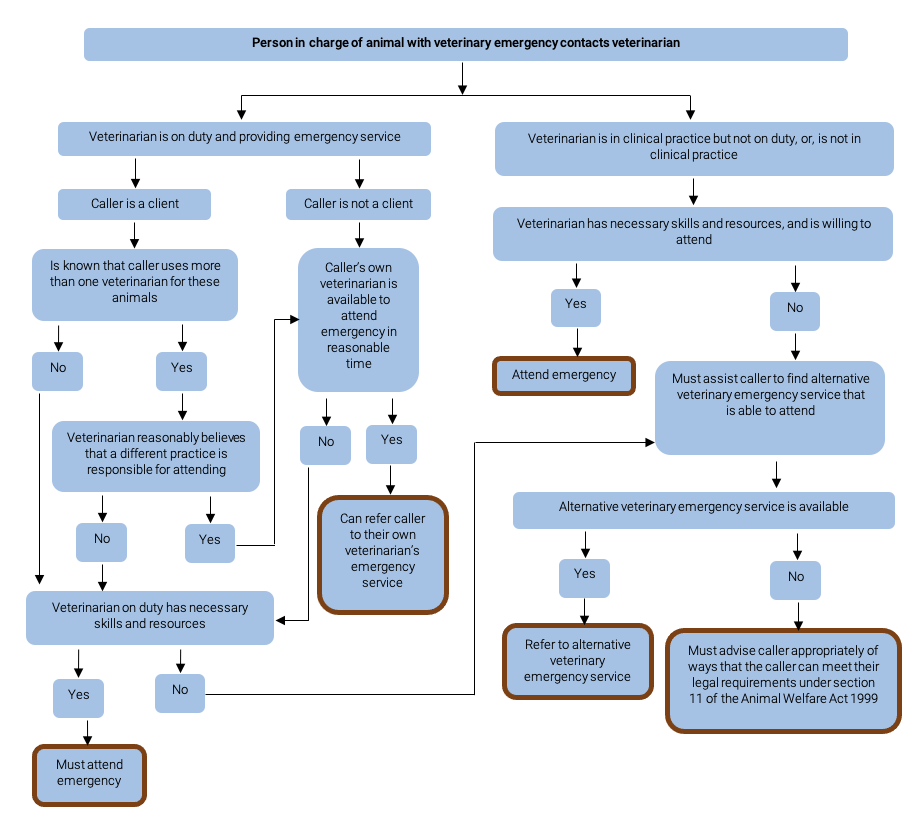
:::
# Section 5.8
There will be times when a veterinarian who is not currently working in clinical practice, or who is not on duty, is called upon in a veterinary emergency. On these occasions, if the veterinarian is unable to attend the animal personally to provide emergency treatment, he/she must make a reasonable effort to assist the caller to locate an alternative source of emergency veterinary care.
Instances will occur where there is no available veterinary service. In any such case the veterinarian must provide appropriate advice in order that the person in charge of the animal is able to take the necessary steps to alleviate any unreasonable or unnecessary pain or distress being suffered by the animal.
:::ExpandableHeading
## Understanding section 5.8
Section 7 of this part of the Code describes the responsibilities of those veterinarians on duty providing an emergency service. Section 8 describes the responsibilities of all other veterinarians – whether they are a clinical practitioner who is not on duty, or a veterinarian not employed in clinical practice.
When contacted in a veterinary emergency, those veterinarians in clinical practice and not on duty, and those not in clinical practice, who have the necessary skills and resources and who are willing to attend may choose to attend the affected animals.
While there is no legal obligation for veterinarians to respond when called upon in a veterinary emergency, veterinarians in this group choosing not to attend the emergency personally, still have an ethical responsibility to respond professionally and help the caller to find a solution so that the animal is not left to suffer unreasonably. Where possible, the veterinarian must provide reasonable assistance to guide the caller to a suitable and available emergency service.
Where there is no other available veterinary service the veterinarian must appropriately advise the person in charge of the animal(s) how best they can meet their obligations under sections [10](https://www.legislation.govt.nz/act/public/1999/0142/latest/link.aspx?id=DLM50298) and [11](https://www.legislation.govt.nz/act/public/1999/0142/latest/link.aspx?id=DLM50299) of the Animal Welfare Act 1999. The person ultimately responsible for ensuring that an animal does not suffer is the person in charge of the animal.
:::
# Section 5.9
Veterinarians must make provision for the care of animals currently receiving in-patient treatment. This must be at a level appropriate to the clinical problem being managed and must be communicated to the client.
:::ExpandableHeading
## Understanding section 5.9
In-patients are those animals remaining in the veterinary clinic for the purposes of treatment.
Veterinarians have an ongoing ethical responsibility to their patients receiving in-patient care. This responsibility extends outside normal business hours.
As well as ethical responsibilities, veterinarians have legal obligations as the person in charge (as defined in the Animal Welfare Act 1999) of their inpatients. More specifically sections [10](https://www.legislation.govt.nz/act/public/1999/0142/latest/link.aspx?id=DLM50298) and [11](https://www.legislation.govt.nz/act/public/1999/0142/latest/link.aspx?id=DLM50299) of the Animal Welfare Act 1999 set out those requirements.
Veterinarians must make proper provision to manage their in-patients appropriately for the clinical condition being treated.
The owners of in-patients must be informed of the level of supervision and clinical management the in-patients will be receiving out of normal business hours.
:::
# Section 5.10
When veterinarians provide a [specific and limited range of veterinary services](https://hub.vetcouncil.org.nz/glossary#specific-and-limited-range-of-veterinary-services) to the animals under their care, the following general conditions must be met:
1. The veterinarian has verifiable advanced skills in the specific area of practice covered by the service.
2. The service is limited in its scope so as not to be confused with the services provided by a [General Veterinary Practitioner](https://app.archbee.com/public/PREVIEW-wrBJXyHoscpUG72h2-7zt/PREVIEW-Gs8lan75noOL7EJ4nNi5V#general-veterinary-practitioner).
3. The veterinarian offers no more than one of the specific range of services, for example, embryo transplants, equine dentistry, or lameness examinations. A veterinarian that offers one service to a selection of clients, but more than one to others is not a specific and limited service provider as more than one service is offered overall.
4. The service is not, and is not likely to be seen as, a substitute to the client developing a relationship with a General Veterinary Practitioner. Hence this scope excludes a number of veterinary service models ( e.g. vaccination-only clinics, companion-animal-desexing-only clinics, mobile equine gelding clinics etc).
5. The specific and limited service veterinarian consistently provides those services to all their clients. The veterinarian must not selectively provide a general veterinary services to certain clients and ‘specific and limited range of veterinary services’ to others unless the following are met:
1. The veterinarian must have explicit, written terms of service with clients that makes it clear whether they are being provided with general veterinary services or a Specific and Limited service.
2. For Specific and Limited clients, the veterinarian must be able to demonstrate that they have confirmed, before providing services, that the client has a General Veterinary Practitioner, has obtained to consent to share info, and confirmed with the practice that the client has access to 24-7 emergency care.
3. For general veterinary services clients, the veterinarian must be able to demonstrate that they have made arrangements for adequate emergency care for those clients at all times, including when they are unavailable because they are providing Specific and Limited services.
4. The veterinarian must still meet full requirements of the Code for Specific and Limited clients including personally making arrangements for emergency care in relation to the services they provide.
# Section 5.11
When providing [Unique Services](https://hub.vetcouncil.org.nz/glossary#specific-and-limited-range-of-veterinary-services) to the animals under their care, veterinarians must comply with the following conditions:
1. The veterinarian **must** only authorise the use of [RVMs](https://hub.vetcouncil.org.nz/glossary#restricted-veterinary-medicine-rvm) for immediate use on specific clinical matters they have consulted on.
2. The veterinarian **must**, with the client’s permission, contact the client’s General Veterinary Practitioner. Communication between the veterinarians is required because if the total veterinary input is fragmented it may be difficult to achieve the best possible veterinary care outcomes for the animal(s) and the client.
# Section 5.12
When providing [Advanced Services](https://hub.vetcouncil.org.nz/glossary#specific-and-limited-range-of-veterinary-services) to the animals under their care, veterinarians must comply with the following conditions:
1. The veterinarian **must only** authorise the use of [RVMs](https://hub.vetcouncil.org.nz/glossary#restricted-veterinary-medicine-rvm) for immediate use on specific clinical matters they have consulted on. This includes the authorisation and supply of RVMs that require special circumstances approval for the ongoing management of a specific condition. The following are specifically excluded:
1. The [authorisation for future supply](https://hub.vetcouncil.org.nz/6-veterinary-medicines#authorisation-for-future-supply) in order to hold specific RVMs in anticipation of use.
2. The authorisation of companion animal vaccines and other RVMs not required for the matter consulted on.
3. The authorisation of RVMs for the following dairy and beef cattle Disease Control Programs:
1. Milk Quality programs including dry cow antibiotic treatment authorisations
2. Mobility programs including general lameness treatments
3. Fertility programs including reproduction hormones
4. Calf and heifer nutrition programs
5. Nutrition programs
6. Infectious disease control programs
7. Parasite management control programs
2. The veterinarian **must only** provide the service after confirming the involvement of a General Veterinary Practitioner and communicating directly with them about the service they are providing. This must include access to existing patient records and the sharing of the records relating to the treatment the Advanced Services veterinarian provides. This means that, if the client does not have a General Veterinary Practitioner or declines consent to contact their General Veterinary Practitioner and the sharing of records, the advanced service must not be provided.
3. The veterinarian must make arrangements for 24-hour emergency cover that is proportionate to the services they provide and RVMs they authorise. This emergency cover must be provided by themselves or, if agreed to, by the General Veterinary Practitioner.
# Section 5.13
When providing [Consultancy Services](https://hub.vetcouncil.org.nz/glossary#specific-and-limited-range-of-veterinary-services) to the animals under their care, veterinarians must comply with the following conditions:
1. The veterinarian **must only** authorise the use of [RVMs](https://hub.vetcouncil.org.nz/glossary#restricted-veterinary-medicine-rvm) for diagnostic purposes, i.e. RVMs must not be authorised for therapeutic purposes.
2. The veterinarian **must only** provide the service after confirming the involvement of a General Veterinary Practitioner and communicating directly with them about the service they are providing. This must include access to existing patient records and the sharing of the records relating to the treatment the Consultancy Service veterinarian provides. This means that, if the client does not have a General Veterinary Practitioner or declines consent to contact their GVP and the sharing of records, the consultancy service must not be provided.
3. The veterinarian must make arrangements for 24-hour emergency cover that is proportionate to the RVMs they authorise (i.e. diagnostic RVMs). This emergency cover may be provided, if agreed to, by the General Veterinary Practitioner.
***
:::Changelog{title="Updates"}
::ChangelogItem{type="added" description="Updated April 2016"}
::ChangelogItem{type="improved" description="Corrected links, minor editorial fixes January 2023"}
::ChangelogItem{type="added" description="New guiding principle added March 2023"}
::ChangelogItem{type="fixed" description="Updated references to the Privacy Act & minor stylistic improvements June 2025"}
::ChangelogItem{type="added" description="Changed numbering scheme July 2025"}
::ChangelogItem{type="added" description="Sections 5.10 to 5.13 added, section 5.7 amended to replace "clients' animals" with "animals under their care" March 2026"}
::ChangelogItem{type="added" description="Guiding principle wording change to “these animals” May 2026"}
:::
[title] Nurses signing vaccination records
[path] Professional standards and guidance/Technical advice/Delegation/
:::hint{type="info"}
*Technical advice is our interpretation of how professional standards apply in a particular situation. It is designed to help veterinarians deal with common issues in practice, using their professional judgement to apply the advice to their own situation. It represents our best efforts at the time of publication but standards and expectations change over time and particular care should be used when reading old advice.*
:::
***
***Are nurses allowed to sign the vaccination certificate and If so do they need a qualification - certificate, diploma, technician?***
***
:::hint{type="info"}
*This guidance does not apply to certificates for export as these are different and would usually require a veterinarian.*
:::
Under a veterinary authorisation a veterinary nurse could be authorised to administer a vaccination (see our technical advice on [Nurses administering vaccinations to companion animals](docId:7Xh9RgVyouIryZvpQ8hQj)).
We don’t see any issues with a veterinary nurse signing vaccination booklets as long as they are clear about their position and don’t appear to be a veterinarian. If, for example, the current vaccination booklets imply a veterinary signature, then this would need to be amended when a nurse signs.
Whether animal care facilities such as kennels and catteries will find nurse-signed booklets acceptable is up to them but we see no reason why they should not be okay.
There are specific situations where it may be more appropriate for a veterinarian to sign the booklet, for example, Greyhound Racing requirements or similar.
***
:::Changelog{title="Updates"}
::ChangelogItem{type="added" description="13 October 2021"}
:::
[title] Untitled
[path] Professional standards and guidance/Technical advice/
[title] Controlled Drugs and PMs FAQ
[path] Professional standards and guidance/Technical advice/Stewardship/
***When authorising human medicines (prescription medicines (PMs)), for example gabapentin and/or controlled drugs, for example phenobarbitone, for patients that are very likely to require it long term; how often must the veterinarian examine the patient to be able to authorise these medications?***
This is a common question and it will be answered below in two parts. This first part relates to how much can be authorised and dispensed each time, and the second part is what must happen for a new authorisation.
### *How many months’ supply can I authorise and dispense at a time?*
Looking at the Code of Professional Conduct (CoPC), this describes the actions veterinarians must take when authorising medicines in [Section 6.3 Authorisation.](docId\:uUCHsu_9cXggI8oOuNAG_)
***Actions that veterinarians must take when using or authorising restricted veterinary medicines:***
1. *Comply with the requirements and expectations of the MPI in relation to authorisation. This is set out in MPI’s published ACVM Notice Requirements for Authorising Veterinarians dated 28 August 2015.*
2. *Comply with all points in sections 1 and 2 of the Veterinary Medicines section of this Code*
3. *Only authorise RVMs following a veterinary consultation, or issuing VOI as detailed in section 4.*
4. *Only authorise PMs or controlled drugs following a veterinary consultation.*
5. *Honour requests that ask for written authorisations instead of dispensing.*
6. *Decide, when authorising RVMs and PMs, the most appropriate period of supply for each product authorised after considering the maximum periods of supply. The following maximum periods of supply apply for authorisations:*
- *3 months for PMs*
- *6 months for RVMs for companion animals other than horses*
- *4 months for critically important antibiotics*
- *12 months for all other RVMs for production animals and horses.*
*Within the above limits, the actual period of supply chosen will depend on the particular RVM/PM, the condition being treated, and the risks that need to be managed.*
Here we see that for **PMs ** e.g. Gabapentin, the maximum period of supply is 3 months and for new authorisation following this there must be a veterinary consultation. What a veterinary consultation comprises of will be covered in the second part of this advice.
**For controlled drugs,** the requirements around supplying controlled drugs were amended in December 2022. The relevant part of the Misuse of Drugs Regulations (“the Regulations”) is cl 31(1) (a)-(d). Which set out that a **person may not supply a controlled drug more than once on that same prescription, or in a quantity that is greater than a quantity sufficient for a use of a period of one month**.
So, the maximum period of supply for controlled drugs (for example, phenobarbitone) is one month with no repeats.
### What is a veterinary Consultation? Do I have to physically examine the patient every time I authorise more medication after the maximum period of supply (so after three months for PMs and one month for controlled drugs, including phenobarbitone)?
A veterinary consultation is defined in the Code [here](https://hub.vetcouncil.org.nz/glossary#f3bh7).
***Veterinary Consultation***
*A veterinary consultation must include the veterinarian:*
1. *interviewing the client (or a legitimate and authorised representative of the client)*
2. *collecting and recording sufficient information relevant to the individual circumstances to ensure the proposed course of action (including treatment) is appropriate to meet the needs and best interests of the animal(s) and the client*
3. *obtaining appropriate consent to the proposed course of action*
4. *being given, and accepting responsibility for, the ongoing health and welfare of the animal(s) concerned in relation to the consultation. This includes arranging emergency care after considering the circumstances and the potential for adverse effects from, or failure of, the agreed course of action*
5. *determining and providing the appropriate level of advice and training so as to be satisfied that the agreed course of action can proceed as planned.*
*A veterinary consultation will usually involve the veterinarian seeing the animal(s) at the time of the consultation. If not, the animals must have been seen recently or often enough for the veterinarian to have sufficient personal knowledge of the condition/health status of the animal(s). This consultation is required in order for the veterinarian to be able to propose the particular course of action.*
### In regards to seeing the animal as in the consultation as defined above, what is recently or often enough?
Veterinarians are expected to use their professional judgement in determining this in each individual case. When deciding whether the animal has been seen recently or often enough to authorise further medication without an in-person examination, many factors must be considered some of which are included here:
- Time since initial diagnosis
- Any changes in the medication or treatment plan
- The animal's medical history and stability of their condition
- Any risk factors that need to be managed
- Recent laboratory results or monitoring data
- Presence of co-morbidities or complicating factors
- Owner factors, such as their ability to monitor, observe, and comply with treatment recommendations
- Age and breed of the animal
For more detailed information about this, read the guidance [linked here](https://hub.vetcouncil.org.nz/guidance-for-authorisation-of-controlled-drugs-in-veterinary-medicine).
### Should I document this?
Veterinarians should document their decision in the clinical record, including the factors considered and whether a re-examination is required.
### Summary
- The maximum period of supply for PMs is 3 months and for controlled drugs is 1 month.
- The actual amount authorised and dispensed each time can be less than these maximums (but cannot exceed them). This will be decided by the authorising veterinarian taking into account any risk factors that need to be managed.
- A new authorisation must then be made which includes a veterinary consultation.
- A veterinary consultation includes the veterinarian seeing the animal or have seen the animal recently or often enough for the veterinarian to have sufficient personal knowledge of the condition/health status of the animal.
- All relevant factors (risk, clinical, owner, medication history) must be considered when deciding if the animal(s) need to be seen in person.
- The rationale for the chosen period of supply and the nature of the consultation (in-person, phone, or video) should be documented.
- If in doubt, err on the side of caution and arrange to see the animal in person.
- Regularly review your practice’s protocols for authorising and dispensing controlled drugs and PMs to ensure they remain up to date with current regulations and standards.
[title] Registration policies
[path] Policies/
[title] Cannabidiol products for use in animals
[path] Professional standards and guidance/Technical advice/Stewardship/
:::hint{type="info"}
*Technical advice is our interpretation of how professional standards apply in a particular situation. It is designed to help veterinarians deal with common issues in practice, using their professional judgement to apply the advice to their own situation. It represents our best efforts at the time of publication but standards and expectations change over time and particular care should be used when reading old advice.*
:::
***
***Can a veterinarian authorise human Cannabidiol products for use in animals?***
***
VCNZ has not established a specific position for Cannabidiol products yet. Until then, we are following the current regulations, which apply to therapeutic products (such as prescription medicines and [Restricted Veterinary Medicines](https://hub.vetcouncil.org.nz/glossary#TiF6C)) and permit veterinary discretion.
As long as the therapeutic product you are considering using is a CBD product and is approved as a medicine, then it would be treated like any other prescription medicine and can be [prescribed](https://hub.vetcouncil.org.nz/glossary#LrD_E) without specialist recommendation or Ministerial approval.
Any medicinal cannabis product which is not a CBD product is a Class B1 [controlled drug](https://hub.vetcouncil.org.nz/glossary#LWhOX). These may contain any level of cannabinoids and include all dried flower products.
If it is a less or unrefined cannabis or hemp product, then the potential presence of other tetrahydrocannabinols (especially THC) would trigger controlled drug status. Ministry of Health approval would then be required before special circumstances approval.
As of April 2023, there is only one Cannabidiol with no THC that is approved in New Zealand as a prescription medicine. Here is a link to the [EPIDYOLEX](https://www.medsafe.govt.nz/profs/Datasheet/e/epidyolexsol.pdf) minimum safety datasheet.
There is also currently only one approved, scheduled product (Class B1 controlled drug) available. Here is a link to the [SATIVEX](https://www.medsafe.govt.nz/profs/datasheet/s/sativexspray.pdf) minimum safety datasheet.
**Where can I find more information?**
The Medicinal Cannabis Agency provides guidance for prescribing health professionals [here](https://www.health.govt.nz/our-work/regulation-health-and-disability-system/medicinal-cannabis-agency/medicinal-cannabis-agency-information-health-professionals).
There is also a list of medicinal cannabis products that meet the minimum quality standard available [here](https://www.health.govt.nz/our-work/regulation-health-and-disability-system/medicinal-cannabis-agency/medicinal-cannabis-agency-information-health-professionals/medicinal-cannabis-products-meet-minimum-quality-standard).
**What about products that are not a registered prescription medicine?**
Other products that are not approved prescription medicine are considered to be Section 29 products. Although veterinarians may be able to prescribe them, they are not currently able to be sourced and sold to vets in NZ.
To authorise and dispense these products, you would need to import them yourself and would need ACVM approval to do this. For details about this, email ACVM: [approvals@mpi.govt.nz](mailto\:approvals@mpi.govt.nz)
***
:::Changelog{title="Updates"}
::ChangelogItem{type="added" description="June 2023"}
:::
[title] Guidance on AI Transcription and Client Privacy: Protecting Personal Information in the Digital Age
[path] Professional standards and guidance/Guidance/
Scope of this Guidance
This guidance is specifically focused on the privacy and security of client information when using AI transcription tools in veterinary practice. It is not intended to provide advice or recommendations regarding the accuracy, reliability, or clinical appropriateness of AI-generated transcripts, nor does it address broader ethical considerations or the risks of errors, hallucinations, or misinterpretations that may arise from the use of artificial intelligence. Users should seek separate guidance for those aspects.
## 1. Introduction: Your Continuing Obligation to Client Privacy
As registered veterinarians, your professional and legal responsibilities extend beyond the clinical care of animals. You act as custodians of personal information (PI) belonging to your clients, which includes data collected during consultations, procedures, and administrative tasks.
This information, such as names, addresses, contact details, and records of client-veterinarian communications, is subject to the **New Zealand Privacy Act 2020**. This Act, along with the foundational Information Privacy Principles (IPPs), requires you to take reasonable steps to protect that data from loss, unauthorised access, or misuse.
Digital tools, including Artificial Intelligence (AI) transcription services, offer significant efficiency benefits in documentation. However, introducing a new third party into your information chain creates new privacy risks that require careful management and due diligence. This guidance is intended to help you navigate those risks responsibly.
## 2. Understanding the Privacy Risks of Digital Transcription
When you use an AI transcription tool, you are effectively transferring raw, sensitive client data (the audio of your consultation) to an external technology provider for processing. The following risks require your immediate consideration:
### A. Third-Party Control and Data Use
Under the Privacy Act, when you pass client PI to a service provider for processing, the information is deemed to be held by *both* you (the agency) and the provider (the agent). You remain legally accountable for how that provider manages the data.
● **Risk:** Many generic AI platforms use the data they process (your consultation audio and the resulting text) to train and improve their models. This means sensitive client and animal information could be permanently ingested into a commercial AI system without your client’s explicit knowledge or consent. This is a potential breach of **IPP 10 (Limits on Use)**.
● **Risk:** If the transcription service is based outside New Zealand, the data is subject to the privacy laws of that overseas jurisdiction, increasing the risk of unauthorised disclosure or government access (**IPP 12 – Disclosure outside New Zealand**).
### B. Security and Storage Vulnerabilities
Transferring data over the internet and storing it on a third-party server exposes it to a greater risk of cyber attack or data breach.
● **Risk:** If the platform uses weak encryption or fails to limit access, a data breach could lead to the unauthorised disclosure of client identities linked to specific veterinary histories, damaging client trust and potentially incurring a serious harm notification requirement under the Act.
## 3. Mandatory Requirement for Client Consent and Transparency
The use of an AI transcription tool is a material change in how you collect and process personal information. To comply with **IPP 3 (Collection of personal information from the individual concerned)**, you must ensure the client is fully aware of this change.
### The Principle of Informed Consent
Before recording and processing a consultation via an AI transcription service, the veterinarian should:
1. **Inform the Client:** Clearly explain that an AI service will be recording the conversation to generate a transcript for the clinical record.
2. **State the Purpose:** Explain that the sole purpose of the transcription is clinical documentation for their animal and that the transcript will be securely imported into the clinic’s record system.
3. **Identify the Recipient (The Service):** While you do not need to name the specific software, you must inform them that a third-party technology provider will be processing the audio data.
4. **Provide the Option to Decline:** Crucially, the client must be given a clear option to decline the use of the AI transcription tool. If a client declines, you must stop the recording immediately and use traditional note-taking methods. The client’s decision to decline must not prejudice their animal's care.
**Guidance Note:** *We strongly recommend obtaining this consent in both a verbal format at the start of the consultation and documented via a signed consent form or a clear notation in the clinical record. At a minimum, we recommend that the client be made aware of the use of AI transcription tools via email and/or posters in the reception areas of clinics.*
## 4. Security Checklist: Selecting a Responsible AI Tool
Before contracting with any AI transcription provider, you must undertake due diligence to ensure the service meets the security standards required by **IPP 5 (Storage and security of personal information)**.
We recommend evaluating potential providers against the following key security and contractual criteria:
| **Feature** | **Requirement and Rationale** |
| --------------------------------------- | ------------------------------------------------------------------------------------------------------------------------------------------------------------------------------------------------------------------------------------------------------------ |
| **Contractual Guarantee (No Training)** | The provider **must** contractually guarantee that your uploaded audio files and resulting transcripts **will not be used for model training, product development, or any other purpose** beyond generating your specific transcript. |
| **Data Encryption** | The tool must employ strong, industry-standard encryption (e.g., AES-256) for data both **in transit** (when audio is sent and transcript is received) and **at rest** (when data is stored on their servers). |
| **Access Controls & Authentication** | The service should support **Multi-Factor Authentication (MFA)** for all user accounts. Furthermore, it should use **Role-Based Access Controls (RBAC)** to ensure that only the clinician or specific administrative staff can access the client’s records. |
| **Data Residency** | Clarify the physical location (jurisdiction) where the data is hosted. Preference should always be given to providers who host data within New Zealand or another country with equivalent privacy protections. |
| **Data Retention and Disposal** | The provider must have a clear policy on how long they retain the audio and text files and guarantee **secure and verifiable deletion** of data after the transcript is delivered and imported into your system. |
| **Audit Trails** | The system must maintain comprehensive, immutable (unchangeable) logs detailing who accessed the data, when, and what actions were performed. These logs are vital for investigating security incidents. |
| **Security Certifications** | Look for independent external validation, such as ISO 27001 certification (Information Security Management System), which demonstrates a commitment to robust security practices. |
## 5. Summary of Regulatory Expectation
Adopting new technology requires corresponding diligence in managing privacy risks. The Vet Council's expectation is that veterinarians integrate **"Privacy by Design"** principles\* into their selection and usage of AI transcription tools.
This means:
1. **Transparency:** Being upfront with clients about the technology being used.
2. **Choice:** Ensuring clients have a non-prejudicial option to decline.
3. **Security:** Selecting a tool based on robust, verified security measures, especially contractual clauses limiting the third-party provider’s use of your client’s information.
By taking these steps, you safeguard the personal information entrusted to you and maintain the high level of trust vital to the veterinary profession in Aotearoa New Zealand.
*\*This guidance is informed by the Privacy by Design (PbD) methodology, as set out by the New Zealand Digital Government. Practitioners are encouraged to review the official PbD principles and apply them when selecting and using AI transcription tools. See: Privacy by Design (PbD) – NZ Digital Government.*
\[i]**Transparency Statement **
This technical advice has been prepared with the assistance of artificial intelligence (AI) tools to support the drafting and refinement of content. The AI was used to enhance clarity, consistency, and efficiency in the development process.
All information presented has been reviewed, edited and approved by the Veterinary Council of New Zealand staff to ensure it meets professional standards, reflects current veterinary practice, and aligns with regulatory requirements.
[title] Authorisation of Dry Cow Therapy - Effective from 1 January 2027
[path] Professional standards and guidance/Statements/
## Objective:
To set expectations for veterinarians when authorising Dry Cow Antibiotic Treatment (DCAT) and internal teat sealants (ITS).
## Introduction
Effective management of udder health during lactation, around the time of drying off and over the dry period, is typically achieved through careful attention to milking management, udder hygiene, minimising exposure to environmental bacteria, nutrition, and stock handling. Restricted veterinary medicines (RVMs) including internal teat sealants (ITS) and antimicrobial products play an important role in curing existing Intramammary infection (IMI) and minimising the risk of subclinical and new IMI over the dry period.
While antimicrobials are an effective element of an udder health programme [\[3\]](https://hub.vetcouncil.org.nz/statement-authorisation-of-dry-cow-therapy#linksnotes), their use must be justified at the individual cow-level with the aim of minimising the risk of antimicrobial resistance and food residues. This applies during lactation and at dry-off.
Veterinarians authorising DCAT must have clear justification for this use. This includes having a sound understanding of the current prevalence and incidence of clinical and subclinical mastitis in the herd, the bacteria involved, the effectiveness of antimicrobial therapies, and mastitis management controls in use on the farm.
## Principles for prescribing DCAT and ITS
1. A key component in managing the risk of antimicrobial resistance emergence is the veterinary authorisation for DCAT only when it is justified and appropriate.
2. Veterinary authorisations require veterinarians to make a professional judgement and appropriate recommendations.
3. A veterinary authorisation of DCAT must meet all standards for the authorisation of RVMs as set out by the ACVM Notice: Requirements for Authorising Veterinarians (ACVM Notice) [\[1\]](https://hub.vetcouncil.org.nz/statement-authorisation-of-dry-cow-therapy#linksnotes) and Code of Professional Conduct (Code)[\[2\]](https://hub.vetcouncil.org.nz/statement-authorisation-of-dry-cow-therapy#linksnotes).
4. DCAT must only be authorised following a consultation where the veterinarian has collected sufficient information [\[3\]](https://hub.vetcouncil.org.nz/statement-authorisation-of-dry-cow-therapy#linksnotes).
5. Veterinarians authorising DCAT must be involved in the ongoing udder health programme of the cows/herd.
6. If more than one veterinarian (e.g. general practitioner and a veterinary consultant) is involved in managing the udder health programme on a farm, each must seek the owner’s consent and must communicate with the other veterinarian(s) to share information to ensure optimal treatment and welfare outcomes.
7. Current SmartSAMM Technote 14 recommended best practice is to ensure that all cows are protected by some form of treatment during the dry period – either being internal teat sealants (ITS) or DCAT, or a combination of both.
ITS are used to:
- Reduce the risk that uninfected quarters become infected during the dry period, and
- Extend the period of reduced risk when used in combination with DCAT.
DCAT is used to:
- Treat existing intramammary infections
- Reduce the risk that uninfected quarters become reinfected during the DCAT period of activity.
## Authorising Selective DCAT and ITS
For herds with a low bulk milk somatic cell count, low incidence rate of clinical mastitis, and low culling percentage for mastitis-related problems, it is likely that few cows are truly infected at drying off. Cows that are at low risk [\[4\]](https://hub.vetcouncil.org.nz/statement-authorisation-of-dry-cow-therapy#linksnotes) of having an intramammary infection at the time of dry-off do not require DCAT. Therefore, herds with indicators of a low prevalence of infection [\[5\]](https://hub.vetcouncil.org.nz/statement-authorisation-of-dry-cow-therapy#linksnotes) should not use DCAT in every quarter of every cow (i.e. Selective DCAT should be used).
ITS should be used instead of DCAT to prevent new infections over the non-lactating period in those cows that are unlikely to be infected at drying off.
The hygienic administration of products (particularly internal teat sealants) and the herd management pre- and post-dry-off (to ensure minimal milk leakage and good retention of ITS), are fundamental to successful drying off.
Selective DCAT involves the treatment of a subset of cows within a herd that are likely to be infected with a pathogen and would benefit from DCAT. [SmartSAMM Technote 14 (Drying off)](https://www.dairynz.co.nz/media/rtpkgfos/mastitis-technote-14.pdf) provides guidance for which cows are likely to benefit from DCAT. All cows will benefit from an ITS.
### Veterinarians’ responsibilities when authorising selective DCAT and ITS
1. DCAT/ITS must only be authorised by a veterinarian for herds [under their care](https://www.vetcouncil.org.nz/Web/3.About/Current%20Projects/Under-the-care-of-a-veterinarian.aspx). The authorising veterinarian **must** have visited the **herd **at least once in the previous six months, and must ensure the information is sufficient (as defined in the appendix), and that there is a current udder health programme.
2. When authorising DCAT, veterinarians are expected to review animal health and herd test records and only authorise DCAT for use in cows that are likely to be infected as recommended in technote 14 (i.e. selective DCAT treatment).
3. Veterinarians **must **be able to justify each individual animal’s treatment by ensuring there is sufficient evidence to support a need for DCAT use for each animal for which the product is authorised (i.e. individual cow somatic cell count (ICSCC) (herd test) results and other mastitis diagnostics test results, where available).
Analysis of ICSCC, with or without the inclusion of clinical case information during the preceding lactation, has been shown to be effective across numerous national and international research studies in the assessment of the prevalence and incidence of mastitis in individual cows. This supports the application of ICSCC for choosing individual cows for selective DCAT [\[4\]](https://hub.vetcouncil.org.nz/statement-authorisation-of-dry-cow-therapy#linksnotes).
Where herds do not undertake herd testing, alternatives such as a hand-held rapid mastitis test (RMT)[\[4\]](https://hub.vetcouncil.org.nz/statement-authorisation-of-dry-cow-therapy#linksnotes), or automated conductivity or somatic cell measures via the milking management system, or other evidence-based and validated testing methods that meet industry standards, may be used to define intramammary infection status.
Veterinarians are expected to use their judgement and an evidence-based medicine approach to authorise DCAT / ITS.
This should include:
- the likely diagnosis, where appropriate, and the reason for the proposed course of action
- treatment options including expected outcomes, risks including the accuracy of the tests, side effects, benefits, and costs (this may be a range of likely costs)
- the veterinarian’s experience and skills to undertake the treatment, if relevant
- referral or further testing options, where appropriate; and
- post-treatment requirements and likely costs.
4. The authorising veterinarian **must **ensure all persons administering RVMs are competent [\[6\]](https://hub.vetcouncil.org.nz/statement-authorisation-of-dry-cow-therapy#linksnotes). This includes providing advice on adequate teat disinfection, administration technique (NZVA’s [Dry-off resources](https://nzva.org.nz/clinical-resources/cattle/dry-off/) are an example of a best practice approach and are useful to help inform veterinarians’ decisions), and milk and meat withholding periods.
5. Particularly where ITS are used alone, the application requires appropriate hygienic insertion to avoid potential iatrogenic intramammary infections and subsequent animal welfare issues. Veterinarians are expected to ensure all persons administering RVMs are competent to do so.
6. Veterinarians **must **include the following information as a minimum in dry-off authorisation documents and clinical records:
- a clinical history
- consultation and examination details
- cow identification list or the methodology for the authorisation of DCAT and/or ITS
- the decision-making process and supporting evidence, the results of any diagnostic tests that led to the decision for treatment, and their reasons for deciding to use the antibiotic in individual cows, including the diagnosis (confirmed or suspected)
- the name of the product and details about its administration and withholding periods
- the communications and instructions given to the owner or person in charge relating to the authorisation
- the assessment and provision of the appropriate level of advice and training to administrators
- instructions for monitoring for adverse events and mastitis over the dry period, and a process for reporting such cases to the authorising veterinarian
- drying off plan, including feeding strategy
- a document of the owner’s informed consent to the treatment plan.
## Authorising whole herd DCAT
**Definition of Whole Herd DCAT **[\[7\]](https://hub.vetcouncil.org.nz/statement-authorisation-of-dry-cow-therapy#linksnotes)**:** For the purposes of this Statement, Whole Herd DCAT is defined as treatment of cows with DCAT **irrespective of the likely infection status.**
[Technote 14](https://www.dairynz.co.nz/media/rtpkgfos/dairynz-technote-14-dry-cow-strategy.pdf)**: **Based on recent evidence, the NMAC (National Milk Quality Advisory Council) has updated SmartSAMM Technote 14 *and *recommends that **selective use of DCAT is the default approach for most herds. **
Guidelines for when whole-herd DCAT may be justified are provided by the NMAC (Table 3).
***Technote 14 Table 3. (2025) Herds where whole herd dry cow antibiotic treatment (DCAT) may be justified.***
| **Measure of infection ** | **Criteria ** |
| ----------------------------------------------------------------------------------------------------------- | --------------------------------------------------------------------------------------------------------------------------------------------------------------------------------------------------------------------------------------------------- |
| 1. **Bulk milk SCC** | Arithmetic mean bulk milk SCC until end of 7th month of lactation ≥200,000 cells/mL
(Equivalent to whole season bulk milk SCC above 250,000 cells/mL) |
| **AND** | |
| 2. **Indication of significant change in prevalence of infection during late lactation **
| Arithmetic mean monthly bulk milk SCC has increased by >40,000 cells/mL between the 6th and 7th months of lactation.
(Equivalent to arithmetic mean monthly bulk milk SCC increases across last 3 months of lactation by ≥50,000 cells/mL). |
(NB. This means an increase of 50,000 over the last three months of lactation not each month).
**Based on these criteria, veterinarians must only authorise whole herd DCAT as part of an udder health programme to manage animal welfare in herds with a high and increasing risk of infection. **
### Veterinarians’ responsibilities if prescribing whole herd DCAT
1. The threshold for authorising at a whole herd level is the same as that required for an individual animal (selective treatment) - you **must **have sufficient contact with the herd/animal to be able to justify that authorisation (i.e. the authorising veterinarian **must** have visited the **herd **at least once in the previous six months and they must ensure the information is sufficient and that the udder health programme is current).
2. Veterinarians **must** review the infection status in a herd and be able to justify their decision to authorise whole herd DCAT based on technote 14 Table 3 above.
**Exceptions:** Where the specific criteria in Table 3 are not met, veterinarians may exercise professional judgment to authorise whole herd DCAT in exceptional circumstances where they can demonstrate that treatment is necessary to protect animal welfare or address significant herd health risks.
Any decision to authorise whole herd DCAT based on professional judgment must be justifiable with documented evidence of the clinical reasoning, risk assessment, and exceptional circumstances that require departure from standard selective treatment protocols.
The clinical reasoning, risk assessment, and exceptional circumstances must be recorded in an exception form (the exception form provided by the DCV is considered an acceptable standard and the records must be available for review to ensure transparency and professional accountability [(Appendix 2)](https://hub.vetcouncil.org.nz/statement-authorisation-of-dry-cow-therapy#appendix-2-supporting-framework-for-professional-j).
3. If a veterinarian authorises whole herd DCAT, they **must **also ensure an udder health improvement programme [\[3\]](https://hub.vetcouncil.org.nz/statement-authorisation-of-dry-cow-therapy#linksnotes) is provided and implemented. This should be based on the Vet Council’s guideline *Udder Health Programmes and Information Requirements for Authorisation of antimicrobial Dry Cow Therapy *[(Appendix 1)](https://hub.vetcouncil.org.nz/statement-authorisation-of-dry-cow-therapy#appendix-1-udder-health-programmes-and-information).
4. The udder health improvement programmeshould include the determination of the aetiology of intramammary infections (i.e. culture and sensitivities), and milking time visits to identify mastitis risk factors.
The aim should be to reduce the prevalence and incidence of intramammary infections and hence BMSCC to transition the herd to selective treatment, i.e.whole herd DCAT **must not** be used as a substitute for other mastitis control measures.
## Further information
Information on current best practice for udder health management is available via the [DairyNZ SmartSAMM programme](https://www.dairynz.co.nz/animal/cow-health/mastitis/).
# Appendix 1: Udder Health Programmes and Information Requirements for Authorisation of antimicrobial Dry Cow Therapy
To meet the conditions of consultation to authorise dry cow antimicrobial therapy (DCAT) and provide an udder health improvement programme for a client, the following is the minimum requirement for 'sufficient information'.
A. It must be demonstrated that the authorisation of DCAT is part of an ongoing mastitis control programme. The definition of 'ongoing' is acceptance for, and provision of, the continuing care and active monitoring of mastitis in the herd.
B. An understanding of the epidemiology of sub-clinical and clinical mastitis must be demonstrable. Interpretation should be based on and include information about:
- Clinical mastitis
- Somatic cell counts
- Milking management
- Cow and herd-level mastitis control strategies implemented
(**NB Definition of 'epidemiology':** The study of disease in the population, defining its incidence and prevalence, examining the role of external influences such as infection, diet or toxic substances and examining appropriate preventative or curative measures).
C. The veterinarian must be familiar with the animals and their environment through direct physical examination in the current lactation.
D. **Supporting information: **Adequate history for a milk quality consultation and the development of an udder health improvement programme would normally include the following information documented in the clinical record, where appropriate:
- Bulk milk somatic cell count data for the previous and current lactation
- Individual cow somatic cell counts (i.e. herd test records) for the current and previous lactation
- Bacteriology from clinical and sub-clinical mastitis cases
- Clinical mastitis-incidence at key stages:
- calving (defined as calving to one week post calving);
- lactation to dry off;
- dry period.
- Milking technique and hygiene assessed at a milking-time assessment
- Mastitis prevention measures e.g. teat spraying
- Teat skin and teat-end scores
- Environmental mastitis risk assessment
- Pre-calving heifer management programme
- Dry cow therapy records
- Dry off management strategy, including the management of milk yields immediately prior to dry off
- Culling history for mastitis over the last three years
- Staff training and competence
- Nutritional status and feeding strategy around dry‑off.
The nutritional status and feeding strategy of cows around dry‑off significantly influence udder involution, mastitis risk, DCAT efficacy, animal welfare, and the achievement of target body condition scores (BCS) for calving.
Therefore, nutritional assessment [\[8\]](https://hub.vetcouncil.org.nz/statement-authorisation-of-dry-cow-therapy#linksnotes) is required as part of the “sufficient information” needed before authorising DCAT. During this process, the veterinarian will document:
- BCS assessments and projected BCS trajectory
- Late‑lactation feeding plan
- Pre‑dry‑off milk‑yield reduction strategy
- Post‑dry‑off maintenance feeding plan
- Dry‑period and transition‑period feeding plans
- Identified nutritional risk factors (e.g. feed deficits, over‑conditioned cows, high milk yield)
- Mitigation strategies and recommendations.
From this data, the veterinarian needs to provide a treatment plan that will include:
1. Which products (i.e. antimicrobial and/or internal teat sealant) to use for individual animals at the end of lactation. Considerations include:
(i) cure rate of existing infection; or
(ii) prevention of new infection during the dry period and at calving; or
(iii) both (i) and (ii).
2. Which cows are eligible for dry cow antimicrobial therapy based on SmartSAMM TechNote14.
(i) Maximum SCC from any individual herd test SCC across lactation that exceeds the SmartSAMM Technote 14 cut points
(ii) History of clinical mastitis in the current lactation
(iii) Other cow specific risk factors that may include:
- milk yield > 15 L/cow/day and > 4 years of age at the latest herd test,
- poor udder conformation or teat damage,
- palpation of scar tissue in quarter etc.
3. Which cows to cull ([SmartSAMM Technote 15](https://www.dairynz.co.nz/media/043oalxa/smartsamm_technote_15_cull_persistently_infected_cows_2012.pdf)) - based on non-response to therapy (either repeated clinical cases (e.g. >2 times in the current lactation) or previous season’s requirement for DCAT (e.g. >200,000 cells/ml in the previous and current lactation)).
4. What mastitis prevention and control measures need to be implemented, including management factors, additional monitoring such as teat scoring, teat spray coverage etc (i.e. an udder health improvement programme).
This information will allow the veterinarian to provide an ongoing udder health programme including:
a. Advice and training on
i. correct administration of DCAT and ITS
:::Paragraph{indent="3"}
ii. management of the drying off process (feeding, milking frequency, paddock selection; ([Technote 16](https://www.dairynz.co.nz/media/rpkh3udk/smartsamm_technote_16_dry_off_abruptly_taking_steps_to_reduce_yield_2012.pdf))
:::
iii. handling of clinical mastitis during the dry period
iv. management of cow prior to calving
v. management of cow post calving.
b. Advice on selection of antibiotic and NSAID treatment of clinical mastitis.
c. Advice on the reason for current mastitis status, e.g. is the problem due to environmental mastitis, poor dry cow management, a faulty milking machine and/or milking management, or some other factor?
d. An action plan to help the farmer manage their mastitis situation in the future.
e. Perform a mastitis investigation including a milking time assessment, e.g. using the DairyNZ mastitis investigation kit [\[9\]](https://hub.vetcouncil.org.nz/statement-authorisation-of-dry-cow-therapy#linksnotes).
f. Guidelines for the farmers on the economics of their course of action.
# Appendix 2: Supporting Framework for Professional Judgment Decisions in Exceptional Circumstances
## Required Documentation Elements
When authorising whole herd DCAT based on professional judgment beyond Technote 14 Table 3 criteria, veterinarians must document the following in the whole herd DCAT exception form:
### 1. Clinical Justification
- Detailed description of the exceptional circumstances
- Evidence of immediate or significant animal welfare risk
- Assessment of why selective DCAT is inadequate for the specific situation
- Analysis of potential consequences if whole herd DCAT is not implemented.
### 2. Risk Assessment Documentation
- Current herd health status and trends
- Environmental or management factors contributing to the decision
- Assessment of infection pressure and transmission risk
- Evaluation of the alternative management strategies considered.
### 3. Professional Reasoning
- Reference to relevant clinical evidence or guidelines supporting the decision
- Consultation with colleagues or specialists (if applicable)
- Consideration of antimicrobial stewardship principles
- Timeline for reassessment and transition back to selective treatment.
### 4. Monitoring and Review Plan
- Specific parameters to be monitored during and after treatment
- Timeline for evaluating treatment effectiveness
- Plan for implementing udder health improvements
- Schedule for reassessing the need for continued whole herd approach.
## Examples of Justifiable Exceptional Circumstances
Based on the accompanying guidance document, examples may include:
### Emerging Pathogen Outbreaks
- Detection of highly contagious pathogens (e.g. Streptococcus agalactiae)
### Acute Welfare Crises
- Outbreaks of gangrenous or "black" mastitis approaching dry-off
### Acute Environmental Risks
- Catastrophic or prolonged weather events
- Infrastructure failure creating immediate infection risk
- Environmental conditions that cannot be immediately mitigated
## Professional Accountability Measures
### Peer Review Process
- Decisions based on professional judgment should be reviewable by veterinary peers (e.g. a panel of senior dairy cattle veterinarians)
- The Vet Council may request case documentation for quality assurance purposes
- Professional development opportunities may be recommended based on challenging cases.
### Continuing Professional Development
Veterinarians making frequent professional judgment exceptions should, and may be requested to, undertake additional training
Updates on antimicrobial stewardship and mastitis management
Case study discussions within professional networks
Undertake training to become an NMAC (National Mastitis Advisory Committee) accredited mastitis advisor [\[10\]](https://hub.vetcouncil.org.nz/statement-authorisation-of-dry-cow-therapy#linksnotes).
### Quality Assurance
- Regular review of professional judgment decisions by the Vet Council
- Identification of trends requiring guidance updates
- Feedback to profession on appropriate use of professional judgment.
## Implementation Guidelines
### Decision-Making Process
1. **First Assessment**: Evaluate against Technote 14 Table 3 criteria
2. **Exception Consideration**: If the criteria are not met, assess exceptional circumstances
3. **Risk-Benefit Analysis**: Document your comprehensive evaluation
4. **Professional Consultation**: Consider seeking input from colleagues for complex cases
5. **Decision Documentation**: Record your full justification and monitoring plan
6. **Implementation**: Proceed with clear monitoring and review schedule
### Record Keeping Requirements
- Detailed clinical records including an exception report with full justification
- Evidence supporting the exceptional circumstances
- Monitoring data and outcomes
- Review dates and reassessment plans
- Communication with farm management regarding expectations.
### Review and Feedback Mechanism
- Annual review of professional judgment cases by the Vet Council
- Compilation of case studies for profession-wide learning
- Updates to guidance based on emerging patterns or issues
- Continuous improvement of decision-making frameworks.
# Links/notes
1. ACVM Notice: Requirements for Authorising Veterinarians
2. [Code of Professional Conduct](docId\:H_LaUUT6kRSCM2qcOOKNT)
3. Appendix 1 Udder Health Programmes and Information Requirements for Authorisation of antimicrobial Dry Cow Therapy
4. [Technote 14](https://www.dairynz.co.nz/media/rtpkgfos/mastitis-technote-14.pdf)
5. Technote 14: Section 14.4 Plan to use appropriate treatment and prevention for all cows in the herd
6. [Technical Advice: Authorising restricted veterinary medicines for dispensing and use by non-veterinarian staff](https://hub.vetcouncil.org.nz/authorising-restricted-veterinary-medicines-for-dispensing-and-use-by-non-veterinarian-staff)
7. Whole herd DCAT is also known as Blanket DCAT
8. DairyNZ [Smartsamm Technote 16](https://www.dairynz.co.nz/resources/?spotlight=7132) and [Smartsamm Guideline 16](https://www.dairynz.co.nz/resources/?spotlight=7134) provides the current industry best practice guidance for Dry off.
9. [DairyNZ Mastitis Investigation Kit](https://www.dairynz.co.nz/resources/tools/mastitis-investigation-kit/)
10. [https://www.dairynz.co.nz/animal/mastitis/mastitis-advisors/](https://www.dairynz.co.nz/animal/mastitis/mastitis-advisors/)
[title] Dealing with cases of suspected or actual animal abuse and family violence
[path] Professional standards and guidance/Guidance/
When you, as a veterinarian, suspect that an animal has sustained injuries as a result of deliberate abuse, it can be difficult to establish the appropriate course of action. It can be even more challenging if you suspect that the violence perpetrated on the animal may also have been used to threaten or intimidate human family members.
Despite the relative rarity with which situations of deliberate animal abuse – and associated family violence – may have been recognised in practice, it is clear that such events are occurring in our society. Raising veterinarians’ awareness of such issues, interfacing as they do with both animals and their owners, provides a unique opportunity to assist in reducing violence in New Zealand society.
This booklet aims to provide some information and guidance to assist veterinarians and practices to prepare for such situations.
Download the guidance:
::File{src="https://archbee-doc-uploads.s3.amazonaws.com/5ZTpSgccSDCXbym7d-uMH/YcNXY9FeAUHk0-gInF7b7_dealing-with-animal-abuse-and-family-violence.pdf" label="Dealing with animal abuse and family violence.pdf"}
:::Changelog{title="Updates"}
::ChangelogItem{type="added" description="Published 2013"}
:::
[title] Delegating procedures on cats and dogs to veterinary nurses and technicians
[path] Professional standards and guidance/Guidance/
## Coming soon.....
Please check back later or call our Advisors on 04 473 9600 or email vet\@vetcouncil.org.nz
[title] Certification of fitness for transport of livestock
[path] Professional standards and guidance/Statements/
# Objective
To assist veterinarians to comply with the requirements for certifying animals for transport.
# Principles
1. A veterinary certification of fitness for transport is a key component in protecting the welfare of diseased or defective animals.
2. Veterinary certification is discretionary and requires a veterinarian to make a professional judgement.
3. Animals should only be transported when the veterinarian is confident that their condition can be appropriately managed, it will not deteriorate further, and that the welfare of the animal will not be compromised further.
4. The transportation of animals is regulated by:
1. [The Animal Welfare Act 1999](https://legislation.govt.nz/act/public/1999/0093/latest/DLM33502.html)
2. [The Animal Welfare (Care and Procedures) Regulations 2018](https://www.legislation.govt.nz/regulation/public/2018/0050/latest/whole.html)
3. [Code of Welfare: Transport within New Zealand 2018](https://www.mpi.govt.nz/animals/animal-welfare/codes/all-animal-welfare-codes/).
5. Veterinarians must know and comply with the requirements of the Animal Welfare Act, its regulations, relevant Codes of Welfare and the [Code of Professional Conduct](docId\:H_LaUUT6kRSCM2qcOOKNT)
6. Animals must not be transported in a manner which causes ‘unreasonable or unnecessary pain or distress’.
7. Animals must not be transported if they display any injuries, signs of disease, abnormal behaviour or physical abnormalities that could compromise their welfare during the journey unless a veterinary declaration of fitness for transport has been completed.
8. Transportation of an animal with specific conditions (as defined by Regulations ) is allowed if the animal is accompanied by a veterinary certificate that:
1. states the animal is fit for transport; or
2. specifies conditions that must be complied with to manage the risks associated with transport; and the owner or person in charge of the animal complies with all relevant conditions.
9. Veterinarians should support owners and persons in charge (PIC) of animals to comply with the regulations to transport animals.
# Systems & procedures
NZVA’s Transportation of livestock policy 2018 (members only) is a best practice approach and should inform veterinarians decisions.
VCNZ endorse the use of the NZVA Fitness of livestock for transport veterinary declaration (as at 1
February 2019).
# Veterinarian's responsibilities
Starting point
A useful starting point should be that an animal with a disease or defect is not suitable for transport unless the veterinarian is reasonably confident that the condition can be suitably managed, and the welfare of the animal will not be further compromised.
## Preparing for certification
Veterinarians should have available all the necessary information to enable them to make a decision. Information likely to be helpful in preparing to make a decision includes:
- advance notice that the visit is for a transport certificate
- notice of anticipated transport dates and timeframes
- preferred slaughter premises (if applicable)
- clinical history of the animal
- suitability of the facilities available for the examination
- a copy of an existing certificate
- details of any treatment given (including drug withholding periods).
## At the time of certification
Certification is a discretionary exercise of professional judgement. When signing a certificate, veterinarians MUST:
- exercise their professional judgement when considering the welfare of the animal/s in question and the most appropriate approach to managing them and to determine whether:
- they are appropriate to transport
- they should be certified
- be confident that the condition of the animal will not deteriorate, and the welfare of the animal will not be further compromised
- examine the animal at the time of certification
- consider the distance and time of travel (this may impact the welfare during transport and arrival condition)
- consider the option of priority slaughter on arrival at the slaughter premises
- complete the certificate in full
- note location of the slaughter premises on the certificate
- maintain a complete record (this may include photos or video footage).
The veterinarian’s clinical record of certification must meet the following minimum standards:
- have a clinical history
- note consultation and examination details at the time of certification and date
- note animal identification
- set out the decision-making process and supporting evidence which may include a differential diagnosis
- detail the communications and instructions given to the owner and/or PIC
- include a copy of the fully completed certificate (including a stipulated expiry date).
Veterinarians SHOULD ensure, and document, that they confirm:
- the time and distance travelled is as short as possible
- the animal will go directly to the nearest appropriate slaughter premise.
When this is not possible, the MPI Verification Services veterinarian of the premises the animal is being transported to SHOULD be notified of the prior to transport
Seeking veterinary advice or second opinion
If the decision to certify an animal is ambiguous, consideration should be given to seeking a second opinion and/or more information on a case by case basis.
Options for advice or second opinions include:
- Another colleague from the same or neighbouring practices
- MPI Verification Services veterinarian at the slaughter plant (if transport is to slaughter).
## Declining to sign a certificate
A veterinarian has discretion to decline to sign a certificate.
If veterinarians, in their professional judgement, believe that the owners and/or persons in charge of the animal/s are not suitably experienced or trained to recognise early signs of distress, injury, ill-health, or deterioration of the animal’s condition, or know how to respond effectively, they should decline to certify the animal.
If a veterinarian declines to sign a certificate it is helpful to document reasons and ensure these are explained to the owner or PIC. The client and animal records should also be updated to include the decision reached and communication that occurred with the owner or PIC.
Where an animal is deemed unfit for transport, the veterinarian must immediately ensure the animal receives treatment that alleviates any unreasonable or unnecessary pain or distress being suffered. This could include humane slaughter on that property as soon as practical. Appropriate treatment/management should be documented in the clinical notes.
## Communication with owners and PICs
Veterinarians have a responsibility to communicate with the owners and PICs of animals that are being transported to ensure they are aware that:
- transport is stressful for livestock
- if the health of an animal is already compromised prior to transport, the process of transportation may exacerbate the condition
- there are requirements and conditions of the certificate that must be met
- they must hold a copy of the certificate
- certified animals should not noticeably deteriorate before transport and should be capable of travelling such that they arrive at their destination in a state similar to that when they were examined for certification and that:
- An owner or person in charge of the animal/s must seek veterinary re-examination if the animal’s condition deteriorates from examination to loading date (per the agreement on the signed declaration)
- Additional travel conditions may be stipulated on the certificate that must be complied with.
## Untreated injury
Veterinarians should ensure that they do not contribute to practices that would breach the Animal Welfare Act. Consideration should be given to whether the animal received adequate and reasonable treatment and attention on that farm for the condition. For example, if the veterinarian becomes aware that an animal with a healed fracture suffered a welfare compromise through non-treatment at the time of the injury, then this should be reported to the MPI Compliance.
Failing to treat injuries such as this is unacceptable and contravenes the Animal Welfare Act 1999, if the owner or person in charge has not provided appropriate treatment for the animal to manage pain and distress. The expectation to treat an injury is an obligation under the Act (s11 – obligation to alleviate pain or distress of ill or injured animals). If a veterinarian discerns there was sufficient evidence that the animal was not treated, they should contact MPI.
MPI advice is that a veterinary certificate can still be provided in cases where an animal that did not receive appropriate treatment to manage pain and distress is now able to bear weight evenly on four limbs and withstand transport (i.e. it would be fit for transport).
# Guidance for veterinary employers
Preventing further compromise to the welfare of diseased and defective animals intended for transport requires experience, training and adherence to high standards.
Veterinarians, recent graduates and new staff in particular require appropriate induction and should receive suitable education and ongoing continuing professional development on the topic of transport certification.
Veterinarians, recent graduates and new staff in particular should be suitably supported when undertaking certification for transport assessments.
The appropriate tools and resources should be made available for easy compliance with the expectations outlined in the Regulations, the Code of Professional Conduct, the NZVA guidelines and this statement.
Veterinarians conducting certification for transport assessments should be made aware of the expectations set out in this statement by their employer and they should not accept this task if they feel that they have not been sufficiently trained and/or supported.
# Links
- [Animal Welfare Act 1999](https://www.legislation.govt.nz/act/public/1999/0142/latest/DLM49664.html)
- [Animal Welfare (Care and Procedures) Regulations 2018](https://www.legislation.govt.nz/regulation/public/2018/0050/latest/whole.html)
- [Code of Welfare: Painful Husbandry Procedures 2018](https://www.mpi.govt.nz/animals/animal-welfare/codes/all-animal-welfare-codes/)
- [Transport within New Zealand – Animal Welfare Code of Welfare 2018](https://www.mpi.govt.nz/animals/animal-welfare/codes/all-animal-welfare-codes/)
- [Code of Professional Conduct](docId\:H_LaUUT6kRSCM2qcOOKNT)
- [1. Animal welfare](docId\:gr85iChRVF-W2r-SSpYY7) section
- NZVA’s Transportation of livestock policy and guideline December 2018
- [DairyNZ Lameness Scoring System](https://www.dairynz.co.nz/animal/cow-health/lameness/identifying-lame-cows/)
# Definitions
### Appropriate
Acceptable, suitable or right for a particular situation or occasion
### Must
Minimum standards that all veterinarians must meet are identified by the use of the word ‘must’.
### Person in charge
The ‘person in charge’ is defined very broadly and encompasses every person who is seen to have the animal under their care, control or supervision.
This definition extends to include the animal’s veterinarian in situations where the animal is being treated or managed under the specific instructions of the veterinarian and the veterinarian’s degree of control of the animal is such that they are in a position to actively influence the animal’s welfare.
### Should
Advice and recommendations to encourage veterinarians to maintain, or aspire to, high standards of professional conduct are identified by the word ‘should’.
***
Download a PDF version of this statement:
::File{src="https://archbee-doc-uploads.s3.amazonaws.com/5ZTpSgccSDCXbym7d-uMH/q-Gl9mDZcc9v27yWtzvOW_fitness-for-transport-statement.pdf" label="Fitness for Transport Statement.pdf"}
:::Changelog
::ChangelogItem{type="added" description="Published July 2020"}
:::
[title] Governance Policies
[path] Policies/
[title] The Hub
[path] /
Welcome to the Hub. The Hub is our place for standards, guidance and policies. It brings everything together in one site, making it simple to research or find the information you need.
You can use the navigation and search box on the left of this page to find a particular document or topic.
There are PDF versions of most documents available for download and printing. We recommend you use the online version where possible to ensure you get the most up to date information.
::::LinkArray{contentSource="CUSTOM"}
:::LinkArrayItem{headerType="COLOR" headerColor="#ff8900"}
[Professional standards and guidance](docId:5j-yHnmhf07u4NcGPC1lM)
:::
:::LinkArrayItem{headerType="COLOR" headerColor="#009b4c"}
[Case summaries](docId:0nwSWI_RokQVVg2Y0gNWX)
:::
:::LinkArrayItem{headerType="COLOR" headerColor="#D8E5F5"}
[Consumer guidance](docId\:MvHxLOCPCNC8eN6yj5kXp)
:::
::::
[title] Regulatory functions
[path] Policies/
[title] Policies
[path] /
Our policies set out how we carry out our work and perform our legal functions. This includes explaining how we carry out the functions and exercise the powers given to us by the [Veterinarians Act 2005](https://www.legislation.govt.nz/act/public/2005/0126/latest/DLM363859.html).
[title] Policy on Provisional Registration
[path] Policies/Registration policies/
# Legislation
Refer to [section 15](https://www.legislation.govt.nz/act/public/2005/0126/latest/DLM364247.html) and [section 16](https://www.legislation.govt.nz/act/public/2005/0126/latest/DLM364248.html) of the Veterinarians Act 2005.
# Policy
The Council has delegated to the Registrar the power to approve straightforward applications for registration under s12 of the Veterinarians Act and section 20 of the Trans-Tasman Mutual Recognition Act 1997 subject to:
1. all required documentation being provided
2. the application also being checked by another VCNZ staff member
3. applications involving significant fitness to practise declarations being referred to the Registration Committee
In circumstances where not all the required documentation has been provided the Registrar is empowered to approve provisional registration subject to receipt of:
1. certified application for registration (can be faxed or emailed)
2. application fee
3. letter of good standing direct from overseas regulatory body (can be faxed or emailed)
4. certified copy of the identification pages of the applicant’s passport or drivers license (can be faxed or emailed)
The Council has also delegated to the Registrar the power under s15(5) to cancel the provisional registration of those who have failed to provide the required additional information within 6 months of being provisionally registered.
The Veterinarians Act does not provide for provisional registration to be available to limited or specialist registration applicants.
***
:::Changelog{title="Updates"}
::ChangelogItem{type="added" description="Policy reviewed and confirmed with minor amendments, February 2012"}
::ChangelogItem{type="fixed" description="Policy reviewed and confirmed February 2014"}
:::
Download a PDF version of this policy:
::File{src="https://archbee-doc-uploads.s3.amazonaws.com/Mlj4EEShZmQX2zIciB9bN-aVTXG8-wC13mAO2CusT2n-20250709-220914.pdf" label="Policy on Provisional Registration.pdf"}
[title] Policy on Competence and Competence Assessment
[path] Policies/Regulatory functions/
# Introduction
The Veterinary Council’s principal purpose is to protect the public interest by ensuring that veterinarians are competent and fit to practise – not just at the time of initial registration, but on an ongoing basis.
There are two strands to the Council’s competency provisions. The first is focused on
the profession as a whole and is aimed at ensuring that veterinarians continue to be competent by maintaining recency of practice and engaging in continuing professional development. The second strand relates to the few veterinarians whose competence has been called into question. The Veterinarians Act allows the Council to assess the veterinarian’s performance and to put in place remedial measures if this is found wanting.
In such situations the Council has statutory powers to suspend or place conditions on a veterinarian’s practice. But given its view that competency provisions should be educational and rehabilitative the Council prefers to seek the veterinarian’s agreement to work with the Council to address the concerns identified.
# Legislation
The principal purpose of Veterinarians Act 2005 (the Act) is to “protect the public interest by aiming to ensure that veterinarians are competent to practice”.
Section 26(b) requires the Council to be satisfied that an applicant meets the practising requirements of the Act before being issued with an annual practising certificate. The practising standards the Council requires all veterinarians to meet are defined by notice in the New Zealand Gazette and include:
- complying with defined competency standards
- seeking Council approval before resuming practice in a non recent area
- engaging in relevant continuing professional development.
For further information refer to Gazette Notice [Minimum Standards for Practising as a Veterinarian](http://www.vetcouncil.org.nz/documentation/Gazette%20Notices/minimum_standards.pdf).
Sections 55, 58, 59 and 60 of the Act provide for competence assessment of veterinarians. The Act specifies that the Veterinary Council of New Zealand (Council) may carry out a competence assessment on a veterinarian, on its own initiative or on the recommendation of a Complaints Assessment Committee.
The Veterinarians Act provides that a competence assessment “ must follow the (health assessment) procedure set out in s55(2) to (5) and those provisions apply with all necessary modifications, as if the medical examination were an examination by a person qualified to assess” the veterinarian’s competence.
Section 55 (2) (d) (i) states that if the veterinarian refuses to undertake the examination the Council may, despite the refusal, take action under s57 (1). Council has therefore decided that if a competence assessment is unable to be conducted or completed, because of a veterinarian’s failure to respond adequately, it may consider this as an indication that the veterinarian fails to meet the required standard of competence.
# Continuing professional development
The Council considers that Continuing Professional Development (CPD) is essential to maintain and enhance professional skills and knowledge and as such, requires all veterinarians to engage in relevant CPD activities.
For further information refer to Vet Council document [Continuing Professional Development – Guidance for Veterinarians](http://www.vetcouncil.org.nz/documentation/CPDInformationforVets.pdf).
# Definition of Competence and Competence Standards
The Council considers that a competent veterinarian is one who applies knowledge, skills, attitudes, communication and judgement to the delivery of appropriate veterinary services in accordance with their field of veterinary practice. In considering how well a veterinarian is working, consideration needs to be given to the actual demonstration of competence through performing the tasks required in the relevant field of veterinary practice, to a defined standard and to be able to do this on a consistent basis.
The Council has developed a set of competence standards and performance indicators so that there is a measurable standard for each veterinarian to be assessed against. Some of these standards will not necessarily apply to those in non clinical practice.
The eight competence standards are:
- Understand the scientific and evidence basis for veterinary medicine and integrate this knowledge into current practice
- Obtain and record relevant information sufficient for analysis, diagnosis and retrieval
- Analyse information to enable accurate diagnosis and develop appropriate treatment strategies
- Know when and how to refer
- Implement safe and effective veterinary procedures and therapeutic strategies
- Use veterinary skills and knowledge to prevent and relieve animal suffering, maintain and enhance the health, productivity and well being of animals and promote and protect public health, animal product safety and certification and New Zealand biosecurity
- Communicate effectively
- Practise in a professional, ethical and legal manner
These standards are based on the current graduating competencies of BVSc (Massey) students and may be subject to change.
For further information refer to [Competency Standards and Performance Indicators for Veterinarians](docId\:anEjoINYJlRZBvHeO2tC7).
The Council recognises that veterinary practice is complex and encompasses clinical and non clinical activities. The “Competency Standards and Performance Indicators for Veterinarians”:
- do not necessarily cover all aspects and areas of a veterinarian’s practice; and
- some of the competency standards will not be relevant to the work of veterinarians engaged in non clinical practice.
In considering an individual veterinarian’s competence the Council will also take into account the performance standards considered reasonable by informed peers.
# Determinants of a Competence Assessment
The Council may carry out a competence assessment of a veterinarian, on its own initiative or on the recommendation of the Complaints Assessment Committee.
Council has agreed that the following factors increase the probability of underlying incompetence and may, in combination, or on their own, lead to a competence assessment:
- A pattern of poor standards of care or performance that suggests that the veterinarian’s practice may not meet the required standard of competence. For example a pattern of poor care with several clients or one client over a period of time
- The magnitude of the mistakes – evidence of a significant knowledge or skill deficit or a one off serious departure from accepted standards of practice
- Working in a professionally isolated environment or in an environment which does not assist the maintenance and/or development of competency.
Incompetent practice may be the result of personal or external stress factors or gradually evolving illness or disability such as age related deterioration, depression, substance abuse or other chronic illness.
Issues appropriately dealt with by Council’s competence processes are those where the problems should be amenable to educational intervention.
# When competence assessment is not appropriate
Council has agreed that the following factors decrease the likelihood of it deciding to assess the competence of a veterinarian:
- the matter would be more appropriately dealt with by other agencies such as the Courts, the Police or Government agencies and does not directly relate to professional or clinical competence
- the matter is one of professional misconduct which is more appropriately dealt with by the Complaints Assessment Committee
# Veterinary Council Approach to Competence Assessment
Although competency assessment may be triggered by a recommendation from a Council Complaints Assessment Committee following consideration of a complaint, competency assessments do not investigate complaints and are not a disciplinary process. Rather they are designed to be evaluative, educational and rehabilitative in nature and based on thorough, transparent and fair processes.
Competence assessment is however a formal statutory process which can have significant consequences for the veterinarian concerned. In recognition of the anxiety that they can cause for veterinarians being assessed, they are also as consultative and supportive as possible.
The fact that a veterinarian is undergoing a competence assessment is not public information.
# Notification to the Veterinarian
If the Council is considering undertaking a competence assessment the veterinarian will be advised of why and asked to comment. The veterinarian is also asked to comment on any factors, such as personal health, environmental, managerial, or systems which may be impacting on his or her practice and what steps have been taken to address these.
# Preliminary Inquiry Process
If, after receiving the veterinarian’s comments, the Council considers that it does not have enough information to decide whether a competence assessment is required, it may seek further information through a broad based preliminary inquiry process.
This process is not a reiteration of the original complaint/s or concern/s.
The veterinarian is asked to consent to a 2 – 3 hour onsite visit by a named veterinarian interviewer with the purpose of gathering further information on the veterinarian’s:
- professional development activities
- professional support and associations
- distractors or stressors impacting on the veterinarian’s practice
- working environment and practice systems
- general strengths and weaknesses
The interviewer is provided with information on the initial concerns or complaints and the veterinarian’s response to the Council, so that they are aware of the background.
If the interviewer needs to review a random selection of records or talk to other staff during the onsite visit this will be signalled in advance.
Veterinarians cannot be required to undergo this interview. However if they decline, it is more likely that Council will require a full competence assessment.
Following the visit, the interviewer prepares a report for Council which the veterinarian has the opportunity to review and comment on. This report covers the veterinarian’s strengths and weaknesses and the other issues identified above. It does not contain recommendations and will not be provided to competency assessors in the event that Council decides a competence assessment is required.
The interviewer’s report may identify issues which the Council considers do not necessarily meet the threshold for competence assessment, if they can be remedied with the veterinarian’s agreement. In such circumstances the Council may enter into an agreement with the veterinarian on the actions to be taken to ensure they meet the practising requirements for the issue of their next practising certificate. This agreement may provide for a follow-up visit to monitor compliance.
# Competence Assessment Decision
If, after receiving the veterinarian’s comments and/or further information from the preliminary inquiry process, the Council decides that a competence assessment should be undertaken, the veterinarian is provided with the reasons for the decision to carry out the assessment and asked to comment on the proposed terms of reference and membership of the assessment team. The Competence Assessment Team (CAT) is a committee of Council.
The veterinarian is given brief background details of the proposed assessors and may request a change if he or she perceives a conflict of interest or lack of expertise to assess his or her specific practice. Such a request will be carefully considered, but may not be granted.
The veterinarian is also advised of:
- the requirement to make practice records available to the assessment team
- his or her right to have a support person or observer present during the assessment
- Council’s expectation that s/he will inform their employer and relevant others that the competence assessment is taking place
- his or her opportunity to comment on the assessment team’s report before it is considered by Council
# Competency Assessment Teams
Following Council’s decision to require a veterinarian to undertake a competence assessment, draft terms of reference for the review are developed which include the proposed assessors and convenor.
The Council maintains a panel of trained veterinarians and laymembers who are available to undertake competence assessments. Suitable assessors need to be competent, have good interpersonal skills and preferably have some knowledge of educational assessment. Veterinarians are not appointed as assessors, if there is any perceived conflict of interest, or if they have previous proven complaints or current complaints against them.
(For further information refer to “Guidance on the Appointment of Competency Assessors” available from the Council office on request)
A Competence Assessment Team of up to 3 members will be appointed by the Council from a panel of assessors. Team members usually include a person familiar with assessment methods and a peer practising in the same branch of veterinary medicine as the person being assessed. One person will be appointed to convene the assessment team.
Before appointment, CAT members must declare any conflicts of interest and sign a confidentiality agreement in which they undertake not to reveal or release any personal or health information obtained about the veterinarian being assessed or his or her clients, except as legally required during the course of, or after, the assessment.
# Terms of Reference for Competence Assessment
The terms of reference provide a summary of why the competence assessment is being carried out and outline the scope of the assessment. This may be focussed on the area/s of concern which prompted the assessment or may be more general depending on the individual circumstances of the case.
The competency assessment is not a ‘fishing expedition”. However if the Competence Assessment Team identify any other competence issues during the course of the assessment, which would normally be serious enough to warrant concern, these must be notified to Council.
The assessment wherever possible uses standard assessment techniques (e.g. structured interviews, communication skills, clinical case management, records assessment and practice systems) but some aspects may need to be adapted to meet the needs of the particular assessment. The terms of reference contain suggestions on the tools most suitable to use for the particular circumstances.
# Competence Assessment Process
The Competence Assessment Team will visit the veterinarian at his or her place of work. The veterinarian can expect the onsite part of the assessment to last one day and may have a support person present.
Within a month of conducting the assessment, the Competence Assessment Team will draft a report to the Council with a recommendation on whether the veterinarian’s practice meets the standard of competence reasonably to be expected of a veterinarian practising in the relevant area of practice.
Where the CAT is of the opinion that veterinarian does not meet the required standard of competence the report will also include recommendations to Council on:
- how the deficiency or deficiencies might be overcome;
- whether an educational programme would be appropriate, and if so the scope of such a programme;
- other requirements to promote and ensure competent practice - whether by conditions placed on the veterinarian’s registration or practising certificate or by voluntary agreement; and
- the method/s by which the veterinarian should be reassessed after any educational programme and/or completion of other requirements
The veterinarian is provided with a copy of the draft report and asked to comment.
The veterinarian’s comments are taken into account by the CAT in finalising its report to Council.
A copy of the final report is provided to the veterinarian who is invited to make submissions or to be heard on the matter.
The Council considers the report together with any oral or written submissions from the veterinarian. The veterinarian and/or the convenor of the CAT may be present at the Council meeting.
If the CAT has determined that the veterinarian does not meet the required standard of competence, then the Council may take one or more of the following actions as specified in the Act (s60)
1. cancel the veterinarian’s registration;
2. suspend the veterinarian’s registration for a specified period;
3. cancel the veterinarian’s practising certificate;
4. suspend the veterinarian’s practising certificate for a specified period;
5. order that the veterinarian’s be ineligible to hold a practising certificate for a specified period;
6. impose conditions on the veterinarian’s practice.
The Council has decided that its use of these statutory suspension, cancellation or conditions on practice provisions will only be used in situations where the veterinarian is not co-operative and his or her practice falls below the required standard and poses a significant threat to the public interest.
As such, the usual outcomes of a competency assessment process, if the veterinarian's practice does not meet the required standard of competence, will be a voluntary agreement with the veterinarian to undertake an educational programme and/or practise under certain requirements such as supervision, oversight, limitations on the range of practice or practical experience. Such agreements are not noted on the veterinarian’s entry in the Council’s public register of veterinarians.
# Appeal rights
The competence assessment process observes the rules of natural justice.
The Veterinarians Act does not contain any appeal rights against a Council decision to require a veterinarian to undergo a competence assessment.
However if the Council decides to take statutory action following a competence assessment the veterinarian may appeal, under s64 of the Veterinarians Act, to the District Court against any decision to suspend his or her practising certificate or registration or to impose conditions.
# Costs of the Assessment
The Council pays for the costs of the preliminary inquiry process and any competence assessment. The veterinarian meets the costs of any subsequent educational programme or other requirements such as supervision.
# Evaluation of the Assessment Process
The Council evaluates each assessment review to enable it to improve and refine its processes.
***
:::Changelog{title="Updates"}
::ChangelogItem{type="added" description="Reviewed May 2012"}
:::
Download a PDF version of this policy:
::File{src="https://archbee-doc-uploads.s3.amazonaws.com/Mlj4EEShZmQX2zIciB9bN-HkgGWQwEZ8B9M-3sU6kHE-20250710-003740.pdf" label="Policy on Competence and Competence Assessment.pdf"}
[title] Policy on the management of conflicts of interest
[path] Policies/Governance Policies/
# Purpose
To establish a transparent and consistent conflicts of interest policy to be used to identify and manage interest declarations to ensure integrity in carrying out the functions of the Veterinary Council.[\[1\]](#)
# Legislation
Section 3 of the Veterinarians Act 2005 states the purpose of the Act is to:
“ … protect the public interest by aiming to ensure that veterinarians are competent to practise …”
Schedule 1, section 14 of the Veterinarians Act 2005 states that:
(4) A member must not be present at, or vote at, or otherwise participate in a meeting if the member has a direct or indirect pecuniary interest in the matter being considered.
(5) If a member is a veterinarian, the member must not be present at, or vote at, or otherwise participate in a meeting if either or both of the following matters are being considered:
(a) a matter relating to disciplining the member under this Act:
(b) a matter relating to the member's registration.
# Background
Conflicts of interest, or perceptions of conflicts of interest, cannot always be avoided. Some are natural and unavoidable in small countries like New Zealand.
All Council and Council Committee members are also private individuals, and may have more than one professional role. There will be occasions where members private or other professional interests come into conflict, or are perceived to come into conflict, with their Council responsibilities and could potentially affect their ability to be or to be perceived as being neutral or impartial.
The Veterinary Council needs to have confidence that a system exists to prevent or manage any conflict of interest.
# Policy
## Context
Council and Council Committee members must perform their functions in good faith, honestly and impartially, and avoid situations that might compromise their integrity or otherwise lead to conflicts of interest.
Detailed guidance on managing conflicts of interest is set out in:
- the State Services Commission (SSC) [Board Appointment and Induction Guidelines](http://www.ssc.govt.nz/board-appointment-guidelines) (2012); and
- Office of the Auditor General Good Practice Guide on [Managing conflicts of interest: Guidance for Public Entities](http://www.oag.govt.nz/2007/conflicts-public-entities/)
## Definition
Schedule 1, section 14 of the Veterinarians Act 2005 is limited to pecuniary/financial interests only. The section prevents members from having any involvement in the matter in such circumstances.
However, a conflict of interest, or a perception of conflict of interest, may take a number of forms. It may be financial or non-financial. It may be direct or indirect. It may be professional or family related.
The Veterinary Council must bear in mind its overriding purpose is to protect the public interest in carrying out its functions.[\[2\]](#)
The Council has therefore agreed that:
A conflict of interest arises where a Council or Council Committee member has an interest which conflicts (or might conflict, or might be perceived to conflict), with the interests of the Veterinary Council.
A conflict of interest may arise from (but is not necessarily limited to):
- directorships or other employment
- interests in professional practices or business enterprises
- professional associations or relationships with other organisations or persons
- personal associations with other groups or organisations or persons; or
- family relationships
Conflicts of interest, as defined above, should be avoided wherever possible, and where this is not possible, must be declared fully and promptly by the member with the conflict, and managed to the satisfaction of the Veterinary Council.
## Disclosure of interests
Council and Council Committee members, on, or before appointment, must disclose any financial, professional or personal interests (direct or indirect), which may conflict, or be perceived to conflict, with their Council responsibilities.
The Council office maintains and updates a Register of Member Interests.
Council and Council Committee members must disclose any financial, professional or personal interests (direct or indirect), which may conflict, or be perceived to conflict, with their responsibilities at every Council or Committee meeting,
Wherever possible, Council and Committee members should declare such interests to the Registrar on receipt of the agenda papers for the meeting, so that any concerns about maintaining a quorum or around meeting procedures, can be addressed before the meeting.
The disclosure will be recorded in the minutes of the Council or Committee meeting. The disclosure (if not already disclosed) will also be entered into the separate Member Interest Register.
The disclosure should include the nature and extent of any interest (and/or if relevant the monetary value), including professional organisations the member is involved in and whether they are an office-holder in the professional organisation.
This disclosure provision requires members to disclose a very broad range of interests, including many current interests that may provide the foundations of their involvement in the Council or its Committees. However, it is important for all interests to be disclosed to allow the issue of materiality to be determined. In the interest of openness and fairness (and to minimise the risk of having to defend allegations of improper conduct) Council encourages members to take a cautious approach to these matters and, if in doubt, to err on the side of prudence by declaring the interest.
Members are also encouraged to seek advice from the Registrar.
Members must advise the Council immediately of any change in their interests that occurs.
## Management of conflicts of interest
Conflicts of interest involve difficult judgements that need to balance a number of factors (for example, the type and size of the private interest; the degree to which the members’ private interest could influence their professional role; and what approach should be used to avoid or mitigate the risk).
The existence of other interests does not necessarily cause a conflict. A conflict occurs when there is an overlap between the interest and the functions of the Veterinary Council. A good test is:
*“Would a reasonable person, aware of all the facts, consider that the Council member carrying out their functions pursuant to the Veterinarians Act 2005, would be adversely affected by the other interest or duty the member has?”*
Another way to look at the test is to ask:
“Would the member’s other interests create an incentive to act in a way that may not be in the best interests of the Council?’
A conflict of interest may be more perceived than actual. Perception is a very important factor. Accordingly, in dealing with conflicts of interest or those interests which might be perceived to conflict with the functions of the Council, careful attention must be given to ensure that that they are managed in a fair and transparent way and that this can be demonstrated.
It is the Chair’s responsibility (or the Acting Chair’s if the conflict is the Chair’s), in consultation with Council or Committee members, to decide whether a member’s interest constitutes a material (significant) direct or indirect interest, and, if so how this conflict should be managed, eg by the member abstaining from discussion and/or voting and/or withdrawing from the meeting while this item is discussed.
In cases where the interest may be regarded as remote or insignificant, it will be reasonable to formally record or declare the conflict, but to decide to take no further action.
Whether an interest is material (significant) or not will depend on the nature and degree of the interest as it relates to the matters before the Council or Committee and will be considered on a case by case basis. Relevant factors in deciding how serious the interest may be include:
- The type and size of the member’s interest
- The nature or significance of the decision or activity being carried out
- The extent to which the member’s other interests could specifically affect, or be affected by, the Council’s decision or activity
- The nature and extent of the member’s current or intended involvement in the Council’s decision or activity.
Suggestions on how to manage conflicts of interest are set out in Appendix 1 below.
# Specific Guidance
Current membership of the New Zealand Veterinary Association (NZVA) Board is not normally considered compatible with membership of the Council or a Council Complaints Assessment Committee. In such circumstances the individual concerned will be involved in NZVA or Council matters that could potentially affect their ability to be, or to be perceived as being, neutral or impartial.
While members may freely converse with any veterinarian, they must decline invitations to represent or accompany a veterinarian in any investigation, assessment or disciplinary matter undertaken by the Council or provide support to an individual’s application for registration eg by writing a letter of support or reference. This is to avoid any compromise to the role of the Council and/or any suggestion of pressure from a Council member during such a procedure.
# Appendix 1: Options for managing conflicts of interest [\[3\]](#)
| **Strategy** | **Possible action** | **When most suitable** |
| ------------------------------------------------------------------------- | --------------------------------------------------------------------------------------------------------------------------------------------------------------------------------------------------------------------------------------------------------------------------------------------------------------------------------------------------------------------------------------------------------------------------------------------------------------------------------------------------- | ----------------------------------------------------------------------------------------------------------------------------------------------------------------------------------------------------------- |
| *Register*
To formally record details of the interest | decide there is no conflict of interest or very low risk from the declared interest
inform affected parties and record in any minutes that a disclosure has been made and of the action taken | for low-risk conflicts of interests
where the act of transparency through disclosing the interest is sufficient |
| *Relinquish*
To give up the private interest | the member agrees to divest or withdraw support from the interest that is creating the conflict.
the member agrees to leave an employment position or an organisation which gives rise to the conflict | when the person’s commitment to their Council duties outweighs their attachment to the private or other interest |
| *Restrict*
To put restrictions on the member’s involvement | limit the member’s involvement by requiring the member to:
* withdraw from the discussion and/or
* abstain from voting and/or
leave the relevant part of meeting and/or
ensuring the member does not receive relevant/confidential information | the member can be effectively separated from parts of the activity or process giving rise to the conflict
the conflict of interest is not likely to arise frequently |
| *Recruit*
To use a third party to oversee part or all of the process | engage an independent third party to oversee or review the integrity of the process (or to carry out the process in situations where the majority of members are conflicted/perceived to be conflicted and a quorum cannot be achieved)
increase the number of people making the decisions to balance any influence, or perceived influence, of the person declaring the interest
seek the views of those likely to be concerned and ask whether they object to the person being involved | it is not feasible or desirable to remove the member from the decision-making process
in situations where the member’s expertise is necessary and not easily replaced
a quorum cannot be achieved |
| *Remove*
To remove the member from the matter | remove the member from any involvement in the matter | for ongoing serious conflicts of interest, where restrictions or recruitment of others is not appropriate |
| *Resign*
To leave Council | resign from the Veterinary Council | - where serious conflicts of interest exist and no other options are workable |
These methods of managing a conflict of interest may be used singularly or in combination, depending on the nature and extent of the conflict of interest that is being considered.
***
:::Changelog{title="Updates"}
::ChangelogItem{type="added" description="Reviewed and confirmed August 2015"}
::ChangelogItem{type="added" description="Reviewed without change: December 2022"}
:::
Download a PDF version of this policy:
::File{src="https://archbee-doc-uploads.s3.amazonaws.com/Mlj4EEShZmQX2zIciB9bN-rjHU3qaYMdZaSsbTp3HBG-20250710-013050.pdf" label="Policy on the management of conflicts of interest.pdf"}
1. Pursuant to section 75 of the Veterinarians Act 2005 [↑](#)
2. Section 3 of the Veterinarians Act 2005 [↑](#)
3. Based on “Managing conflicts of interest: Guidance for public sector entities. 2007”. Office of the Auditor General. [http://www.oag.govt.nz/2007/conflicts-public-entities/](http://www.oag.govt.nz/2007/conflicts-public-entities/) [↑](#)
[title] Policy on the management of health impaired veterinarians
[path] Policies/Regulatory functions/
# Purpose
To manage situations where veterinarians suffer or are affected by conditions that affect their fitness to practise as veterinarians.
# Legislation
Part 3 of the Veterinarians Act 2005 (Sections 55, 56 & 57) provides the Council with powers:
- to medically assess veterinarians who appear to be suffering from a mental or physical disability or condition that may affect their ability to practise satisfactorily.
- to put in place measures to protect the public interest and rehabilitate the veterinarian concerned.
Section 4 of the Act contains the following definition:
- Mental or physical condition includes, without limitation –
- any mental or physical impairment; and
- any condition or impairment caused by alcohol or drug abuse.
Council has defined minimum standards for practising as a veterinarian (NZ Gazette Notice of 4 August 2011). These state that a veterinarian must be fit in order to maintain his or her practising certificate and to practise as a veterinarian. Matters that may bring a veterinarian’s fitness to practise into question can include:
- the contracting of any addictive, mental or physical condition;
- any addictive or inappropriate taking of drugs or alcohol.
# Fitness to Practise
A veterinarian may be unfit to practise if he or she:
- is unable to make safe judgements; or
- is unable to demonstrate the level of skill or knowledge required for safe practice; or
- behaves inappropriately; or
- risks infecting patients or clients with whom he or she comes into contact and where adequate steps have not been taken to eliminate the risk; or
- acts or omits to act in ways that impact adversely on patient or client safety.
Conditions that a person may suffer from include alcohol or drug dependence, other psychiatric disorders, a temporary stress condition, an infection with a transmissible disease and certain illnesses or injuries or physical disabilities.
# Management of health impaired veterinarians
The Council’s health assessment and monitoring process is designed to separate health issues from those of conduct and discipline. The Council’s approach is non-judgemental, rehabilitative and confidential except in extreme cases where the veterinarian declines to co-operate and the public interest is threatened. The intention is that with treatment the veterinarian should be able to remain in work safely or return to work as quickly as possible.
The Council has delegated authority to manage health-impaired veterinarians to the Registrar in consultation with the Health Advisory Group (HAG), made up of Council’s Medical Advisor, Professional Advisor and a Council lay member. After consultation with the HAG, the Registrar can enter into voluntary agreements with the veterinarian concerned (for example, conditions on their practice; to undergo a medical assessment; or agreements to limit or cease practice pending medical assessment; and requirements following medical assessment).
These actions are reported to the Council at each meeting.
The process is confidential to the veterinarian, their health practitioners, the Registrar and the HAG. However in circumstances where the veterinarian is not cooperating or where there is a significant threat to the public interest, the Registrar will recommend to Council that it invoke its statutory provisions to require a medical assessment; suspension following medical assessment; and/or public conditions on practice.
Veterinarians’ health issues come to the Council’s attention through notifications from the veterinarians themselves, colleagues; members of the public or health practitioners.
The majority of health cases are notified by veterinarians themselves. This can be through declarations made during the annual practising certificate (APC) renewal process; or notifications throughout the year. Veterinarians are advised to notify any new or continuing mental or physical conditions (such as neurological, psychiatric, depressive or addictive disorders and physical deterioration due to injury, disease or degeneration) at the time they arise, rather than waiting for the formal required APC declaration.
Supporting medical information is normally requested, along with the veterinarian’s comments if not already provided.
General experience is that no further action is required for the majority of health notifications. In some cases a voluntary agreement may be put in place with this early intervention enabling veterinarians with a treatable illness to keep practising while receiving treatment. In others an independent medical assessment may be required.
# The medical assessment process
In circumstances where a veterinarian is asked to undergo a medical assessment, an independent medical practitioner is appointed, following consultation with the veterinarian, to undertake and provide a report. This is at the Council’s expense. In circumstances where the veterinarian does not agree to this assessment the Council may invoke its statutory provisions to require it. If a veterinarian refuses to undergo a medical assessment, the Council may cancel or suspend the veterinarian’s registration or APC; order the veterinarian ineligible to hold a APC for a specified period of time; or impose conditions on their practise.
The costs of any further medical assessments which may be required as part of a subsequent rehabilitation and/or monitoring programme are normally met by the veterinarian concerned.
The medical assessment report is provided to the veterinarian for comment, and this and the veterinarian’s comments are then reviewed by the Registrar in consultation with the Health Advisory Group (or the Council in circumstances where the statutory provisions were invoked). The veterinarian is entitled to attend and be heard or make written submissions. The veterinarian can attend the meeting or teleconference personally, with a support person if wished; or send a representative.
The Registrar, or Council, may decide on one or more of the following:
- no further action
- to seek a voluntary agreement with the veterinarian to conform to certain conditions on their practise relevant to their condition
- to recommend that the Council place conditions on the veterinarian’s practice relevant to their condition \[s61]
- to recommend that the Council cancel or suspend the veterinarian’s registration or cancel or suspend their practising certificate while treatment is carried out \[s57].
The usual outcome is a voluntary agreement with the veterinarian underpinned by the acknowledgement that a breach may result in conditions on or suspension of practise.
As noted above, the process is designed to separate health issues from those of discipline. The approach is non-judgemental with a focus on rehabilitation. Council recognises that with treatment and/or limitations on practise most veterinarians should be able to remain in work safely.
In some cases it may be considered necessary to consult or meet with an employer representative, to ensure that the necessary practice requirements of the veterinarian can be met and that the employer is aware of the risks. In this case the veterinarian must agree to the sharing of information between the Council and the employer.
# Voluntary agreements or conditions on practice
A typical programme for managing an unwell veterinarian might include some or all of the following:
- limiting the veterinarian’s practice to certain procedures, locations and times
- mentoring and/or supervision of the veterinarian’s practice, often with reporting to Council
- requiring the veterinarian to inform work colleagues about the relevant health issues
- treatment, counselling or other therapy
- random urine and/or hair and/or blood testing to check for the presence of drugs or alcohol
- requiring the veterinarian to comply with the treatment recommendations of their health practitioners; and regular supervision and reporting to Council
- prescribing restrictions
- attending peer support groups such as Alcoholics anonymous and Narcotics Anonymous.
# Release of Health Information
If the Council considers it necessary to invoke its statutory powers to suspend a veterinarian or impose conditions on their practice under section 56(1)(a) or (b) or 57(1) of the Act, then it has a requirement under s 22, 23 and 27 to record this in the online public Register of Veterinarians.
In accordance with the Privacy Act 2020 the Council will not release any personal health information other than to those directly involved in the treatment and monitoring of the veterinarian. Inquirers will be directed to seek information from the veterinarian concerned.
***
:::Changelog{title="Updates"}
::ChangelogItem{type="added" description="December 2010"}
::ChangelogItem{type="added" description="Reviewed and confirmed with minor amendment, September 2012"}
::ChangelogItem{type="added" description="August 14 – changes to reflect disestablishment of Health Committee"}
:::
Download a PDF version of this policy:
::File{src="https://archbee-doc-uploads.s3.amazonaws.com/Mlj4EEShZmQX2zIciB9bN-LR_26Y2J8fz0NqWcCebZS-20250710-004516.pdf" label="Policy on the management of health impaired veterinarians.pdf"}
[title] Information Security Policy
[path] Policies/Governance Policies/
## Purpose
The purpose of this policy is to define information security requirements, in accordance with the Veterinary Council of New Zealand (Vet Council) strategic direction, in order to improve the security posture of the Vet Council
## Scope
This policy applies to all employees, including Board members and contractors.
## Benefit
This policy benefits Vet Council by defining a framework that will ensure appropriate measures are in place to protect the confidentiality, integrity and availability of information; and ensure employees and all other stakeholders understand their role and responsibilities; have adequate knowledge of security policy, procedures and practices and know how to protect information.
## Policy Statement
Vet Council will:
1. Establish and maintain an information security governance structure that ensures data and information is identified, understood, and protected.
2. Identify and manage information security risks in the information security governance structure.
3. Take a risk management approach to meet Vet Council’s business needs while keeping information safe and secure and have a clearly defined information risk appetite.
4. Understand the information security lifecycle with a process to follow to mitigate risks to information assets.
5. Have delegated employees with accountability and responsibility in maintaining leadership and oversight of information security and the risks accepted by Vet Council.
6. Establish and maintain a Security Awareness Programme. Ensure all employees are provided with appropriate security awareness training to support them upholding their Information Security Policy obligations and create a strong security culture.
7. Apply a secure by design principle with standards and procedures to implement requirements in Vet Council’s digital assets and infrastructure.
8. Ensure information security incidents or breaches are managed in accordance with an established Incident Management procedure.
9. Establish assurance procedures to ensure:
1. The information security governance functions are fit for purpose and continually matured
2. Evidence that the information security risks are being managed effectively, including digital systems assurance.
**Review**
This policy should be subject to periodic review annually by the CEO to ensure relevancy.
## Related Policies, Standards and Documents
This policy acts as an umbrella document to all other security policies and associated standards. This policy defines the responsibility to protect and maintain the confidentiality, integrity and availability of information.
This policy should be read in conjunction with the following policies, standards and documents:
- Information Technology Acceptable Use Policy
- Privacy Policy
## Relevant Legislation and Regulations
- Privacy Act 2020
**Definitions**
| **Term** | **Definition** |
| -------------------- | ----------------------------------------------------------------------------------------------------------------------------------------------------------------------------------------------------------------------------------------------------------------------------- |
| Accountability | A security principle indicating that individuals can be identified and held responsible for their actions. |
| Availability | The property being accessible and usable upon demand by an authorised entity. |
| Confidentiality | The property is of a sensitive nature and cannot be made available or disclosed to unauthorised individuals, entities or processes. |
| Control | A means of managing risk, including policies, procedures and guidelines which can be of administrative, technical, management or legal nature. |
| Employees | All individuals that are engaged to do work for Vet Council including but not limited to temporary or permanent staff, contractors, students. |
| Incident (or breach) | An event that may or has resulted in the unauthorised access or change of information or if information has been lost, taken or is otherwise unavailable. |
| Information | In this policy context, information includes all forms of data and information, whether it be digital/electronic or structured, unstructured, personal, classified or unclassified or hard copy/physical. |
| Information Security | The preservation of the confidentiality, integrity and availability of information. Additionally, other properties such as authenticity, accountability, non- repudiation and reliability can also be involved. |
| Integrity | The property of safeguarding the accuracy and completeness of assets. |
| Policy | A set of ideas or a plan to guide decisions and actions. The policy process includes the identification of different alternatives such as programmes or spending priorities, and choosing among them based on the impact they will have. |
| System | An equipment or interconnected system or subsystems of equipment that is used in the acquisition, storage, manipulation, management, control, display, switching, interchange, transmission, or reception of data and that includes computer software, firmware and hardware. |
***
:::Changelog{title="Updates"}
::ChangelogItem{type="added" description="February 2022"}
:::
## Download this policy
::File{src="https://archbee-doc-uploads.s3.amazonaws.com/5ZTpSgccSDCXbym7d-uMH/ZRuaVfoFiVqVysawvmeZY_information-security-policy-v10.pdf" label="Information Security Policy v1.0.pdf"}
[title] Policy on the collection and handling of personal information
[path] Policies/Governance Policies/
# Overview
This policy sets out how the Veterinary Council of New Zealand (VCNZ) collects, uses and stores personal information in accordance with its responsibilities under the Privacy Act 2020.
We collect, use and store personal information to carry out our functions and activities under the Veterinarians Act 2005 (the Act). Personal information is information about an identifiable individual.
# Collection of personal information
Our role is to protect the public interest by ensuring that veterinarians are fit and competent to practise. We will only collect personal information where it is necessary to do so, and only for a lawful purpose connected with the functions or activities of VCNZ.
We collect personal information from those who communicate with us, including email addresses, phone numbers and names. We will only retain your information for as long as is reasonably necessary for us to carry out our functions.
We collect personal information so that we can:
- Keep and maintain the Register of veterinarians
- Process applications for registration and Annual Practising Certificates
- Monitor and audit compliance with minimum standards including compliance with continuing professional development requirements
- Develop and maintain professional standards, including providing advice
- Carry out our complaints, investigation and discipline functions, including receiving and considering complaints and concerns about veterinarians
- Investigate and take action where there are concerns about veterinarians’ health or competence
- Investigate offences and bring prosecutions under the Act.
We collect and use information in summary form in order to:
- Set and implement standards for veterinary practice
- Promote high standards of veterinary education and conduct
- Advise and make recommendations to the Minister for Primary Industries and Massey university on relevant veterinary issues
Personal information will be collected with the individual’s consent, or where it is required or authorised by law. We take reasonable steps to ensure you are aware that we are collecting your information and that you understand what we will use it for and who it will be disclosed to.
We will only collect personal information directly from the individual unless there is a lawful reason not to. In some circumstances, it will be lawful for us to both collect and use personal information from third parties. This might be required as part of a third parties’ statutory function or authority.
VCNZ will not collect personal information by unlawful means, or by means that are unfair or intrude unreasonably on an individual’s personal affairs.
## Access and correction
You have the right to know what information we hold about you. You can contact us to:
- Ask whether we hold any information about you
- Request a copy of the information
- Request correction of information if you believe it is inaccurate.
Your rights to access and correct any information held by VCNZ are subject to the Privacy Act 2020. We will do our best to correct any incorrect or inaccurate information as soon as we are made aware.
We will take steps to verify your identity before we provide you with access to any of the requested information.
# Use and disclosure of personal information
We will only use your personal information for the purpose it was collected unless an exception in the Privacy Act 2020 applies.
We will not disclose your personal information to anyone unless you have authorised this, disclosure is necessary for us to carry out our functions, or we believe that disclosure is lawfulunder the Privacy Act 2020. In certain situations, we may be required by law to disclose your personal information.
We keep the personal information we hold safe by storing in a safe and secure manner. We take precautions to prevent unauthorised access to private or personal information and do our best to ensure that any personal information we hold is kept secure in accordance with current good cyber-security practice.
We take reasonable steps to ensure that third parties protect personal information that we share with them, including confidentiality agreements.
We do not generally share personal information with overseas entities unless we are asked to do so by the person concerned (for example, providing letters of standing to overseas regulators). Where we do send personal information overseas, we will comply with the requirements of the Privacy Act 2020.
# Confidentiality
We sometimes collect and store information that is confidential in nature. Where the confidential information is not subject to the Privacy Act 2020, we will only use and disclose that information where doing so is necessary to carry out our functions under the Act, or where disclosure is required by law.
## Breach of privacy
We take all reasonable steps to ensure the personal information we collect and store is protected against loss, unauthorised access and disclosure or any other misuse, including getting and implementing external advice on good cybersecurity practices.
If a notifiable privacy breach takes place, we will notify the Privacy Commissioner and any affected parties.
# Information for website users
This applies to information collected through the VCNZ website.
We may collect, hold and use statistical information about your visits to help us improve our website. This includes:
- Your IP address
- The search terms you used
- Pages viewed and links clicked on
- Date and time of website visit
- Whether the site was visited after using a search engine or a link from another site
- What device you used to view the site
We do not attempt to identify website users or their browsing activities unless they give us personal information while using our website. You can browse and access our website without providing your personal information.
Some pages on our website may contain links to other organisations or third parties. These websites are independent of VCNZ and we aren’t responsible for their privacy policies or content.
We currently use Google Analytics to track and report traffic on the VCNZ website. We analyse non-identifiable we traffic data to improve our services. You can opt out of Google Analytics without affecting how you view our website. You can view more information on opting out [here](https://tools.google.com/dlpage/gaoptout).
# Contact us
Please get in contact if you have concerns about the way we are managing your personal information.
You can contact us at vet\@vetcouncil.org.nz or on 04 473 9600. Alternatively, you can contact us at
The Privacy Officer
Veterinary Council of New Zealand
PO Box 10 563
Wellington 6143
We may occasionally update this policy to reflect changes to our practices.
This policy also applies to personal information held about members of Council and its committees, staff members and other parties who do work for Council.
# Information for veterinarians
We make some information about registered veterinarians publicly available. This is to meet our statutory obligations. The following information is publicly available:
- Information on the Register of Veterinarians
- Conditions on practice imposed under Section 61 of the Veterinarians Act 2005
- Suspensions
- Outcomes of Judicial Committee hearings where there is no name suppression
## The Register of veterinarians
The Veterinarians Act requires us to maintain a register of veterinarians. The Register can be viewed and searched through our website. There is some information that we must make available to the public. This includes your name, registration status and qualification. We need your contact details, but these are not made publicly available unless you choose to publish them.
## Unique identifier
Every veterinarian is assigned a unique identifier called a registration number. This takes place when someone first registers with VCNZ. A veterinarian’s registration number is not public information and is not normally disclosed to outside parties.
## Workforce survey
We collect statistical information in order to report on workforce trends. This information may be used to assist in workforce planning and summary information is analysed. Individuals are not identifiable in the final publication.
## Recording concerns, complaints and notifications
We keep a record of complaints, notifications and enquiries that we receive about veterinarians. We do this to document that the matter was considered by VCNZ and the outcome that was reached. We also hold this information in case a pattern of conduct or performance emerges.
We may review previous cases in the event of a new notification or complaint. When doing this we will assess whether the information is accurate and relevant before taking it into account. Previous complaints or notifications may be particularly relevant where there are questions about a veterinarian’s competence.
## Retention and disposal of information about people on the register
We keep the following information about people who have been registered for a period of 70 years or for the lifetime of the person concerned (whichever is shorter), including after a request for removal from the register:
- Registration application documentation
- Any significant correspondence between us and the person
- Records of any disciplinary action taken
- Information about any complaints or concerns that were considered by a Complaints Assessment Committee
- Information about any concerns that were considered by the Notification Review Group
- Information about any serious competence concerns that come to our attention
- Information about any serious health concerns that come to our attention
- Details of any action taken by us under sections 57 or 60 of the Veterinarians Act as a result of a competence or health assessment
- Details of any voluntary undertaking or other informal measure taken in response to concerns about health or competence
- Details of any conviction that meets the criteria set out in section 50 of the Veterinarians Act
We keep some information about registered veterinarians indefinitely. This includes:
- The entry on the register of veterinarians, including date of registration and essential personal details (e.g. name, date of birth).
- Records of any proceedings before a Judicial Committee.
***
:::Changelog{title="Updates"}
::ChangelogItem{type="added" description="February 2022"}
:::
Download a PDF version of this policy:
::File{src="https://archbee-doc-uploads.s3.amazonaws.com/Mlj4EEShZmQX2zIciB9bN-UtOnwqzSTfALYCQ_05POh-20250710-020027.pdf" label="2022-02 Privacy policy.pdf"}
[title] Authorising Gabapentin without examination
[path] Professional standards and guidance/Technical advice/Stewardship/
:::hint{type="info"}
*Technical advice is our interpretation of how professional standards apply in a particular situation. It is designed to help veterinarians deal with common issues in practice, using their professional judgement to apply the advice to their own situation. It represents our best efforts at the time of publication but standards and expectations change over time and particular care should be used when reading old advice.*
:::
***
***In what circumstances can I authorise Gabapentin for a new client before having examined the animal?***
***
You may find yourself in a situation where you have been requested to perform a home euthanasia or examine an aggressive dog for a new client and you have no personal knowledge of the animal. The issue relates to you, the veterinarian, authorising a sedative, for example Gabapentin, in the absence of having performed a consultation and examining the animal.
There are a number of factors over and above the usual aspects of authorising veterinary medicines that the veterinarian should consider and if scrutinised they should be able to justify their actions.
Firstly the choice of drug. Gabapentin is a Prescription Medicine (PM) not a Restricted Veterinary Medicine (RVM) and its use would be considered off label. The veterinarian would therefore need to be comfortable that their decision to select this product (Gabapentin) instead of an RVM was justifiable under the Cascade system.
That said the use of Gabapentin in companion animals is widely documented and a brief search provided the following information:
- Effects of a single oral dose of gabapentin on storm phobia in dogs: A double‐blind, placebo‐controlled crossover trial ([link](https://bvajournals.onlinelibrary.wiley.com/doi/epdf/10.1002/vetr.453))
- Effects of a single preappointment dose of gabapentin on signs of stress in cats during transportation and veterinary examination ([link](https://avmajournals.avma.org/view/journals/javma/251/10/javma.251.10.1175.xml?tab_body=abstract))
- Use of single-dose oral gabapentin to attenuate fear responses in cage-trap confined community cats: a double-blind, placebo-controlled field trial ([link](https://journals.sagepub.com/doi/full/10.1177/1098612X17719399))
- The use of gabapentin to help manage anxiety in dogs ([link](https://www.dvm360.com/view/use-gabapentin-help-manage-anxiety-dogs))
Secondly in establishing a new vet-client relationship the veterinarian should, with the client’s consent, consider requesting the animal’s previous clinical records and also contacting the previous veterinarian in order to gather more information about the animal. They would also naturally be more able to rely on the information provided by the client, and they could consider conducting a teleconference in order to determine if it was appropriate to authorise the Gabapentin.
Thirdly the veterinarian should turn their mind to the risk of misuse of Gabapentin by the client. The veterinarian should consider these risks such as assessing the perceived risk with whatever knowledge they have about the client, the size and therefore dose required for the animal etc, and act accordingly.
This risk however appears to be considered low and would presumably be manageable in the situations described. This document describes one review of the misuse, abuse, and diversion of Gabapentin: [Gabapentin misuse, abuse, and diversion: A systematic review](https://www.ncbi.nlm.nih.gov/pmc/articles/PMC5573873/).
Lastly they should ensure they have the informed consent of the owner including covering risks and side effects etc before they complete their authorisation. It would be important to record this in the patient file and it may be wise if there appeared to be concerns for the veterinarian to document this formally with the owner by way of email correspondence or a signed consent.
In the absence of being able to satisfy the aspects above the veterinarian may decide to require an in-person consultation and conduct an examination (at a distance if necessary) of the animal before authorising the Gabapentin or they could work with the previous veterinarian and suggest that they authorise the Gabapentin in anticipation of the new client visit.
***
:::Changelog{title="Updates"}
::ChangelogItem{type="added" description="15 July 2022"}
:::
[title] Controlled drugs discrepancies
[path] Professional standards and guidance/Technical advice/Stewardship/
:::hint{type="info"}
*Technical advice is our interpretation of how professional standards apply in a particular situation. It is designed to help veterinarians deal with common issues in practice, using their professional judgement to apply the advice to their own situation. It represents our best efforts at the time of publication but standards and expectations change over time and particular care should be used when reading old advice.*
:::
***
***What do I do if I identify a discrepancy in my controlled drugs reconciliation?***
***
Controlled drugs discrepancies can happen for a number of reasons and, when they happen, it is important to increase the focus on controlled drug custodianship and reconciliation.
Consider the seriousness of the discrepancy and decide whether the issue should be escalated. Seriousness can depend on both the nature and the volume of the drug involved. For example, both a situation involving a low volume of a high risk controlled drug and a high volume of a lower risk controlled drug could be sufficiently serious to escalate. More serious cases should be escalated because they could raise a number of issues, including workplace health and safety, potential criminal offending and potential breach of the Code of Professional Conduct. If you are in doubt as to whether to report, contact us to discuss.
The responsibility for the controlled drugs and any discrepancies remains with the veterinarian even after reporting to VCNZ (or other authorities, such as the Police).
The veterinarian should work through possible explanations for the variances and undertake a systematic review by performing the following steps:
1. Perform a follow up reconciliation using a second team member and include assessing:
1. Drug ordering and receipting into stock
2. Drug usage and recording (e.g. missed charges etc)
3. Variances and their recording due to:
1. syringe/hub residues
2. waste of unused drug
3. expired drug
4. drug drawn up versus invoiced/recorded drug volumes.
2. Review access to the controlled drug safe.
3. Consider potential health and safety risks if the drug is diverted for personal use and the potential for self-harm:
1. Are there any vulnerable people that may have accessed the drugs?
2. What steps can you take to protect their welfare?
For non-serious discrepancies (e.g. small quantities of lower risk drugs), the veterinarian may decide to draw a line as of the current stock take and simply start with the new and correct drug balances from that date forward. It would be prudent to ensure that all reconciliation from this point is accurate, regularly audited and accounted for.
Possible remedies if the discrepancy is potentially serious:
1. Appoint an external investigator (vet) to review all weekly controlled drug audits, and consider whether this is a simple irregularity or a more serious incident. They may go into the clinic in person to visually check all hard copies of invoices receipted in, and also review our controlled drug book for any unusual entries.
2. Arrange for a two-code safe system to be installed to prevent one person taking drugs out of the safe alone.
3. Consider the psychological health and safety of all staff with access and address any issues immediately.
4. Perform a systems audit, checking the incoming and outgoing stock processes. This could include reviewing supplier invoices to check that controlled drugs coming in, are being receipted in to the clinic, and added into systems stock (stock reconciliation); and reviewing recording and invoicing systems to check appropriate usage records.
5. Review roster and attendance data to check if any patterns are apparent in staffing when there have been controlled drug variances reported.
6. Consider engaging with a health and safety specialist to ask for advice on how to keep our teams safe, and also initiate a further investigation.
7. Considering the risk decide whether to remove controlled drugs from the clinic.
8. Consider an external health and safety investigator to perform on site interviews using a root-cause or Incident Cause Analysis Method (ICAM) investigation process.
9. Review current policy and practices in clinic to identify any further opportunities and risks, and address these.
10. Consider reporting the missing stock to the police as this may trigger a criminal investigation.
Any concerns regarding the conduct of a veterinarian in relation to controlled drugs discrepancies would be best reported to VCNZ. We are mindful that these issues are often linked to the health of the person involved and will take a sensitive and rehabilitative approach to the issue, where possible. If you have concerns or questions, you are welcome to call us of a confidential (and optionally anonymous) discussion.
***
:::Changelog{title="Updates"}
::ChangelogItem{type="added" description="22 December 2021"}
:::
[title] Compounding Veterinary Medicines
[path] Professional standards and guidance/Statements/
This statement should be read in conjunction with:
- The [6. Veterinary medicines](docId\:uUCHsu_9cXggI8oOuNAG_) section of the [Code of Professional Conduct](docId\:H_LaUUT6kRSCM2qcOOKNT)
- MPI [Guidance on compounding veterinary preparations](https://www.mpi.govt.nz/processing/agricultural-compounds-and-vet-medicines/acvm-guidance-for-veterinarians/)
# Definitions
**Compounding** means to combine ingredients (for example, generic chemicals or biological compounds or trade name products) to prepare a medication to be dispensed to a person to treat an animal. To prepare means not only the process of combining ingredients in an appropriate manner for the intended purpose but also placing the medication into appropriate packaging with appropriate labelling to allow it to be dispensed to and used by a person other than the veterinarian who compounded it.
Practices that are also included but do not strictly fit the above definition of compounding are:
- decanting and breaking down trade name products into smaller quantities when there is no change in the product itself
- reconstituting trade name products, and
- preparing medications to be used immediately by the veterinarian who prepares the medication.
**Prescribing** in this document means to make a decision about the choice of a particular veterinary medicine as the most appropriate under the circumstances and to convey that decision to the person requesting the advice. It is not used in the context of authorising the use of veterinary medicines that have conditions of registration that restrict who can sell or use the products. To convey the latter meaning the word ‘authorisation’ would be used.
**Dispensing** means to supply or sell a veterinary medicine.
# General requirements for Compounding
Compounded veterinary medicines are either compounded by a veterinarian or by a manufacturer or compounding pharmacist on behalf of that veterinarian. The practice of compounding and dispensing compounded veterinary medicines is authorised via an exemption from registration in [Schedule 2](https://www.legislation.govt.nz/regulation/public/2011/0327/latest/link.aspx?search=ts_regulation%40deemedreg_agricultural_resel_25_a\&p=1\&id=DLM3982204) of the [ACVM (Exemptions and Prohibited Substances) Regulations 2011](https://www.legislation.govt.nz/regulation/public/2011/0327/latest/link.aspx?search=ts_regulation%40deemedreg_agricultural_resel_25_a\&p=1\&id=DLM3982204). The exemption only applies to veterinarians. Veterinarians must comply with all of the conditions of exemption from registration (refer to Regulations 7, 10, 12 and 14)
If the compounding is to be carried under a veterinarian’s direction, the compounding order (equivalent to the manufacturing specifications, such as formulation, packaging and labelling) must be the instructions of the veterinarian to the person who will compound the veterinary medicine.
Compounded veterinary medicines are not assessed by the Ministry for Primary Industries (MPI), so there is no external review of information to support their use as veterinary medicines. Nevertheless, they may be used as such when a veterinarian accepts full responsibility for their use and takes due care to manage risks. Apart from any other risks, the ones relevant to the [ACVM Act](https://www.legislation.govt.nz/act/public/1997/0087/latest/DLM414577.html) are:
- trade in primary produce
- agricultural security
- animal welfare and
- public health not related to those managed under the [HSNO Act](https://legislation.govt.nz/act/public/1996/0030/latest/DLM381222.html).
Veterinarians must have a documented system in place for compounded veterinary preparations and must implement this in accordance with Regulations 7, 10, 12 and 14. Under these Regulations veterinarians must provide adequate labelling and, if the compounded product is to be used on a food-producing animal, must provide sufficient advice to avoid residues that do not comply with New Zealand food residue standards.
# Prohibition on promotion and advertising
Compounded veterinary medicines must not be advertised or promoted as veterinary medicine trade name products.
They must not be displayed for sale to the general public.
# Selling
Compounded veterinary medicines must be sold only in the context of a veterinarian providing professional services associated with an adequate consultation for particular animals under his/her care. They must not be offered for sale as trade name products.
# Prescribing
Compounded veterinary medicines must be prescribed only after a veterinary consultation and only for animals under the care of the prescribing veterinarian. The veterinarian must conclude that there is no alternative product that has already been authorised under the [ACVM Act](https://www.legislation.govt.nz/act/public/1997/0087/latest/DLM414577.html) (ie registered or specifically exempt from registration).
# Compounding
Veterinarians must be competent in all aspects of formulation and manufacturing commensurate with the type, complexity and potential hazards of the preparations they are compounding. In the first instance, it is up to the compounding veterinarian’s judgement as to whether or not he/she is competent to compound a particular medication. However, the veterinarian must be able to defend that judgement successfully in light of common practice of the veterinarian’s peers.
Veterinarians must have a documented system in place governing their compounding.
Veterinarians must not use or specify an ingredient that is prohibited from use as an agricultural compound or specify an ingredient or use that is inconsistent with limitations on a similar veterinary medicine trade name product. The most current list of prohibited/restricted substances can be obtained from the Agricultural Compounds and Veterinary Medicines (ACVM) Group within MPI.
Because prescribing a compounded veterinary medicine must be restricted to those cases in which there is no suitable alternative, the veterinarian should not compound any more of the preparation than would be needed to meet his/her short-term requirements. The prescribing veterinarian must take full responsibility for the product, its preparation, packaging and labelling.
The veterinarian should not store quantities of compounded veterinary medicines in anticipation of future needs beyond the short term. The veterinarian must be satisfied that, if the veterinary medicine is stored at all, it will continue to meet the compounding specifications.
# Third parties compounding preparations under a compounding order
When a prescribing veterinarian contracts the compounding to a third party, the veterinarian retains full responsibility for the medication. The veterinarian must ensure that the third party is competent and reliable to carry out the preparation. The veterinarian must issue a compounding order specifying the product, quantity required, packaging and labelling.
It is recognised that specialist compounding pharmacists may have more detailed and current information than veterinarians regarding formulation specifications, manufacture and quality control. It is acceptable practice for veterinarians and specialist compounding pharmacists to collaborate in the specification and manufacture of preparations. It is also acceptable practice to include human medicines approved for sale in New Zealand or a veterinary medicine trade name product that has been registered under the [ACVM Act](https://www.legislation.govt.nz/act/public/1997/0087/latest/DLM414577.html) without specifying its full formulation. However, there must be sufficient information to judge that, even without the full formulation information, the medicine or veterinary medicine can safely be considered fit for the purpose, and can be mixed with the other ingredients with no adverse consequences.
Proprietary ingredients of the compounding pharmacist that have not been registered or approved for sale in New Zealand and for which the pharmacist refuses to disclose the formulation should not be acceptable to the veterinarian issuing the compounding order.
The quantity of the compounded veterinary medicine should be only what is necessary and sufficient to meet the prescribing veterinarian’s short-term requirements. If the veterinarian intends to do the packaging and/or labelling personally, the compounding order must specify this. The veterinarian must consider how long the preparation could be kept, depending on the stability of the preparation and the need by the current cases being treated.
The third party compounding a veterinary medicine in accordance with a compounding order should follow the instructions of the veterinarian and prepare no more than was specified in the compounding order. However, the veterinarian will be held responsible for any adverse consequences.
Where the specification of the formulation has been a collaborative effort, the acceptance by the veterinarian of any lack of disclosure must be apparent. The acceptability of a lack of disclosure must be based on the professional judgement of the veterinarian issuing the compounding order. However, the veterinarian must be able to defend that judgement successfully in light of common practice of the veterinarian’s peers.
The veterinarian must ensure that the compounding order is clear and complete in its instructions and limits the quantity to the amount that meets the short-term requirements. The third party is expected to keep records of compounding orders and be able to relate their preparations to specific compounding orders. It is also expected that the full quantity prepared is given to the veterinarian (or his or her agent) who issued the compounding order. The third party must not retain or hold any part of the order. However, if they do and they offer the preparation to another party or offer it for sale themselves, the exemption from registration will be nullified and the action is likely to be illegal. The original veterinarian will not be held responsible for the action, if the veterinarian took no part in the action.
# Importation prohibited
Compounded veterinary medicines must not be imported without approval from MPI.
# Decanting and breaking down trade name products
At times, a client may not be able to use all the product in the smallest pack size available. A veterinarian may, under the exemption from registration for compounding, decant off a portion of a liquid trade name product or break down a non-liquid/gas trade name product into smaller quantities. The veterinarian must ensure that:
- the product Is not altered in any material way other than to change from the original packaging and labelling
- no additional hazards are introduced through careless or inappropriate procedures during decanting or breaking down
- the choice of alternative packaging does not jeopardise the quality of the product
- all the crucial information about the product is provided to the client, as well as the veterinarians contact information and additional instructions.
Having breached the integrity of the trade name product, the veterinarian must take full responsibility for any adverse consequences.
# Reconstituting trade name products
Trade name products must be reconstituted in accordance with the instruction for each product, using only appropriate diluents and careful procedures to avoid introducing additional hazards.
# Preparing medication to be used immediately by the veterinarian who prepares the medication
At times, a veterinarian may have to compound a preparation for immediate use. The preparation will not be stored or dispensed to another person, so the requirements for packaging and labelling are irrelevant. However, the requirements for careful formulation and preparation still apply. The veterinarian must ensure that the resulting medication is fit for purpose and take full responsibility for any adverse consequences.
***
Download a PDF version of this Statement:
::File{src="https://archbee-doc-uploads.s3.amazonaws.com/5ZTpSgccSDCXbym7d-uMH/lWj3fyzQ_mME9q4TasNeB_statement-on-compounding-veterinary-medicines.pdf" label="Statement on Compounding Veterinary Medicines.pdf"}
:::Changelog{title="Updates"}
::ChangelogItem{type="added" description="Published August 2011"}
::ChangelogItem{type="fixed" description="Minor updates to organisation names made January 2023"}
:::
[title] Flystrike table
[path] Professional standards and guidance/Guidance/
Products actively registered and approved for use against flystrike in sheep
| Product Name | Registration No. | Active ingredient(s) | WHPs for Flystrike Prevention (sheep) |
| ---------------------------------- | ---------------- | -------------------- | ------------------------------------- |
| Vanquish | A005997 | Alpha-cypermethrin | Meat 7 days Milk 35 days |
| Asuntol Liquid | A001042 | Coumaphos | Meat 7 days Milk 72 hours |
| Vetrazin Spray-On | A005717 | Cyromazine | Meat 7 days Milk 35 days |
| Vetrazin Liquid | A005835 | Cyromazine | Meat 7 days Milk 35 days |
| Cyrazin Spray-On | A007508 | Cyromazine | Meat 14 days Milk 35 days |
| Cyrazin Liquid | A007509 | Cyromazine | Meat 7 days Milk 35 days |
| Venus Liquid | A008077 | Cyromazine | Meat 7 days Milk 35 days |
| Venus Spray On | A008078 | Cyromazine | Meat 21 days Milk 35 days |
| Cyro-Fly 500 Dip and Jetting Fluid | A009185 | Cyromazine | Meat 7 days Milk 35 days |
| Cyro-Fly 60 Spray-On | A009186 | Cyromazine | Meat 21 days Milk 35 days |
| Youngs Cyromazine Liquid | A009247 | Cyromazine | Meat 7 days Milk 35 days |
| Young's Cyromazine Spray-On | A009248 | Cyromazine | Meat 21 days Milk 35 days |
| Lucifly Spray On | A009906 | Cyromazine | Meat 7 days Milk 35 days |
| Lucifly Liquid | A009907 | Cyromazine | Meat 7 days Milk 35 days |
| Strikeout Liquid | A009951 | Cyromazine | Meat 7 days Milk 35 days |
| Strikeout Spray On | A009952 | Cyromazine | Meat 7 days Milk 35 days |
| Luzine Spray-On | A009953 | Cyromazine | Meat 7 days Milk 35 days |
| Luzine Liquid | A009954 | Cyromazine | Meat 7 days Milk 35 days |
| Flysafe Spray-On | A010481 | Cyromazine | Meat 7 days Milk 35 days |
| Banish Spray-On | A010482 | Cyromazine | Meat 7 days Milk 35 days |
| Banish Liquid | A010484 | Cyromazine | Meat 7 days Milk 35 days |
| Flysafe Liquid | A010486 | Cyromazine | Meat 7 days Milk 35 days |
| Cyguard Spray-On | A011136 | Cyromazine | Meat 21 days Milk 35 days |
| Cyguard Liquid | A011137 | Cyromazine | Meat 7 days Milk 35 days |
| --------------------------------------------- | ------- | ------------------------ | ------------------------------------------------------------- |
| Cyroshield Liquid | A011352 | Cyromazine | Meat 7 days Milk 35 days |
| Vetmed Cyromax Liquid | A011382 | Cyromazine | Meat 7 days Milk 35 days |
| Vetmed Cyromax Spray On | A011399 | Cyromazine | Meat 7 days Milk 35 days |
| Cyroshield Spray On | A011451 | Cyromazine | Meat 21 days Milk 35 days |
| Active+ Cyro Liquid | A011467 | Cyromazine | Meat 7 days Milk 35 days |
| Active+ Cyro Spray On | A011468 | Cyromazine | Meat 7 days Milk 35 days |
| Unlock Cyromazine Liquid | A011883 | Cyromazine | Meat 7 days Milk 35 days |
| Unlock Cyromazine Spray-On | A011884 | Cyromazine | Meat 21 days Milk 35 days |
| AHD Unlock Cyromazine Spray-On | A011946 | Cyromazine | Meat 21 days Milk 35 days |
| AHD Unlock Cyromazine Liquid | A011947 | Cyromazine | Meat 7 days Milk 35 days |
| Inovata Cyro Liquid | A011990 | Cyromazine | Meat 7 days Milk 35 days |
| Inovata Cyro Spray | A012004 | Cyromazine | Meat 7 days Milk 35 days |
| Saturate Gold | A010950 | Cyromazine,Diflubenzuron | Meat 10 days Milk 35 days |
| Unlock Combination | A011637 | Cyromazine,Diflubenzuron | Meat 10 days Milk 35 days |
| Cyrazin KO | A010635 | Cyromazine,Ivermectin | Meat 21 days Milk 35 days |
| Cyrex | A009917 | Cyromazine,Spinosad | Meat 7 days Milk 35 days |
| Clik | A006606 | Dicyclanil | Meat 35 days (non-Merinos) Meat 56 days(Merinos) Milk 35 days |
| ClikZin Spray-On | A010284 | Dicyclanil | Meat 7 days Milk 35 days |
| Young's Dicyclanil 50 Spray-On | A010607 | Dicyclanil | Meat 35 days (non-Merinos) Meat 56 days(Merinos) Milk 35 days |
| Luci-Guard Spray-on Sheep BlowflyTreatment | A010844 | Dicyclanil | Meat 28 days Milk 35 days |
| STRIKEFORCE-S Spray-On SheepBlowfly Treatment | A011349 | Dicyclanil | Meat 14 days Milk 35 days |
| Clik Extra | A011384 | Dicyclanil | Meat 21 days Milk 35 days |
| Zenith Concentrate | A006102 | Diflubenzuron | Meat Nil Milk 35 days |
| Magnum | A007704 | Diflubenzuron | Meat Nil Milk 35 days |
| ---------------------------------- | ------- | --------------------------- | ------------------------- |
| Fleecemaster | A007849 | Diflubenzuron | Meat Nil Milk Nil |
| Saturate Classic | A010906 | Diflubenzuron | Meat 7 days Milk 35 days |
| Unlock Concentrate | A011628 | Diflubenzuron | Meat 7 days Milk 35 days |
| Fleece Guard | A010577 | Diflubenzuron, Deltamethrin | Meat 7 days Milk 35 days |
| Unlock Pour On | A011630 | Diflubenzuron, Deltamethrin | Meat 7 days Milk 35 days |
| Dectomax | A006199 | Doramectin | Meat 35 days Milk 35 days |
| Seraphos 1250 | A004265 | Propetamphos | Meat 14 days Milk 35 days |
| Maggo | A005679 | Propetamphos | Meat 14 days Milk 35 days |
| Extinosad | A008206 | Spinosad | Meat nil Milk 35 days |
| Zapp | A07299 | Triflumuron | Meat 49 days Milk 35 days |
| Zapp Jetting Fluid | A008247 | Triflumuron | Meat 42 days Milk 35 days |
| Epic Ezy Pour-On for Sheep | A009309 | Triflumuron | Meat 63 days Milk 35 days |
| Clipguard | A009413 | Triflumuron | Meat 49 days Milk 35 days |
| Exilice | A009587 | Triflumuron | Meat 63 days Milk 35 days |
| Exit Pour On for Sheep | A010391 | Triflumuron | Meat 49 days Milk 35 days |
| Vetmed Triflumax Pour On for Sheep | A011233 | Triflumuron | Meat 49 days Milk 35 days |
| Zapp Encore | A010400 | Triflumuron, Imidacloprid | Meat 56 days Milk 35 days |
***
:::Changelog{title="Updates"}
::ChangelogItem{type="added" description="Published May 2023"}
:::
[title] Authorising Controlled Drugs for use by non-veterinarians
[path] Professional standards and guidance/Technical advice/Delegation/
:::hint{type="info"}
*Technical advice is our interpretation of how professional standards apply in a particular situation. It is designed to help veterinarians deal with common issues in practice, using their professional judgement to apply the advice to their own situation. It represents our best efforts at the time of publication but standards and expectations change over time and particular care should be used when reading old advice.*
:::
***
***Who can administer Controlled Drugs (including pentobarbitone). Are they vet only, or can it be authorised for a non-veterinarian to administer? If they can be authorised for non-veterinarians to administer does the veterinarian have to be present?***
***
The Misuse of Drugs Act allows a veterinarian to authorise (prescribe) controlled drugs such as pentobarbital for a non-veterinarian to administer to an animal in their care.
Health and safety requirements mean that a veterinarian and a veterinary clinic or business must have in place very clear measures to manage the risks associated with the authorisation and use of controlled drugs and other products that carry significant risk.
The assessment of risk should include the potency and the volume of the product (including controlled drugs) being authorised (or that the non-veterinarian would have access to). Both factors contribute to the potential for harm.
This would include authorising controlled drugs in a quantity that has regard to the dose and frequency of dose, or the directions given by the veterinarian such that the risks are sufficiently mitigated.
For example, a veterinarian authorising 1 months’ supply of an opiate (allowable under the Code) for a large 60kg dog that requires a significant dose for its pain management may limit the volume of drug dispensed to only a few weeks at a time in order to manage the risks.
When deciding whether to authorise a non-veterinarian to administer controlled drugs, veterinarians must consider the risks associated with any misuse of the drug for example the selling, or use, of the drug for recreational practices or self-harm. Veterinarians should also consider the issue of ‘moral distress’. There is a degree of responsibility, both professionally and psychologically, associated with the process of euthanasing an animal and careful consideration should be given to the delegation of this procedure to non-veterinarians.
Taking this all into account, it would be prudent, when authorising and dispensing controlled drugs, to consider the following:
- The character and state of the client/non-veterinarian. Are they sufficiently competent, reliable and trustworthy?
- What recommendations will you make regarding the safe storage of and access to the product?
- How should it be dispensed and labelled (e.g. appropriate warnings, etc)? Is it better dispensed in pre-prepared syringes (for example Temgesic for oral treatment for cats, which may avoid users needing to use needles to draw up the dose, etc)?
- How much should be dispensed? The Misuse of Drugs Regulations 1977 specify a maximum period of supply of 1 month and leave management of the risks to the veterinarian’s judgement.
- How is use monitored? This is difficult, though observing the patient’s condition and the frequency of repeats may provide some insight into the appropriate use of the product.
With these aspects in mind, the responsibility sits with the veterinarian to make a reasonable judgement. Ultimately the veterinarian will need to take all of these factors into account to decide if it is a good idea to authorise a controlled drug in this situation.
***
:::Changelog{title="Updates"}
::ChangelogItem{type="added" description="12 January 2022"}
:::
[title] Untitled
[path] Professional standards and guidance/Technical advice/
[title] Remote Veterinary Care (Telehealth and Telemedicine)
[path] Professional standards and guidance/Guidance/
With technology improvements, and as shown during the COVID-19 lockdowns, it is possible to provide some veterinary services without face to face contact between the veterinarian and patient. This guidance provides some definitions and structures to help navigate this space.
Remote Veterinary Care can bring benefits including better patient and client access to care and advice. We support the use of technology to realise these benefits while ensuring the responsible practice of remote veterinary care by veterinarians that maintains animal health and welfare standards.
# Remote Veterinary Care Model
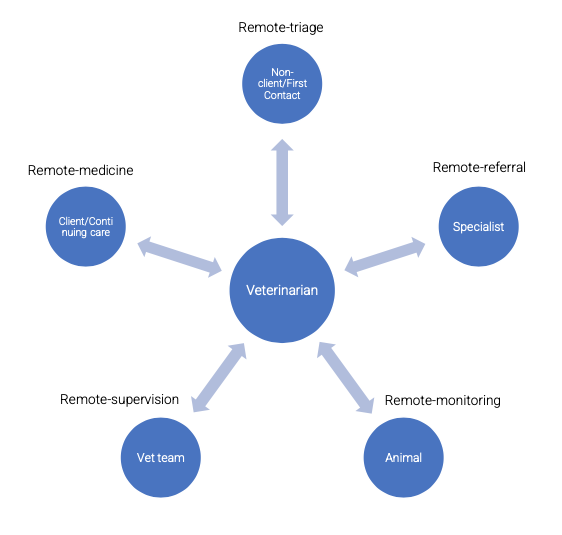
# Background
Remote Veterinary Care (RVC) is an interaction between a veterinarian, client and patient in which the veterinarian is not physically present with the client and patient. It can take place on a variety of platforms, including but not limited to telephone, video call and social media.
RVC can benefit patients, clients, and veterinarians in circumstances where physical access to a veterinary practice is difficult or where telecommunications technology enables a more rapid veterinary assessment. However, RVC services are not appropriate in some circumstances.
Veterinarians are expected to deliver a consistent and acceptable standard of care and veterinary practice irrespective of whether this is delivered by physical or virtual means.
Communication and coaching skills, the ability to combine clinical experience with telehealth, clinical knowledge, ethical awareness, collegiality, and a supportive attitude are all important competencies for the provision of telehealth.
# Remote Triage
Remote triage (RT) is the safe, appropriate, and timely assessment of animal patients via electronic consultation (e.g. phone or video call with their owners). The assessment may be based on the owner’s report of history and clinical signs, sometimes supplemented by visual information (e.g. photographs or video).
While possible causes may be discussed, a diagnosis is not rendered. The essence of RT is to make good and safe decisions regarding a patient’s disposition and to produce a plan (immediate referral to a veterinarian or not), under uncertain conditions and sometimes under urgency.
RT may be conducted by non-veterinarians and is effectively conducted on a daily basis in almost every practice each time a staff member answers the phone and advises a client. It is also often conducted by non-veterinarians to triage afterhours calls for veterinary practices.
Enhancing RT by the use of technologies, including videos, etc, may improve the ability of the veterinary staff to accurately assess an animal and make recommendations in relation to accessing veterinary care.
Any advice provided through RT should be general in nature to avoid the client perceiving they have received a diagnosis specific to the patient’s illness or injury.
It would be prudent for veterinarians conducting RT to distinguish between providing RT and veterinary remote-medicine.
Only registered veterinarians with a current practising certificate can use the title “veterinarian”. This means that, in any situation where either the person providing the RT service or the client is located in New Zealand (or both), the person may only call themselves a veterinarian if they are registered as a veterinarian in New Zealand and hold a current annual practising certificate.
# Veterinary Remote Medicine
Veterinary remote medicine (VRM) is the provision by a VCNZ registered veterinarian with a current annual practising certificate, of specific veterinary advice, formulation of a treatment plan, or veterinary treatment of an animal through remote diagnosis of disease and injury using technology where no physical examination of the animal by the veterinarian takes place.
## VCNZ’s perspective on VRM in New Zealand
VRM is another method or mode of delivering veterinary care, rather than a new model of practice. A veterinarian’s existing legal and professional obligations are not altered when veterinary services are provided via VRM.
VCNZ expects a consistent standard of care and veterinary practice by veterinarians whether the delivery is physical or virtual.
For clarity, a veterinarian conducting a consultation either in person or via VRM to a patient, whether existing or new, must meet the expectations of a veterinary consultation as defined in the [Code of Professional Conduct](docId\:H_LaUUT6kRSCM2qcOOKNT), namely:
1. *Interviewing the client or a legitimate and authorised representative of the client*
2. *Collecting and recording sufficient information relevant to the individual circumstances to ensure the proposed course of action (including treatment) is appropriate and meets the needs and best interests of the animal(s) and the client*
3. *Obtaining appropriate consent to the proposed course of action*
4. *Being given, and accepting responsibility for, the ongoing health and welfare of the animal(s) concerned in relation to the consultation. This includes arranging emergency care after considering the circumstances and the potential for adverse effects from, or failure of, the agreed course of action*
5. *Determining and providing the appropriate level of advice and training so as to be satisfied that the agreed course of action can proceed as planned.*
*A veterinary consultation will usually involve the veterinarian seeing *\[in person]* the animal(s) at the time of the consultation. If not, the animals must have been seen *\[in person] *recently or often enough for the veterinarian to have sufficient personal knowledge of the condition/health status of the animal(s). This consultation is required in order for the veterinarian to be able to propose the particular course of action.*
## Is an examination necessary?
Veterinarians must employ sound professional judgment to determine whether using VRM is appropriate each time they consider practising via VRM, and only provide advice via VRM to the extent that is possible without a physical examination.
A sufficiently well-developed ability to combine clinical experience with telehealth, clinical knowledge and ethical awareness are essential skills for VRM, and recent graduates should consider this carefully before relying solely on a VRM consultation to form a clinical opinion.
In determining whether VRM is appropriate in each case, a veterinarian must consider whether practising via VRM will enable them to satisfy all relevant and applicable legal and professional obligations and meet the expected standard of care in any specific case.
Veterinarians must not substitute VRM technology for a physical examination when a physical examination is necessary and where they could not reasonably make an appropriate diagnosis or create a treatment plan without one. If an examination is necessary, the veterinarian must not attempt to treat[\[1\]](#) the animal by remote-medicine and must arrange to examine the animal or refer the animal to another veterinarian.
## Uses of VRM
Situations where VRM might be used include:
- Primary care, such as first-contact situations, following the principles above, where the veterinarian has determined that a physical examination is not necessary.
- Medical progress follow up. VRM can be very beneficial in continuing care situations, for example as part of a medical progress exam (revisit) process, to assess the animal’s or animals’ ongoing illness and response to treatment, and where it has been determined that a physical examination is not required.
## Medical progress follow-up (revisits)
VRM is well-suited to continuing care situations, including medical progress exams (revisits), and veterinarians are encouraged to consider it as a clinically appropriate default option in this context.
In a revisit, the veterinarian already has personal knowledge of the animal, an established diagnosis, and an agreed treatment plan. The evidentiary basis for remote consultation is therefore substantially stronger than for a first-opinion presentation.
Appropriate uses include monitoring an animal's response to treatment, reviewing ongoing management of a chronic condition, post-operative follow-up where physical examination findings are unlikely to change clinical management, and reassessing whether a current treatment plan remains appropriate. This may include the authorisation of Restricted Veterinary Medicines (RVMs) or Prescription Medicines (PMs) via VRM, provided the veterinarian meets all the usual requirements for authorisation of RVMs and PMs under the Agricultural Compound and Veterinary Medicines Act 1997, its Regulations, and the Code of Professional Conduct. This includes ensuring the VRM is conducted by the authorising veterinarian and the animal has been seen in person recently or often enough to give the veterinarian sufficient personal knowledge of its condition.
The same professional judgement applies in any VRM consultation: the veterinarian must be satisfied that a physical examination is not required and that the standard of care can be met remotely. If the clinical picture has changed significantly, the animal's condition has deteriorated, or if the revisit raises new clinical concerns, the veterinarian should arrange an in-person examination rather than proceeding via VRM.
As with all VRM consultations, undertaking a medical progress follow-up via VRM establishes or continues a client relationship, and the obligation to ensure provision of a continuous emergency service in relation to the care provided. If the veterinarian cannot personally ensure this, specific prior arrangements must be made with colleagues who can.
## Geographical constraints and eligibility to provide VRM
VRM occurs in New Zealand when either:
- The animal that is receiving the veterinary care is located in New Zealand, or
- The veterinarian or veterinary specialist providing the service is located in NZ in relation to an animal anywhere in the world.
In both of the above situations, the veterinarian or veterinary specialist must be registered as a veterinarian in New Zealand and hold a current annual practising certificate.
The credentials of all advice givers, as well as disclaimers on telehealth and remote-medicine resources, should be unambiguous and prominently displayed (e.g. on a website or as part of an acceptance of terms and conditions when a client engages the service).
Veterinarians providing remote-medicine services must ensure that clients are aware of the provider’s identity, location, registration status, and their policies on the collection, storage and use of personal information when accessing veterinary services through remote-medicine.
## Emergency care and adverse events following VRM consultations
The act of undertaking any consultation including a VRM, establishes a client relationship which carries with it the requirement to ensure provision of a continuous emergency service in relation to the service provided.
If the client does not have an existing relationship with another (local) veterinarian, the VRM veterinarian becomes the ‘usual veterinarian’ for this patient. Where circumstances are such that the veterinarian cannot personally ensure provision of a continuous emergency service, specific prior arrangements must be made with colleagues who can do so and provide their colleagues in the area and the mutual client with a specifically arranged emergency service locally.
Offering VRM consultations is seen as distinct from veterinarians offering a specific and limited range of veterinary services – refer to our technical advice [here](https://www.vetcouncil.org.nz/Web/News/Technical_Advice/Emergency_services_and_limited_services.aspx).
A veterinarian conducting VRM consultations, where they are also geographically remote, must therefore have established an arrangement with a local veterinarian to provide any required emergency care service.
# Veterinary Remote Referral
Veterinary remote referral (VRR) between veterinarians is a remote consultation between a primary care veterinarian, one or more colleagues in a different location.
A primary care veterinarian has the professional discretion to consult with veterinary colleagues, specialists or other consultants to gain insights and advice on the care of a patient. These consultations can be conducted using VRR technologies.
VCNZ sees a formal consultation or an informal dialogue between veterinarians in which no reproducible medical records and documented exchange of diagnostic, treatment, or surgical recommendations are provided, as VRR.
Any professional obligations and responsibilities associated with a VRR remain with the primary care veterinarian (**unless the case is formally referred** for secondary or tertiary level care).
It is ultimately the responsibility of the primary care veterinarian undertaking a VRR to judge the credibility and reliability of the referral veterinarian to whom the case is referred. For example, that the individual providing the advice/referral is properly registered and, in the case of specialists, credentialed, and to ensure that their decision making in a case is justifiable and evidence-based.
VRR of the client is a remote consultation between a primary care veterinarian, one or more colleagues in a different location, and the pet owner.
If the case is formally referred for secondary or tertiary level care then the referral veterinarian becomes responsible for the care they provide. An agreed approach to managing the patient post discharge from referral veterinarian back to the primary care veterinarian is recommended.
In situations where integrative care is undertaken, both the primary and referral veterinary care providers will hold professional obligations and responsibilities and it would be prudent for them to communicate carefully on the management of the case.
# Electronic Authorisation (prescribing) via veterinary remote medicine.
Veterinarians considering authorisation of Restricted Veterinary Medicines (RVMs) or Prescription Medicines (PMs) via VRM must meet all the usual requirements for authorisation of RVMs and PMs set by the [Agricultural Compound and Veterinary Medicines Act 1997](https://www.legislation.govt.nz/act/public/1997/0087/latest/DLM414583.html) and Regulations and the [Code of Professional Conduct](docId\:H_LaUUT6kRSCM2qcOOKNT).
That is:
- Only authorise RVMs and PMs following a veterinary consultation, or issuing a VOI,
- Have sufficient information to support the authorisation,
- Establish that the use of the RVM or PM is appropriate and justified under the circumstances,
- Confirm that any person who will administer the RVM or PM understands and is able to competently carry out the authorising veterinarian’s instructions for use,
- Determine and provide the appropriate level of advice and training and be satisfied that the agreed course of action can proceed as planned,
- Provide direction (or make arrangements) to address anticipated adverse events that arise from the use of the RVM or PM,
- Ensure there are arrangements for emergency care (afterhours) for the client.
If the veterinarian has not seen \[in person] the animal (or conducted an on-farm consultation for the herd to which the animal belongs) recently enough, or often enough, to reasonably reach a general or preliminary diagnosis, and after performing VRM concludes that RVMs may be required to treat that animal, the veterinarian must either perform an examination of the animal or refer the client to another veterinarian for this purpose.
# VRM and privacy
The veterinarian must ensure that they safeguard a client’s privacy when practising via remote-medicine. This includes taking precautions and confirming that the technology and physical setting being used by the veterinarian and client have adequate security protocols in place to ensure compliance with the veterinarian’s legal and professional obligations to protect clients’ privacy and confidentiality.
# VRM and record keeping
The veterinarian must ensure that information collected when practising via VRM becomes a part of the medical record. Electronic or video recordings of the VRM session do not have to be retained as part of the clinical record.
# Some examples of the appropriate use of remote medicine
- A family on vacation consults with their usual veterinarian via phone or a messaging app about an issue related to their pet’s diabetes that the veterinarian has been treating. The veterinarian determines that she can consult about the condition without a physical examination, because one was performed recently.
- A family video calls their veterinarian with a follow-up question after a recent onsite appointment.
- A veterinarian with a regular client in a remote region whose animal the veterinarian has seen recently may consult via e-mail and digital photographs.
- A farmer consults a veterinarian via video chat about a potential skin condition in a herd. The veterinarian determines that they can consult about the condition without a visit, because they have been on farm recently.
- A farmer consults a veterinarian via video chat about a ‘down cow’. The veterinarian determines that they can consult via VRM initially, because they have been on the farm recently and are confident they have sufficient knowledge of the health status of the animal, they have provided recent training to the farm staff, and the client has a current RVM authorisation for future supply.
# Some examples where it is not appropriate to use remote medicine
- A veterinarian in Australia decides to offer VRM in New Zealand and is not registered with VCNZ
- A veterinarian on Stewart Island provides VRM to a Sheep and Beef farmer in the North Island and authorises the use of restricted veterinary medicines without having established an arrangement with a local veterinarian to provide afterhours and emergency care.
- A veterinarian in Wellington provides a VRM second opinion (not a referral) for a pet owner living in Nelson and advises them to discontinue the restricted veterinary medicines that have been authorised for the pet, without consultation with the original veterinarian.
# Business systems
The introduction of any new system or process will require some consideration and adjustment to ensure the safety of patients, clients, and staff. Areas to consider would include establishing client identity, client consent, client follow up systems, development for recent graduates on triaging, when and how to escalate cases to a visit, and charging.
# Glossary
### ***Electronic authorisation***
The use of VRM to authorise the use of veterinary medicines.
### ***Primary care veterinarian***
A veterinarian who provides both the initial contact for a client and their animal/s with an undiagnosed health concern and the continuing care of varied medical and/or surgical conditions. This includes medical diagnosis and treatment, welfare assessment and management, and provision of information about illness, its prevention and health maintenance.
### ***Secondary and tertiary level care***
The treatment by veterinary specialists and veterinarians accepting referrals (referral veterinarians) of a patient that has been referred by [primary care](https://medical-dictionary.thefreedictionary.com/primary+care) veterinarian. Once a patient is hospitalised and needs a higher level of specialty care, they may be referred to a tertiary care facility. Tertiary care requires highly specialised equipment and expertise.
### ***Integrative care***
The linking of specialist (e.g., dermatology, gastroenterology, cardiology, orthopaedic surgeon etc) services for a patient with a chronic illness with a primary care clinician (either within the subspecialty practice or elsewhere) who continues to provide primary care.
### ***Examination***
The process of evaluating objective anatomic findings through the use of observation, palpation, percussion and auscultation.
### ***Herd consultation and assessment***
A meaningful and in-person assessment using visual, olfactory, auditory, and, where determined appropriate, tactile evaluation of a herd or a representative subset of a herd that enables the veterinarian to have sufficient personal knowledge of the condition/health status of the animals.
### ***Artificial Intelligence Triage (AIT)***
A remote interaction between a pet owner and an AI based intelligent conversational platform
### ***Artificial Intelligence Referral (AIR)***
A remote interaction between a veterinarian and an artificial intelligence solution providing diagnostic support.
### *Remote-supervision*
The supervision of people using mediums such as audio or audio-video conference, text messaging and email. Clinical supervision is integral to continuing professional development of healthcare professionals. While remote-supervision may be useful in any context, its value is amplified for healthcare professionals working in rural and remote areas where in-person access to supervisors within the local work environment is often diminished.
### ***Telemonitoring, mHealth or mobile health***
The use of mobile devices to monitor a patient. Some applications and wearables are designed to provide information directly to veterinarians while others are designed and marketed directly to consumers for their education and for animal monitoring without clinical input.
***
1. Treat in this context may include authorising veterinary medicines, providing veterinary advice for example behavioural or nutritional advice, or undertaking a veterinary procedure. [↑](#)
***
Download a PDF version of this guidance:
::File{src="https://archbee-doc-uploads.s3.amazonaws.com/5ZTpSgccSDCXbym7d-uMH/aQYrGpKBXRAZSA0I5NT2q_guidance-on-remote-veterinary-care-telehealth-and-telemedicine.pdf" label="Guidance on remote veterinary care (telehealth and telemedicine).pdf"}
:::Changelog{title="Updates"}
::ChangelogItem{type="added" description="Published September 2021"}
:::
[title] Discretionary Use of Human and Veterinary Medicines by Veterinarians
[path] Professional standards and guidance/Statements/
# Introduction
The [Agricultural Compounds and Veterinary Medicines Act](https://www.legislation.govt.nz/act/public/1997/0087/latest/DLM414577.html) (ACVM Act) provides a legislative basis for preventing or managing the risks associated with the use of agricultural compounds (which include veterinary medicines), in the management of animals or plants.
The risks to be managed are:
- risks to trade in primary produce
- risks to public health
- risks to animal welfare
- risks to agricultural security.
It is also a requirement that the use of agricultural compounds does not result in breaches of domestic food residue standards.
The Act also requires that consumers are provided with sufficient information about agricultural compounds.
The Act defines **veterinary medicine** as "any substance, mixture of substances, or biological compound used or intended for use in the direct management of animals".
It is an offence under this legislation to import, manufacture, sell or use a veterinary medicine that is not specifically registered as a trade name product, or exempted as a defined group.
It is also an offence for a veterinarian to knowingly fail to provide a client with information to prevent the occurrence, in any primary produce from any animal treated with an agricultural compound, of residues of that compound which contravene any requirements of the [Animal Products Act 1999](https://legislation.govt.nz/act/public/1999/0093/latest/DLM33502.html), or the [Food Act 2014](https://www.legislation.govt.nz/act/public/2014/0032/latest/DLM2995811.html) or any regulations or notices in force under those Acts or successive legislation.
Veterinary discretionary use includes use of:
- human medicines
- specially compounded medicines
- “off-label” use of registered veterinary medicines.
[Schedule 2 of the Agricultural Compounds and Veterinary Medicines (Exemptions and Prohibited Substances) Regulations 2011](https://www.legislation.govt.nz/regulation/public/2011/0327/latest/link.aspx?id=DLM3982204) identifies the groups of agricultural compounds which are exempt from registration under the ACVM Act. This schedule also sets out the relevant conditions that apply when compounds from these groups are used.
As well as complying with the ACVM Regulations, veterinarians must meet the requirements of the [Code of Professional Conduct](docId\:H_LaUUT6kRSCM2qcOOKNT).
## Human Medicines (including non-prescription medicines)
Preparations scheduled as medicines under the [Medicines Act 1981](https://www.legislation.govt.nz/act/public/1981/0118/latest/DLM53790.html) and used on animals as veterinary medicines are identified as exempt under the 2011 Regulations with the following conditions:
1. Must not be used on animals except under the direct care or with the authorisation of a veterinarian.
2. Must not be advertised for sale for use on animals
3. Certain conditions of the Regulations apply including the need for the product to be fit for purpose. These conditions include in particular (but are not limited to) that when used as recommended the product will not:
- Be toxic to animals treated or exposed to the compound to an extent that causes unnecessary or unreasonable pain or distress, and,
- Fail to reduce or eliminate pain or distress to animals treated with the compound where the elimination of pain or distress is a stated purpose of the product.
## Specially compounded medicines
Preparations scheduled as “Compounded Veterinary Preparations used by Veterinarians” are also identified as exempt under the 2011 Regulations with the following conditions:
1. Must not be used on animals except under the direct care or with the authorisation of a veterinarian.
2. May only be used on animals specified by the compounding veterinarian, or animals of a type specified by the compounding veterinarian.
## Off-label use of registered veterinary medicines
Off-label use of registered veterinary medicines is permitted, provided the products do not have a condition of registration specifically prohibiting such use. Where discretionary use is not approved, that product may be used only as specified in the current approval (which includes label directions and registration conditions).
Most over-the counter (OTC) veterinary medicines will have a generic condition of registration stating :
:::BlockQuote
“*Any person using the product on any animal or in any manner other than as specified in the approved product and manufacturing specifications must, before using the product, seek advice from an appropriately qualified source and confirm that the intended use is not likely to cause unnecessary or unreasonable pain or distress in the animal treated.*”
:::
If in the professional judgement of the veterinarian it is appropriate to do so, veterinary medicines registered as OTC products may be used in a discretionary manner. Where the veterinarian is unsure, they should seek appropriate advice. While the additional consultation, prescribing and record keeping required for discretionary use of human, veterinary and compounded medicines are not required for registered OTC products, it is strongly advised that veterinarians, when recommending off-label use, keep records of the advice provided.
The product stewardship expectations set out in section 2 of the Veterinary Medicines section of the Code apply to the recommendation, sale and use of OTC products and to off-label use.
The rest of this statement applies only to discretionary use of restricted veterinary medicines, human and compounded medicines.
Before discretionary use of restricted veterinary medicines, human medicines or specially compounded medicines, there must be a veterinary consultation in regard to discretionary use as described below, and the requirements as listed must be met. VCNZ’s expectations around veterinary consultation are set out in the COPC glossary.
Veterinarians should note that failure to comply with the COPC in relation to using veterinary medicines may result in a complaint being laid before VCNZ and/or a Ministry for Primary Industries (MPI) investigation under the ACVM Act or the Animal Welfare Act.
Civil liability may also be a consequence as a result of losses incurred by a client through inadequate advice or service. In addition veterinarians are responsible for any consequence(s) of the improper compounding of unregistered veterinary medicines used in a discretionary manner.
# Veterinary consultation and discretionary use
## General requirements of veterinarians
All the following steps must be performed before discretionary use. Veterinarians should document the consultation process (e.g. in clinical records).
1. The veterinarian must meet all of the requirements of consultation (as set out in the Code) including being given and accepting responsibility for the ongoing health and welfare of the animals to be treated. They must have obtained sufficient information about the animal or group of animals, to judge that treatment with a veterinary medicine is justified.
2. The process of reaching a decision about which product to use can be compared to a linear cascade (see [Figure 1](https://app.archbee.com/public/PREVIEW-wrBJXyHoscpUG72h2-7zt/PREVIEW-VfUt5vYjzmgCuPr4Yx5G3#Zg9PM)). If there is a registered veterinary medicine that can be used in compliance with the label and registration conditions (or an exempted veterinary medicine) to achieve the intended clinical effect, it should be considered first.
3. If there is no such suitable product, but there is a registered or exempted veterinary medicine available, which can be expected with discretionary (off-label) use, to meet the treatment and welfare needs of the animal(s) and manage the risks identified in the ACVM Act, it can be considered as an alternative treatment option.
4. If no registered or exempt veterinary medicine is available which, even with discretionary use, meets the treatment and welfare needs of the animal(s) a "human medicine" or preparation specially compounded by or for a veterinarian may be used, provided the risks identified in the ACVM Act can still be managed.
5. In all cases the decision for discretionary use must balance the negative effects of the drug with its benefits to the animal.
6. If there is no alternative treatment available, and the animal’s need justifies it, a veterinarian may apply to the Ministry for Primary Industries ACVM Group to import a veterinary medicine for alleviation of an immediate welfare need of an animal under the care of that veterinarian provided certain conditions are met. Contact the ACVM Group for information.
7. Human or compounded medicinal preparations must not be offered for general sale, and must not be imported without MAF approval. When compounding is carried out by another person, the veterinarian must provide a written prescription or a compounding order. Legal responsibility for compounding (including formulation, manufacturing, quality control, packaging and labelling) rests with the prescribing veterinarian.
### Figure 1: Choosing a Veterinary Medicine

## Specific requirements for discretionary use in food-producing and non food-producing animals
This section lists the requirements of veterinarians on each occasion of discretionary use of veterinary medicines or human medicines or specially compounded preparations.
Requirements for discretionary use in production and companion animals are listed separately. The principal difference is the need to apply withholding periods in animals used for producing food for human use.
### *Discretionary use in food-producing animals*
Veterinarians are required to:
- Ensure there is no specific ban precluding the medicine under consideration from being used on the intended species or in the intended way. Contact MPI if there is doubt.
- Ensure the discretionary use will not jeopardise or hinder any official regulatory control programme or pest management strategy, or any other aspect of agricultural security. Contact MPI if there is doubt. If there is significant risk to agricultural security, do not proceed with the intended discretionary use.
- Assess the scientific data available so as to reasonably predict the efficacy of the intended use, and that unnecessary pain or distress will not result from the discretionary use.
- Assess from the information available, including the pharmacology of the medicine, the probability of residues of the medicine occurring in food, and provide advice for withholding times that are sufficiently long to ensure that no violative residues result. If the medicine is a registered veterinary medicine, the registering company may hold relevant information. If there is insufficient information on which to establish a withholding time, the default withholding time set by MPI should apply:
- Birds meat 63 days, eggs 10 days
- Ruminants (including deer) meat 91 days, milk 35 days
- Camelids meat 63 days
- Lagomorphs (rabbits, hares) meat 63 days
- Monogastrics (pigs, horses) meat 63 days
- Fish, crustacean, molluscs meat 35 days
- (These times do not apply to sustained release formulations because the withholding period must apply to the time after the release period, not after administration.)
- Advise the animal’s owner/agent of the withholding time.
- Ensure that the following information is conveyed to the animal's owner or agent, in writing, and that a record is kept by the prescribing veterinarian:
- Name of owner or owner’s agent;
- The identity of the animal/group to be treated;
- The trade name of the drug, the active ingredient if compounded, and the concentration;
- The dose rate and frequency of treatment;
- The route and method of administration;
- The duration of treatment;
- The withholding time;
- The date of treatment;
- The name of the prescribing veterinarian and the name, address and contact phone numbers of that veterinarian’s practice.
- MPI requires records to be kept for inspection for two years
- Ensure that the following information is conveyed to the animal’s owner or agent:
- Any special considerations in regard to operator safety;
- Specific advice that adverse reactions should be reported immediately to the prescribing veterinarian or in the absence of that veterinarian to other veterinarians in the practice.
## *Discretionary use in companion animals and other animals not kept for food production*
Discretionary use may involve prescribing or dispensing of medicine, or administration to the animal within the veterinary clinic in the course of treatment.
The nature of the information conveyed to the owner differs in the two situations.
### *Requirements of the veterinarian in prescribing or dispensing medicine for discretionary use*
- Ensure there is no specific ban precluding the medicine under consideration from being used on the intended species or in the intended way. Contact MPI if there is doubt.
- Ensure the discretionary use will not jeopardise or hinder any official regulatory control programme or pest management strategy, or any other aspect of agricultural security. Contact MPI if there is doubt.
- Assess the scientific data available so as to reasonably predict the efficacy of the intended use, and that unnecessary pain or distress will not result from the discretionary use.
- As for restricted veterinary medicines, there is a requirement to keep, for at least two years, auditable records for veterinary, human or compounded medicines used in a discretionary manner. Ensure that this information includes
- Name of owner or owner’s agent;
- The identity of the animal(s) to be treated;
- The trade name of the drug, the active ingredient (if compounded for discretionary use) and the concentration;
- The dose rate and frequency of treatment;
- The route and method of administration;
- The duration of treatment;
- The date of treatment;
- The name of the prescribing veterinarian and the name, address and contact phone numbers of that veterinarian’s practice.
- As for any other treatment administered, dispensed or prescribed, advise the animal’s owner or agent of any special considerations in regard to operator safety.
- As for any other treatment administered, dispensed or prescribed, advise the owner or agent to report any adverse reaction immediately to the veterinary practice.
### *Requirements of the veterinarian for discretionary use of medicines in clinic*
- Ensure there is no specific ban precluding the medicine under consideration from being used on the intended species or in the intended way. Contact MPI if there is doubt.
- Ensure the discretionary use will not jeopardise or hinder any official regulatory control programme or pest management strategy, or any other aspect of agricultural security.
- Contact MPI if there is doubt.
- Assess the scientific data available so as to reasonably predict the efficacy of the intended use, and that unnecessary pain or distress will not result from the discretionary use.
- Record the following information for inspection for at least two years:
- Name of owner or owner's agent;
- The identity of the animal(s) to be treated;
- The trade name of the drug, the active ingredient if compounded, and the concentration;
- The dose rate and frequency of treatment;
- The route and method of administration;
- The duration of treatment;
- The date of treatment;
- The name of the prescribing veterinarian.
- Inform the animal’s owner or agent that adverse reactions should be reported immediately to the veterinary practice.
# Definitions
### Agricultural security
The ACVM Act [defines](https://www.legislation.govt.nz/act/public/1997/0087/latest/DLM414583.html) agricultural security as:
:::BlockQuote
the exclusion, eradication, and effective management of—
a)pests
b)unwanted organisms under the [Biosecurity Act 1993](https://www.legislation.govt.nz/act/public/1997/0087/latest/link.aspx?id=DLM314622)
:::
**Pests**, is also defined in [section 2](https://www.legislation.govt.nz/act/public/1997/0087/latest/DLM414583.html) and includes:
:::BlockQuote
(a)any unwanted living organism including micro-organisms, pest agents, and any genetic structure that is capable of replicating itself (whether that structure comprises all or only part of an entity, and whether it comprises all or only part of the total genetic structure of an entity) that may affect plants, animals, or raw primary produce; and
...
:::
### Authorisation
The process of a veterinarian creating a documented approval allowing a client to purchase a particular restricted veterinary medicine to administer to a particular animal(s) in accordance with the instructions of the veterinarian
### Companion animal
Companion animals are considered to be cats, dogs and any other animals kept as pets, excluding ungulates. Where such animals are kept in a farming situation, for production of food they are not considered to be companion animals
### Compounding Order
A compounding order is an instruction by a veterinarian to a third party to compound a product to be dispensed by the veterinarian
### Discretionary use
The use by or on the authority of a veterinarian of:
- a registered veterinary medicine in a manner not specified in the conditions on registration for the product, or
- a human medicine scheduled under the Medicines Act 1981 and exempted from registration under the ACVM Act, or
- a preparation specifically compounded, by or on the authority of that veterinarian, for use on animals in that veterinarian's immediate care
### In writing
Providing information “in writing” may involve including details on a label, invoice, receipt or by some other written means
### Prescription
A prescription is an instruction issued to a third party to dispense, and, in the context of discretionary use, may include instructions regarding a product to be compounded.
### Unreasonable or unnecessary pain or distress
This is a professional but subjective assessment by the veterinarian of what is unreasonable or unnecessary pain or distress taking into account the veterinarian’s knowledge of animal welfare and New Zealand society's current attitudes
### Withholding time
The time that must elapse between the last treatment and sale for slaughter for human consumption or harvest of product to be sold for human consumption or use.
***
Download a PDF version of this Statement:
::File{src="https://archbee-doc-uploads.s3.amazonaws.com/5ZTpSgccSDCXbym7d-uMH/ovhlsVGgkaJOgBVXb1NED_discretionary-use-statement.pdf" label="Discretionary use statement.pdf"}
:::Changelog{title="Updates"}
::ChangelogItem{type="added" description="Published September 2012"}
::ChangelogItem{type="improved" description="Minor updates and corrections (links and organisation names) January 2023"}
:::
[title] Authorisation of adult cat and dog vaccinations for administration by veterinary nurses during the current veterinary workforce shortage
[path] Professional standards and guidance/Statements/
# Introduction
This document sets standards for the authorisation of cat and dog vaccines (which are restricted veterinary medicines) for an existing client during the veterinary workforce shortage. These are requirements that we expect all veterinarians to follow.
Some parts of this document temporarily remove the restrictions as set out in the Code, to help manage the current impacts on veterinary resources and to maximise delivery of veterinary services to meet animal welfare needs.
This use of Restricted Veterinary Medicines (RVMs) by a veterinary nurse in the absence of a veterinary consultation is not a default setting and may only be authorised by veterinarians during this exceptional period. The normal standards will apply again when the veterinary workforce shortage has abated.
# The use and administration of vaccines for vaccinations for adult cats and dogs by veterinary nurses
The expectations for authorising and good stewardship of RVMs and Prescriptions Medicines (PMs) are set out in the [Code of Professional Conduct](docId\:H_LaUUT6kRSCM2qcOOKNT) and the [ACVM Notice: Requirements of Authorising Veterinarians](https://www.mpi.govt.nz/dmsdocument/20054-requirements-for-authorising-veterinarians).
Under normal circumstances, veterinary authorisation of RVMs and PMs involves the veterinarian examining the patient (or having recently seen the patient themselves or by [another veterinarian from the same practice](https://www.vetcouncil.org.nz/Web/News/Technical_advice/Technical_Advice__Authorising_between_clinics.aspx)) as part of a Veterinary Consultation and practices such as veterinary nurses administering RVMs and PMs are conducted as an extension of this in person consultation.
In these unique circumstances and the ongoing need when a veterinarian or their business is unable to provide veterinary services to their clients, VCNZ will **temporarily** allow veterinarians to authorise vaccines for adult cats and dogs for veterinary nurses, considered by the authorising veterinarian to be competent, to use and administer vaccinations **in the absence of a concurrent physical examination by the veterinarian and beyond the RVM’s maximum period of supply**.
# Competency and RVM risk assessment
During this period, vaccines for adult cat and dog vaccinations can be authorised by a veterinarian for use by a veterinary nurse providing the veterinarian meets the requirements set out in this document. This allowance will enable veterinarians to continue to prioritise animal welfare, while minimising the risks to themselves, their colleagues and the wider public.
Veterinarians must take care not to substitute examination by a veterinary nurse when an in person physical **examination by a veterinarian** is necessary. For example, it may be appropriate for animals with comorbidities or on long term medication to receive a veterinary examination rather than a veterinary nurse examination e.g. cases such as a diabetic cat, a dog with congestive heart failure, or a patient on long term NSAID therapy for arthritis.
Before authorising a cat or dog vaccine for use by a veterinary nurse in these circumstances, the veterinarian(s) must be satisfied, and it should be included in the clinical record, that it is appropriate to do so. To make that decision, veterinarians must use their professional judgment and consider RVM risk factors and staff competency in each circumstance.
# Competency and RVM risk considerations
- Have you seen the animal recently enough to have sufficient personal knowledge, in the circumstances, of the condition/health status of the animal including for example factors such as age, breed and physical maturity, and any existing conditions (or has it been, for example, over a year since their last examination)?
- Given the understanding of the condition/health status of the animal – do you consider it is possible to gather enough information via a veterinary nurse examination to make a safe decision to administer the vaccine (or is it possible that a physical exam performed by a veterinarian of this animal could make a material or significant difference to your assessment)?
- Is the veterinary nurse able to competently (safely and effectively) gather the animal’s history, perform an examination, interpret the information gathered and determine it is appropriate to proceed, and administer the correct vaccine including for example triennial vaccination regimes (or are there risks involved that may impact the safety of the person or animal or reduce the efficacy of the product including the absence of appropriate competence)?
- Is the administration of the vaccination necessary in the interests of animal welfare (or can the treatment be performed by another veterinarian or reasonably delayed until a physical examination can be performed by a veterinarian)?
- Is the age of the animal such that there are manageable risks (or is the animal less than two years or more than 10 years old, for example)?
- Is the breed of the animal such that there are manageable risks (or is the breed predisposed to particular issues that impact the risks)?
- What are the natures of, and risks associated with, the vaccine? This includes thinking about the potential for adverse events.
Veterinarians should refer to our [Technical Advice: Authorising restricted veterinary medicines for dispensing and use by non-veterinarian staff](https://www.vetcouncil.org.nz/Web/News/Technical_Advice/Technical_advice_Authorising_Medicines_staff.aspx), which outlines the veterinarians’ responsibilities.
# Decision to authorise
If a veterinarian has considered the risks and decides NOT to authorise the vaccine the veterinarian can decline to authorise a veterinary nurse to vaccinate the animal. They may then organise for a veterinarian to examine and vaccinate the animal or to refer the client to another veterinarian for this purpose
If a veterinarian has considered the risks and decides to authorise the vaccine, they MUST ensure they are satisfied that their decision is justified and appropriate to achieve the intended effect and ensures the welfare of the animal.
# Decision considerations
- The animal’s owner is an existing client AND the animal has been seen recently (within the last year) by the veterinarian.
- Any consent given by the client is fully informed and with an understanding of the risks involved including those associated with the absence of a physical exam by a veterinarian.
- The correct RVM product is being administered and there is an appropriate adverse event reporting system.
- Any veterinary nurse who will administer the vaccine is appropriately trained and is able to competently carry out the authorising veterinarian’s instructions for use
- There is a detailed clinical record, including the:
- reasons for using a veterinary nurse to administer the vaccine and evidence in the record which may be for example a reference to a clinic policy, systems, and training records that the veterinarian has considered the risks
- details of the RVM products authorised including batch number, expiry date, site of administration etc, and appropriate advice given to meet the requirements above.
- The veterinarian can justify their decision, in the context of the current veterinary shortage (e.g. by reference to this Statement in their policy document).
# RVM information and adverse events
All other aspects of the requirements upon authorising veterinarians, which includes providing owners with all of the information they need and ensuring that they have access to veterinary care in the event of an emergency or adverse event, still apply.
# Timeframe and review
This provision will continue to apply during the veterinary shortage. It will be reviewed regularly to assess its fitness for purpose.
***
Download a PDF version of this Statement:
::File{src="https://archbee-doc-uploads.s3.amazonaws.com/5ZTpSgccSDCXbym7d-uMH/gAtqECHOF20vS_p-2lSSc_authorisation-of-adult-cat-and-dog-vaccinations-for-administration-by-veterinary-nurses.pdf" label="Authorisation of adult cat and dog vaccinations for administration by veterinary nurses.pdf"}
:::Changelog{title="Updates"}
::ChangelogItem{type="added" description="Published December 2022"}
:::
[title] Cattle Disbudding and Dehorning by Non-Veterinarians
[path] Professional standards and guidance/Statements/
# Objective
To provide clarity on the expectations and obligations on veterinarians when non-veterinarians request local anaesthetic to perform disbudding and dehorning procedures.
# Principles
Disbudding and dehorning cattle are necessary farm practices. They are painful procedures and are regulated under the [Animal Welfare (Care and Procedures) Regulations 2018](http://www.legislation.govt.nz/regulation/public/2018/0050/latest/whole.html#LMS22929).
VCNZ encourages all those responsible for animals during disbudding and dehorning to adopt the highest standards of husbandry, care, welfare and handling.
Veterinarians have a special duty to protect animal welfare and alleviate animal suffering. They must know and comply with the requirements of the [Animal Welfare Act 1999](http://www.legislation.govt.nz/act/public/1999/0142/latest/whole.html?search=sw_096be8ed817c720c_Therapeutic_25_se\&p=1#DLM49664), Animal Welfare (Care and Procedures) Regulations 2018 (the Regulations) and the relevant [Codes of Welfare](https://www.mpi.govt.nz/protection-and-response/animal-welfare/codes-of-welfare).
Because of their training and experience veterinarians and large animal technicians and technologists (LAVTs) are the best qualified people to carry out disbudding and dehorning in keeping with the requirements of the Animal Welfare Regulations. However, where circumstances are appropriate, and the volume of animals is sufficient to justify the training requirements and support competence, non-veterinarians may be trained to administer the local anaesthetic and carry out the procedure safely and effectively.
The [Regulations ](http://www.legislation.govt.nz/regulation/public/2018/0050/latest/whole.html#LMS22929)allow for the disbudding and de-horning of cattle by non-veterinarians under specific conditions. The person conducting the procedure must be:
- suitably experienced or trained in the correct use of the method being used
- able to recognise early signs of significant distress, injury, or ill-health
- satisfied the animal will be under the influence of an appropriately placed and effective local anaesthetic that is authorised by a veterinarian for the purpose of the procedure, and
- satisfied that the health and welfare needs of the animal are met during the procedure and recovery.
Veterinarians are responsible for the authorisation and stewardship of the restricted veterinary medicines (RVMs) needed for pain relief and analgesia for these procedures.
Local anaesthetic is an RVM that can be authorised by a veterinarian for use by non-veterinarians to allow them to undertake disbudding and dehorning.
# Systems & Procedures
The NZVA Policy ‘Dehorning of Cattle and Disbudding of Calves’ (members only) and its appended documents provide a detailed and best-practice approach to training and assessment of training of non-veterinarians in these procedures.
# The Veterinarian’s responsibilities
Veterinarians should expect to be approached from clients and non-clients to access local anaesthetic to disbud or dehorn their cattle.
Veterinarians are not obliged to authorise RVMs or provide a Veterinary Operating Instruction (VOI) for disbudding or dehorning and must not if, in their professional opinion, they decide that the people are not competent to carry out any of the following:
- the administration of the anaesthesia
- the management and handing of the RVM products
- the management of the health and welfare needs of the animal, or
- the disbudding or dehorning procedure and recovery.
Similarly, veterinarians must decline the request for RVMs for disbudding or dehorning if, in their professional opinion, they decide the animal’s welfare needs will not be met during the procedure and recovery.
Veterinarians must ensure all non-veterinarians administering the local anaesthetic, and additional analgesic(s) where it is deemed necessary by the veterinarian, have the appropriate skills and knowledge for it to be effective.
Veterinarians must be satisfied that all non-veterinarians performing the disbudding or dehorning have the appropriate skills and knowledge to safely and correctly carry out the procedure using the chosen method.
Training and competence assessments of non-veterinarians should be documented.
Veterinarians must be satisfied that the non-veterinarians administering the local anaesthetic can recognise adverse events and know how to manage them effectively.
Veterinarians must comply with the requirements for authorisation of an RVM.
Veterinarians authorising RVMs for disbudding and dehorning must be competent and have sufficient experience in the related field of veterinary practice.
In addition, for dehorning procedures veterinarians should consider the following:
- The potential for horn development to begin from 4-6 weeks of age at which stage using a disbudding procedure may be inappropriate. This also highlights the importance of appropriate training and education of non-veterinarians.
- There is likely to be a higher welfare risk associated with the procedure.
- There is likely to be a need for increased analgesia which may necessitate analgesics or sedatives under veterinary supervision in addition to local anaesthesia.
- There is a need for appropriate restraint from animal welfare and health and safety perspectives.
- There is an increased requirement for post-operative assessment and care.
- That different training requirements and a reduced frequency of exposure to the procedure may make non-veterinarians’ competence more difficult to maintain.
- The requirements under [Section 58 of the Animal Welfare (Care and Procedures) Regulations 2018](http://www.legislation.govt.nz/regulation/public/2018/0050/latest/LMS22931.html?search=sw_096be8ed817efd82_dehorning_200_se\&p=1\&sr=2): Dehorning Cattle Beasts.
# Employer responsibilities
Employers of veterinarians and allied veterinary professionals should ensure that:
- Veterinarians and LAVTs are appropriately trained on the topic of disbudding and dehorning.
- The appropriate tools and resources are made available for easy compliance with the expectations with the Regulations, the Code and this statement.
- Authorisations and VOIs for disbudding and dehorning comply with the relevant ACVM requirements and the Code of Professional Conduct.
# Links
- [Animal Welfare Act 1999](http://www.legislation.govt.nz/act/public/1999/0142/latest/DLM49664.html?search=sw_096be8ed817c720c_Therapeutic_25_se\&p=1)
- [Animal Welfare (Care and Procedures) Regulations 2018](http://www.legislation.govt.nz/regulation/public/2018/0050/latest/whole.html#LMS22929)
- [Code of Welfare: Painful Husbandry Procedures](https://www.mpi.govt.nz/animals/animal-welfare/codes/all-animal-welfare-codes/)
- [Code of Professional Conduct](docId\:H_LaUUT6kRSCM2qcOOKNT)
- [Agricultural Compounds and Veterinary Medicines Act 1997](http://www.legislation.govt.nz/act/public/1997/0087/latest/DLM414577.html)
- [ACVM Notice: Requirements for Authorising Veterinarians 2015](https://www.mpi.govt.nz/dmsdocument/20054-requirements-for-authorising-veterinarians)[](https://www.nzva.org.nz/page/policydehorning)
- [Guidance Document: Veterinary Operating Instructions](https://www.mpi.govt.nz/dmsdocument/20057-veterinary-operating-instructions-requirements-for-authorising-veterinarians-notice)
# Definitions:
### Pain relief
Any analgesic or local anaesthetic drugs (or both) administered with the aim of providing significant alleviation of pain (Animal Welfare Care and Procedures Regulations 2018)
### Dehorning
The removal of the horn or part of the horn (including any regrowth after disbudding) from a cattle beast by amputation, but does not include:
- Removal of the hard insensitive tip of the horn resulting in a blunt hard end, or
- Removal of an ingrown horn within 3cm of the point where the horn touches or breaks the surface of the skin or touches the eyelid or surface of the eye.
### Disbudding
The removal of the horn bud in young calves when it is still free-floating in the skin layer above the skull. Attachment of the horn bud occurs from around 6 weeks of age.
### Should
Additional advice and recommendations to encourage veterinarians to maintain, or aspire to, high standards of professional conduct are identified by the word ‘should’.
### Must
Denotes minimum standards that veterinarians are expected to meet.
### Analgesia
The administration of RVMs with analgesic properties such as Nonsteroidal Anti-inflammatories, Alpha-2 agonists and Opioids.
***
Download a PDF version of this Statement:
::File{src="https://archbee-doc-uploads.s3.amazonaws.com/5ZTpSgccSDCXbym7d-uMH/_76BL1Ue1iRrN99dj8iPb_statement-on-cattle-disbudding-and-dehorning-by-non-veterinarians-oct-2019.pdf" label="Statement on Cattle Disbudding and Dehorning by Non-Veterinarians Oct 2019.pdf"}
:::Changelog{title="Updates"}
::ChangelogItem{type="added" description="Published October 2019"}
::ChangelogItem{type="improved" description="Links updated and definition of "Must" clarified January 2023"}
:::
[title] Recent changes to penicillin withholding periods
[path] Professional standards and guidance/Guidance/
*We are grateful to the ACVM Group for preparing this guidance*
### Background
[New Zealand Food Safety](https://www.foodsafety.govt.nz/index.htm%20) (NZFS) registers trade name products under the [Agricultural Compounds and Veterinary Medicines (ACVM) Act 1997](https://www.legislation.govt.nz/act/public/1997/0087/latest/DLM414577.html) after conducting a risk assessment on that product to confirm the benefits of its registration and use and all associated risks can be appropriately managed.
Once a product is registered, NZFS can decide to reassess a registered product if significant new information comes to light that draws that original risk assessment or the applied risk management controls into question. Reassessment can also be triggered if there has been a significant change in the use of any or all registered trade name products that can alter the risk assessment associated with the approved use.
In 2020, NZFS began a programme of reassessing all antibiotic-based agricultural compounds. The first step in this work was to classify all antibiotic compounds as ‘Important’, ‘Highly Important’, and ‘Critically Important’ with respect to each compound’s risk of developing antimicrobial resistance (AMR) and its clinical need as a veterinary or horticultural treatment. The classification would also trigger the application of a mandatory classification label for each product, as well as a standardised statement advising veterinarians and end users of the expectations of prudent use and AMR risks.
More information on the classification process and the outcomes of classification of the first tranche of antibiotic compounds to be reviewed can be found on the MPI website in the paper [AMR Reassessment Review: Macrolides, Later-Generation Cephalosporins and Penicillins](https://www.mpi.govt.nz/dmsdocument/38966-AMR-Reassessment-Review-Macrolides-Later-Generation-Cephalosporins-and-Penicillins).
Once the classification of an agricultural compound is complete, individual trade name products are reassessed to review all existing claims, dose rates, and use patterns to ensure that the efficacy and safety of the approved uses were still supported. If the existing label information is found not to conform to the expectations of prudent antibiotic use, such as having a dose rate that is too low to be efficacious against modern disease profiles or having claims against organisms known to now be resistant to the active ingredient, the product label information and approval is updated to address these risks.
For products used in food producing animals or crops, this work includes a review and adjustments to the maximum residue levels (MRLs) and withholding periods where needed to manage food safety and trade risks.
### Penicillin Reassessments
Penicillins were included in the first tranche of antibiotic reassessment work, with amoxicillin, ampicillin, cloxacillin, penethamate hydriodide, penicillin G benzathine, and penicillin G procaine all being classed as Highly Important Antibiotics. This triggered the reassessment of all 69 individual trade name veterinary medicine products, as well as the MRLs associated with each compound.
For some products, the post-reassessment changes involve minor adjustments to label information and the addition of the mandatory classification and prudent use statements.
For others, however, target species, diseases, dose rates, dosing intervals or withholding periods required an update to bring this information in line with current practice and AMR risk management. What, and how much, change is required depends on each product’s individual risk profile, the age of the product, and the time since its last review and update.
**The most common change actioned for the penicillin products was an increase in dose rate. Available data and recent literature evaluating the efficacy and AMR risk place most best-practice use of penicillins at a dose rate between 15 mg\_kg and 30 mg\_kg or higher, with narrower dose rates and ranges dependent on the specifics of product formulation, penicillin identity, and target species.** For some older products, approved dose rates were as low as 6 mg/kg, requiring many products to increase in the minimum dose rate or range previously approved for their products. **These changes to the approved dose rates, and in some cases a reconsideration of historic data and information, has led to meat and milk withholding period changes for some products.**
### Old Label vs New Label
Once the reassessment of a particular product has been finalised, the new dose rates, withholding period, and other label information is included on a new approved product label that is published to the [ACVM Register](https://eatsafe.nzfsa.govt.nz/web/public/acvm-register) . But because these products are actively used in veterinary clinics and on farm throughout the reassessment process, there will be products in circulation and on farm that are still labelled with the ‘old’ label.
When a product is reassessed, one of the aims of the reassessment is to determine whether the label changes need to be actioned immediately or can be phased in over time. If there is a critical risk to be managed that requires immediate label changes, NZFS will require product registrants to recall existing stock in the market and relabel stock under their control, as well as notify veterinarians, owners, and farmers of the change to make sure the risk is managed. A critical risk can be related to inefficacy, animal safety, food safety, trade, or other risks that require immediate attention and action.
For all other situations, NZFS will usually allow registrants to keep existing products in the market with the ‘old’ label while advising vets, owners, and farmers of the change to come and directing them to the ACVM Register to review the ‘new’ label. This transition period is allowed to ease potential problems with product availability and the costs associated with recalling and relabelling with the understanding that any new product to be manufactured, imported, or sold will be sent to market with the new label in place.
### Old vs New Dose Rate, Withholding Periods, and MRLs
This leads to an important question: are veterinarians expected to authorise penicillins based on the use pattern (dose rates and withholding periods) on the ‘old’ label in the clinic, or the use pattern on the ‘new’ label on the ACVM Register?
First, a word on withholding periods. The legal requirement when using any veterinary medicine in a food-producing animal is to ensure the resulting residues will conform to the MRL, not conformance to the withholding period itself. The withholding period on the product label is evidence-based advice that has been confirmed to ensure MRL conformance when the veterinarian authorises used according to the approved dose rate and treatment duration.
Where they have been changed, the increased penicillin dose rates have been driven by the most up to date information available that demonstrates the lower historic on-label dose rates can no longer be relied on to effectively treat some infections. While using the ‘old’ dose rate means that applying the ‘old’ withholding periods can be expected to ensure MRL compliance, it also means there is a potential that treatment may not effectively treat the infection. The vet must therefore decide based on the individual animal’s diagnosis, potential AMR risk, and other clinical factors whether to use the ‘new’ dose rates based on current evidence or continue with the ‘old’ dose rate.
Where veterinarians have in the past used these products off label at a higher dose rate than the ‘old’ label indicated it is expected they will have automatically applied a longer withhold period in order to ensure MRL compliance.
The following advice therefore applies:
1. If a veterinarian authorises use according to the ‘old’ use pattern where the dose rate and/or treatment duration has now changed, the ‘old’ withholding period can apply though the veterinarian must be aware of and manage the potential risk of inefficacy at that dose. (e.g. In a situation where a farm has an existing RVM Authorisation this can be updated at the next planned Farm / RVM Consultation).
2. If a veterinarian authorises use according to the ‘new’ use pattern, the ‘new’ withholding period should apply as it has been assessed to ensure MRL conformance when the updated use pattern is used.
1. If a veterinarian is authorising according to the updated use pattern for a product that still bears the ‘old’ label, the veterinarian’s authorisation is the source of the instructions (dose rate, duration, and withholding period) to be followed, this could effectively be considered during this transition phase as still being ‘on label’.
2. Where a vet has already issued their authorisation and wishes to update it to the ‘new’ use pattern and withholding periods, they can revoke the existing authorisation and replace it with a new one even if the packaging still bears the ‘old’ label.
3. If a veterinarian authorises use according to a use pattern that does not match the ‘old’ or ‘new’ label, they will be authorising off-label use of that product and should be assigning a withholding period they have assessed will be sufficient to ensure MRL compliance.
4. Once new product is available with the ‘new’ labelling, it is expected that veterinarians will ensure any new authorisations have use patterns and withholding patterns that comply with the new label requirements to better manage efficacy and AMR risk.
***
:::Changelog{title="Updates"}
::ChangelogItem{type="added" description="Published March 2023"}
:::
[title] Introduction
[path] Professional standards and guidance/Code of Professional Conduct/
This Code sets out the professional standards the public, the profession and the Vet Council expect veterinarians to meet and to be measured against.
The work of veterinarians can take many forms. Their roles and responsibilities, whether in clinical or non-clinical practice, extend beyond individual patients and clients to include food safety, public health and biosecurity, among other things. The principles of this Code are intended to be broad enough to set the expectations of veterinarians in any area of veterinary practice.
[The Veterinarians Act 2005](https://www.legislation.govt.nz/act/public/2005/0126/latest/DLM363859.html) restricts the right to practise as a veterinarian in New Zealand to those who are appropriately qualified, are registered with the Vet Council and hold a current practising certificate. The rights conferred by veterinary registration go hand in hand with legal and professional responsibilities and are placed at risk if these obligations are ignored or flouted.
Veterinarians must comply with all of the requirements in this Code irrespective of whether they are charging fees for the services provided. If veterinary services are provided for free (pro bono), this does not remove the veterinarian's obligations to meet the expectations set out in this Code.
Structure of the Code
The Code has been structured around seven fundamental principles that form the basis of the professional behaviour expected of veterinarians. The principles cover seven broad themes:
1. [1. Animal welfare](docId\:gr85iChRVF-W2r-SSpYY7)
2. [2. Client relationships](docId\:P6WiA0faFESys5dTJw_9P)
3. [3. Professional relationships](docId\:g7UmY1lHaKnZ5U4kNO-yw)
4. [4. Professional integrity](docId:99ucuL1h6H7IZzoVq1EGl)
5. [5. Veterinary services](docId\:QyTt_vObkFxDyhtxLEmCb)
6. [6. Veterinary medicines](docId\:uUCHsu_9cXggI8oOuNAG_)
7. [7. Legislative requirements](docId\:fU_fjVdYWz2B4PHu8YACI)
Supporting each principle is a series of statements which set out the specific expectations and a [Glossary](docId\:Gs8lan75noOL7EJ4nNi5V) with definitions of some of the terms used in the Code.
More detail on the expectations, and how veterinarians can comply with them, is provided in comprehensive explanatory notes. These notes, and other identified resources also provide specific examples of the Code's application.
Legal status of this Code
The principles and responsibilities specified in this Code have been prescribed, [by notice](https://vetcouncil.org.nz/Web/Web/2.Resources/Legislation.aspx) in the New Zealand Gazette, as minimum standards for practising as a veterinarian under Section 88 of the Veterinarians Act 2005.
All veterinarians must comply with the Code.
# How this Code will be used
For those entering the profession, the Code identifies the fundamental principles of professional veterinary practice and serves as an educational tool.
For those within the profession the Code provides the basis for monitoring their own practice. The related online explanatory notes serve as an educational tool to guide veterinarians on meeting their professional obligations.
For those outside the profession the Code provides guidance for understanding the standards expected of veterinarians.
The Code will be used by the Vet Council and its Committees as a standard by which to measure veterinarians’ professional conduct in the event of complaints and concerns being raised.
The minimum standards are identified in the Code and related explanatory notes by the use of the word ‘**must**’. The explanatory notes include additional advice and recommendations to encourage veterinarians to maintain, or aspire to, high standards of professional conduct. In this case the word ‘**should**’ is generally used.
The overarching expectation of the Code is that veterinarians will exercise sound professional judgment. The Code is not exhaustive. It is accepted that there is not necessarily one right decision in every set of circumstances and that the Code cannot define how every situation must be managed. The Vet Council expects veterinarians to evaluate situations (whether in relation to a clinical matter or not), apply the principles of this Code and make competent and reasonable decisions about the most appropriate course of action taking into account the individual circumstances and the best potential outcomes.
Veterinarians are professionally accountable for their practice, which means being personally responsible for what they do or do not do. Veterinarians are encouraged to take advice from senior colleagues and managers, but when faced with conflicting responsibilities they must exercise their own professional judgment in deciding on the appropriate course of action and use this Code as a basis for making that decision.
Revision of the Code
This Code is based on the Vet Council's interpretation of the professional conduct standards that the public and the profession expect all veterinarians to meet. It may need to be reviewed in the light of any changes to these expectations or any significant issues arising from its implementation. It is reviewed by the Vet Council regularly.
[title] Mentoring Guidelines
[path] Professional standards and guidance/Guidance/
# Introduction
Mentoring relationships occur frequently in the veterinary profession. Such relationships, usually informal, and between senior and junior colleagues, are invaluable in providing advice, support and encouragement to less experienced veterinarians, or those experiencing difficulties.
These guidelines deal with those more formal situations where the Veterinary Council or one of its Committees has recommended or requires a veterinarian to establish a mentoring relationship.
# What is mentoring?
Council initiated mentoring is a supportive and collegial relationship between two veterinarians. Mentoring provides a structured forum for regular, dedicated time for in-depth reflection on professional practice and issues which may impact on practice. It is an exchange between colleagues with the main goal being to develop and/or maintain professional skills and competence.
Mentoring is not supervision. Supervision is a different process which under the Veterinarians Act is defined as “the monitoring of, and reporting on, the performance of a veterinarian by another veterinarian”.
Mentoring relationships may be established by Council or its Committees in the following situations:
- Health impairment – where a health condition has been or has the potential to affect a veterinarian’s fitness to practise. In such circumstances it is common for undertakings to be made with the veterinarian that protect the public and at the same time enhance the veterinarian’s rehabilitation. Mentoring relationships can assist in the recovery/rehabilitation process and provide support in times of stress
- Where the Complaints Assessment Committee has identified performance or conduct concerns and enters into an undertaking with the veterinarian to address these concerns
- Competence – where a competence assessment has found that a veterinarian’s performance does not meet the required standard and remediation is required a mentor can be appointed to assist the veterinarian over a specified period to overcome identified deficiencies of knowledge and assure the public interest is protected. A mentor can also be appointed prior to a competence assessment taking place, or in place of competence assessment, to assure the public interest is protected and help the veterinarian address the identified deficiencies.
- Discipline – where the Council’s Judicial Committee requires remediation of a veterinarian who has appeared before the Committee on professional misconduct charges and the knowledge or behavioural deficiencies displayed would be amenable to peer support and guidance
# The mentor
According to the Concise Oxford Dictionary a mentor is an “experienced and trusted advisor”. That is exactly the role that Council appointed mentors should play.
The mentor is usually a local veterinarian who is respected by his or her peers and who can provide objective, non-judgmental and confidential advice, support, and encouragement to the veterinarian concerned.
A mentor is a good listener and a teacher/ advisor who leads through guidance and example and who can keep their relationship with their mentee on a friendly, but professional, basis.
Successful mentoring relationships involve very open, honest and equal communication and regular interaction between the mentor and the mentee over time.
# How is the mentor appointed?
In circumstances where the Veterinary Council requires or recommends a veterinarian to establish a mentoring relationship, the mentor is identified by:
- the Veterinary Council in consultation with, and the agreement of, the mentee; or
- the prospective mentee who seeks the Council’s approval of the proposed mentor
# What is the mentor’s role?
The Council provides the mentor with background information about the mentee.
Every mentorship is an individual one, so the following list is not prescriptive. Rather it provides in a general way, a few areas in which guidance and support might be usefully incorporated into a mentoring relationship:
- discussion of the effects on the veterinarian’s individual situation, both personal and professional
- how the veterinarian deals with work related issues/problems - issues with colleagues, staff or clients, or the handling of individual cases
- development of skills in reflective practice
- re-evaluation of professional and personal boundaries
- personal and health issues - advice, insight into problems
- involvement with the profession including continuing professional development activities
- long and short term career directions
- encouragement to comply with any conditions required by/recommendations of, the Council
- reporting requirements to Council
Mentors are provided with additional generic information on the mentoring process.
Refer to University of Otago Mentoring Handbook, 2008
# Does the mentor report to the Council?
This depends on the reason why the mentoring is required. To build trust and rapport the interactions between the mentor and mentee should normally be regarded as confidential.
However:
- all mentors must report immediately to Council in circumstances where they have reason to believe that their mentee’s health status, conduct or performance may be adversely impacting on the public interest
- the Council may require the mentor to report on progress after a specified time has transpired or at regular intervals. The particular requirements will be set out in the individual agreements made with the veterinarian concerned.
The reporting requirements, if not already determined, need to be discussed and clarified at the first mentoring meeting.
Where the mentor is required to report to the Council, the person being mentored should be provided with a copy of this report.
# Overall goals
By end of the mentoring period, the veterinarian (mentee) should:
- have successfully resolved the immediate issues that required intervention from the Veterinary Council
- have reviewed their practice so that there are reduced risks of similar situations arising in the future
- have well-developed habits of reflective practice
- be making good use of collegial supports
- have sufficient professional awareness to be able to identify areas of risk as they arise in future practice.
# Payment for mentors
Although mentors often do not expect or seek payment, they are encouraged to do so.
The mentee is expected to meet the cost of the mentoring, but payment can be delayed in circumstances of financial difficulty.
It should be noted that the collegial support provided within the mentoring relationship enables some veterinarians to continue working who would be otherwise unable to practise.
# Frequency of meetings
A meeting should be arranged as soon as possible after the mentorship is established. At that initial meeting it is useful to discuss reasons why a mentoring relationship has been deemed appropriate.
The frequency of meetings and length of the mentoring relationship will depend on individual circumstances and/or Council requirements.
Mentors are asked to make firm arrangements for the next meeting with the mentee prior to concluding the present one.
# Advice
Further information and advice is available from the Council.
***
Download a PDF version of these guidelines:
::File{src="https://archbee-doc-uploads.s3.amazonaws.com/5ZTpSgccSDCXbym7d-uMH/jvlro1BfQXRQoIS_C3vH3_vcnz-mentoring-guidelines.pdf" label="VCNZ Mentoring Guidelines.pdf"}
:::Changelog{title="Updates"}
::ChangelogItem{type="added" description="Published August 2014"}
:::
[title] Technical advice
[path] Professional standards and guidance/
[title] Veterinary supervision
[path] Professional standards and guidance/Guidance/
Veterinarians must use their judgement when determining the level of oversight or supervision that is required of the person that has been instructed to administer a veterinary medicine and carry out the agreed course of action (e.g. a procedure or treatment).
In considering whether to direct staff or students or veterinarians receiving training (the person) to carry out a treatment, the veterinarian must consider the risks associated with the Restricted Veterinary Medicine (RVM), how difficult the treatment or procedure is in the light of any associated risks.
Note that [Section 15 of the Animal Welfare Act 1999](https://www.legislation.govt.nz/act/public/1999/0142/latest/DLM50406.html#DLM50406) requires that veterinary students performing surgical procedures **must** do so *under the direct supervision of a veterinarian*.
The person must have been trained or is suitably qualified to treat the animal/s concerned, understands the associated risks and has the necessary experience and good judgement to react appropriately if any problem should arise.
The veterinarian must also be sure that they will be available in a reasonable timeframe to answer any call for assistance and should be satisfied that the person feels capable of carrying out the treatment competently and successfully.
Lastly the supervising veterinarian must turn their mind to the aspect of consent – what would the owner reasonably expect of the veterinarian when giving their consent. This should be included in the consent form and the wording may include, for example:
- For a veterinary team undertaking training: *‘Our trained and qualified veterinary staff, which includes Vet Techs and Vet Nurses being supervised by a veterinarian, will be performing the procedure on your animal today’* or something similar.
- For a student undertaking experience: ‘*A suitably trained veterinary (nurse/tech) student being supervised by a veterinarian, will be performing the procedure on your animal today’* or something similar.
When ensuring the client is informed and their consent obtained, the veterinarian should use their judgement and acknowledge differing levels of risk associated with different procedures and varying competence of persons in training. For example it would be prudent that a veterinarian disclose and ensure that a client is aware of all the facts should a veterinary student be performing a desexing procedure under supervision.
Discussions for obtaining consent with clients should include who will be performing the procedure, their training and experience and what support will be provided to the person in order to address potential risks.
In summary the veterinarian must consider whether:
- The competence of the individual that will be administering the RVM AND performing the activity or procedure is appropriate i.e. whether the person has been suitably trained and is experienced and capable of performing the activity correctly
- In relation to the person’s competence, the level of supervision is appropriate
- The authorisation of the RVM is appropriate in the circumstances and the stewardship requirements will be met
- The health and safety risks associated with the RVM can be sufficiently mitigated
- Any animal welfare issues that may arise can be appropriately managed
- Adverse events and emergencies can be managed appropriately
- The authorised RVM will be used and stored safely, and their use appropriately reconciled.
Noting that as the level of risk associated with the RVM increases so does the expectation of veterinary oversight and caution.
If the veterinarian is uncomfortable with the level of risk associated with the authorisation of an RVM it is acceptable to decline to authorise it.
## Definitions
VCNZ has interpreted the levels of supervision that a veterinarian could reasonably apply as follows. The examples provided are intended to explain what is allowed and to promote concepts within the profession.
### Veterinary direction
**'Veterinary direction**' means the veterinarian instructs the person as to the tasks to be performed and is confident the person is suitably trained and experienced and capable of performing the activity correctly and the veterinarian is not necessarily present.
**Examples**
A veterinarian may authorise RVMs to be administered for a:
- junior veterinary nurse to premedicate an animal in hospital while they perform a house call in anticipation of performing an anaesthesia on their return.
- suitably qualified and experienced veterinary nurse to sedate and prepare an animal for a radiography series on a patient while they are returning to from a house call.
- suitably trained and experienced veterinary nurse to conduct adult cat and dog vaccinations while they are out of the clinic (refer to the Guidance on [Authorisation of adult cat and dog vaccinations for administration by veterinary nurses during the current veterinary workforce shortage](docId\:c9tiz4ppxnMmQl26DK87u)).
- technician to perform teat sealing on a client’s heifers – the veterinarian does not need to be on farm.
- trained and experienced technician to sedate using xylazine and local and perform disbudding on a client’s calves – the veterinarian does not need to be on farm.
- trained and experienced technician to visit and perform an equine artificial insemination procedure. The veterinarian does not need to be on farm.
### Veterinary supervision
**'Veterinary supervision**' means the veterinarian provides oversight to and ensures the activity is done correctly and that they are on the premises and readily available to provide advice and support to the person and ready to respond to a request for assistance if needed.
**Examples**
A veterinarian may authorise RVMs to be administered for a:
- suitably qualified and experienced veterinary nurse to anaesthetise (including for example performing the premedication, induction, intubation and anaesthetic maintenance) and perform prophylactic dental procedures (as far as current legislation allows) on a patient while they are also in the building performing consultations.
- relatively inexperienced but trained technician to sedate calves with xylazine and instil local anaesthetic in order to disbud them while they meet with the farmer separately but remains on the premises (e.g. at the yards).
- relatively inexperienced yet trained technician to perform metrichecking procedures while they administer treatments separately but remains on the premises (e.g. at the yards).
- veterinarian being supervised while retraining to return to practice from parental leave performs a number of desexing surgeries while they are also in the building taking client calls.
### Direct and constant veterinary supervision
**'Direct and constant veterinary supervision**' means the veterinarian is physically present and giving the person their undivided personal attention and oversight to ensure the activity is performed correctly and the veterinarian is prepared to rapidly assist as needed.
**Examples**
A veterinarian may authorise RVMs to be administered for a:
- veterinary student to anaesthetise and perform a desexing surgery on a patient while they are present in surgery to observe the procedure (per [Section 15](https://www.legislation.govt.nz/act/public/1999/0142/latest/DLM50406.html#DLM50406) of the Animal Welfare Act 1999). Veterinarians should use their judgment as to whether they need to be scrubbed and prepared to intervene or not depending on the level of risk associated with the procedure and the experience and confidence of the person being supervised.
- relatively inexperienced veterinary technician (as part of a training program) to perform a local anaesthetic administration for disbudding, while they (the authorising veterinarian) are present.
- relatively inexperienced veterinary technician (as part of a training program) to pass a nasogastric tube in a horse with colic, while they (the authorising veterinarian) are present.
- veterinarian being supervised while retraining in production animals having only done companion animals previously performs their first caesarean section surgery on a cattle beast, while they (the authorising veterinarian) are present during the procedure. Veterinarians should use their judgment as to whether they need to be scrubbed and prepared to intervene or not depending on the level of risk associated with the procedure and the experience and confidence of the person being supervised.
***
:::Changelog{title="Updates"}
::ChangelogItem{type="added" description="Published May 2023"}
:::
[title] Responsible Use of Dry Cow Antibiotic Treatments in New Zealand
[path] Professional standards and guidance/Guidance/
The way veterinarians authorise dry cow antibiotics is changing. As a New Zealand dairy farmer, you already know how important dry-off management is for setting up production for next season. This new approach will continue to support your focus on low somatic cell counts (SCC), mastitis prevention, and milk yield and quality, while protecting the effectiveness of antibiotics for the future.
**When does this start? **Your vet will start working with you at your next dry-off consultation.
The Veterinary Council of New Zealand (Vet Council)\[i] and Dairy Cattle Veterinarians (DCV)\[ii] have updated the approach to dry cow antibiotic authorisation, after working with veterinarians and consulting with dairy industry stakeholders. This supports the New Zealand Antimicrobial Resistance Action Plan and encourages a stronger focus on prevention and long-term udder health.
# Why this matters
## Protecting antibiotics that work
Using antibiotics in healthy cows unnecessarily increases the risk of bacteria becoming resistant to them, making mastitis harder and more expensive to treat. Treating only the cows that need antibiotics helps protect their effectiveness for the future.
## Protecting our markets and reputation
New Zealand’s open, transparent food systems underpin global confidence in our dairy exports. Responsible antibiotic use, supported by selective dry cow therapy and udder health planning, helps preserve that trust and maintain our premium market positioning.
## Protecting community and environmental health
Antibiotics are essential medicines — for your cows, your children and grandchildren, and your community. When antibiotics are used unnecessarily in healthy cows, bacteria may develop resistance, putting animal, human, and environmental health at risk.
## Why veterinarians believe this is important
Veterinarians want the same outcome as farmers: healthy cows with fewer underlying diseases, fewer mastitis cases, and lower reliance on antibiotics.
There is compelling evidence (research and on-farm) that selective DCAT works and maintains SCC outcomes.
A stronger focus on prevention, good record keeping, and individualised udder health plans means fewer cows need antibiotics at dry‑off. This protects antibiotic effectiveness for the future, improves long‑term herd health, and supports better outcomes for cows, farmers, and the dairy industry.
# What is selective dry cow treatment?
Selective dry cow treatment means treating only the cows that need antibiotics at dry-off (those that show evidence of infection), rather than routinely treating the whole herd. Decisions are based on each cow’s actual infection status, using herd test data and mastitis records. The great news is that most farms are already on this journey.
Cows that are healthy at dry-off do not benefit from dry cow antibiotics. For these cows, an internal teat sealant (ITS) provides effective protection against new infection during the dry period, without using antibiotics.
Your vet will use your herd test records and mastitis history to identify which cows are likely to be infected and genuinely need treatment. This evidence-based approach means antibiotics are used where they work, and resources are not spent treating cows that don’t need them.
# What this means for your farm
To prepare for the 2027 dry-off season:
**Step 1 — Keep good records**
Continue regular herd testing through the season. Record all clinical mastitis cases and note which cows received treatment during lactation.
**Step 2 — Target an optimal Bulk Milk Somatic Cell Count (BMSCC) - work with your vet to develop an Udder Health Plan**
Your vet will work with you to develop an individualised udder health plan for your farm to keep your BMSCC in an optimal range, including:
• A review of your herd test results
• Identifying which cows need dry cow antibiotics and which will benefit from teat sealant only
• Developing a mastitis management plan for your farm.
**Step 3 — Follow the plan and monitor results**
Apply treatments as recommended, implement the management improvements in your udder health plan, and monitor for any mastitis cases over the dry period.
# Learn more and get support
Your veterinarian is your first point of contact. Talk to them before your next dry-off to develop an udder health plan tailored to your herd.
Additional resources:
• Vet Council website: vetcouncil.org.nz
• DairyNZ Technote 14 — Drying Off: [dairynz.co.nz/animal/cow-health/mastitis/](https://www.dairynz.co.nz/media/rtpkgfos/mastitis-technote-14.pdf)
****
**Questions?** Contact your veterinarian or visit the Vet Council website for more information.
\[i]**The Veterinary Council of New Zealand (Vet Council)**
The Veterinary Council of New Zealand is the independent regulatory body for veterinarians. It sets professional standards and requirements to ensure veterinarians practise safely, responsibly, and in the best interests of animal health, farmers, and the wider community. These standards apply when veterinarians authorise and prescribe antibiotics for dairy cattle.
\[ii]**Dairy Cattle Veterinarians (DCV)**
Dairy Cattle Veterinarians is New Zealand’s largest professional group representing veterinarians who work with dairy farmers. DCV supports best‑practice herd health, mastitis prevention, and responsible antibiotic use, and works closely with the Vet Council and industry partners to help veterinarians and farmers achieve healthy cows and sustainable dairy systems.
[title] 1. Animal welfare
[path] Professional standards and guidance/Code of Professional Conduct/
# Guiding principle
**Veterinarians have a duty to promote positive animal welfare and alleviate animal suffering**
:::ExpandableHeading
## Understanding the guiding principle
Veterinarians are expected to use their training and knowledge for the benefit of society. Animal welfare is more than protecting animals from cruelty. It also relates to promoting their health and wellbeing. Because of their training veterinarians have expert knowledge on how to assess animal health and welfare, and how to optimise the care and management of animals. It follows that veterinarians have an over-riding professional duty to protect animals from unreasonable or unnecessary pain or distress.
:::
# Section 1.1
Veterinarians must be familiar with and comply with the Animal Welfare Act 1999 and the relevant Codes of Welfare. In the course of their work, veterinarians must consider and take all reasonable steps to protect the needs of animals in relation to the five basic requirements of:
1. proper and sufficient food and water
2. adequate shelter
3. the opportunity to display normal patterns of behaviour
4. appropriate physical handling
5. protection from, and rapid diagnosis of, injury and disease.
This obligation is qualified however, as the needs in each individual case are assessed according to what is appropriate to the species, environment and circumstances of the affected animal(s).
:::ExpandableHeading
## Understanding section 1.1
The Animal Welfare Act 1999 establishes the legal framework of obligations and responsibilities applying to people who are in charge of animals. These requirements equally apply to veterinarians when they assume responsibility for the care of animals whether in a professional or personal capacity.
The Animal Welfare Act 1999 also places specific responsibilities on veterinarians. Veterinarians are expected to have a working knowledge and understanding of how to apply those expectations in the course of their work. Relevant provisions of the Animal Welfare Act 1999 include:
1. the destruction of sick and injured animals
2. responsibilities associated with restricted, controlled and significant surgical procedures
3. roles of veterinarians on Animal Ethics Committees.
Codes of Welfare developed by the National Animal Welfare Advisory Council (NAWAC) specify minimum standards and recommendations for best practice. Veterinarians are expected to be familiar with and comply with the published standards relevant to their area of practice.
The five animal welfare freedoms were developed in 1965 by the Farm Animal Welfare Council in the United Kingdom and are now recognised internationally as identifying the critical needs of all animals (and what might be interpreted as the legal minimum requirements). They provide a framework for assessing the welfare of animals in varying situations.
Section 4 of the Animal Welfare Act 1999 identifies those critical requirements as the basis for defining the physical health and behavioural needs of animals. The Animal Welfare Act 1999 then uses that definition in section 10 to establish the obligation of owners and persons in charge of animals to meet those needs in accordance with good practice and scientific knowledge.
When reviewing the physical, health and behavioural needs of an animal, each of the five basic requirements should be considered taking into account what is appropriate for the species, environment and circumstances of the particular animal. It may not be appropriate to consider that the same solutions and standards necessarily apply to all species in all situations.
:::
# Section 1.2
In the course of their work veterinarians must not ignore circumstances where they have reasonable grounds to suspect
non-compliance with the requirements of the Animal Welfare Act 1999 and Codes of Welfare. Veterinarians must be satisfied that their co-workers and their clients are informed of and comply with the relevant provisions of the Animal Welfare Act 1999 and Codes of Welfare that relate to work they are undertaking.
:::ExpandableHeading
## Understanding section 1.2
Arguably, because of their training and knowledge, and the expectations placed on them by society as the ‘animal health professionals’, veterinarians are assumed to have expert knowledge of the principles of animal welfare. As such veterinarians are expected to be advocates for animal welfare.
It follows that veterinarians have a responsibility to educate themselves, their co-workers (staff and veterinary colleagues) and their clients about the relevant welfare standards that apply in their field of veterinary practice. They must be satisfied that co-workers and clients are informed of the existence of the relevant provisions of the Animal Welfare Act 1999 and Codes of Welfare as they pertain to their own particular circumstances, and that they are aware of the applicable standards.
As well as informing their co-workers and clients of these provisions, veterinarians have a responsibility to ensure compliance with animal welfare standards. While it is not the role of veterinarians to actively audit clients in relation to animal welfare, they must not ignore situations where they have reasonable cause to suspect that animal welfare standards have been breached.
The Animal Welfare Act 1999 casts a broad net of potential liability in relation to offences. Veterinarians should be aware that a variety of situations may arise where liability may extend to them even though they are not the owner of the animal(s). Some examples are set out below.
1. Sections 164, 165 of the Animal Welfare Act 1999 set out vicarious liability provisions that relate to principals of organisations, employers and others who do not act to prevent breaches of the Animal Welfare Act 1999 by their staff and in relation to animals under their care.
2. Section 29(h) identifies potential liability offences for those who are associated with aiding and abetting of offences under the Animal Welfare Act 1999. Knowing of and not taking all reasonable steps to remedy potential breaches of the Animal Welfare Act 1999 might be interpreted as aiding and abetting.
3. Various sections of the Animal Welfare Act 1999 set clear legal obligations and responsibilities on the ‘person in charge’ of animal(s). The ‘person in charge’ is defined very broadly and encompasses every person who is seen to have the animal under their care, control or supervision. This definition extends to include the animal’s veterinarian in situations where the animal is being treated or managed under the specific instructions of the veterinarian.
:::
# Section 1.3
Veterinarians must act immediately to remedy situations where they have cause to suspect unreasonable or unnecessary pain or distress in an animal(s), or possible breaches of animal welfare legislation.
:::::ExpandableHeading
## Understanding section 1.3
As well as any legal responsibility, veterinarians also have a professional obligation to take immediate action to remedy situations where they have reasonable cause to suspect violations of the Animal Welfare Act 1999. They are expected to exercise sound professional judgement when deciding how to act in these circumstances. In order to determine the best course of action, veterinarians need to gather as much relevant information regarding the circumstances, as they require to exercise their discretion and should carefully document their involvement showing clearly that they have taken all necessary steps to manage their legal and professional responsibilities.
The Flow Diagram of Actions following observation of Animal Welfare Case provides a suggested protocol to consider when presented with a welfare case.
Situations which must be reported to an inspector appointed under the Animal Welfare Act 1999 (SPCA inspector, MPI animal welfare inspector, Police, or the Animal Welfare Hotline 0800 008 333) include:
1. Where animal welfare is reasonably considered to be at risk (ie a suspected offence under the Animal Welfare Act 1999) and a veterinarian suspects that the owner or person in charge of the animal is not acting reasonably to relieve the situation
2. Situations of severe neglect or cruelty to animals, whether the owner person in charge is a client or not.
[Privacy Principle 11(1)(e)(i)](https://www.legislation.govt.nz/act/public/2020/0031/latest/LMS23342.html) of the [Privacy Act 2020](https://www.legislation.govt.nz/act/public/2020/0031/latest/LMS23223.html#LMS23376) allows the disclosure of personal information where it is reasonably believed such disclosure is necessary to avoid prejudice to the maintenance of the law by any public sector agency, including the prevention, detection, investigation, prosecution, and punishment of offences. The decision to disclose client information and details when reporting suspected breaches of the [Animal Welfare Act 1999](https://www.legislation.govt.nz/act/public/1999/0142/latest/DLM49664.html) to the appropriate authorities can therefore be made when there are valid and justifiable reasons for doing so. If veterinarians are unsure whether to report, they are encouraged to discuss this with the Vet Council, NZVA, MPI Animal Welfare or their lawyer.
When reporting a client to the authorities the veterinarian needs to act in good faith, having regard to all relevant information and preferably base their decision on personal knowledge and not unverified information. If unsure about their responsibility to report, veterinarians are encouraged to ring the Vet Council, NZVA, MPI Animal Welfare or their own lawyer for advice.
Only the specific information necessary for the maintenance of the law should be disclosed, and only to inspectors appointed by the Minister under the [Animal Welfare Act 1999](https://www.legislation.govt.nz/act/public/1999/0142/latest/DLM49664.html). This includes but is not limited to police officers and inspectors employed by MPI and the SPCA.
In situations where veterinarians have reasonable cause to suspect violations of the [Animal Welfare Act 1999](https://www.legislation.govt.nz/act/public/1999/0142/latest/DLM49664.html) other than severe neglect or cruelty; and where the owner or person in charge of the animal(s) is a client and can be communicated with, the veterinarian should, discuss the situation with that person and develop an action plan to relieve the situation.
::::hint{type="info"}
:::ExpandableHeading
Where, for whatever reason the veterinarian decides they cannot discuss their concerns with the client the matter must be reported to an inspector appointed under the Animal Welfare Act 1999 (SPCA inspector, MPI animal welfare inspector, Police or the MPI Animal Welfare Hotline 0800 008 333).
:::
::::
Where an action plan has been developed to remedy a situation, the plan should identify criteria to measure improvement, with benchmarks which must be achieved within agreed timeframes. A system of monitoring agreed outcomes must be put in place. Depending on the circumstances an appropriate plan of action might include: improved nutrition in poor condition animals, specific treatment or possibly euthanasia.
Where improvements are seen the monitoring should be ongoing until the veterinarian is convinced a satisfactory outcome has been reached. If follow-up monitoring shows no improvement, or the plan hasn't been followed, or the situation is worse, the matter must be reported to an inspector appointed under the Animal Welfare Act 1999 (SPCA inspector, MPI animal welfare inspector, Police or the MPI Animal Welfare Hotline 0800 008 333).
Veterinarians should communicate their concerns to their manager or a senior veterinarian in the practice at the start of the process and at each step throughout.
Detailed records of each step of the process should be maintained by the veterinarian. A documented plan is crucial in the event that the care of the animal or the role of the veterinarian is called into question in the future. Photographs are a useful additional tool to record progress.
Where a new client presents an animal which has clearly been suffering unreasonable or unnecessary pain or distress for some time, the veterinarian must ascertain from the client whether or not the animal has previously been attended by a veterinarian, and if possible confer with that veterinarian. The owner's compliance with any previous veterinary treatment and recommendations should be taken into account in determining whether an action plan and monitoring, as discussed above, are applicable. The requirements described in section 5 of the [3. Professional relationships](docId\:g7UmY1lHaKnZ5U4kNO-yw) section of this Code in relation to supersession are relevant in this context.
At times veterinarians may have reasonable cause to suspect breaches of the [Animal Welfare Act 1999](https://www.legislation.govt.nz/act/public/1999/0142/latest/DLM49664.html) outside the course of their work, eg when they are on holiday. In these situations, veterinarians are expected to use their judgement to determine whether they intervene directly or report the matter. Circumstances may make it unreasonable or inappropriate for the veterinarian to communicate directly with the person in charge of the animal(s). In such situations the matter must be reported by the veterinarian to an inspector appointed under the [Animal Welfare Act 1999](https://www.legislation.govt.nz/act/public/1999/0142/latest/DLM49664.html) (SPCA inspector, MPI animal welfare inspector, Police or the MPI Animal Welfare Hotline 0800 008 333).
Veterinarians in the course of their work must act lawfully at all times including the times when dealing with situations where they have reasonable cause to suspect animal welfare violations. Veterinarians must exercise sound professional judgement when making decisions relating to animals in these circumstances maintaining appropriate respect for an owner's property rights in relation to their animals. Veterinarians should avoid actions which could, for example, be interpreted as theft or even trespass. For example in situations of:
1. a person bringing another person's dog to the clinic for treatment or euthanasia without the consent of the owner
2. entering a property without the owner's permission even though the veterinarian suspects breaches of animal welfare standards.
If veterinarians are unsure how to respond in particular circumstances they are encouraged to discuss this with the Vet Council, NZVA, MPI Animal Welfare or their lawyer.
The Vet Council accepts research linking the association between deliberate physical maltreatment of animals and violence against humans. Veterinarians, when confronted with situations of animal abuse, should consider whether people within that home might be at risk. As well as responding appropriately to the ill treatment of the animal (paragraphs a-o above), veterinarians should use their judgement to determine whether the appropriate government authorities (Police, Child, Youth and Family) should be informed. If veterinarians are unsure whether to report, they are encouraged to discuss this with the Vet Council, NZVA, MPI Animal Welfare or their lawyer.
### Flow diagram for animal welfare issues

:::::
# Section 1.4
When euthanasia is necessary it must be carried out humanely. In situations where an animal's owner is not known or cannot be contacted, veterinarians must exercise their duty under [section 138 of the Animal Welfare Act 1999](https://www.legislation.govt.nz/act/public/1999/0142/latest/DLM51273.html) to euthanise severely sick or injured animals responsibly.
:::ExpandableHeading
## Understanding section 1.4
Veterinarians have a professional and legal duty to take steps to relieve unreasonable or unnecessary pain or distress in animals under their care. This includes the need to administer first aid and adequate pain relief (and even euthanasia) whether or not payment can be made at the time of the treatment. They are expected to exercise sound professional judgement when making decisions on treatment, recognising the need in some cases to balance what treatment might be necessary or appropriate against commercial considerations and the wishes of the owner. The over-riding priority is to ensure that animal welfare is not compromised. There is further discussion on this topic as it relates to providing emergency services to clients who have economic restraints in the [5. Veterinary services](docId\:QyTt_vObkFxDyhtxLEmCb) chapter, explanatory notes to section 7.
Veterinarians are encouraged to develop and foster relationships with local SPCA branches. Such relationships can include standard protocols for how the practice and the SPCA might share responsibility for the emergency care of animals where the owner cannot be identified.
[Section 138 of the Animal Welfare Act 1999](https://www.legislation.govt.nz/act/public/1999/0142/latest/DLM51273.html) identifies the powers of veterinarians relating to the destruction of severely injured or sick animals (excluding marine mammals).
This section deals both with situations when an owner of the animal is known and also when the owner cannot be found within a reasonable time.
Veterinarians are advised to read [section 138 of the Animal Welfare Act 1999](https://www.legislation.govt.nz/act/public/1999/0142/latest/DLM51273.html) very carefully and must be familiar with these legal requirements, their authority under this section and also the limitations on their authority.
Veterinarians must act with extreme caution, exercising sound professional judgement when using these powers in order to avoid possible legal liability associated with an inappropriate decision to destroy the animal.
[Section 138](https://www.legislation.govt.nz/act/public/1999/0142/latest/DLM51273.html) requires that, where a veterinarian (or Inspector or auxiliary officer appointed under the Animal Welfare Act 1999) finds a severely sick or injured animal and ‘reasonable treatment will not be sufficient to make the animal respond and the animal will suffer unreasonable or unnecessary pain or distress’, he or she must destroy the animal if the owner cannot be found within a reasonable time. Alternatively, if the owner is available but does not agree with the decision to euthanise the animal this section provides for a second opinion to be sought.
The critical factor is that the veterinarian must ‘find’ the animal. Interpretation of ‘find’ is broad and includes the situation where a veterinarian is presented with such an animal by an owner or by a member of the public. The significance of the word ‘find’ is that the veterinarian does need to physically come across the animal, as distinct from simply gaining knowledge of the animal. This suggests that the veterinarian is required to carry out a physical examination of the animal before reaching a conclusion. It follows that where a veterinarian learns of a severely sick or injured animal but has not seen it, the destruction of the animal cannot be authorised by the veterinarian. The veterinarian has a professional duty to examine the animal and take all reasonable steps to locate the owner before considering the option of euthanasia.
While the legislation does not constrain the veterinarian to act only under the authority of an appointed inspector in making the decision to euthanise the animal, it is strongly recommended that they do so wherever possible. While the veterinarian is most likely to understand the medical basis for the decision to euthanise, the appointed inspector may be able to advise on the soundness of the decision taking into account the legal complexities. In an emergency, if a warranted inspector is not readily available, veterinarians are advised to consult with a member of the police, as police officers are deemed to be inspectors under the Animal Welfare Act 1999.
Where veterinarians act independently in reliance on s138, they must be very sure that they follow all the obligatory procedural steps to minimise the risk of associated legal liability and should document the same.
If veterinarians are unsure about making a decision to euthanise an animal under section 138 they are encouraged to discuss this with the Vet Council, NZVA, MPI Animal Welfare or their lawyer before they act.
[Section 140 of the Animal Welfare Act 1999](https://www.legislation.govt.nz/act/public/1999/0142/latest/DLM51275.html) identifies the obligations applying to veterinarians when presented with a severely sick or injured marine mammal.
The [American Veterinary Medical Association Guidelines on Euthanasia](https://www.avma.org/resources-tools/avma-policies/avma-guidelines-euthanasia-animals) define euthanasia as the act of inducing humane death in an animal. In order to be humane, euthanasia techniques should result in rapid loss of consciousness followed by cardiac or respiratory arrest and the ultimate loss of brain function. In addition, techniques should minimise distress and anxiety experienced by the animal prior to loss of consciousness.
Selection of the most appropriate method of euthanasia in any given situation depends on the species of animal involved, available means of animal restraint, skill of personnel, number of animals, and other considerations. Veterinarians are expected to exercise sound professional judgment and use their knowledge of clinically acceptable and science-based techniques in selecting an appropriate euthanasia technique taking into account the above factors.
The [AMVA guidelines](https://www.avma.org/resources-tools/avma-policies/avma-guidelines-euthanasia-animals) provide useful advice on euthanasia.
:::
# Section 1.5
Veterinarians must ensure that in the course of their work, only persons appropriately approved under sections 15–20 of the [Animal Welfare Act 1999](https://www.legislation.govt.nz/act/public/1999/0142/latest/DLM49664.html#DLM51275) perform significant, restricted or controlled surgical procedures. Veterinarians must be satisfied that any person under their authority who performs any type of surgical procedure on an animal is appropriately trained and supervised, and that the animal does not suffer unreasonable or unnecessary pain or distress.
:::ExpandableHeading
## Understanding section 1.5

| Type of surgical procedure | Description of surgical procedure |
| ----------------------------------------------------------------------------------------------------------------------------------------------------------------------------------------------------------- | -------------------------------------------------------------------------------------------------------------------------------------------------------------------------------- |
| Prohibited surgical procedures ([section 21(2)](http://www.legislation.govt.nz/act/public/1999/0142/latest/DLM50413.html)) | It is an offence for any person to perform these procedures e.g. cropping the ears of a dog. |
| Significant surgical procedures ([sections 6](http://www.legislation.govt.nz/act/public/1999/0142/latest/DLM50292.html) and [15](http://www.legislation.govt.nz/act/public/1999/0142/latest/DLM50406.html)) | These procedures may generally be performed only by a vet. In cases of uncertainty the Minister can recommend an order in council to clarify whether a procedure is significant. |
| Restricted surgical procedures ([section 17](http://www.legislation.govt.nz/act/public/1999/0142/latest/DLM50408.html)) | These procedures may only be carried out by a vet, who must satisfy himself or herself that the procedure is in the interests of the animal e.g. debarking a dog. |
| Controlled surgical procedures ([section 18](http://www.legislation.govt.nz/act/public/1999/0142/latest/DLM50409.html)) | These procedures may be carried out by a vet or person with veterinary approval only e.g. develvetting |
| Non significant surgical procedures | These procedures (not specifically mentioned in the Act) can be carried out by any person e.g. the clipping of a dog’s nails. |
Under Section 6 of the Animal Welfare Act 1999 significant surgical procedures include but are not limited to restricted surgical procedures, controlled surgical procedures and any other surgical procedure declared by Order in Council to be significant for the purposes of the Act.
Debarking of dogs, declawing of cats and the docking of the tail of a horse are all classified as restricted surgical procedures. Only veterinarians or veterinary undergraduate students working under the direct and constant supervision of a veterinarian are allowed to perform restricted surgical procedures.
Before a restricted surgical procedure may be performed veterinarians must satisfy themselves that it is in the interests of the animal. The ‘interests of the animal’ is paramount, not the interests of the animal's owner. For example, the docking of the tail of a horse where there is infection or a cancerous growth can reasonably be thought to be in the interests of the animal. Whereas the docking of the tail of a Shire horse for horse show purposes or for cosmetic reasons is clearly not in the interests of the animal.
Develvetting of deer is a controlled surgical procedure. Only veterinarians, undergraduate veterinary students acting under the supervision of a veterinarian, the owner of an animal who is acting under veterinary approval, and the employee of the owner of an animal acting under veterinary approval may perform controlled surgical procedures. Veterinary approval in the context of the performance of controlled surgical procedures is defined in the Animal Welfare Act 1999 and veterinarians are referred to the Act for the detailed requirements.
When approving laypersons to carry out velvet removal and authorising the purchase and use of restricted veterinary medicines veterinarians are strongly advised to comply with the MPI ACVM Guidance Document: Veterinary Operating Instructions Appendix: Xylazine, Yohimbine and Lignocaine for Velvet Antler Removal. Veterinarians who comply with this standard can be assured that they will meet their legal and professional responsibilities under the Animal Welfare Act 1999, the Agricultural Compounds and Veterinary Medicines Act 1997 and the Vet Council Code of Professional Conduct.
Under the Animal Welfare Act 1999 significant surgical procedures (that are not listed as controlled surgical procedures) must only be carried out by a veterinarian or an undergraduate veterinary student under the direct and constant supervision of a veterinarian.
Any person may perform a surgical procedure on an animal that is not a significant surgical procedure but must do so in a manner that does not result in unreasonable or unnecessary pain or distress.
Where a matter is brought to the attention of the Ve Council about a person not authorised under the Animal Welfare Act 1999 performing a surgical procedure which might reasonably be considered to be significant the matter in the first instance will be referred to MPI for investigation of a possible breach of the provisions of the Animal Welfare Act 1999. In circumstances where the surgical procedure has been performed under the authority of a veterinarian the Vet Council will consider a number of factors. These could include whether the veterinarian has acted appropriately taking into account the outcome of the MPI investigation and the circumstances under which the procedure was performed including: the degree of supervision of the person, the level of training of the person and whether the animal has suffered unnecessary or unreasonable pain or distress.
Where a matter is brought to the attention of the Vet Council about a non-veterinarian, acting under the authority of a veterinarian, performing a surgical procedure not reasonably considered to be significant, the matter will be considered in the context of whether the veterinarian has acted appropriately in delegating the procedure. Consideration would likely include the circumstances under which the procedure was performed including: the degree of supervision of the person, the training of the person and whether the animal has suffered unreasonable or unnecessary pain or distress.
In considering whether a procedure can be delegated to a non-veterinarian the following criteria should be applied.
1. There must be no increased risk of pain or distress to the animal or breach of animal welfare legislation or codes
2. Standards and public confidence in safeguards relating to animal health and welfare, public health, and fitness for purpose of animal products must not be jeopardised
3. Legal requirements and professional obligations involved in certification must not be breached
4. Agricultural compounds and veterinary medicines legislation or codes of practice must not be breached
5. The training required to satisfy the above must be specified, courses of instruction should be available and should have been satisfactorily completed by persons carrying out each procedure
6. The veterinary control required should be specified and be appropriate for each procedure, taking account of the qualifications and competence of the person permitted to carry it out
7. Adequate arrangements to secure and enforce the above must be established
8. The consent of the owner knowing that the procedure will be carried out by a person who is not a veterinarian.
Significant surgical procedures are defined by the Governor General, by Order in Council, acting on the advice of the Minister tendered after consultation with the National Animal Welfare Advisory Committee. Alternatively, recognition of a significant surgical procedure may follow a successful court prosecution under the Animal Welfare Act 1999. The Vet Council, if asked to provide advice on what might reasonably be considered to be a significant surgical procedure, will base its advice on a modified version of guidelines prepared by NZVA. The modified guidelines involve a 3 step process. Where the answer to the first two questions is yes and the answer to the third question is no, the Vet Council will advise that the procedure can reasonably be considered to be a significant surgical procedure. More definitive advice would need to be sought from MPI.
**Step 1** Does the procedure lead to significant pain and also involve:
1. entry into a body cavity; or
2. invasion of the periosteum; or
3. surgical removal of significant viable tissue.
**Step 2 **Does the procedure require:
1. a detailed knowledge of anatomy and physiology; and
2. a knowledge of the medical and surgical management of complications during and post surgery including: herniation, infection, haemorrhage, adhesions, shock, homeostasis, allergic reactions, pain; and
3. an understanding of pharmacology including; pharmacokinetics, and dynamics, anaesthesia and analgesia, allergic response; and
4. an understanding of pathophysiology; and
5. an understanding of asepsis and antisepsis.
**Step 3** Is the procedure normally or commonly performed by non-veterinarians in New Zealand?
:::
# Section 1.6
Veterinarians must not carry out treatments or procedures on animals unless they meet the following criteria. Treatments or procedures must:
1. only be performed:
1. when the procedure is reasonable and appropriate in the circumstances in order to prevent, diagnose or treat an illness or injury; or
2. in accordance with accepted farming practices (eg develvetting deer); or
3. in accordance with generally accepted principles of responsible pet ownership (eg de-sexing cats and dogs)
2. only be performed with appropriate pain management
3. not be performed primarily for the convenience of the owner
4. meet accepted professional standards.
:::ExpandableHeading
## Understanding section 1.6
It is inappropriate to perform procedures on animals or carry out treatments that are either not necessary or not in accordance with accepted husbandry and management practices. In all cases the welfare of the animals must be preserved.
All surgical and some non-surgical procedures involving tissue damage can be expected to be painful. Analgesia must be included in the planning for all potentially painful procedures. An analgesia plan must be tailored for each patient and type of procedure, and be continued for an appropriate period after the procedure. Being able to assess pain is a crucial part of pain management. Veterinarians are expected to have a sound knowledge of the physiology of pain and pharmacology of pain control substances.
Procedures and treatments must be carried out in accordance with accepted professional standards. ‘Accepted professional standards’ means:
1. those standards specifically published by the Vet Council; or
2. (in the absence of a stated and relevant Vet Council standard) those standards generally recognised by the veterinary community including those of NZVA, and taking into account the views of veterinarians practising in the relevant clinical area.
The [Animal Welfare Act 1999](https://www.legislation.govt.nz/act/public/1999/0142/latest/DLM49664.html) prohibits certain procedures and restricts others from being performed on animals. The Act also defines who can perform surgical procedures. In order to further safeguard animal welfare, this Code establishes additional professional obligations which apply to veterinarians for the purpose of ensuring that animals are not subject to unnecessary treatment or procedures not already specified in the legislation. Because of the nature of the relationship between humans and animals, it is not appropriate to restrict procedures to just those which are purely necessary for medical reasons. For example develvetting of deer is not carried out for medical reasons but is legitimate when carried out in compliance with legal requirements and accepted industry guidelines. Similarly routine desexing of companion animals is not always performed for medical reasons but is considered a legitimate part of responsible pet ownership.
These obligations are not intended to restrict any particular surgical procedure where it is undertaken for justifiable medical reasons. Each case should be considered on its own merits in terms of whether it is justified depending on the circumstances. For example:
1. the excisional biopsy of benign skin tumours from dogs may be justified because of the potential for malignant change
2. treatments or procedures on companion animals carried out as part of a planned breeding programme, may be justified on wider animal welfare grounds
3. the amputation of all or part of a dog's tail without having a justifiable medical reason or because the dog is a particular breed, type or conformation is unacceptable. It is the policy of NZVA that tails should not be docked. While the Animal Welfare (Dogs) Code of Welfare 2010 makes provision for tails to be docked (minimum standard 17), allowing a tail band to be used by an appropriately experienced person operating under a documented quality assurance system (such as the Accredited Tail Dockers Scheme promoted by the New Zealand Kennel Club) veterinarians are required to comply with the Code of Professional Conduct as the Codes of Welfare do not necessarily reflect veterinary policy or ethics
4. the insertion of neuticles (prosthetic testicles) cannot be justified. This procedure has no benefit to the animal and can be used to conceal genetic defects
5. the implantation of an intraocular silicone prosthesis following the surgical removal of the contents of the eye (leaving the outer shell or sclera, and implanting a silicone implant within the walls of the eye) is considered acceptable
6. the implantation of a silicone prosthesis in the eye socket following eye enucleation is considered acceptable.
:::
# Section 1.7
Where a client's animals are found to carry inherited defects that compromise their welfare or that of their prospective progeny, veterinarians must give the client sound genetic counselling and management advice which is in the best interests of the animal and its progeny.
:::ExpandableHeading
## Understanding section 1.7
Veterinarians are trained to diagnose health conditions in animals which have a genetic basis. Breeding programmes that select or allow for genetic defects in the offspring compromise those animals' welfare. Veterinarians are expected to provide sound advice to clients planning to breed animals about how to develop reproductive programmes that will reduce the incidence of hereditary diseases.
Veterinarians are encouraged to seek advice from the appropriate NZVA Special Interest Branch (SIB) for specific information on relevant inherited disorders.
***
:::
# Animal welfare resources
- [Animal Welfare Act 1999](http://www.legislation.govt.nz/act/public/1999/0142/latest/DLM49664.html?search=ts_act_Animal+Welfare+Act_resel\&p=1\&sr=1)
- [Codes of Welfare](https://www.mpi.govt.nz/protection-and-response/animal-welfare/codes-of-welfare)
- [WOAH (OIE) Guidelines for Killing of Animals for Disease Control Purposes](https://www.woah.org/en/what-we-do/standards/codes-and-manuals/terrestrial-code-online-access/?id=169\&L=1\&htmfile=chapitre_aw_killing.htm)
***
:::Changelog{title="Updates"}
::ChangelogItem{type="added" description="Updated July 2016"}
::ChangelogItem{type="added" description="New guiding principle added March 2023"}
::ChangelogItem{type="added" description="Changed numbering scheme July 2025"}
:::
[title] 6. Veterinary medicines
[path] Professional standards and guidance/Code of Professional Conduct/
# Guiding Principle
**Veterinarians must act as responsible stewards of veterinary medicines. They must use sound professional judgment to protect animal health and welfare, the environment and public health and consider both short and long-term impacts.**
# Section 6.1: Product Stewardship
:::hint{type="info"}
This section identifies the relevant expectations when a veterinarian is considering treating an animal with a veterinary medicine with specific reference to risk management.
Veterinarians must follow these requirements when they use or recommend an unrestricted veterinary medicine or authorise (prescribe) an RVM.
Veterinarians must consider the risk of such use or recommendation to [public health, trade in primary produce, agricultural security, animal welfare](https://www.legislation.govt.nz/act/public/1997/0087/latest/DLM415060.html), occupational health and safety, and the environment and act accordingly to avoid or mitigate significant risks.
:::
**Veterinarians must:**
Ensure they are satisfied that the choice and use of the product is justified and appropriate to achieve the intended effect and ensures the welfare of the animal.
Determine and provide the appropriate level of advice and training (if any) to:
1. administer the veterinary medicine safely and appropriately
2. monitor the effects of treatment on the animals
3. make provision for veterinary intervention in the case of adverse effects.
Determine and provide the appropriate level of veterinary involvement (if any) required during and after administration so as to manage the risks.
Provide appropriate advice on how to manage residues and withholding periods in food-producing animals.
Provide advice on aspects such as correct handling and storage.
Provide advice on how to dispose of unused or expired products.
:::ExpandableHeading
## Understanding section 6.1
The stewardship expectations for RVMs apply to the veterinarian whether they personally use or administer the product, or whether they authorise another person to use or administer the product.
The same expectations also apply to unrestricted veterinary medicines (such as flea shampoo) when a veterinarian or an employee of the veterinary practice is using them or making recommendations to a client or member of the public about them. Veterinarians should ensure that practice employees are competent to make recommendations and that they perform to the standard expected in this Code. Where a veterinarian believes that practice employees are not performing to the expected standards, the veterinarian is responsible for taking steps to address this.
Veterinarians must identify and manage the risks associated with using veterinary medicines. Their treatment should minimise the risk of unexpected harmful consequences to the patient, the owner and the public, as well as to them and their staff.
### Justified and appropriate use of veterinary medicines
Justified use means a valid reason exists to use the veterinary medicine based on accepted medical principles. Veterinarians are expected to make conscientious and judicious use of current best evidence and integrate this with their own clinical expertise and experience when making decisions about the treatment of their patients.
Appropriate use means the product and the way it is administered are suitable for the situation.
### Competence and training in how to administer the product, recognise effects of treatment, and manage adverse effects
Veterinary medicines are administered to animals to achieve an intended effect. Veterinarians are responsible for ensuring that people who administer veterinary medicines are competent to administer the treatments safely and as directed. Veterinarians are also responsible for providing training where appropriate. Further, they should also be providing advice about the intended effects of the treatment and how to identify and manage adverse effects.
The authorising veterinarian must be satisfied that the veterinary medicine will be administered safely and appropriately, and that it will only be used for the specific conditions authorised. If the veterinarian has doubts, then they should reconsider whether to provide an authorisation or they should provide extra training. The authorising veterinarian must be confident that anyone administering veterinary medicines to animals is competent and capable.
The level of training required will vary depending on the circumstances. Consider the levels of advice required in these scenarios.
| **Lower level of training required** | **Higher level of training required** |
| --------------------------------------------------------------------------------------------------------------------------------- | ----------------------------------------------------------------------------------------------------------------------------------- |
| advice to an owner of a cat or dog about administering a tablet | level of supervision required to train an owner in administering insulin
injections |
| level of training required to teach a person to administer an intramuscular antibiotic injection (in a production animal setting) | level of training required to teach a person how to administer nerve blocks so as to disbud calves (in a production animal setting) |
### Veterinary involvement and oversight during and after administrating the veterinary medicine
The level of veterinary involvement/oversight required during and after administering a veterinary medicine will depend on the particular circumstances and the degree of risk that needs to be managed. Some factors are set out in below.
- type of veterinary medicine (eg, anaesthetic, antibiotic)
- the level of training and experience of the person administering the product
- regulatory requirements for that particular product
- level of monitoring required during and after administration.
- the product is only used to treat the conditions for which it is authorised
- potential risks involved with administration
- route of administration (eg, IV, SC, PO, IM)
- expiry dates of the product
- type of patient and existing condition
- risk of unexpected treatment outcomes
### Management of residues in food-producing animals
Veterinarians have a professional responsibility, and a legal responsibility under section 55 (3) of the Agricultural Compounds and Veterinary Medicines Act 1997, to provide information to clients to prevent any residues in primary produce occurring from any animal treated with a veterinary medicine which may contravene the requirements of the Food Act 2014 and the Animal Products Act 1999. Veterinarians and their clients may both be charged with offences under this legislation. Whether or not the veterinarian will be accountable depends on the information they give the client. The veterinarian should document that advice in the client’s records and give a copy to the client. The client should sign the copy held at the veterinary practice
Veterinarians should use (or give direction for use of) veterinary medicines in a way that is consistent with approved uses for the product and convey the label advice for withholding periods. If a veterinary medicine is being used off-label, then it cannot be presumed that the label information on withholding periods is applicable. The veterinarian will need to consider a suitable withholding period, using their professional judgement and previous experience, technical guidelines, pharmacological knowledge, trial results and pharmaceutical company advice. The veterinarian should consider a [default withholding period](https://www.mpi.govt.nz/animals/veterinary-medicines-acvm/withholding-periods-for-veterinary-medicines/) if they have any doubts.
If a veterinarian determines that an unrestricted veterinary medicine can be used in an off-label manner and advises an alternative withholding period, then a client may use the product legally in accordance with that advice. If as a result of the professional advice, non-compliances with the Food Act 2014 and the Animal Products Act 1999 thresholds are reported, then the veterinarian may be legally liable for actual losses by the client that are directly attributable to the professional advice.
### Impartiality when authorising, selling or recommending veterinary medicines to clients
Clients must be able to obtain, and, equally importantly, know they can obtain an unbiased opinion from their veterinarian on the suitability, safety and efficacy of veterinary medicines for treating particular conditions. Veterinarians must be satisfied that the use of a particular veterinary medicine is necessary to achieve a specific and required clinical effect. Considerations of commercial gain for the veterinarian should not influence the use of a veterinary medicine.
### Disposal of expired or unused RVMs, needles and syringes
Hazardous wastes include pharmaceutical waste (bottles, containers, CIDRs, dry cow and lactation mastitis product tubes), and used needles and syringes. These hazardous wastes are a threat to public health, safety and the environment. In clinic waste or waste generated by veterinarians on farm should be disposed of into appropriate containers which meet the relevant Australian and/or New Zealand standards for reusable and non-reusable containers. For example, veterinarians should advise clients on how to:
- return needles and syringes to the clinic
- return unused or expired products to the clinic
- dispose of hazardous farm waste in an on-farm offal pit
- disposal of unused or expired products by flushing them into a sewerage system.
:::
# Section 6.2: Legislative requirements
:::hint{type="info"}
Section 2 sets out the legislative requirements for veterinarians who are using or authorising RVMs. In particular, they must comply with the requirements and expectations of MPI’s ACVM Group in relation to authorisation. These are set out in the current MPI [Notice Requirements for Authorising Veterinarians](https://www.mpi.govt.nz/animals/veterinary-medicines-acvm/acvm-guidance-veterinarians/).
:::
**When using, selling or dispensing veterinary medicines (unrestricted or restricted) or prescription medicines veterinarians must:**
1. Follow all relevant legislation, including these Acts and their associated subordinate legislation:
1. [the Agricultural Compounds and Veterinary Medicines Act 1997](https://www.legislation.govt.nz/act/public/1997/0087/latest/DLM414577.html)
2. [Animal Products Act 1999](https://www.legislation.govt.nz/act/public/1999/0093/latest/whole.html)
3. [Hazardous Substance and New Organisms Act 1996](https://www.legislation.govt.nz/act/public/1996/0030/latest/DLM381222.html)
4. [Health and Safety at Work 2015](https://www.legislation.govt.nz/act/public/2015/0070/latest/DLM5976660.html)
5. [Medicines Act 1981](https://legislation.govt.nz/act/public/1981/0118/latest/DLM53790.html)
6. [Misuse of Drugs Act 1975](https://www.legislation.govt.nz/act/public/1975/0116/latest/DLM436101.html)
2. Comply with the conditions of registration on all registered veterinary medicines. For example, a registered veterinary medicine could have a specific condition of registration (will be stated on the label) that states only a veterinarian can administer it. In that case, a veterinarian is not permitted to authorise (prescribe), dispense or sell this medicine.
3. Comply with all ACVM regulatory controls when using exempted veterinary medicines.
4. In order to be able to demonstrate compliance with the legislation veterinarians must maintain an up to date inventory of veterinary medicines and prescription medicines and ensure there are appropriate systems to:
1. Store products appropriately;
2. Report adverse events associated with treatment;
3. Maintain the integrity of products;
4. Provide security of products;
5. Ensure safe handling of products;
6. Keep records of all purchases and sales and for dispensing of RVMs;
7. Label all RVMs and prescription medicines according to requirements.
::::ExpandableHeading
## Understanding section 6.2
A veterinarian’s treatment should not cause a detrimental effect to agricultural trade or New Zealand agricultural security. A primary purpose of the [Agricultural Compounds and Veterinary Medicines Act 1997](https://www.legislation.govt.nz/act/public/1997/0087/latest/DLM414577.html) is to prevent or manage risks to public health, trade in primary produce, animal welfare and agricultural security associated with the use of agricultural compounds and veterinary medicines. Veterinarians must comply with the regulatory controls of all veterinary medicines they choose to use, sell or authorise. Inherent in this requirement is the expectation that veterinarians have read the registration conditions and have systems in place to warn them of any changes that might affect how the product is permitted to be used. The [Health and Safety at Work Act 2015](https://www.legislation.govt.nz/act/public/2015/0070/latest/DLM5976660.html), among other requirements, identifies an employer’s responsibilities to identify hazards and to take steps to remove or manage them.
### Maintaining an inventory of veterinary medicines and prescription medicines
Veterinarians must ensure an inventory of veterinary medicines and prescription medicines is maintained. Keeping an inventory means keeping records and verification of all the activities relating to the receipt, storage and dispatch (including dispensing or breaking-down, if applicable). This includes the following, as applicable:
1. training records of staff in relation to handling and supply (dispensing)
2. records verifying stock levels
3. sales and purchase information
4. records of disposal/destruction (if applicable).
Veterinarians should keep records of dispensing, including details identifying product and client, dates and any other details (ideally including batch numbers – see next paragraph) so that they can reconcile stocks on the premises and contact clients when a product is recalled.
:::hint{type="info"}
Note: Even though tracking batch numbers is sometimes difficult, recording batch numbers is the only way to trace back if a product fails or is recalled.
:::
### Storing supplies of veterinary medicine
Storage means holding supplies of veterinary medicines. The expectation is that storage will comply with product label requirements, the Hazardous Substances and New Organisms (HSNO) Act 1996, Misuse of Drugs Act 1995 and regulations, and the Health and Safety at Work Act 2015 and regulations.
## Reporting adverse effects from using a veterinary medicine
Veterinarians are not legally required to report in general, but are expected to report to MPI and to the manufacturer any adverse events from using a veterinary medicine. See [Adverse Event Report: Veterinary Medicines](https://www.mpi.govt.nz/dmsdocument/20294/send).
### Maintaining the integrity of a product
Maintaining the integrity of a product means to store, transport, handle or supply it in a way that does not compromise the confidence that the product still complies with the manufacturing specification. A breach of the integrity of the product includes altering labels, opening sealed internal packaging, decanting, breaking down or supplying information in conflict with the label. If a veterinarian does any of these things, they must accept responsibility for their decision if there are adverse consequences.
### Ensuring labelling complies with NZVA guidance
Veterinarians should ensure that the labelling of any RVM or PM when dispensed complies with the [New Zealand Veterinary Association (NZVA)‘s Guide to Veterinary Authorising (Prescribing) and Dispensing](https://vetcouncil.org.nz/common/Uploaded%20files/Web/NZVA_Guide_VeterinaryAuthorisingDispensing.pdf).
### Ensuring security, control and safe custody
Security refers to:
1. the requirements for safe custody of controlled drugs as specified in the Misuse of Drugs Act and regulations
2. veterinarians maintaining enough security and control of RVMs to ensure RVMs are only used according to a veterinary authorisation or veterinary operating instructions (VOI)
3. veterinarians ensuring non-veterinarian staff do not sell RVMs without appropriate authorisation.
Safety of handling refers to the responsibilities that apply under the [Health and Safety at Work Act 2015](https://www.legislation.govt.nz/act/public/2015/0070/latest/DLM5976660.html).
::::
# Section 6.3: Authorisation
:::hint{type="info"}
Section 3 sets out who is authorised to purchase and use RVMs, and how that authorisation works.
Veterinarians who are registered with the Veterinary Council and hold a current annual practising certificate are specifically recognised to purchase and use RVMs by the Director General of the Ministry for Primary Industries (MPI) as set out in [Requirements for Authorising Veterinarians](https://www.mpi.govt.nz/animals/veterinary-medicines-acvm/acvm-guidance-veterinarians/).
:::
**Actions that veterinarians must take when using or authorising restricted veterinary medicines:**
1. Comply with the requirements and expectations of the MPI in relation to authorisation. This is set out in MPI’s published ACVM Notice [Requirements for Authorising Veterinarians](https://www.mpi.govt.nz/animals/veterinary-medicines-acvm/acvm-guidance-veterinarians/) dated 28 August 2015.
2. Comply with all points in sections 1 and 2 of the Veterinary Medicines section of this Code.
3. Only authorise RVMs following a veterinary consultation, or issuing VOI as detailed in section 4.
4. Only authorise PMs or controlled drugs following a veterinary consultation.
5. Honour requests that ask for written authorisations instead of dispensing.
6. Decide, when authorising RVMs and PMs, the most appropriate period of supply for each product authorised after considering the maximum periods of supply. The following maximum periods of supply apply for authorisations:
1. 6 months for PMs
2. 6 months for RVMs for companion animals other than horses
3. 4 months for critically important antibiotics
4. 12 months for all other RVMs for production animals and horses.
7. When authorising RVMs in anticipation of future use, the veterinarian must:
1. Issue specific instructions to a specified person, or persons, for use on specified animals in specific situations beyond immediate use requirements.
2. Ensure the quantity of the RVM and the duration in which it can be held is limited and appropriate, taking into consideration the potential for the circumstances to change.
3. Have sufficient information and enough current knowledge of the health status of the animal(s) to ensure that the ongoing use and choice of RVMs remains appropriate and necessary.
4. Make available to the client a printed or electronic summary of all the RVMs authorised in anticipation of use.
5. Review information from the client about what authorisations and stocks of products are already on farm, and the expiry dates of that stock.
6. Review of the use of RVMs. This requires veterinarians to:
1. Conduct regular and appropriately frequent reviews to confirm that the circumstances have not changed and the choice of RVM and treatment regime is still appropriate.
2. Limit the quantity of RVMs and the duration the RVMs can be held to appropriate levels taking into consideration the potential for circumstances to change.
3. Ensure that at a minimum the [period of review](https://hub.vetcouncil.org.nz/glossary#period-of-review) is least within the last six months. This includes the review of authorisations and appropriate other records.
8. Ensure the people who are authorised to administer RVMs are competent to administer the treatments safely and as directed, and document that they have done so.
Within the above limits the actual period of supply chosen will depend on the particular RVM/PM, the condition being treated, and the risks that need to be managed.
:::ExpandableHeading
## Understanding section 6.3
Veterinarians should be familiar with the MPI ACVM Notice: [Requirements for Authorising Veterinarians](https://www.mpi.govt.nz/animals/veterinary-medicines-acvm/acvm-guidance-veterinarians/) dated 28 August 2015. This document sets out MPI’s expectations for veterinarians who authorise the purchase and use of restricted veterinary medicines (RVMs).
When authorising the use of an RVM the veterinarian must have gathered sufficient information to support their decision. They must ensure use is justified, the RVM will be used appropriately and that all risks are managed. A veterinary consultation is the main method to ensure that expectation is met.
MPI sets out in the Requirements for Authorising Veterinarians that records relating to authorisations must be kept for 5 years. Particular expectations about the quality of records are identified in the [Competency Standards and Performance Indicators for Veterinarians](docId\:anEjoINYJlRZBvHeO2tC7). This Code also requires that veterinarians keep and maintain clinical records.
### Veterinary consultation
Consultation has several aspects. For a more detailed breakdown of what is expected in obtaining, recording and analysing information, see [Competency Standards and Performance Indicators for Veterinarians](docId\:anEjoINYJlRZBvHeO2tC7).
Sometimes the Vet Council will publish statements setting out what is considered reasonable for specific situations. One example is the Vet Council statement on [Authorisation of Dry Cow Therapy - Effective until 30 December 2026](docId\:KPfVWFmCtBKaMMXYYhZGJ). This sets out the minimum requirements for authorising dry cow therapy.
When RVMs are being used to treat or control clinical or production problems that are being managed as a herd or flock problem, the expectation is that the veterinarian will apply the requirements of consultation to the herd or flock collectively rather than to each animal in the herd or flock.
In certain situations it is acceptable for the veterinarian providing the authorisation not to have recently examined or seen the animals as part of a consultation.
One example is the authorisation of a veterinary medicine for a client by a veterinarian employed in the same local practice where:
- that co-worker works in the same area of practice as the client's usual veterinarian; and
- the usual veterinarian would have otherwise authorised the veterinary medicine because they had recently seen the animal and so have personal knowledge of its status, including its health condition.
In exceptional cases where there is an animal emergency or natural disaster and an in-person assessment is not possible, the veterinarian must use their judgement to decide whether to authorise RVMs without conducting an in-person clinical assessment. In these situations, veterinarians must ensure the following factors have been reviewed and that any risks can be adequately managed (note this list is not exhaustive):
1. The health condition(s), or potential health condition(s), being treated and any associated risks including zoonotic and associated public health risks.
2. The nature of the RVMs being authorised, including any possible risks and side effects.
3. Whether the RVM is being authorised under the “Off Label Use” cascade as outlined in the COPC and therefore the associated risks have been considered.
4. The time since the last in-person clinical assessment and physical examination of the animal/s or premises was performed by a veterinarian.
5. Whether there is access to the previous clinical history or knowledge of the health status of the animal/s at the premises.
6. The understanding and knowledge about whether the client is capable of, or has capable staff to, competently carry out the authorising veterinarian’s instructions.
7. Whether the animal/s is/are known to the veterinarian and/or whether there is an existing relationship with the client.
8. The practicality of a physical examination for individual animals e.g. where the animals are remote and inaccessible.
9. The health status of the herd, flock, or group of animals.
10. The overall state of the animal’s health and welfare.
11. The impact of any authorisation made without physical exam on the ability to gather subsequent diagnostic information.
12. Agreement with the client of the next available time for follow-up assessment and clinical examination that is practical and appropriate for the RVMs requested.
13. What a reasonable frequency of in-person clinical assessments for the on-going care of the animal/s would be.
14. The number of animals requiring treatment and the amount of product required, sufficient to meet the immediate use requirements.
The veterinarian should be prepared to justify their decision and must record this justification in the clinical notes.
Few other situations apply where not seeing or examining the animal is acceptable.
### Authorisation for future supply
Following a veterinary consultation, a veterinarian may authorise RVMs for future supply. This means the RVMs are authorised to be used in line with specific instructions on specified animals in specific situations beyond immediate use requirements. When authorising RVMs for future supply in production animals, veterinarians must have enough current knowledge of the health status of the animal(s) to ensure that the ongoing use and choice of RVMs remains appropriate and necessary. Veterinarians should obtain enough information through the period of supply of the authorisation to ensure that the circumstances have not changed. For example, they can get updates from the client, get reports from technicians who have worked on the farm, electronic means, and or review farm records.
Farmers are responsible for managing the inventory of authorised RVMs on farm and for ensuring that they only have product on hand that hasn’t expired. Farmers should not have any RVM on their farm unless the RVM is linked to a current and valid authorisation. To help farmers, veterinarians must provide information about the products they authorise, and consider what products are already on the farm before authorising more.
Before authorising RVMs for future supply, veterinarians should request and review information from the farmer about what stocks of products are already on farm, and the expiry dates of that stock. Further detail about the documentation to provide for newly authorised RVMs is in section 5 of the Veterinary Medicines section of this Code.
The period of supply for some product classes may be shorter (for example, four months for critically important antibiotics). Veterinarians must keep this in mind when setting out their authorisations (see section 6 of the Veterinary Medicines section of this Code).
The authorising veterinarian must identify in the consultation record the competencies needed to administer the authorised RVMs correctly.
The veterinarian must make available to the client a printed summary of all the RVMs authorised for future supply to the client. This summary will identify:
1. details of each specific product
2. the class of animals to be treated
3. what the product is to be used for
4. the amount of product authorised for the period
5. the period of supply
6. the amount that can be dispensed for each time and the period between dispensing
7. the instructions for use
8. storage instructions and information about withholding periods.
Veterinary practices need systems in place to create alerts when authorised amounts are exceeded. In situations where an authorisation for supply exists for an RVM but the quantity is exceeded:
1. Staff must make every effort to contact and obtain a veterinarian’s authorisation to be able to dispense more of the RVM.
2. In situations where a veterinarian’s authorisation cannot be obtained within a reasonable time, staff may dispense enough of the RVM to manage the existing issue. However, they must advise the veterinarian as soon as possible, and the veterinarian must follow up with the client.
3. Staff must not dispense critically important antibiotics in the absence of a veterinarian when an authorisation is exceeded. A veterinarian must always be consulted before critically important antibiotics are dispensed where an authorization has been exceeded.
The documented summary provided to the client is not an authorisation which could be taken to an approved seller to allow the purchase of RVMs.
### Electronic authorisation (telemedicine)
Veterinarians using electronic means to authorise the use of veterinary medicines are expected to provide their animal patients with the same standard of care and comply with the same expectations around consultation regardless of the communication method or service delivery mechanism used.
Two requirements apply when the authorisation of an RVM follows an electronic consultation. First, the veterinarian must have seen the animal(s) recently enough to have enough personal knowledge of its condition/health status so they can propose the particular course of treatment. Second, the veterinarian must be satisfied that a direct physical examination would not add critical information about the management of the case.
### Written authorisations
Where there has been a consultation and a veterinarian has proposed treatment with a veterinary medicine, the client can request the veterinarian provides them with a written authorisation to have the product dispensed by an MPI-approved seller of RVMs rather than by the consulting veterinarian. The consulting veterinarian must comply with that request. The expectation is that this would apply in every situation where the veterinarian would have otherwise dispensed the trade name product.
A veterinarian is not required to provide a written authorisation for a client to take away to be dispensed somewhere else in a situation where that particular product would not normally be dispensed. One situation is where the veterinarian would normally administer the product themselves so as to manage the risks associated with use; or where an adequate consultation has not occurred. Another situation is where the client is requesting a specific product but the veterinarian believes an alternative product is more appropriate.
The veterinarian should provide the written authorisation to the client within 48 hours except in exceptional situations.
The veterinarian writing the authorisation (not the trader ultimately dispensing the product) is responsible for meeting all the requirements in sections 2 and 3 of the Veterinary Medicines sections of this Code.
Veterinarians can dispense RVMs to their clients but must get [MPI approval](https://www.mpi.govt.nz/animals/veterinary-medicines-acvm/selling-veterinary-medicines/) to dispense RVMs authorised by another veterinarian not employed in their veterinary practice.
Veterinarians can charge a reasonable fee for writing the authorisation. However, it is unethical for a veterinarian to require the client to meet a different standard of consultation before they can get a written authorisation compared to the standard of consultation normally required if the veterinarian dispenses the product. An example might be making the client undertake further diagnostic work following a request for a written authorisation when such work is not considered necessary for the veterinarian to dispense the product in the first place.
### Operating plans
The requirement for veterinary authorisation is removed where the use of an RVM is allowed according to an operating plan approved under [section 28](https://www.legislation.govt.nz/act/public/1997/0087/latest/DLM415097.html) of the Agricultural Compounds and Veterinary Medicines Act 1997.
An approved operating plan describes how a person (or an organisation) intends to meet a particular statutory obligation, such as the conditions of registration of a restricted veterinary medicine. In the context of using RVMs, an approved plan describes the situations when a specified veterinary medicine will be used by specified people who are not veterinarians to achieve identified treatment objectives. The operating plan provides the statutory basis for the authorisation of the RVMs, and removes the requirement for veterinary authorisation.
Operating plans approved under section 28 of the Agricultural Compounds and Veterinary Medicines Act 1997 are not the same as VOI.
### Competence and training
Veterinarians must determine and provide the appropriate level of advice and training (if any) to the specific people administering the RVMs to ensure they can:
- recognise and provide appropriate treatment for conditions/diseases identified under the authorisation;
- administer the veterinary medicine competently, including the correct dose, site of administration and frequency of administration
- make an appropriate record of the use of the RVM
- be satisfied that it will only be used for the specific conditions authorised;
- store and dispose of the veterinary medicine responsibly, safely and appropriately;
- monitor the effects of treatment on the animal/s;
- comply with any milk or meat withholding periods
- make provision for veterinary intervention in the case of adverse events (including non-response to treatment) or deterioration.
Veterinarians must record the specified people who are considered competent to administer the RVMs in their authorisation documents.
:::
# Section 6.4: Veterinary Operating Instructions
:::hint{type="info"}
Section 4 discusses veterinary operating instructions (VOIs). These are written instructions for a specified person(s) to hold a specified RVM in anticipation of use to carry out a specified task on a specified animal(s) or class of animals.
RVMs identified in the VOI can only be used for the specified purpose documented in the VOI. Veterinarians are not obliged to issue VOIs; it is up to the discretion of each veterinarian.
MPI’s [Veterinary Operating Instructions Guidelines](https://www.mpi.govt.nz/animals/veterinary-medicines-acvm/acvm-guidance-veterinarians/) state that the guidelines are not mandatory. However, the Vet Council's expectation is that veterinarians must follow them.
:::
**Actions that veterinarians must take when issuing VOIs:**
1. Comply with the requirements and expectations of MPI in relation to VOIs as set out in MPI’s guidance document.
2. Undertake sufficient monitoring (which is recorded) so that they are confident that the terms of the VOI are being complied with
3. Withdraw the VOI immediately in situations of non-compliance.
4. Do not use VOIs to authorise the use of RVMs when veterinary diagnosis and judgement are required.
5. Do not use VOIs to authorise the use of any controlled drug as defined in the [Misuse of Drugs Act 1975](https://www.legislation.govt.nz/act/public/1975/0116/latest/DLM436101.html).
:::ExpandableHeading
## Understanding section 6.4
### Veterinary operating instructions are used in limited situations
VOIs are only used in cases that require no veterinary involvement to decide if an RVM should be used. This means they are only appropriate in those situations where no veterinary diagnosis or veterinary judgement is required when deciding to use the RVM. Treating a bacterial infection does require a diagnosis and judgement about the choice of antibiotic, dose, route of administration, period of treatment. This means a VOI would not be appropriate.
VOIs are generally used to authorise the use of RVMs on animals that do not belong to that veterinarian’s clients. VOIs don’t require a veterinary-client relationship between the veterinarian and the owner of the animals to be treated. This means that VOIs can be issued for certain RVMs to carry out procedures on animals not under the veterinarian’s care (such as disbudding by third party e.g. a contractor).
A VOI is not needed when veterinarians are dispensing RVMs to their own clients to use on their own animals. An authorisation is used instead.
No list is available of which RVMs can and cannot be issued under a VOI. Even so, VOIs should not generally be used for antibiotics as veterinary involvement is required as part of good antimicrobial stewardship. An exception might include prophylactic use, where no veterinary diagnosis or veterinary judgment is required (such as AI programmes, or grooms travelling with horses by air or sea).
VOIs must not be used for controlled drugs. Under the Misuse of Drugs Regulations, veterinarians can only prescribe controlled drugs for animals under their care. This means VOI cannot be used as a mechanism for authorising the use of controlled drugs. The penalties for non-compliance with the Misuse of Drugs Act and Regulations can be severe. This does not limit the authorisation of controlled drugs following a veterinary consultation.
### Declining to issue a VOI if concerned that the procedure will have a negative outcome on the animal’s welfare
If a veterinarian is concerned that the procedures that a layperson will undertake may result in negative animal welfare outcomes (such as a lay equine dentist removing an animal’s tooth), the veterinarian should not issue the VOI.
### Identifying possible adverse events and deciding how best to manage them
Veterinarians must identify possible adverse events and decide how best to manage them. The person(s) authorised under the VOI must be appropriately trained to manage events that can be reasonably handled without veterinary involvement. Veterinary intervention will be necessary to appropriately manage certain adverse events. In those situations, the VOI must define how that veterinary involvement will be provided. Unless veterinary care in such events is readily available, it may not be appropriate to issue a VOI. The authorising veterinarian will either need to provide that care themselves, or make prior arrangements with other veterinarians so that the service is readily accessible when needed.
### Defining an end date or review date for each VOI
VOIs must define an end date or review date. That date must be no more than 12 months from the date the VOI started.
### Writing a VOI for use on animals not in the same location as the authorising veterinarian
VOIs may be written to be used on animals not in the same regional location as the authorising veterinarian. In these situations, authorising veterinarians should keep in mind that meeting all their VOI responsibilities may be hard (such as supervising the VOI or managing adverse events). So a VOI is probably not appropriate. Veterinarians are advised to seek advice from the Vet Council.
### Various reasons for using a VOI
Some examples of how a VOI might be used in practice are:
1. prophylactic treatment of healthy animals for the purpose of preventing disease (such as vaccination of animals admitted to a shelter organisation for the purposes of adoption)
2. Analgesia of healthy animals to allow for a procedure or manipulation (such as the use of local anaesthetic for disbudding calves)
3. treatment of any animal identified as having a particular condition or state of health that is clearly described in the VOI so as to justify the use of an RVM listed in the VOI (such as sedation of an agitated horse by a groom on an export flight or shipment).
### VOIs must not authorise the use of antibiotics.
The administration of antibiotics requires:
- The animals to be Under the Care of the veterinarian
- Individual clinical assessment by a veterinarian
- Direct veterinary authorisation specific to the animal(s) being treated
This prohibition/restriction applies to all uses of antibiotics, including (but not limited to):
- Prophylactic or metaphylactic use
- Treatment of diagnosed conditions
- Any group or individual animal treatment
For guidance on the use of antibiotics in shelter environments and other specific contexts, veterinarians should refer to the relevant specific guidance documents published by the Veterinary Council of New Zealand.
### Ensuring the person identified in the VOI is trained and competent to use the specified RVM
The veterinarian must be satisfied that any person identified in the VOI is competent to use the specified RVM and can carry out the instructions as documented. The veterinarian or another person may have to train the person specified in the VOI or assess their competency. Where VOIs are renewed, the veterinarian must be satisfied that the person is still competent. This may require a reassessment of their competency as part of the renewal process.
### Keeping accurate and detailed records
Veterinarians should ensure that any person identified in the VOI keeps accurate records of the use of the RVMs specified in the VOI. These should include the details below.
- how, when, where and on whose animals RVMs were used and in what situations
- volume or amount of product used
- date of use
- method of administration
- name and address of person in charge of the animals
- reason for use
- identity of the animals (or herd or flock)
- adverse reactions or events
- identity of the person using or providing the RVM
- enough details to allow immediate stock reconciliation
### Determining the level of monitoring and auditing needed to ensure compliance with VOI terms
Veterinarians must use their professional judgement to determine the level of monitoring and auditing needed to be confident that the terms of the VOI are being complied with.
As part of this monitoring, the veterinarians must examine the records of use so they are satisfied the treatment decisions of the specified person are valid and comply with the VOI terms. The veterinarian will decide how often the records need examining based on the particular circumstances. Veterinarians must reconcile all RVM purchases and disposals against the record of use often enough for them to be confident that product use still complies with the VOI terms. Veterinarians must reconcile RVM use at least every 6 months, or at the end of the VOI term if that is a shorter timeframe.
### Written authorisation required if the user does not purchase the RVM from the issuing veterinarian
If the user specified in the VOI does not purchase the RVM from the issuing veterinarian, a written authorisation is required for the user to purchase it from an approved seller of RVMs. While the VOI might be issued for up to 12 months, the veterinarian may choose to provide authorisations for purchase for shorter timeframes. This will allow for monitoring and ongoing auditing to ensure use complies with the VOI terms.
### VOIs do not need MPI approval and are not routinely audited
MPI does not need to approve VOIs. Also, VOIs are not routinely audited. A veterinarian may need to produce them after an adverse outcome or for some other reason (such as an on-farm audit).
:::
# Section 6.5: Documentation
:::hint{type="info"}
Section 5 discusses the requirements for records and documentation associated with authorising or using prescription medicines (PM) and RVMs.
:::
1. Veterinarians must record every instance of the authorisation of a PM or RVM in a way that links their decision to use the PM or RVM to:
1. the animal or group of animals (for example, herd or flock)
2. the client
3. the authorisation
4. the authorising veterinarian.
2. Veterinarians must facilitate the traceability of RVMs that have been authorised for use in production animals:
1. They must ensure through their own clinical records; records of written authorisations they have provided to clients; and labelling of products they have dispensed that the treatment of an individual animal can be linked back to a specific authorisation.
2. Provide the farmer with a documented summary of each product they have authorised at the time of authorisation, including those authorised for future supply. Consider using Appendix 4 of NZVA Guide to Veterinary Authorising (Prescribing) and Dispensing to model the summary of RVMs authorised for future supply provided to the client.
3. Ensure the information in their clinical records complies with Section E (7) of NZVA Guide to Veterinary Authorising (Prescribing) and Dispensing Section.
3. Where an external written authorisation is provided to the client to be filled by an MPI approved seller for RVMs, or a pharmacy for PMs, its form must comply with the requirements as set out in the NZVA Guide to Veterinary Authorising (Prescribing) and Dispensing Section D(3) for PMs, and Section E(6) for RVMs.
4. Label all products where a PM or RVM is authorised by a veterinarian and then dispensed by the veterinarian’s practice to the client. Follow the labelling guidance set out Section E(8) of the NZVA [Guide to Veterinary Authorising (Prescribing) and Dispensing.](https://vetcouncil.org.nz/common/Uploaded%20files/Web/NZVA_Guide_VeterinaryAuthorisingDispensing.pdf)
:::ExpandableHeading
## Understanding section 6.5
The [MPI Requirements for Authorising Veterinarians](https://www.mpi.govt.nz/animals/veterinary-medicines-acvm/acvm-guidance-veterinarians/) sets out the ACVM requirements for veterinarians including:
1. keeping records of veterinary authorisations for five years
2. recording the decision to authorise and that the record must provide enough information to link the RVM to the client, the authorisation and the authorising veterinarian
3. ensuring the record is easily accessible
4. The form the record takes is at the discretion of the authorising veterinarian. It could be a clinical record, diary entry for the consultation, visit log, invoice, a combination of these records or whatever the veterinarian uses to record the decision according to accepted standards and as appropriate in the circumstances.
The requirements for documentation apply to all practising veterinarians, whether they work in production animal practice or companion animal practice.
Some clients (particularly farmers) are subject to audits of RVM use. In order to facilitate a client’s ability to keep their own records and be able to provide the necessary information when faced with an audit of their RVM use, veterinarians must provide them with a written summary of all RVMs they have authorised for future supply at the time of the authorisation. Veterinarians can use Appendix 4 of the [NZVA Guide to Veterinary Authorising (Prescribing) and Dispensing](https://vetcouncil.org.nz/common/Uploaded%20files/Web/NZVA_Guide_VeterinaryAuthorisingDispensing.pdf) as a template. To help farmers comply with on-farm audits of RVM use, veterinarians must be able to provide copies of all invoices of RVMs supplied when requested.
The copy of the summary of RVMs authorised for future supply provided to the farmer is not, and cannot, be used by the client as an external authorisation/prescription to be filled by an RVM trader.
:::
# Section 6.6: Antibiotic use
:::hint{type="info"}
Section 6 sets out the use of antibiotics so as to encourage prudent use and minimise the risk of antibiotic resistance.
Prudent antibiotic use is about maximising the chances of successful treatment while minimising the development of resistance.
:::
**Actions veterinarians must take to ensure they use antibiotics correctly:**
1. Comply with sections 1 to 5 of the Veterinary Medicines section of this Code
2. Limit antibiotic use to those situations where the treatment is necessary to protect the health and welfare of the animal.
3. Do not use antibiotics routinely for prophylactic or metaphylactic purposes in place of good clinical or animal husbandry practices.
4. Consider using microscopy, a culture or both to identify the type of bacteria in situations where such tests are practical (in terms of time and resources), and likely to provide clinically useful information, before deciding to use or authorise an antibiotic.
5. Select the most appropriate antibiotic after considering factors such as:
1. the likely bacteria to be treated
2. the spectrum of activity of the antibiotics available (the narrower the better)
3. the ability to achieve therapeutic concentrations at the site of infection
4. the immune status of the patient
5. any concurrent diseases of the patient
6. the age of the patient
7. the physiological status of the patient.
6. Consider whether any other evidence-based treatment or management option might be an alternative or adjunctive treatment to antibiotic therapy or might be used to increase the chances of a successful outcome (such as antisepsis, wound drainage, and vaccination).
7. Be able to justify (registration label instructions or contemporary independent peer reviewed studies) their prescribing decisions relating to dose rates, duration of therapy and routes of administration.
8. Document clearly in the clinical record the reason for deciding to use a particular antibiotic.
9. Limit the period of supply for critically important antibiotics in an authorisation to 4 months.
10. Do not advertise products containing antibiotics to clients.
**Actions veterinarians must take to ensure they use Critically Important Antibiotics correctly:**
1. Comply with points 1 to 10 above.
2. Restrict use to situations where first line antibiotics have been shown to be ineffective.
3. Restrict use to cases supported by bacteriological tests or where the prescribing decision is supported by studies or references that are recent and independently peer reviewed.
4. Do not use critically important antibiotics as preventive treatment in feed or water in the absence of clinical signs in the animal to be treated.
5. Limit off label use for instances where no suitable alternatives are available.
::::ExpandableHeading
## Understanding section 6.6
Principles of prudent antibiotic use include:
1. maintaining stricter veterinary oversight when antibiotics are authorised and used
2. restricting prophylactic and metaphylactic use of antibiotics
3. restricting antibiotic use to situations where the veterinarian believes a bacterial infection in the animal(s) needs treating
4. reserving the use of [critically important antibiotics](https://hub.vetcouncil.org.nz/glossary#F-7AN)
5. using other strategies to prevent disease (one strategy is vaccination)
6. following recommended dose rates and duration
7. helping to ensure the public is educated about responsible antibiotic use.
### Veterinarians must document their reasons for deciding to use a specific antibiotic
Veterinarians must document in the record their reasons for deciding to use the antibiotic. They must document the diagnosis (confirmed or suspected) and the results of any diagnostic tests that led to the decision for treatment, the name of the product and details about administration.
### Veterinarians must only use antibiotics when needed to protect the animal’s health and welfare
Veterinarians must only use antibiotics in situations where antibiotics are needed to protect the animal’s health and welfare. Two examples of bacterial infections that may not need antibiotic treatment are:
1. uncomplicated infectious canine respiratory disease complex (kennel cough)
2. uncomplicated balanoposthitis.
Veterinarians should not use antibiotics in clinical cases that do not involve bacterial infection, such as:
- idiopathic cystitis in cats
- primary viral upper respiratory infections in cats.
### Veterinarians must consider other strategies that reduce or remove the need to use antibiotics
Veterinarians must consider whether they can use other evidence-based clinical or management strategies to reduce or remove the need to use antibiotics. Two strategies are:
1. applying aseptic principles for surgery and good surgical technique so that the need for peri-operative antibiotic use is minimised
2. using an antiseptic treatment (such as a shampoo) or topical applications as an alternative to systemic antibiotics for skin conditions.
### Veterinarians must understand when it is appropriate to use antibiotic prophylaxis and antibiotic metaphylaxis
Antibiotic prophylaxis refers to the treatment of animals with antibiotics in the absence of disease. It is a preventive form of use where the probability of disease is considered particularly high and where it has been demonstrated through evidence-based studies to successfully reduce the incidence of certain diseases. Examples of appropriate antibiotic prophylaxis include perioperative use in high-risk surgical patients (such as those undergoing contaminated or clean-contaminated procedures, immunocompromised patients, or procedures involving prosthetic implants). If a veterinarian chooses to use antibiotics prophylactically, choice of antibiotic, dose, route, duration and timing of administration are all critical. As such, the veterinarian should use evidence-based studies to support their treatment decisions and select the antibiotic with the narrowest appropriate spectrum and lowest importance to human health that will be effective.
Antibiotic metaphylaxis refers to the treatment of herds and flocks with antibiotics if they are considered at risk of suffering an outbreak of infectious disease due to exposure to disease agents or unfavourable host or environmental conditions. A certain level of disease may already be present; treatment is to prevent further animals becoming infected and to treat any animal that may suffer infection yet shows no obvious signs of disease. Such an animal would not normally be treated because they cannot be diagnosed. Yet, it exposes all other animals to infection and can lead to significant episodes of disease. In such cases, the veterinarian should justify and document the treatment on the basis of clinical findings and the development of a disease in a herd or flock.
Veterinarians should never use antimicrobial metaphylaxis in place of good animal husbandry and management practices.
### Veterinarians should know when to consider first line or empirical therapy, and when to consider second line therapy
[First line or empirical therapy](https://hub.vetcouncil.org.nz/glossary#A97VR) involves the use of an antibiotic without knowing the type of bacteria involved or its sensitivity. Common first line antibiotics include penicillin; amoxicillin/clavulanic acid; 1st- and 2nd-generation cephalosporins; tetracyclines and trimethoprim-sulphonamides. The spectrum of activity of the antibiotic should be appropriate for the suspected infection and as narrow as possible
Second line antibiotic therapy can be considered when culture and sensitivity testing, together with patient and infection factors indicate that no first-line drugs are reasonable treatment options. Where culture and sensitivity testing show several antibiotics would be effective, the veterinarian should choose the antibiotic considered most suitable for the situation and least likely to produce clinically significant resistance. Second line antibiotics may include critically important antibiotics. The use of these antibiotics is restricted because they are considered more important in treating serious bacterial infections in humans, or because of concern about the development of antibiotic resistance. A veterinarian should not use critically important antibiotics empirically without good justification. For example, their use of antibiotics is supported by studies that are recent and independently peer reviewed. There must be a legitimate and sound clinical rationale which is evidence based and where dose rate and route of administration is consistent with label instructions. It is not sufficient to authorise the use of an antibiotic because a client requests the product or for reasons of convenience, ease of use and withholding periods. Veterinarians must demonstrate that they are acting appropriately as risk managers when authorising these products empirically. Three scenarios are noted below:
:::hint{type="success"}
**Scenario 1**
Swabs have been sent to the lab for culture and sensitivity from 5 horses from the same stable with the same clinical symptoms. Results indicate the need to treat with a Critically Important Antibiotic. A sixth horse from the same stable develops the same symptoms.
These results would provide a sufficient epidemiological background to support treating the sixth horse with the same antibiotic. However, this would not be sufficient to justify the same treatment in a horse with the same symptoms from a different stable.
:::
:::hint{type="danger"}
**Scenario 2**
A veterinarian cannot treat a cow with a 3rd or 4th generation cephalosporin after a difficult calving just because they are not confident in the client’s ability to administer daily injections.
The same principle applies to the treatment of a cat with a bite wound abscess with a long acting 3rd or 4th generation cephalosporin.
Bacteriological testing and evidence that appropriate first line or empirical therapy is insufficient are needed.
:::
:::hint{type="warning"}
**Scenario 3**
An experienced farmer has a sick cow with severe mastitis in multiple quarters where the cow is likely to die before the results of bacteriological testing are available.
In an emergency like this, the decision to treat empirically with tylosin might be justifiable if samples are collected for bacteriological testing so that the infection can be identified to help in making decisions should the emergency occur again.
:::
### Veterinarians should advise their clients to use antibiotics responsibly
Veterinarians should keep clients informed about the importance of using antibiotics responsibly. They should emphasise the importance of complying with instructions for use. Veterinarians should consider choosing acceptable dosing regimens that are achievable for the animal’s owner (such as combining antibiotics with food or providing them in a liquid or paste form).
### Veterinarians must not advertise the sale of antibiotics to their clients
Veterinarians must not advertise the sale of antibiotics to their clients as this has the potential to impact on authorising decisions.
### Veterinarians should not use a request from a client as the basis for deciding whether to use an antibiotic
Veterinarians should base their decision to authorise the use of any particular antibiotic product based on the clinical need following a veterinary diagnosis rather than on a request from a client.
::::
# Section 6.7: Controlled drugs
:::hint{type="info"}
Section 7 sets out the minimum protocols that veterinarians must follow when receiving, storing and reconciling any controlled drugs.
The requirements of this section are the minimum professional requirements for veterinarians regardless of any exemptions given to veterinarians in the Misuse of Drugs legislation.
:::
**Actions veterinarians must take to ensure they have the appropriate minimum protocols in place:**
1. Ensure that protocols exist in their veterinary practice to securely receive, store and reconcile the use of any controlled drugs used.
2. Store all controlled drugs as set out in section 28 of the Misuse of Drugs Regulations 1977.
3. Record every instance of sale or use of a controlled drug and link its use to the date, amount and type of drug, client and authorising veterinarian.
4. Use a controlled drug register to record the use and purchase of specific classes of controlled drugs and for reconciling stock. Drugs that need reconciling are Schedule 1 (Class A), Schedule 2 (Class B) and Schedule 3 (Class C) Part 4 controlled drugs.
The register can be in electronic format, manual format or both formats.
5. Reconcile controlled drugs at least monthly. Reconcile the opening stock, closing stock, purchases and sales for every strength of each type of controlled drug as identified in 4 above.
6. Check that the stock remaining is always the same as the calculated balance. Investigate any volume or amount not accounted for in the reconciliation. Ensure documented procedures are in place to help resolve discrepancies.
7. Discuss with the Vet Council any significant unexplained variances in the reconciliation that cannot be explained or are thought to be due to suspected diversion.
8. Keep reconciliation records for 4 years.
**Table 1: Electronic vs manual format of the register**
::::VerticalSplit{layout="middle"}
:::VerticalSplitItem
**Electronic format of the register**
Register is printable on request.
Entries on each page relate to only one form or strength of one controlled drug.
Each line relates to one use of the controlled drug.
Each line contains the same information as would be in the manual report, including the calculated Balance.
:::
:::VerticalSplitItem
**Manual format of the register**
Register is printed as a bound volume.
Pages are numbered consecutively.
All columns are as described in [Form 1 Schedule 1](https://www.legislation.govt.nz/regulation/public/1977/0037/latest/DLM56104.html?search=ts_regulation_misuse+of+drugs_resel\&p=1) of the Misuse of Drugs Regulations 1977
Entries on each page relate to only one form or strength of one controlled drug.
Each line relates to one use of the drug.
For each line, the information required for each column is recorded, including the Balance.
:::
::::
**Table 2: Reconciliation of electronic vs manual formats**
::::VerticalSplit{layout="middle"}
:::VerticalSplitItem
**Electronic format is used to record transaction of controlled drugs**
A report is generated on the day of reconciliation.
Report is reconciled each month.
The report has an entry for the actual stock of each controlled drug.
The actual stock is reconciled against the calculated balance.
A copy of the report showing the reconciliation for each drug is saved and stored either electronically as a PDF (or equivalent), or as a printed hard copy.
A copy of the report is available on request.
:::
:::VerticalSplitItem
**Manual format is used to record transaction of controlled drugs**
A line is entered on each page, and dated to record the actual stock of the controlled drug.
The actual stock is reconciled against the calculated balance at that date and time.
:::
::::
:::ExpandableHeading
## Understanding section 6.7
All controlled drugs are either registered as PM (under the [Medicines Act 1981](https://legislation.govt.nz/act/public/1981/0118/latest/DLM53790.html)) or as RVM (under the [Agricultural Compounds and Veterinary Medicines Act 1997](https://www.legislation.govt.nz/act/public/1997/0087/latest/DLM415097.html)). [The Misuse of Drugs Act 1975](https://www.legislation.govt.nz/act/public/1975/0116/latest/DLM436101.html) and the [Misuse of Drugs Regulations 1977](https://www.legislation.govt.nz/regulation/public/1977/0037/latest/DLM54840.html#DLM55389) specifically apply to all controlled drugs.
To authorise the use of controlled drugs for the treatment of animals, veterinarians must comply with sections 1, 2, 3 and 5 of the Veterinary Medicines sections of this Code. Veterinarians must have met the requirements for consultation and have created and maintained appropriate records detailing the treatment decision.Controlled drugs are classified as classes A, B or C and then subdivided into sub-classes. The classification is based on the assessment of risk of harm the drug poses to individuals or to society when misused. Schedules 1 to 3 of the Misuse of Drugs Act 1975 identify those particular drugs in each class. Veterinarians are expected to know which controlled drugs (and which trade-name products containing controlled drugs) are used in their veterinary practice, and to know what is required to comply with the legislation and this Code.
Reconciliation is expected for Class A and Class B controlled drugs because these are described as having a “very high risk” and a “high risk” respectively. While a number of Class C controlled drugs are commonly used in veterinary practice, those listed in Part 4 of the Act are considered most at risk in the context of veterinary practice in this Class and therefore need a higher degree of stewardship. Reconciliation of Class A, Class B and Class C part 4 controlled drugs includes (but is not limited to) the following commonly used controlled drugs: morphine, methadone, pethidine, fentanyl, buprenorphine, ketamine and pentobarbital.
### Storing controlled drugs
[Section 28](https://www.legislation.govt.nz/regulation/public/1977/0037/latest/DLM55389.html?search=ts_regulation_misuse+of+drugs_resel\&p=1) of the Misuse of Drugs Regulations 1977 sets out the legal requirements for the custody of controlled drugs. The regulations apply to any person in possession of any controlled drug for the purposes of sale or for use in the course of their profession.
Controlled drugs must be stored properly to avoid unauthorised access. No members of the public (including family and friends) should have access to them. Staff and contractors employed by the veterinary practice should be allowed access only as appropriate.
All veterinarians must be aware of the protocols in their veterinary practice that cover the receipt, use, storage, security and reconciliation of controlled drugs. All staff must be aware of and comply with those protocols. While veterinarians have overall responsibility for the controlled drugs, many of the tasks associated with security functions such as storage and monitoring can be delegated to non-veterinary personnel. It is recommended that protocols managing the receipt of controlled drugs into the practice are established and strictly adhered to, in order to facilitate reconciliation.
All controlled drugs not required for immediate use must be kept in a locked cupboard or compartment (‘safe’) that meets the specifications set out in section 28 of the Misuse of Drugs Regulations 1977, and which is of an ‘approved type’. ‘Immediate use’ means the amount of controlled drug that can be reasonably expected to be used throughout a working day. These drugs should still be closely monitored throughout the day. At the end of the working day, those controlled drugs available for immediate use must be locked up securely in their safe.
The safe must be constructed of metal, concrete or both. Where the safe is installed after 1977, it must be of an approved type. The safe must be fixed to the building or to the vehicle. When the key to the cupboard or compartment is not being used, it must be kept in a safe place. When the building or vehicle is unoccupied, the key must not be kept in it. The safe can be fitted with a combination lock of an approved type. Specifications for safes to store controlled drugs are noted in Appendix I at the end of this section.
### Carrying controlled drugs in a vehicle
Veterinarians who carry controlled drugs in their vehicles for use at work must comply with the statutory requirements. Those controlled drugs not required for immediate use must be stored in a locked metal compartment securely fixed to the vehicle. If the vehicle is left unattended the veterinarian must take all reasonable steps to secure the vehicle against unlawful entry. A locked vehicle boot, locked ute service box, locked cabinet within the service box or locked glove box currently meet these requirements.
If controlled drugs are kept in vehicles:
1. only carry the smallest quantities of the drugs
2. do not keep the key to the compartment in the vehicle when the vehicle is unattended
3. lock the drugs in the cabinet if they are in the vehicle overnight
4. try to park the vehicle in a locked garage or secure area overnight if controlled drugs are in the locked cabinet inside it, or consider removing the drugs if the parking area is not secure.
### Having and using a controlled drugs register
The Vet Council requires veterinarians to use a Controlled Drug Register to record the receipt, sales and stock levels and document reconciliations. This requirement is in place even though [Section 41](https://www.legislation.govt.nz/regulation/public/1977/0037/latest/DLM55965.html?search=ts_regulation_misuse+of+drugs_resel\&p=1) of the Misuse of Drugs Regulations 1977 provides an exemption for veterinarians.
Veterinarians may use a manual register, an electronic register, or both.
Veterinarians must be able to quickly and easily produce the controlled drugs register detailing the use of controlled drugs within their veterinary practice for examination and review. The register must be able to reconcile controlled drugs received, used and remaining on hand.
### Reconciling physical stock of controlled drugs against sales and purchases
Physical stock of controlled drugs must be reconciled against sales and purchases. An important component of this process is the need to account for variances. Where a reconciliation identifies stock of controlled drugs that cannot be accounted for, the veterinarian must provide a reasonable and justifiable explanation. Discrepancies need to take into account multi-injection vials, leakage, loss by evaporation, product remaining in needle hubs and syringes, breakages and unused product remaining in a vial or bottle. The veterinarian must put in place strategies to deal with discrepancies, including those arising from recording issues and human error.
The minimum frequency for regular reconciliation of controlled drugs is monthly since it can be difficult to explain reconciliations easily and accurately if reconciliations are less frequent. At least two people should be responsible for the reconciliation process.
The veterinarian should resolve situations where the reconciliation does not balance. They should identify a reason where possible and take corrective actions to ensure that the reconciliation balances next time.
Where corrective action is taken to improve the accuracy of future reconciliations, yet unexplained variances continue, the veterinarian must report the variances to the Vet Council. The veterinarian should seek advice from the Vet Council if they cannot explain any large or recurring error in the reconciliation.
Strategies that may assist a veterinarian to comply with the above requirements include:
1. ensure the receipt of the controlled drugs is accurately recorded
2. develop good systems to ensure that all purchases and use are accurately tracked
3. maintain a logbook that tracks purchases, and use full packs of controlled drugs to make reconciliation easier
4. increase the frequency of reconciliations
5. Reconcile more frequently any product that is used more frequently and any product in multi-injection vials
6. consider reducing the number of controlled drugs used in the veterinary practice
7. consider restricting access to controlled drugs to particular authorised staff members
8. consider implementing a procedure that requires two people to be involved each time a
9. controlled drug is removed from the safe for use.
### Disposing of controlled drugs
The veterinary practice must dispose of expired, damaged, returned or unused controlled drugs in a way that destroys them so that they are non-recoverable and their consumption is impossible or improbable (so they cannot be abused or diverted for any other use). The Ministry of Health’s main concern is to prevent diversion. If access to a commercially available disposal system is not possible, the Ministry of Health considers the most appropriate disposal method (to prevent diversion) of controlled drugs is flushing them into the sewerage system. Even so, it recognises the potential harmful environmental consequences.
Veterinarians must:
1. take all steps to prevent diversion
2. render controlled drugs inactive in the disposal process
3. ensure any controlled drugs being disposed of away from the practice remains under the control of a veterinarian, or that the veterinarian is satisfied that suitable controls are in place to prevent diversion
The following disposal methods are suggested.
1. Small amounts left in syringes, bottles or ampules are placed in a sealed, tamper-proof sharp container and the container is destroyed by a company specialising in destruction of bio-medical products.
2. Tablets are crushed and ampules opened and then placed in a sharp container, the container is destroyed by a company specialising in the destruction of bio-medical products.
3. Full or incomplete bottles (depending on volume) are either disposed of in a sharps container and destroyed by a company specialising in destruction of bio-medical products, or emptied into the sewerage system.
4. Controlled drugs are delivered to a pharmacist who has agreed to accept them for disposal.
5. The disposal of controlled drugs (if being carried out within the clinic) is witnessed by a veterinarian, nurse or veterinary technician. The clinic recording system for controlled drugs is appropriately updated to note this disposal, the amount, and the date. The disposal is signed (or recorded if noted in a computerised system) by the veterinarian disposing of the controlled drugs and by the witness.
### Appendix 1: Summary of requirements for the custody of controlled drugs: Steel safes

:::
# Section 6.8: Off label use
:::hint{type="info"}
Section 8 set outs how to use or authorise a registered veterinary medicine (restricted or unrestricted) off label, a human medicine or a preparation that has been compounded.
:::
**Actions that veterinarians should take when using or authorising off label:**
1. Comply with all of the points in sections 1 to 7 of the Veterinary Medicines sections of this Code.
2. Consider if a registered veterinary medicine is available that will adequately achieve the intended effect and ensure the welfare of the animal. If appropriate, choose the registered veterinary medicine.
3. Do not supply any consented or unconsented human medicine for use as a veterinary medicine, or any registered veterinary medicine off label unless the additional risks that might occur (such as residues) are manageable.
4. Only import unconsented human medicines or veterinary medicines from overseas after obtaining [Special Circumstances Approval](https://www.mpi.govt.nz/animals/veterinary-medicines-acvm/veterinary-medicines-registering-authorising/authorisation-of-veterinary-medicines-under-special-circumstances/) from MPI.
5. Ensure where possible, when considering combining different products, that the products are clinically compatible for concurrent use and that appropriate withholding period advice is provided to the person buying the product.
:::::ExpandableHeading
## Understanding section 6.8
### General requirements for using or authorising the off-label use of products
The statement on [Discretionary Use of Human and Veterinary Medicines by Veterinarians](docId\:VfUt5vYjzmgCuPr4Yx5G3) sets out Vet Council expectations for using or authorising these types of products.
### Deciding which product to use
The process of deciding which product to use can be compared to a linear cascade (see below).
::::VerticalSplit{layout="middle"}
:::VerticalSplitItem
**Choice 1**
**Choice 2**
**Choice 3**
**Choice 4**
:::
:::VerticalSplitItem
Use a registered veterinary medicine if it is available and can be used in compliance with the label and registration conditions (or an exempt veterinary medicine) to achieve the intended clinical effect.
If there is no such suitable product, use a registered or exempt veterinary medicine if available. The medicine must be expected, with discretionary (off-label) use, to meet the treatment and welfare needs of the animal(s) and manage the risks identified in the ACVM Act.
If no registered or exempt veterinary medicine is available which, even with discretionary use, meets the treatment and welfare needs of the animal(s), use a ‘human medicine’ or preparation specially compounded by or for a veterinarian. Only use this medicine if the risks identified in the ACVM Act can are still manageable.
If choices 1 to 3 are not available, and the animal’s need justifies it, veterinarians may apply to the MPI ACVM Group to import a veterinary medicine to ease an immediate welfare need of an animal under their care provided certain conditions are met. Contact the MPI ACVM Group for information.
:::
::::
**Choosing a veterinary medicine**
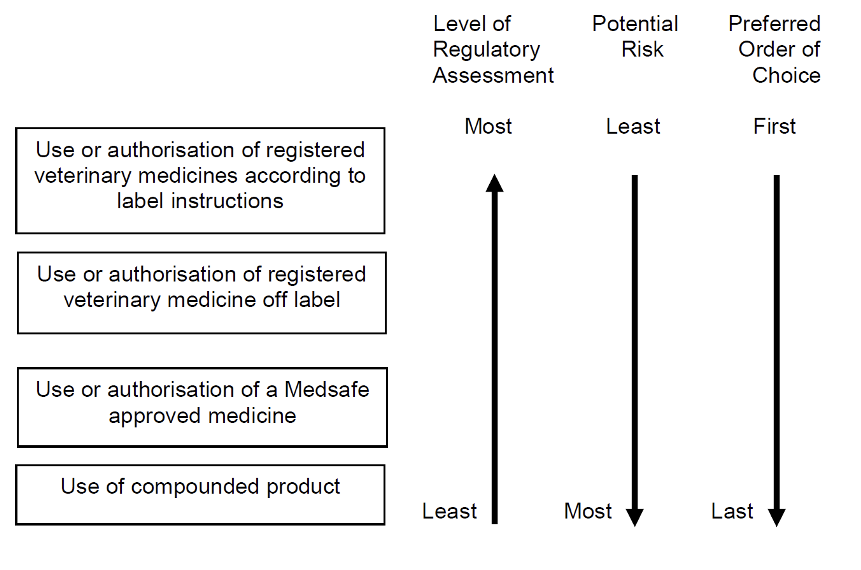
In all cases, a veterinarian’s decision for discretionary use must balance the potential negative effects of the drug with its benefits to the animal.
Veterinarians must have worked through each step before deciding which product to use. The cascade should not restrict a veterinarian’s choices; it should facilitate good decision-making by effectively managing the risks associated with the type of product used. Ultimately, the veterinarian can choose the type of product to use provided they can justify their decision.
Where human medicines are used in animals, and when registered veterinary medicines are used off label, there has been no regulatory assessment to determine the safety and efficacy of using the medicine in these situations.
### Off-label use of a registered veterinary medicine
Off-label use of a registered veterinary medicine occurs when the use does not comply with the approved claims (that is, the route of administration, dose rate, duration of treatment, target species or the condition being treated).
Not all RVMs are permitted to be used off label. In that situation, the medicine will have a condition of registration identifying the prohibition. Where an ‘over the counter’ product is permitted to be used off label, it will carry a condition of registration stating that before off-label use, the user must “seek advice from an appropriately qualified source and confirm that the intended use is not likely to cause unnecessary or unreasonable pain or distress in the animal treated.”
### Proprietary label information
The product label includes all the information that MPI has approved as being able to be supplied to the person the product is sold to, irrespective of the form of that information. Proprietary label information therefore includes:
1. the physical label attached to the product
2. label information on product packaging
3. additional loose material packed with the product.
### Medsafe does not assess human medicines for use in animals
Medsafe (New Zealand Medicines and Medical Devices Safety Authority) is a business unit of the Ministry of Health and is the regulator responsible for administering the Medicines Act 1981. This Act establishes a pre-market evaluation and approval system for human medicines that is designed to ensure that new medicines meet the required standards.
A veterinarian should obtain the informed consent of their client when the risks associated with using a registered veterinary medicine off label, or using a human medicine, are not well known.
If a registered veterinary medicine is available and can be used to achieve the same intended effect within the label and registration conditions, a veterinarian should choose it before the use of a human medicine or the off label use of a restricted veterinary medicine, or a compounded preparation. In some situations an RVM may be available but may not be the preferred treatment choice. This is acceptable if the veterinarian can justify their choice case by case and if choosing a human medicine is the exception rather than the rule. The routine use of a PM, or compounded preparation, in place of an RVM should not be based solely on the cost.
### Using unconsented medicines under section 29 of the Medicines Act 1981
To find out the consent status of a human medicine in New Zealand, go to [Medsafe database search](https://www.medsafe.govt.nz/regulatory/DbSearch.asp).
Veterinarians can use unconsented human medicines (section 29 medicines) legally to treat animals. However, the Medicines Act 1981 does not allow veterinarians to purchase these products from a supplier based in New Zealand. Veterinarians can only obtain unconsented medicines by importing them after obtaining [Special Circumstances Approval](https://www.mpi.govt.nz/animals/veterinary-medicines-acvm/veterinary-medicines-registering-authorising/authorisation-of-veterinary-medicines-under-special-circumstances/) from MPI. Veterinarians can import such medicines in quantities to treat a specific case but cannot hold any of that medicine in anticipation of future use.
### Getting MPI approval to use “animal welfare medications”
In certain specific circumstances MPI will allow veterinarians to import and hold particular unconsented human medicines in anticipation of use. These medicines are referred to as ‘animal welfare medications’. Veterinarians need MPI approval to import and hold particular unconsented human medicines in anticipation of use.
The current list of ‘animal welfare medications’ for companion animals, as approved by MPI are in the [Special Circumstances Approval ACVM Information Requirements](https://www.mpi.govt.nz/animals/veterinary-medicines-acvm/veterinary-medicines-registering-authorising/authorisation-of-veterinary-medicines-under-special-circumstances/).
### Authorising more than one product for use in treating a food-producing animal
When authorising more than one product for concurrent use in treating a food-producing animal, veterinarians must ensure where possible that all products are clinically compatible for concurrent use and that appropriate withholding period advice is provided to the end user.
The veterinarian must consider the pharmacology and elimination of each product and their active ingredients, as well as each withholding period applied to the registered veterinary medicines. The veterinarian must assign a withholding period that allows for any interactions between concurrently administered products, changes in the elimination of the drugs, and any other impacts the concurrent use may have on the efficacy, safety, and residue elimination of the active ingredients.
The pharmacology and elimination of a product can change significantly depending on the species it is administered to, the dose, the administration route, and concurrent use of other products. In food-producing animals, the veterinarian authorising use in any way other than as stated on the product label, including the concurrent use of more than one product, is responsible for ensuring that the authorised use does not cause residues to exceed the maximum residue levels or maximum permissible levels for all medicines used by providing appropriate withholding period advice to end users. This requirement applies to all products for which maximum residue level apply under the Food Act and for which maximum permission levels apply under the Animal Products Act.
### Deciding an appropriate withholding period
The withholding periods approved for a veterinary medicine are based on residue trial work on the use of that one product, in the approved species, and in line with the approved dose rate and interval. MPI has not evaluated use of the product in any other way. Also, the withholding period approved for the product does not apply.
In deciding what an appropriate withholding period is, veterinarians need to consider their own knowledge and experience as well as that of their colleagues. Veterinarians also need to consider technical advice (from a number of possible sources), peer and non-peer reviewed publications, available current data, and the MPI default withholding periods.
:::::
# Section 6.9: Compounded veterinary preparations
:::hint{type="info"}
Section 9 sets out how to use or authorise a compounded veterinary preparation (CVP) for animals under their care.
:::
**Actions veterinarians must take when using or authorising a compounded veterinary preparation:**
1. Comply with all the points in sections 1 to 7 of the Veterinary Medicines sections of this Code.
2. In situations where there is no veterinary medicine approved for the treatment of the condition (i.e. there is no on label indication and dose rate), consider whether there is:
1. an approved veterinary medicine which would be appropriate to use off label to achieve the same therapeutic effect, or
2. if there is an appropriate consented human medicine that will achieve the same therapeutic effect.
If any such trade-name product is available and will adequately achieve the intended effect and ensure the welfare of the animal, the veterinary must choose this product in preference to a CVP.
3. Consider whether an unconsented human medicine or overseas registered veterinary medicine is available that could be imported using MPI’s [Special Circumstances Approval](https://www.mpi.govt.nz/animals/veterinary-medicines-acvm/veterinary-medicines-registering-authorising/authorisation-of-veterinary-medicines-under-special-circumstances/) form within an acceptable timeframe. If appropriate, use this medicine in preference to a CVP.
4. Ensure that CVPs do not contain prohibited or restricted substances as defined by MPI.
5. Ensure that the CVP is compounded, sold and used for the treatment of an animal under the compounding veterinarian’s direct care in accordance with ACVM regulations.
6. Be competent in all aspects of formulation and compounding in situations where the CVP is compounded personally. Be responsible for the product, including its preparation, packaging, shelf life, labelling, and any workplace safety concerns.
7. Be satisfied that any third party contracted to do the compounding is competent. Issue the third party with a compounding order specifying the ingredients, quantity, packaging, shelf life and labelling. The veterinarian requesting the compounding is responsible for all aspects of compounding even when it is carried out by a third party.
8. Ensure that a documented system for compounding is in place.
9. Compound only enough CVP to manage short-term requirements. Do not store the preparation in anticipation of future needs.
10. Do not advertise or promote CVPs as veterinary medicine trade-name products or display them for sale to the general public.
11. Do not import CVPs without approval from MPI.
:::ExpandableHeading
## Understanding section 6.9
MPI and the Vet Council recognise that veterinarians need to be able to compound preparations for the treatment of animals when the need arises. However, in accepting that the need exists, veterinarians should recognise that CVPs have not undergone the usual regulatory assessment, and so expose the veterinarian, the animal(s) treated, the people involved with treatment and the public interest to potential risks. For more information, see the Vet Council Statement on [Compounding Veterinary Medicines](docId\:FZvshzseAey3nr5XkqRUz) and MPI [Guidelines on Developing a Documented System for Compounded Veterinary Preparations](https://www.mpi.govt.nz/animals/veterinary-medicines-acvm/acvm-guidance-veterinarians/#compounding-vet-preparations).
Veterinarians may compound a CVP under entry 9 in schedule 2 of the Agricultural Compounds and Veterinary Medicines (Exemption) Regulations 2011. A veterinarian who chooses to compound a CVP must follow the ACVM requirements in Regulations 7, 10, 12 and 14 and the CVP Notice. The veterinarian must clearly understand and comply with those expectations. For more information, see the statement on [Manufacturing Veterinary Medicines](docId:5dqa3bBVFmZglozbAIYcC).
Compounding a CVP should be seen as a last resort and only undertaken because a trade name product in the desired form or presentation is otherwise unavailable for animal treatment. The guiding principle should be that the CVP improves the animal(s) welfare over and above anything else that is currently available and is therefore a more appropriate veterinary medicine to use.
When deciding what treatment to use, veterinarians should consider the following choices in order. The primary choice is to use an RVM in compliance with the label and registration conditions to achieve the intended clinical effect. If no such RVM is available, the second choice is to use an RVM off label. The third choice is to use a human medicine. The fourth choice is to use a CVP.
Veterinarians should only compound sufficient material to satisfy their clinical requirements, and not in anticipation of future needs. The preparation should only be compounded for a particular animal. However, situations do occur where a group of animals require treatment.
Veterinarians who supply a CVP to a client must include as labelling information:
1. name or description of the product
2. name and contact details of the manufacturer or the veterinarian who made the product
3. active ingredients
4. directions for use
5. use by date/expiry date, if applicable
6. precautions, if any, for use
7. batch number (or equivalent).
:::
# Section 6.10: Decanting
:::hint{type="info"}
Section 10 sets out the actions of veterinarians when decanting. Decanting is a form of compounding that involves breaking down trade-name products into more convenient pack sizes.
:::
**Actions veterinarians must take to when decanting or breaking down a trade-name product:**
1. Ensure that the product is not altered in any way, except when changing the original packaging and labelling.
2. Ensure that no additional hazards are introduced through careless or inappropriate procedures during decanting or breaking down.
3. Ensure that the choice of alternative packaging does not jeopardise the quality of the product.
4. Ensure that all crucial information about the product is provided to the client, including the veterinarian’s contact information and additional instructions.
:::ExpandableHeading
## Understanding section 6.10
At times, a client may not be able to use the entire product in the smallest pack size available. A veterinarian may, under the exemption from registration for compounding, decant off a portion of a liquid trade name product or break down a non-liquid/gas trade name product into smaller quantities.
If the veterinarian breaches the integrity of the trade name product as set out above, they are responsible for any adverse consequences.
:::
# Section 6.11: Providing a dispensing service
:::hint{type="info"}
Section 11 sets out the actions of veterinarians who routinely fill veterinary authorisations in their practice issued by veterinarians from outside their practice.
:::
Actions veterinarians must take to provide a dispensing service.
1. Have an Operating Plan for Restricted Veterinary Medicines Sellers that MPI has approved.
2. Contact the external authorising veterinarian if the authenticity or validity of the authorisation is in doubt.
3. Prepare the order as set out in the written instructions from the authorising veterinarian.
4. Contact the authorising veterinarian if the written authorisation needs changing, to discuss the changes and obtain a new authorisation issued (if the requested changes are accepted).
5. Keep a record of the transaction with a copy of the authorisation.
:::ExpandableHeading
## Understanding section 6.11
Some veterinarians may wish to operate an RVM dispensing service (a veterinary pharmacy) to fill authorisations from other veterinarians not in the same practice or from other people recognised by MPI to authorise the purchase and use of RVMs in line with the approved operation plans. To dispense this way, the veterinarian must have an operating plan approved by MPI that governs the sale of RVM. Veterinarians should contact MPI for guidance on developing their own operating plans.
The accepted standard of practice for providing this dispensing service is set out in the MPI document [Operating Plans for Restricted Veterinary Medicine Sellers](https://www.mpi.govt.nz/animals/veterinary-medicines-acvm/selling-veterinary-medicines/).
Veterinarians who are not approved RVM sellers may fill a one-off urgent authorisation. Two occasions are when a client has gone on holiday and forgotten to take their animal’s treatment, or when another practice has run out of a medicine over a weekend or holiday period.
:::
# Section 6.12: Using a generic chemical
:::hint{type="info"}
Section 12 sets out actions veterinarians must take when using a generic chemical.
:::
Veterinarians must:
1. Recognise that the [generic chemical](https://hub.vetcouncil.org.nz/glossary#U0HFu) has received no regulatory control as to its quality and fitness for purpose for treating animals.
2. Address risk management of the generic chemical in an adequate manner.
3. Advise the client about the use of the generic chemical, including adequate risk management advice as appropriate.
4. Ensure the client has received appropriate withholding period advice about residues resulting from using the generic chemical, as applicable.
:::ExpandableHeading
## Understanding section 6.12
See the glossary definition of generic chemical. Some generic chemicals are methylene blue, zinc oxide, and magnesium sulphate. Chemicals with active ingredients that would prompt the need for registration (such as zinc bacitracin and chloramphenicol) are excluded.
:::
# Section 6.13: Use of veterinary medicines or prescription medicines by people
:::hint{type="info"}
Section 13 covers the prohibited use of veterinary medicines or veterinary PM on or by people.
:::
Veterinarians must not use, recommend or authorise the use of veterinary medicines, PM, pharmacy-only medicines or restricted medicines (as defined in the Medicines Act 1981) for use on or by people.
:::ExpandableHeading
## Understanding section 6.13
The [Medicines Act 1981](https://www.legislation.govt.nz/act/public/1981/0118/latest/DLM53790.html) contains a specific exemption that allows veterinarians to authorise the sale, supply or administration of prescription medicines (as defined in the Medicines Act 1981) to treat animals under their care. The same legal restraint applies to pharmacy-only medicines and restricted medicines.
It is illegal and unethical for veterinarians to authorise the use of these PM to treat people.
:::
# Section 6.14: Advertising
:::hint{type="info"}
Section 14 is about the advertisement or promotion of RVMs to end users (including offering purchasing incentives).
:::
**When advertising RVMs veterinarians must**
1. State that the product is only available under veterinary authorisation
2. Only advertise RVMs if doing so is unlikely to jeopardise the risk management role of the authorising veterinarian.
3. Not advertise antibiotics to the public.
4. Not advertise or offer purchase incentives for products with a specific condition of registration that prohibits them being advertised.
5. Only display a registered veterinary product (and its label) where the public can see it if doing so does not influence a person’s decision to buy it.
:::ExpandableHeading
## Understanding section 6.14
Veterinarians may advertise RVMs to end users (including offering purchasing incentives) provided there is no specific condition of registration prohibiting this, and the product is not an antibiotic.
The MPI document [Advertising guidelines for products registered under the ACVM Act](https://www.mpi.govt.nz/animals/veterinary-medicines-acvm/selling-veterinary-medicines/#selling-restricted-reg) sets out MPI expectations under the Animal Compounds and Veterinary Medicines Act 1997 about the standards veterinarians must maintain when advertising and promoting veterinary medicines. Veterinarians are expected to know and comply with the requirements set out in those guidelines.
The advertising veterinarian must tell the potential buyer to discuss treatment options for their animal or animals with their veterinarian.
:::
***
:::Changelog{title="Updates"}
::ChangelogItem{type="added" description="Updated January 2020"}
::ChangelogItem{type="added" description="New guiding principle added March 2023"}
::ChangelogItem{type="fixed" description="Minor stylistic updates June 2025"}
::ChangelogItem{type="added" description="Changed numbering scheme July 2025"}
::ChangelogItem{type="added" description="Removed paragraph describing "sufficient information" as it has been replaced by a definition in the glossary March 2026"}
::ChangelogItem{type="added" description="Added paragraphs 7 and 8 to section 6.3, added explanatory notes covering these additions and added reference to prescribing without in person consultation in emergencies to explanatory notes March 2026"}
::ChangelogItem{type="added" description="Amended explanation and discussion of antibiotic prophylaxis and added discussion of the prohibition on using VOIs to authorise antibiotics March 2026"}
::ChangelogItem{type="added" description="Update to 6.4.2 for clarity May 2026"}
::ChangelogItem{type="added" description="Amended 3.6.1 to change the period of supply for prescription medicines from 3 to 6 months as of 6 October 2026"}
:::
[title] Statement: Authorisation of Xylazine for use by non-veterinarians
[path] Professional standards and guidance/Statements/
# Purpose
This document sets standards for the authorisation of Xylazine (which is a restricted veterinary medicine) for an existing client for use on their own animals. These are requirements that we expect all veterinarians to follow.
This statement outlines the conditions under which Xylazine may be authorised for use only by the following authorised people:
- Allied veterinary professional staff members (AVPs) being veterinary nurses and technicians
- NVSB-certified farmer velvetter
- Authorised Grooms registered under the Groom’s Scheme
- Authorised Stud masters who have completed a training programme.
It aims to ensure the safe and effective use of Xylazine while maintaining high standards of animal welfare and professional conduct.
# Background
Xylazine is a potent restricted veterinary medicine that requires careful oversight due to its significant effects and potential risks. The use of Xylazine must be strictly controlled to prevent diversion and misuse, and ensure the safety of animals, veterinary professionals, and the public.
**Policy Statement**
1. **Veterinary Authorisation for use by Authorised People only**
- The use of Xylazine is restricted to instances where a veterinary authorisation has been issued and the use of Xylazine is restricted to only the authorised people listed above.
- Animal owners are explicitly **excluded** from having access to or using Xylazine under a veterinary authorisation. This measure is to ensure that Xylazine is administered by individuals with the appropriate training and competence.
2. **Veterinary authorisation specificity**
**Following a consultation, the veterinary authorisation must specify the:**
- person or persons
- animal/s
- treatment (e.g. a single dose required for the purpose), and
- purpose (e.g. to assist with a mare’s mating)
3. **Prohibition Under Veterinary Operating Instructions**
3.1 The use of Xylazine under a Veterinary Operating Instruction (VOI) is strictly prohibited, with the specific exceptions in 3.3.
3.2 VOIs are intended for situations where no veterinary discretion, oversight, or guidance is needed at the time the restricted veterinary medicine (RVM) is used. Given the nature of Xylazine, its use requires ongoing veterinary oversight and cannot be adequately managed under a VOI.
**3.3 Exceptions to this standard are the authorisation of Xylazine using a VOI under the: **
- National Velvetting Standards Body (NVSB) to velvet the antlers of deer in accordance with the Animal Welfare (Care and Procedures) Regulations 2018. The NVSB provides a rigorous programme that is regularly audited.
- MPI accredited Groom Scheme for transport of horses.
# Risks Associated with Xylazine
Xylazine poses several risks, including:
- **Sedation and analgesia**: Xylazine is a sedative and analgesic, that can cause profound sedation. Incorrect dosing or administration can lead to severe complications, including respiratory depression and cardiovascular effects.
- **Health and safety**: While effective for calming and analgesia, the use of Xylazine carries risks of unpredictable behaviour due to the drug's influence on the nervous system and individual animal characteristics (e.g. potential reactivity of sedated equines). To mitigate these risks, proper dosing, observation, and competence are crucial.
- **Potential for misuse**: Due to its potent effects, there is a risk of misuse or abuse if not properly controlled. Examples of misuse are the administration to animals that may or may not be specified on the authorisation, to enable painful procedures to be performed without appropriate pain relief.
- **Potential for diversion**: There is also a significant risk of diversion for human use, which can have serious health implications.
- **Adverse reactions**: Animals may experience adverse reactions, including abortion, hypotension, bradycardia, and hypersensitivity.
# Considerations for Veterinarians
When authorising the use of Xylazine, veterinarians must also consider the following:
- **Competence of the people administering the product**: Ensure that the authorised people administering Xylazine are adequately trained and competent to do so. This includes understanding the correct dosage, administration techniques, and potential side effects.
- **Level of supervision required**: Determine the appropriate level of supervision needed when Xylazine is administered. This may vary depending on the competence of the authorised people and the specific circumstances of the case. The level of supervision required should be in accordance with the guidelines set out in the VCNZ document on veterinary supervision.
- **The character of the person**. Ensure the authorised people are sufficiently competent, reliable, and trustworthy**.**
- **Informed consent by the owner**: Obtain informed consent from the animal's owner before administering Xylazine. The owner should be made aware of the potential risks and benefits of the treatment.
- **Assurance from the owner regarding use**: Ensure that the owner understands that the use of the sedative is limited to the people and animals specified on the authorisation. This should include that the owner ensures that any person working on the animal is aware that it has been sedated.
- **Documentation**: Ensure appropriate documentation of:
- the training and competence assessments.
- the authorisation of the RVM, **specifying the person** authorised to administer the RVM, and the **specified animals** it can be administered to.
- the client’s informed consent including understanding risks associated with the administration
# Health and Safety Considerations
Under the Health and Safety at Work Act 2015, veterinarians, veterinary clinics, businesses, and animal owners must have clear measures in place to assess and manage the risks associated with the authorisation and use of RVMs, including Xylazine. As duty holders under section 45 of the Act, veterinarians must ensure, so far as is reasonably practicable, the health and safety of workers and that other persons are not put at risk by their work.
# Deciding to decline a request to authorise an RVM
Section 4 of the Client relationships part of the Code of Professional Conduct states that veterinarians are not obliged to provide a requested treatment, provided that animal welfare and professional standards are met.
With these aspects in mind, the responsibility sits with the veterinarian to make a reasonable judgement. Ultimately, the veterinarian will need to take all of these factors into account to decide if it is reasonable to authorise Xylazine in this situation.
This means that veterinarians must consider the welfare of the animal, the appropriateness of the treatment, and their professional standards before making a decision. If the requested treatment does not align with these considerations, the veterinarian has the right to refuse to authorise the treatment.
Where a veterinarian, in their judgement, determines that it is not appropriate to proceed without the administration of Xylazine, they will require the presence of an AVP or veterinarian to administer the sedative and remain throughout the procedure.
This ensures that all actions taken are in the best interest of the animal and adhere to the highest professional standards.
# Conclusion
The VCNZ is committed to supporting veterinarians while ensuring the safe and responsible use of veterinary medicines. By restricting the use of Xylazine to instances to use by authorised people and prohibiting its use under a VOI (with the exception of the NVSB and the MPI Groom Scheme), we aim to uphold the highest standards of veterinary practice and animal welfare.
For further information, please refer to the ACVM Notice: Requirements for Authorising Veterinarians and the Veterinary Operating Instructions Guidelines.
[https://www.mpi.govt.nz/dmsdocument/20054/direct](https://www.mpi.govt.nz/dmsdocument/20054/direct) [https://www.mpi.govt.nz/dmsdocument/20057/direct](https://www.mpi.govt.nz/dmsdocument/20057/direct) [https://hub.vetcouncil.org.nz/code-of-professional-conduct](https://hub.vetcouncil.org.nz/code-of-professional-conduct) [https://hub.vetcouncil.org.nz/veterinary-supervision](https://hub.vetcouncil.org.nz/veterinary-supervision) [https://hub.vetcouncil.org.nz/veterinary-medicines#UVP0z](https://hub.vetcouncil.org.nz/veterinary-medicines#UVP0z)
[title] Veterinary Guidance for Managing Public Presentations of Sick or Dead Wild Birds During an HPAI Outbreak
[path] Professional standards and guidance/Guidance/
## Background
High Pathogenicity Avian Influenza (HPAI) is a serious disease affecting birds, with high mortality rates and significant biosecurity implications. The H5N1 strain of HPAI may spread to New Zealand through the movement of wild birds. If it does, members of the public may encounter sick or dead wild birds and bring them to veterinary clinics. Veterinarians play a critical role in managing these situations while balancing public health, animal welfare, and professional responsibilities.
If HPAI H5N1 arrives in New Zealand and establishes in the wild bird population, it can't be eradicated. New Zealand will need to learn to live with the disease present in wild birds. Veterinary practices will need to ensure plans are in place to manage the risk of H5N1 on an ongoing basis.
This guidance has been developed for situations where there are reasonable grounds to believe that wild birds are likely to be infected with HPAI H5N1.
**Pre-Incursion Surveillance**
Before HPAI H5N1 is formally identified in New Zealand, veterinarians play an important role in early detection and surveillance. While HPAI may not yet be confirmed, awareness is essential when particularly avian patients present with symptoms consistent with avian influenza.
**Preparation and Health and Safety**
Veterinarians and veterinary businesses should follow strict health and safety measures, including being properly trained, regular and proper washing of hands and wearing full Personal Protective Equipment (PPE), including a facemask, eye cover, and gloves, when handling ill or dead wild birds or where there is a high index of suspicion of an HPAI infection.
## Public guidance
Members of the public should be directed to the Ministry for Primary Industries (MPI) advice for reporting suspected bird flu:
[🔗How to report suspected bird flu](https://www.mpi.govt.nz/dmsdocument/64557-How-to-report-suspected-bird-flu)
[🔗Guidance for dealing with sick or dead birds during an HPAI H5N1 outbreak](https://www.mpi.govt.nz/dmsdocument/64557-How-to-report-suspected-bird-flu)
## Notification of an outbreak
MPI is responsible for coordinating New Zealand’s response to an HPAI H5N1 outbreak in partnership with the Department of Conservation, the Ministry of Health, and Health New Zealand | Te Whatu Ora.
Local and regional councils, iwi and hapū, industry and community groups will also have important roles following a detection of HPAI H5N1. Landowners, or those responsible for managing the property, will be responsible for birds and animals that are sick or dead on their land.
MPI has a communications plan for the arrival of H5N1, as well as a notification protocol. This will include both a public announcement and notification of key stakeholders.
## Public advice re sick birds
Leaving birds that are sick, or possibly infected with HPAI H5N1, alone will give them the best chance of survival and reduce the risk of further spread of HPAI H5N1. Disturbing birds that might be recovering or nesting can cause stress or lead to worse outcomes for the animal.
Also, avian influenza can spread to people who have close unprotected contact with HPAI-infected birds.
Do not take a sick bird to a veterinarian or wildlife rehabilitation centre (or similar) unannounced. If you choose to seek advice from a vet or wildlife rehabilitation centre, make sure to contact them by phone first. Be aware that for animal welfare and health and safety reasons, birds with HPAI H5N1 may need to be euthanised if they cannot be cared for and rehabilitated at such facilities.
Do not actively cull or disperse wild birds on your property, as this can spread the disease.
Keep domestic animals and people away from wild birds to prevent disturbance and potential infection.
## Veterinary clinic considerations during an HPAI outbreak
Veterinarians should use their judgment when deciding to examine wild or unowned sick birds that may be infected with HPAI. Veterinarians should refer to New Zealand’s current incursion status, current veterinary standards, industry guidelines and government advice.
When deciding whether to accept or examine a sick wild bird, veterinarians should consider the following:
### 1. History
Assess the presenting signs of the bird/s. The most obvious sign of HPAI is **sudden death in several** birds. Other signs in birds can include:
- weakness and trembling
- paralysis
- breathing difficulties
- lack of coordination
- blindness
- diarrhoea
### 2. Avian Medicine Capability
- Assess whether your clinic has the necessary expertise and equipment to safely and effectively manage avian patients.
- NOTE: Clinics that routinely accept injured or sick wild birds, often for transfer to a wildlife facility or, more commonly, for euthanasia, do not require a particular capability or expertise in avian medicine to meet the welfare needs of these animals i.e. to perform euthanasia.
- Consider whether protocols can be established to prevent transmission of HPAI to other avian patients.
- Consider the use of [Remote Triage](https://hub.vetcouncil.org.nz/remote-veterinary-care-telehealth-and-telemedicine#remote-triage) where appropriate for suspected HPAI cases.
- Consider having an arrangement with another practice that does see suspected cases of HPAI.
### 3. Health and Safety Risks
- HPAI poses a zoonotic risk. Assess the ability to successfully manage this risk and ensure staff are trained in appropriate PPE use and infection control protocols (refer to [Health and safety guidance](https://www.tewhatuora.govt.nz/assets/Uploads/Avian-Influenza-Health-Safety-Guidance.pdf)).
- Evaluate the risk to staff, clients, and other animals in the clinic.
### 4. Biosecurity and Transmission Risk
- Consider the potential for HPAI to spread to healthy patients or contaminate the clinic environment.
- Implement strict isolation and disinfection procedures if handling is necessary and you elect to examine or admit the bird.
### 5. Cost Implications
- Determine whether the clinic can absorb or pass on the costs of diagnostics, PPE, treatment, euthanasia, and biosecurity measures.
- Communicate clearly with the public about any fees or limitations.
### 6. Welfare of the sick bird
- Handling may cause significant stress and worsen the bird’s condition.
- While HPAI can cause severe clinical signs in wild birds, handling and treatment is likely to cause additional stress, especially in wild birds unaccustomed to human contact.
- There are no specific treatments for HPAI in wild birds, and euthanasia may be the most humane option if the bird is suffering and unlikely to recover.
- Attempting to rescue, transport, or treat an infected bird may increase the risk of spreading HPAI to:
- Other birds (wild or domestic)
- Humans (though rare, zoonotic transmission is possible)
- Pets or other animals.
- Leaving, or if presented, returning the bird to its original location may limit human contact, and reduce transmission risk. Importantly, a proportion of birds showing clinical signs do recover. Leaving HPAI-infected wild birds where they are is consistent with the government advice to not handle or move the birds.
- **Returning an HPAI-infected wild bird to its original site would not be considered unreasonable, provided it is within your local Territorial Authority guidelines.**
### 7. Local Authority Responsibilities
- Councils maintain important connections with their communities and will be able to share information to prepare and support their constituents when HPAI H5N1 arrives.
- Regional councils have obligations regarding domestic biosecurity and will play a central role in how regions respond to HPAI H5N1. This is expected to be predominantly focused on wild birds in public spaces.
## Veterinarian Responsibilities During Suspected HPAI H5N1 Incursion in Wild Birds
- **Animal Welfare Obligations**
Veterinarians must act promptly to address situations where animals may be experiencing unreasonable or unnecessary pain or distress, or where there may be breaches of animal welfare legislation.
- **Risk Assessment and Management**
- Veterinarians should assess risks on a case-by-case basis and implement appropriate personal and practice-level risk management procedures.
- Practices are encouraged to have a documented plan to minimise risks associated with handling higher-risk animals, including wild birds.
- **Health and Safety Priority**
While animal welfare is important, personal and team safety take precedence. Veterinarians are not expected to put their health or safety at undue risk to provide veterinary services.
- **Handling Suspected HPAI Cases**
- If there is a credible risk that a wild bird may be infected with HPAI H5N1, it is acceptable for veterinarians and clinics to
- Instruct the public to return the bird to its original location without treatment.
- Refer the public to clinics you have an arrangement with if they are seeing wild birds with possible HPAI infections.
- Veterinarians should provide clear instructions to minimise further contact and encourage reporting to relevant authorities (e.g. MPI hotline).
**Public Assistance**
The Veterinary Council expects veterinarians to assist members of the public in finding appropriate guidance or alternative support, while prioritising their own health and safety.
## Recommended actions
- **Encourage the public to leave wild birds where they find them and NOT to bring them to the clinic.** Instead, direct them to MPI’s reporting channels.
- **If a bird is already presented, veterinarians should:**
- Consider whether to accept the bird. It is acceptable to instruct the person presenting it to return it to its original location.
- Use their judgment to decide whether immediate euthanasia is appropriate. If it is suspected of having HPAI and is at the clinic, then euthanasia is also an acceptable course of action if it can be done safely.
- Minimize contact. For example, advising to avoid direct handling if possible, or to use barriers like a container or cage without reaching in.
- Isolate the bird immediately.
- Use appropriate PPE (e.g., disposable gloves, N95 respirator, eye protection, and a disposable gown or coveralls).
- Refer to the MPI website for further information.
- Refer the member of the public who presented the bird to their health provider for advice.
- **Document the encounter** including site where the bird was found, whether other birds are also affected etc and any actions taken for traceability.
- **Take steps to avoid spillover **– spillover events into other species are associated with cohabitation or direct consumption of infected animals and/or faecal matter. Overseas, infected mammals have included dairy cattle, goats, cats and dogs, as well as wildlife species.
## Addendum
### Carcass disposal options
There are a variety of safe methods for carcass disposal of HPAI-infected birds. These methods include composting, onsite burial, incineration, and landfilling. The veterinarian should evaluate disposal methods based on a variety of factors, including the size of the flock, space requirements, associated costs, local conditions, and applicable laws/regulations.
### Post-Incursion Diagnostic Considerations
Once HPAI H5N1 has been confirmed in New Zealand, veterinarians should include this as a differential diagnosis in any case involving birds with symptoms consistent with HPAI. This is particularly important for:
- Wild birds found sick or dead in areas known to have HPAI activity.
- Domestic poultry with unexplained illness or mortality.
- Cats, due to their predatory behaviour and potential exposure through consumption or contact with infected birds.
### Avian Influenza Health and Safety Guidance for Workplaces
Veterinarians are an at-risk occupational group. This includes those in contact with potentially infected birds and other animals, their products and contaminated materials, or their environments and habitats.
[The Avian Influenza Health and Safety Guidance for Workplaces](https://www.tewhatuora.govt.nz/assets/Uploads/Avian-Influenza-Health-Safety-Guidance.pdf) is for workplace managers and people who work with birds and other animals at risk of avian influenza in Aotearoa New Zealand. They provide advice for at-risk occupational groups on how to protect their health against avian influenza. It is intended to complement other available guidance and does not alter employers’ or workers’ obligations to follow appropriate Health and Safety practices.
### Veterinary healthcare team immunisation
While a standard seasonal influenza vaccine is not designed to directly prevent highly pathogenic avian influenza (HPAI), vaccination can indirectly reduce the risk of HPAI by minimizing the potential for viral recombination and genetic drift in co-circulating viruses **\[1]**. This is because a more robust human immune response, even if not perfectly matched to a specific HPAI strain, can reduce the likelihood of co-infections and subsequent reassortment events.
### Te Whatu Ora Recommended immunisation schedule
Vaccination against influenza is recommended annually for everyone from the age of six months to reduce the spread of the influenza virus and to protect against influenza-related complications. It is particularly important to vaccinate contacts of high-risk individuals, such as family and caregivers, and those working in certain occupations. See Table 11.2

## Further information for veterinarians
Guidance is available from MPI for [veterinarians](https://www.mpi.govt.nz/biosecurity/pest-and-disease-threats-to-new-zealand/animal-disease-threats-to-new-zealand/high-pathogenicity-avian-influenza/information-for-veterinarians-about-avian-influenza)
Guidance is available from MPI for [Wildlife rescue and rehabilitation facilities](https://www.mpi.govt.nz/dmsdocument/69507-Guidance-for-dealing-with-sick-or-dead-birds-during-an-HPAI-H5N1-outbreak-Wildlife?utm_medium=email\&utm_campaign=HPAI+stakeholder+update+issue+5\&utm_content=HPAI+stakeholder+update+issue+5+CID_4b7a684dfdf2c965fc30cc1b50c7b386\&utm_source=Email+marketing+software\&utm_term=wwwmpigovtnzdmsdocument69507-Guidance-for-dealing-with-sick-or-dead-birds-during-an-HPAI-H5N1-outbreak-Wildlife)
Guidance is available from DOC on [Avian Influenza](https://www.doc.govt.nz/our-work/wildlife-health/avian-influenza/)
Guidance is available from NZVA on [High Pathogenicity Avian Influenza (HPAI)](https://nzva.org.nz/clinical-resources/wildlife/hpai)
***
**\[1]** - National Center for Immunization and Respiratory Diseases (NCIRD) - [How Flu Viruses Can Change: "Drift" and "Shift"](https://www.cdc.gov/flu/php/viruses/change.html)
[title] Under the Care and specific and limited guidance
[path] Professional standards and guidance/Guidance/
The concept of an animal being “under the care” of a Veterinarian or Veterinary Business is the basis of the relationship between veterinarians, their clients, and their animals. It is critical to the role of veterinarians in society, including promoting the health of animals, public health and the role of animal products in our economy.
We have made changes to define what “under the care of a veterinarian” means and what veterinarians must consider when accepting a client.
As part of this work, we have also made changes to the Code to clarify the rules for veterinarians who choose to offer a "specific and limited range of veterinary services".
The changes came into effect from 1 April 2026 and are now in force.
The following documents are designed to help veterinarians understand the changes:
- Cheat sheet summarising the changes to the Code
::File{src="https://archbee-doc-uploads.s3.amazonaws.com/5ZTpSgccSDCXbym7d-uMH/YKCeCC1n5dVYkxtKhbxRQ-20260423-043421.pdf" label="Under the care changes cheat sheet.pdf" indent="1"}
[title] Authorisation of Critically Important Antibiotics for future use
[path] Professional standards and guidance/Technical advice/Stewardship/
:::hint{type="info"}
*Technical advice is our interpretation of how professional standards apply in a particular situation. It is designed to help veterinarians deal with common issues in practice, using their professional judgement to apply the advice to their own situation. It represents our best efforts at the time of publication but standards and expectations change over time and particular care should be used when reading old advice.*
:::
***
***In what circumstances is it appropriate to authorise (prescribe) critically important antibiotics for a client to hold for future use***
***
Antimicrobial resistance (AMR) is a recognised global issue and one of the [World Health Organisation’s top ten global public health threats](https://www.who.int/news-room/fact-sheets/detail/antimicrobial-resistance). The veterinary profession is responsible for authorising antimicrobials and therefore is obliged to manage the associated risks.
Critically Important Antibiotics (CIAs) are antibiotics that are considered critically important to human health and animal health as identified by the World Organisation for Animal Health and the World Health Organization.
::Image[]{src="https://archbee-image-uploads.s3.amazonaws.com/5ZTpSgccSDCXbym7d-uMH/0UC4B-G1gv4FDPADExKoR_unknown.gif" size="76" width="600" height="494" caption="Image courtesy of the NZVA. CIAs are classified as Red in this traffic light system." position="center" showCaption="true"}
The prudent use of all antimicrobials, including CIAs is a crucial aspect of managing the risks and slowing development of AMR.
As well as the human, animal and environmental health risks, antimicrobial use has implications for international trade and continued market access.
While the choice of antimicrobial agent is important to the success of treatments, the reasons for treatment failure are often multifactorial and are not necessarily directly related to the antimicrobial chosen.
## Authorisation of CIAs
Veterinarians can authorise Restricted Veterinary Medicines (RVMs) for a specified person to hold specific RVMs in anticipation of use (See the [ACVM Notice: Requirements for Authorising Veterinarians](https://www.mpi.govt.nz/dmsdocument/20054/direct)). This, in effect, allows for clients (farmers, most commonly) to determine when to treat an animal, which RVM to select (including antimicrobials), and when treatment has succeeded or failed, based on the instructions provided by the authorising veterinarian.
The Code allows for veterinarians to provide an authorisation of CIAs for a period of supply of up to 4 months. The Code also provides explicit actions veterinarians must take to ensure they are authorising CIAs correctly (see the [6. Veterinary medicines](docId\:uUCHsu_9cXggI8oOuNAG_) chapter, [section 6](https://app.archbee.com/public/PREVIEW-wrBJXyHoscpUG72h2-7zt/PREVIEW-uUCHsu_9cXggI8oOuNAG_#A53Sl)), including:
1. Restrict use to situations where first line antibiotics have been shown to be ineffective.
2. Restrict use to cases supported by bacteriological tests or where the prescribing \[authorising] decision is supported by studies or references that are recent and independently peer reviewed.
3. Do not use critically important antibiotics as preventive treatment in animal feed or water in the absence of clinical signs in the animal to be treated.
4. Limit off label use for instances where no suitable alternatives are available.
Specifically points 1 and 2 above specify expectations to be met prior to the use of CIAs.
We interpret “have been shown to be ineffective” as being:
- Where there is sufficient evidence (supported by studies or references that are recent and independently peer reviewed) that the organism to be treated is not susceptible to first line (i.e green / orange) antibiotics.
- Where there has been an appropriate veterinary investigation which includes:
- review of the relevant preventative control programme;
- assessment of the competence of relevant personnel to identify disease and administer appropriate treatment;
- whether an acceptable treatment protocol has been implemented and complied with; and
- whether there is any evidence of therapy failure or relapse that supports the use of a CIA.
## Authorisation for future use
We take the above requirements to mean that there are very few situations where it would be considered permissible for CIAs to be left on farm for future use.
These are for example, where:
1. A course of treatment with a CIA has been appropriately authorised by a veterinarian, following a consultation, for:
1. a specific animal/s with a diagnosed condition.
2. a group of animals in the face of a diagnosed outbreak
2. A veterinarian authorises a CIA product as part of a herd health programme because:
1. The client has on-farm diagnostic equipment that is used to identify the causative bacteria and there are sensitivity testing results that indicate the CIA product is most appropriate to use (e.g. multiple prior culture results from the herd, or sensitivity results from the on-farm testing equipment) prior to the administration of the CIA; and
2. The authorising veterinarian undertakes regular and appropriately frequent visits (For example – no less frequent than the CIA period of supply); and
3. The authorising veterinarian has confirmed all personnel responsible for administering the CIA have been provided the appropriate level of advice and training and are competent to carry out all instructions given within the authorisation.
3. A specific disease condition has been diagnosed on the property and it has been established using legitimate and sound clinical rationale which is evidence based (supported by diagnostic testing, studies or references that are recent and independently peer reviewed) that the use of a CIA is the appropriate first-choice treatment.
In all circumstances where veterinarians authorise CIAs, they remain responsible for the subsequent use of these products and must:
- Substantiate and record their decision-making process to establish that use of the CIA is justified; and
- Have appropriate record keeping of the diagnostics and CIAs administered; and
- Conduct and record a regular audit and reconciliation of the CIAs authorised within the term of the period of supply.
## Disposal of expired or unused CIAs, needles and syringes
CIAs are considered hazardous wastes and are a threat to public health, safety and the environment.
In clinic waste or waste generated by veterinarians on farm must be disposed of into appropriate containers which meet the relevant Australian and/or New Zealand standards for reusable and non-reusable containers e.g. approved sharps containers, hazardous waste containers, and appropriate biohazard containers for general waste.
Veterinarians must also advise clients on how to:
- return needles, syringes and empty containers to the clinic, and
- return unused or expired products to the clinic, or
- Appropriately dispose of this hazardous waste.
***
:::Changelog{title="Updates"}
::ChangelogItem{type="added" description="4 August 2022"}
:::
[title] Anaesthetic Monitoring
[path] Professional standards and guidance/Guidance/
# Relevant sections of the Code of Professional Conduct
- [1. Animal welfare](docId\:gr85iChRVF-W2r-SSpYY7) (particularly section 6(d)
- [5. Veterinary services](docId\:QyTt_vObkFxDyhtxLEmCb) (particularly section 3)
# Purpose of this Guidance
This document provides guidance to veterinarians on anaesthetic monitoring.
It is not possible to define a single standard in this area because of the large number of variables. As such, this document sets out an overarching principle with advice on how this applies in different scenarios. The application of the overarching principle always needs to be applied to the differing circumstances of each case.
# Principle
All anaesthetised animals must be continuously attended by a person who is able to:
- Immediately identify chances in the physiological status of the animal, that are associated with the anaesthetic or the procedure
- Alter the way the animal is being managed in order to sustain it and achieve the best possible outcome in the circumstances.
This requirement extends through the period of recovery from the anaesthetic until the animal is sufficiently conscious and its condition is sufficiently stable that continuous nursing support is not required.
Rationale
General anaesthesia carries inherent risks and can lead to potentially serious treatment outcomes or death.
An animal’s depth of anaesthesia can change quickly, sometimes in response to surgical stimulus. Cardiovascular and respiratory systems can fail in response to injury, disease or anaesthetic drugs.
Anaesthetic machines can also fail or run out of oxygen.
A safe anaesthetic requires someone who can take steps to prevent problems and diagnose and treat problems immediately.
# Advice on specific situations
## Elective sterile surgery
While the veterinarian doing the surgery should be able to anticipate and prevent problems, particularly if a multifunction monitor is used, s/he is not able to physically response to problems without compromising sterility.
Therefore, another person must be able to act immediately when required and, in the absence of a multifunction monitor, be checking the animal’s status, at a frequency appropriate for that animal and the circumstances.
It is strongly recommended that anaesthetic monitoring records are kept. The monitoring parameters to be assessed and recorded should ideally include heart rate, respiratory rate, temperature, eye position, mucous membrane colour, blood pressure, oxygen saturation and medicine/anaesthetic given.
It is also strongly recommended that the person performing the anaesthetic monitoring is appropriately trained (i.e. either a veterinarian or an trained and experienced veterinary nurse).
In some situations, it may not be necessary for the person monitoring the animal to remain continuously at the animal’s side if they are available to respond immediately if required. For example, where the animal is healthy, the anaesthetic is stable, technological monitoring devices are used, the surgery is routine and low risk and/or where the anaesthetic is no prolonged. Veterinarians are expected to use their professional judgment in deciding whether safe anaesthesia can be maintained without the constant presence of someone to monitor the animals.
## For non-sterile surgery
An additional person to the veterinarian performing the procedure is desirable but not always essential. If an additional person is not present, the veterinarian needs to be able to monitor the animal’s status and quickly implement any required changes to its management.
## For emergency surgery
If a dedicated person is not available, the veterinarian must use their professional judgment in balancing the risks involved in delaying the surgery against the risks involved in anaesthetising an unstable animal. The overarching consideration should be the best welfare outcome for the animal.
The informed consent of the person in charge of the animal should be obtained and documented.
## Other surgery situations
While this guidance applies to all animals undergoing general anaesthesia, the Council recognises that there will be some situations, particularly in production animal surgery, where the veterinarian does not have access to a dedicated person to monitor the animal or is constrained by the budget of the person in charge of the animal concerned.
In such circumstances, the veterinarian should:
- Use their professional judgment in deciding whether to proceed with the surgery, bearing in mind their overarching professional obligation to protect and promote animal welfare and alleviate unnecessary pain and distress
- Obtain and document the informed consent of the person in charge of the animal.
***
Download a PDF version of this guidance:
::File{src="https://archbee-doc-uploads.s3.amazonaws.com/5ZTpSgccSDCXbym7d-uMH/XUiuUF65kdHVBQoiRRVUW_guidance-on-anaesthetic-monitoring.pdf" label="Guidance on Anaesthetic Monitoring.pdf"}
:::Changelog{title="Updates"}
::ChangelogItem{type="added" description="Published September 2012"}
:::
[title] Authorising restricted veterinary medicines for dispensing and use by non-veterinarian staff
[path] Professional standards and guidance/Technical advice/Delegation/
:::hint{type="info"}
*Technical advice is our interpretation of how professional standards apply in a particular situation. It is designed to help veterinarians deal with common issues in practice, using their professional judgement to apply the advice to their own situation. It represents our best efforts at the time of publication but standards and expectations change over time and particular care should be used when reading old advice.*
:::
***
***Can veterinarians authorise non-veterinarian staff members (e.g. nurses and techs) to use medicines?***
***
This advice outlines the expectations of veterinarians who authorise restricted veterinary medicines (RVMs) and Prescription Medicines (PMs) for dispensing or use by a non-veterinarian staff member (staff) under the veterinarian’s direction.
This guidance does not apply where Veterinary Operating Instructions are required or where a veterinary student is undertaking a treatment or procedure under veterinary supervision.
## Guiding principle
The public has the right to expect that their animals receive high quality care regardless of whether that is delivered by a veterinarian directly or via other team members.
## What does the law allow?
The Code and [ACVM Notice](https://www.mpi.govt.nz/dmsdocument/20054/direct) allow a veterinarian to authorise (prescribe) RVMs and PMs for staff to administer to an animal under the veterinarian’s care.
## What is expected when authorising?
### Conducting a consultation
The Code requires that veterinarians must only authorise RVMs and PMs following a veterinary consultation and either having seen the animal(s) at the time of the consultation or have seen recently or often enough for the veterinarian to have sufficient personal knowledge of the condition and health status of the animal(s).
### Addressing animal welfare risks and emergency care
Veterinarians must take reasonable steps to ensure that animal health and welfare is protected when they enable others to provide care to animals.
The duty on veterinarians extends to ensuring people undertaking treatments are able to recognise when treatment is and isn’t indicated; recognise early signs of animal distress, injury or ill-health; and take remedial action or seek help when necessary.
In any situation where a veterinarian authorises treatment with RVMs or PMs by staff, they must have arrangements in place to respond where a side effect or adverse event associated with the RVM or PM occurs.
### Considering risks
Veterinarians must consider the risks of the use of an RVM or PM and act to avoid or mitigate those risks. This includes risks to:
- public health
- trade in primary produce
- agricultural security
- animal welfare
- occupational health and safety
- the environment
Veterinarians must also:
- comply with the regulatory controls of all veterinary medicines they choose to use, sell or authorise
- meet the requirements of the maximum periods of supply when authorising of RVMs and PMs
It is worth noting that veterinarians are not obliged to provide RVMs or PMs, especially where they have concerns about a non-veterinarian’s competence.
### Considering competency
Veterinarians must:
- Confirm that any person who will administer the RVM understands and is able to competently carry out the authorising veterinarian’s instructions for use.
- Ensure that staff they delegate tasks to have training that enables them to deliver the veterinary service to an appropriate standard. Consider what evidence there is, of a person’s competence, including the currency and recency of that person’s training in the correct treatment.
- Ensure practice resources enables staff to deliver delegated veterinary services to an appropriate standard. Resources include equipment, facility and inventory.
### Qualifications
Veterinarians may, where appropriate, rely on a person’s qualification to indicate their competence e.g. veterinary nursing and technician certificates, diplomas and degrees.
Third parties, who have robust training and assessment methodologies can also provide competency training e.g. another veterinarian. Training should include currently accepted practices and meet accepted professional and industry standards.
Veterinarians should use their professional judgement, and consider asking other knowledge experts, when considering the quality of the person’s education and experience.
Where a person is not yet competent, veterinarians may elect to provide training in:
- Treatment, to enable those treatments to be performed safely and humanely
- Competent management and use of RVMs and PMs, prior to authorising
- Recognition of early signs of animal distress, injury, or ill health, including veterinary emergencies and adverse events, and how to engage in that care.
Importantly it is not necessarily the experience, but the treatment being carried out correctly, using appropriate methodology, that determines competence.
Evidence of competency assessments should be supported by training and assessment records, attendance at training events such as an industry training days or online training modules etc. Records should also reflect updated training with current techniques and equipment.
### Veterinary Nurses Registration
The [Allied Veterinary Professional Regulatory Council](https://www.avprc.org.nz/) (AVPRC) is a voluntary regulatory body that registers veterinary nursing, technology professionals and allied animal healthcare practitioners. It sets and monitors the educational and professional standards for veterinary nurses, technicians, and allied animal healthcare practitioners.
This provides a pathway for accountability for staff and, for this reason, veterinarians could turn their minds to endorsing staff registration with AVPRC.
### Supervision
In considering whether to direct staff to carry out a treatment, the veterinarian must consider how difficult the treatment is (including any associated risks), whether the staff member understands the associated risks and has the necessary competence to react appropriately if any problem should arise.
The veterinarian must then use their judgement when determining the level of supervision required by the staff member that has been authorised to carry out the treatment.
The veterinarian must also be sure that they will be available to answer any call for assistance, and should be satisfied that the staff member feels capable of carrying out the treatment competently and successfully.
VCNZ use the following terms to describe differing levels of supervision:
**Veterinary direction** means that the veterinarian instructs a person on the tasks to be performed but is not necessarily present.
**Veterinary supervision** means that the veterinarian is readily available to provide advice and support in response to a request for assistance if needed.
**Direct and constant veterinary supervision** (or observation or oversight) means that the veterinarian is physically present and giving the veterinary nurse or student veterinary nurse his/her undivided personal attention.
## Responsibilities
Veterinarians are considered to be responsible for the conduct of the people they delegate to, and must take steps to ensure that they work within the standards expected.
This does not mean that the veterinarian takes on responsibility for the treatment itself. If concerns were raised, questions about the veterinarian’s conduct would focus on whether the veterinarian took reasonable steps to ensure the points above were met.
Where the veterinarian’s instructions and methods provided during any training are not followed, responsibility would normally sit with the person undertaking the treatment.
## Veterinarian Competence
Veterinarians should work within their area of competence and have the appropriate skills and knowledge to assess another person’s competence, before delegating to them (and authorising medicines). For example, veterinarians without appropriate knowledge in equine treatments, should not authorise RVMs or PMs for treatments by staff on equids.
## Owner Consent
When considering whether a treatment can be delegated to a staff member, the veterinarian has a duty to ensure their clients are informed. This information may for example be contained in a client registration pack that outlines that the practice provides a team-based healthcare approach to veterinary medicine that enhances the quality of care their patients receive, and that all staff are appropriately trained and supervised.
Veterinarians should also be aware of their own insurance policies and understand what cover is (or is not) provided when they delegate non-veterinarians to undertake, for example, a regulated treatment such as teat sealing in cattle.
## Employment and health and safety law
Veterinarians who are employers or in management positions need to have current knowledge of employment law requirements. For example, an employee or contractor who is under 15 years cannot work in any area where the work being done is likely to harm the employee.
Veterinarians must follow all Health and Safety legislation. Employers must look after the health and safety of their workers, including managing risks associated with the use and administration of RVMs and PMs. Employees must take reasonable care of their own health and safety and to ensure that others are not harmed by something they do or don’t do. Again, this for example extends to potential harm associated with RVMs and PMs.
## Further reading
The Code of Professional Conduct, specifically:
- the definition of [veterinary consultation](https://app.archbee.com/public/PREVIEW-wrBJXyHoscpUG72h2-7zt/PREVIEW-Gs8lan75noOL7EJ4nNi5V#f3bh7)
- the [6. Veterinary medicines](docId\:uUCHsu_9cXggI8oOuNAG_) chapter including [section 1](https://app.archbee.com/public/PREVIEW-wrBJXyHoscpUG72h2-7zt/PREVIEW-uUCHsu_9cXggI8oOuNAG_#l6Kt1) (product stewardship) and [section 2](https://app.archbee.com/public/PREVIEW-wrBJXyHoscpUG72h2-7zt/PREVIEW-uUCHsu_9cXggI8oOuNAG_#xT8cu) (legislative requirements)
- the [5. Veterinary services](docId\:QyTt_vObkFxDyhtxLEmCb) chapter, including [section 3](https://app.archbee.com/public/PREVIEW-wrBJXyHoscpUG72h2-7zt/PREVIEW-QyTt_vObkFxDyhtxLEmCb#1AkWz).
- [ACVM Notice: Requirements for Authorising Veterinarians](https://www.mpi.govt.nz/animals/veterinary-medicines-acvm/acvm-guidance-veterinarians/#deciding-on-treatment)
***
:::Changelog{title="Updates"}
::ChangelogItem{type="added" description="13 June 2022"}
:::
[title] Companion animal vaccinations and informed consent guidance
[path] Professional standards and guidance/Technical advice/Client relationships/
:::hint{type="info"}
*Technical advice is our interpretation of how professional standards apply in a particular situation. It is designed to help veterinarians deal with common issues in practice, using their professional judgement to apply the advice to their own situation. It represents our best efforts at the time of publication but standards and expectations change over time and particular care should be used when reading old advice.*
:::
Vaccination is an essential, cost-effective way of controlling certain important infectious diseases in companion animals. It is performed extensively and is considered relatively low risk.
Vaccination recommendations can be a complex and sometimes controversial issue. However, there are a variety of sources (e.g. Restricted Veterinary Medicine (RVM) Product labels and international guidelines) providing evidence-based information that supports the veterinarians’ decisions.
Adverse events associated with vaccines can happen, although this is rare (Moore et al 2023 1). Veterinarians must therefore consider the risks associated with vaccination, balanced with the significant benefits vaccination provides for the patient and the community it lives in.
### Background
Gaining informed consent is important when administering any medicine, including vaccines. Owners who present their pets to be vaccinated should be fully informed by the veterinarian about the purpose, risks, and expected outcomes of each vaccination before they give consent and before the product is administered. Owners must have the opportunity to discuss and raise any questions and concerns. This allows them to make an educated decision about the needs of their pet and fosters a team approach to its care. This team approach can help improve compliance, adherence and strengthen veterinary-client relationships (Spitznagel et al 2; Maddison et al 3).
More information about the process of gaining informed consent and documenting it can be found in the Code of Professional Conduct [here,](https://hub.vetcouncil.org.nz/client-relationships#5yUN7) and in Vet Council guidance [here](https://hub.vetcouncil.org.nz/informed-consent).
Immunisation, along with sanitation and clean drinking water (Rodrigues et al 2020 4), is one of the most effective health interventions in the world for saving lives and preventing significant illness
All approved veterinary vaccines used in Aotearoa New Zealand are registered under the Agricultural Compounds and Veterinary Medicines (ACVM) Act and have been assessed for safety and efficacy.
### What to consider when informing clients
It is important to discuss the most appropriate vaccine and the frequency of administration for the pet. These will be influenced by several considerations that should include species; breed; age; risk of exposure to diseases; timing of the last vaccination; and geographical location.
The cost of an animal vaccination can vary. Factors affecting the cost include the type of vaccine needed and the age and breed of the pet. Some vaccines also require multiple doses to achieve efficacy, which adds to the total cost.
The decision to vaccinate, even with core vaccines, should be based on a risk-benefit assessment for each pet and each vaccine antigen. The benefits of vaccination should be balanced against the risk of adverse events, likelihood of exposure to disease, and disease severity. Every effort should be made to ensure that the pet is healthy before vaccination. However, concurrent illness (including retroviral infections) does not necessarily preclude vaccination5.
An adverse event is defined as any observation in an animal that is unfavourable and unintended following the use of a veterinary medicine. It includes side effects; lack of protection; human exposure; toxicity; or hypersensitivity reactions whether or not the event can be directly attributed to the vaccine. Most adverse reactions are mild, transient and self-limiting. The most severe forms of adverse reactions are very rare, such as injection site tumours, anaphylaxis and autoimmune dysfunction.
We occasionally hear from veterinarians who are concerned that some recommendations from guidelines contradict information in product leaflets or datasheets. Some worry that if they adopt guideline recommendations they might be criticised. For example, if they revaccinate adult animals less frequently than suggested in the product leaflet, or if they give additional doses of vaccine to animals between 12 and 20 weeks of age.
This is not usually the case. Selecting the most appropriate vaccine and how often it’s administered depends on the considerations listed earlier in this guidance, such as age and breed and may include other context specific aspects. Veterinarians are expected to use their professional judgement, as well as current knowledge and guidance (based on scientific evidence), when selecting an appropriate vaccination regime. The WSAVA Vaccination Guidelines 6 and the NZVA vaccination guidelines 7 provide useful advice on vaccinations for cats and dogs.
It is essential for pet owners to understand the importance of animal vaccination in preventing diseases. Not only does vaccination protect the health and wellbeing of their animals, but it also contributes to public health by reducing the spread of contagious diseases between animals.
Addressing common misconceptions about animal vaccination is an important part of educating pet owners. Some people may have concerns about the safety and effectiveness of vaccines, so it is essential to provide accurate information and evidence-based facts to address these concerns.
Encouraging responsible vaccination practices involves promoting regular check-ups with veterinarians and following recommended vaccine schedules for pets. This includes ensuring that pets receive their core vaccinations as well as any additional vaccines based on their lifestyle, environment, and potential exposure to specific diseases.
### Information sources – label and off-label use
The product leaflet/data sheet is a legal document that forms part of the ACVM product registration package for a vaccine. This document provides details about the safety and efficacy of the product and states the minimum Duration of Immunity (DOI) that can be expected after appropriate vaccination administration.
Guidelines are based on all available evidence about DOI by vaccines for cats and dogs, not just the minimum data generated by manufacturers.
Some New Zealand guidelines may recommend vaccinating every three years or less with core vaccine products, even if it has a one-year DOI claim in some countries. Although the advice from guidelines sometimes differs from information in the product leaflet, veterinarians can generally use a vaccine according to recognised guidelines (and therefore the most current scientific evidence) by obtaining informed owner consent for administration that may vary from the product’s registered use (i.e. “off-label use”).
### Medical records documentation
At the time of vaccination, the following information should be recorded in the patient’s medical record:
· Date of vaccine administration
· Identity (name, initials or code) of the person administering the vaccine
· Vaccine name, lot or serial number, expiry date and manufacturer
· Anatomical site and route of vaccine administration.
Any adverse events should be recorded in a way that will alert practice staff during future visits, such as using popups in the patient management platform.
### Recording of Informed Consent
Informed consent must be documented in the patient’s medical record to show relevant information was provided to the client and that they consented to the procedure (for both on-label and/or off-label use of vaccines). At the very least, the note in the clinical record should indicate that a discussion about risks and benefits took place before the vaccination.
***
### References
1 Moore GE, Morrison J, Saito EK, Spofford N, Yang M. Breed, smaller weight, and multiple injections are associated with increased adverse event reports within three days following canine vaccine administration. J Am Vet Med Assoc. 2023 Jul 14;261(11):1653-1659. doi: 10.2460/javma.23.03.0181. PMID: 37451674.
2 Spitznagel MB, Carlson MD. Caregiver Burden and Veterinary Client Well-Being. Vet Clin North Am Small Anim Pract. 2019 May;49(3):431-444. doi: 10.1016/j.cvsm.2019.01.008. Epub 2019 Mar 4. PMID: 30846380.
3 Maddison, Jill & Cannon, Martha & Davies, Rebecca & Farquhar, Robyn & Faulkner, Brian & Furtado, Tamzin & Harvey, Gareth & Leathers, Fiona & Snowden, Austyn & Wright, Ian. (2021). Owner compliance in veterinary practice: recommendations from a roundtable discussion. Companion Animal. 26. S1-S12. 10.12968/coan.2021.0029.
5 2020 AAHA/AAFP Feline Vaccination Guidelines
6 [2024 guidelines for the vaccination of dogs and cats](https://wsava.org/wp-content/uploads/2024/04/WSAVA-Vaccination-guidelines-2024.pdf) – compiled by the Vaccination Guidelines Group (VGG) of the World Small Animal Veterinary Association (WSAVA)
7 NZVA MTN: Vaccine use in New Zealand cats and dogs
8 [WSAVA Owner Breeder Guidelines 14 October 2015](https://wsava.org/wp-content/uploads/2020/01/WSAVA-Owner-Breeder-Guidelines-2015_1.pdf)
***
:::Changelog{title="Updates"}
::ChangelogItem{type="added" description="Published 1 October 2024"}
:::
[title] Guidance for authorisation of controlled drugs in veterinary medicine
[path] Professional standards and guidance/Guidance/
This guidance provides clarity for veterinarians when authorising Controlled Drugs (CDs) and deciding on the appropriate format and frequency for reviewing a patient’s medical progress, before authorising further supply.
CDs are subject to a one-month maximum period of supply per authorisation (with no repeats) due to their high risk and the regulatory requirements of the Misuse of Drugs Act 1975.
This does not mean a compulsory in-person physical exam is needed every 30 days, but that a monthly veterinary consultation for a ‘medical progress re-assessment’ is required for a veterinarian to maintain sufficient personal knowledge of the animal’s health, and to ensure the continued treatment is appropriate.
## Determining the sufficiency of professional oversight
To authorise a CD (e.g. phenobarbitone), a veterinarian must have sufficient personal knowledge of the animal's health status and condition. When considering further supply, they must determine that the animal’s circumstances have not changed, and that the choice of medication and treatment regime is still appropriate.
The required level of oversight should be determined by professional judgment, balancing the risks of the CD with the stability of the animal’s condition. There are complex challenges for prescribers, in relation to issues such as legitimate medical use versus misuse, overuse, diversion, substance use disorder, and overdose.
Phenobarbitone (phenobarbital) is an essential, lifesaving antiepileptic drug (AED) and is considered the first-line of treatment. This is because of its efficacy, broad coverage for multiple seizure types, ease of use, low cost, and good tolerability. Although phenobarbitone is considered essential, it is also listed with other barbiturates as a controlled substance because it has the potential to be abused.
The key question for veterinarians is: What level of consultation is required to ensure the treatment is still safe and effective for the next 30 days?
### 1. Compulsory monthly consultation
A formal consultation with the veterinarian authorising the CD is required for each 30-day authorisation. This consultation establishes that the animal remains under the care of the veterinarian.
This consultation **must **be performed by the veterinarian themselves and must not be delegated. It should include a review of the following factors, which will determine if a physical examination is required:
- **Time since initial diagnosis/last examination:** The longer it has been since the animal’s last physical exam, the higher the need for a new one. Generally, a physical exam is compulsory at least every three to six months for stable, chronic cases, and more often for unstable or high-risk cases.
- **Stability of condition:** Has the primary condition (e.g. seizure frequency) been consistently stable? Evidence of stability - for example: has recent therapeutic monitoring been performed? Evidence of breakthrough events or deterioration requires an immediate physical examination.
- **Animal’s medical history and comorbidities:** Any concurrent diseases or new symptoms that could affect the drug’s metabolism (e.g. liver disease in a cat on phenobarbitone), drug distribution, or excretion require a physical exam and potentially lab work.
- **Changes in treatment plan:** Any recent changes to the CD dose or the introduction of new concurrent medications require closer monitoring. This should be done as an in-person review to assess for interactions.
### 2. Criteria for mandatory physical examination
An in-person physical examination should be considered necessary if any of the following apply:
| **Condition category** | **Criteria triggering physical exam** | **Rationale** |
| ------------------------------------------------------------- | -------------------------------------------------------------------------------------------------------------------------------------------------------------------------------------------------------------------------------------------------------------- | ----------------------------------------------------------------------------------------------------------------------------------------------------------- |
| **Patient status** | **Acute or unstable condition:** Deterioration of the primary condition or new clinical signs (e.g. lethargy, ataxia, or weight loss) that have been reported by the owner. | Ensures timely detection of efficacy loss or adverse reactions. |
| **High-risk medication/species** | **High-risk CD or species-specific toxicity:** The specific CD has a narrow therapeutic index (like phenobarbitone), or the animal is a species known to be highly sensitive (e.g. cats with deficient glucuronidation pathways). | Mitigates higher risk of toxicity/accumulation. |
| **Monitoring deficits** | **Lack of recent monitoring data:** Laboratory results (e.g. therapeutic drug monitoring, haematology, or biochemistry) are outdated or missing. These tests are critical for safe use. | Confirms safety and efficacy through objective data. |
| **Six-monthly re-assessment** | **Scheduled mandatory six-monthly review:** It has been six months since the last comprehensive re-assessment, which requires a full physical exam to confirm the ongoing need for the medication. | Fulfils the professional standard for ongoing therapy. Aligns with the maximum period of supply for RVMs in companion animals. |
### 3. Criteria for remote medical progress assessment consultation (e.g. phone/video review)
A monthly consultation and authorisation of further supply without a physical exam may be appropriate for a limited time and only when the following criteria are met and documented:
1. **Patient stability:** The animal is on a long-term treatment plan, and the condition is **stable and well-controlled**.
2. **Low risk status:** The risk factors (species sensitivity, co-morbidities etc) are known and currently stable and at a low level of risk.
3. **Recent exam:** A thorough physical examination has been performed **within the last three to six months**.
4. **Sufficient monitoring data:** Recent laboratory work (where required for the CD) is available and confirms safety and efficacy (e.g. phenobarbitone levels are within the therapeutic range).
5. **Owner compliance and competence:** The owner demonstrates a high ability to **monitor, observe, and comply** with the treatment recommendations.
A remote medical progress assessment consultation must be documented as a formal part of the patient’s records, detailing the verbal confirmation of the animal’s stability and that there have been no adverse effects identified.
## Essential documentation requirements
Given the risks associated with the use of CDs, meticulous documentation of their use is a core professional standard. These standards are clearly detailed in the Code of Professional conduct here. The patient record should include:
- **Risk factors management:** Specific risks (e.g. potential hepatotoxicity with phenobarbitone) and a plan to manage them, including the required monitoring data and frequency of testing.
- **Justification for supply period:** The specific rationale for the 30-day supply (if the maximum supply is given) and why the chosen level of oversight (physical exam versus a remote review) is sufficient for the next 30 days.
- **Scheduled follow-up:** A documented and scheduled date for the next mandatory physical re-examination and/or blood work.
- **Owner communication:** Documentation of informed consent from the client, including the discussion of potential species-specific adverse events.
The ultimate decision rests with the professional judgment of the veterinarian, who must be able to back the chosen course of action successfully if there is an adverse outcome or the decision was to be scrutinised.
[title] Authorising medicines for specified surgical procedures done by non-veterinarians
[path] Professional standards and guidance/Technical advice/Delegation/
:::hint{type="info"}
*Technical advice is our interpretation of how professional standards apply in a particular situation. It is designed to help veterinarians deal with common issues in practice, using their professional judgement to apply the advice to their own situation. It represents our best efforts at the time of publication but standards and expectations change over time and particular care should be used when reading old advice.*
:::
***
***How do I go about authorising restricted veterinary medicines for specified surgical procedures that will be done by non-veterinarians?***
***
## Introduction
The [Animal Welfare (Care and Procedures) Regulations 2018](https://www.legislation.govt.nz/regulation/public/2018/0050/latest/whole.html) (the Regulations) permit non-veterinarians to undertake [specified surgical procedures](https://www.legislation.govt.nz/regulation/public/2018/0050/latest/whole.html#LMS22933) , subject to conditions. Many of these procedures require pain relief or local anaesthesia, which can only be authorised by a veterinarian.
This advice outlines the expectations on veterinarians who authorise restricted veterinary medicines (RVMs) for use by their clients for these procedures on their animals. These same principles apply for situations where veterinarians authorise other people (i.e. staff) to administer RVMs under the veterinarian’s direction.
This guidance does not apply where Veterinary Operating Instructions are required or where a veterinary student is undertaking a procedure under veterinary supervision.
## Background
The veterinary profession has an opportunity to improve the access and use of pain relief for many common procedures performed on animals by non-veterinarians. Improving access and use of pain relief for these procedures will reduce pain or distress (physical and psychological suffering) in animals.
## Expectations for authorising RVMs
The ACVM Notice, [Requirements for Authorising Veterinarians](https://www.mpi.govt.nz/animals/veterinary-medicines-acvm/acvm-guidance-veterinarians/), specifies the requirements that must be met by veterinarians who authorise restricted veterinary medicines.
[Section 5 ](https://app.archbee.com/public/PREVIEW-wrBJXyHoscpUG72h2-7zt/PREVIEW-gr85iChRVF-W2r-SSpYY7#EejzW)of the [1. Animal welfare](docId\:gr85iChRVF-W2r-SSpYY7) chapter of the Code says:
*…Veterinarians must be satisfied that any person under their authority who performs any type of*\[significant]*surgical procedure on an animal is appropriately trained and supervised, and that the animal does not suffer unreasonable or unnecessary pain or distress.*
These expectations are triggered when a veterinarian consults with an owner or person in charge of an animal and authorises RVM pain relief or anaesthesia to enable a procedure to be undertaken by a non-veterinarian in compliance with the Regulations (i.e. the correct RVM authorised for a specific person for a specific procedure). This is because, even if the veterinarian is not supervising the person who will perform the procedure, they are *enabling* them to do it by authorising the RVM.
[Section 3](https://app.archbee.com/public/PREVIEW-wrBJXyHoscpUG72h2-7zt/PREVIEW-uUCHsu_9cXggI8oOuNAG_#UVP0z) of the [6. Veterinary medicines](docId\:uUCHsu_9cXggI8oOuNAG_) chapter of the Code says:
*Veterinarians must only authorise RVMs following a veterinary consultation or issuing VOI*
The definition of “[veterinary consultation](https://app.archbee.com/public/PREVIEW-wrBJXyHoscpUG72h2-7zt/PREVIEW-Gs8lan75noOL7EJ4nNi5V#f3bh7)” states:
*A veterinary consultation must include the veterinarian determining and providing the appropriate level of advice and training so as to be satisfied that the agreed course of action can proceed as planned.*
We interpret these requirements in the Code to mean that veterinarians who agree to authorise RVMs for the purpose of a non-veterinarian carrying out a procedure are expected to take reasonable steps to ensure:
1. the RVM is appropriate for the circumstances
2. the person who will administer the RVM is competent to do so, and
3. the person who will carry out the procedure is competent to do so to the extent that the animal welfare outcome is acceptable (this includes the ability to identify when the procedure is and isn’t indicated).
This does not mean that the veterinarian takes on responsibility for the procedure itself. If concerns were raised, questions about the veterinarian’s conduct would focus on whether the veterinarian took reasonable steps to ensure the three points above were met.
Where the veterinarian’s instructions and methods provided during the training are not followed, responsibility would sit with the person undertaking the procedure.
The duty on veterinarians extends to ensuring people undertaking procedures are able to recognise early signs of animal distress, injury or ill-health and to take remedial action or seek help.
## RVM Selection
The veterinarian must also consider the varying levels of risk associated with different RVMs (e.g. Lignocaine versus Xylazine) they may be authorising.
This would include considering (for example):
- the competence of the person to administer the product
- ability to evaluate the risks of sedation to animals and staff
- health and safety risks (e.g. accidental human injection)
- the ability to manage adverse events and the ability to manage risks of diversion for human abuse, and
- management of inappropriate use of the RVM (e.g. a sedative authorised for disbudding being used by the farmer when trimming a cows hoof and accidentally injecting themselves or someone else).
The responsibility sits with the veterinarian to make a reasonable judgement about the above factors. Ultimately the veterinarian will need to decide if it is a good idea to authorise a sedative in this situation.
There is useful guidance about the authorisation of similar products such as controlled drugs in our technical advice on [Authorising Controlled Drugs for use by non-veterinarians](docId\:CZW7RAzvdYN2bicYgLvC6).
Veterinarians are not obliged to provide RVMs, especially where they have concerns about the non-veterinarian’s competence.
## Supervision, competence, and training
The Regulations give general requirements about who is a ‘competent’ person. In relation to the specific procedure they are undertaking they must:
- be experienced, or have received training in, the correct use of the method being used
- be able to recognise early signs of significant distress, injury, or ill-health so that the person can take prompt remedial action or seek advice (e.g. from a veterinarian)
- have suitable equipment, and
- have the relevant knowledge, have received relevant training, or be under appropriate supervision.
Veterinarians are expected to consider what evidence there is, of a person’s competence, including the currency and recency of that person’s training in the correct procedure.
Where a person is not yet competent, veterinarians may elect to provide training in the:
- Procedure to ensure competency, to enable those procedures to be performed safely and humanely to ensure there are acceptable welfare outcomes for those animals
- Competent management and use of RVMs prior to authorising, and
- Recognition of early signs of animal distress, injury, or ill health, including veterinary emergencies and adverse events, and how to engage in that care.
Importantly it is not necessarily the experience, but the procedure being carried out correctly, using appropriate methodology, that determines competence.
Evidence of competency assessments should be supported by training and assessment records, attendance at training events such as an industry training days or online training module etc. Records should also reflect updated training with current techniques and equipment.
## Qualifications
Veterinarians may, where appropriate, rely on a person’s qualification to indicate their competence.
Third parties, who have robust training and assessment methodologies can also provide competency training (e.g. another veterinarian). Training should include currently accepted practices and meet accepted professional and industry standards.
Veterinarians should use their professional judgement, and consider asking other knowledge experts, when considering the quality of the person’s education and experience.
## Veterinarian Competence
Veterinarians should work within their area of competence and have the appropriate skills and knowledge in order to be in a position to assess another person’s competence. For example, veterinarians without appropriate knowledge in equine procedures, should not authorise RVMs for procedures on equids.
## Emergency care
In any situation where a veterinarian authorises RVMs, they must have arrangements in place to respond where a side effect or adverse event associated with the RVM occurs, and for the surgical procedure undertaken.
Where the owner or person in charge of the animal(s) is a client, that veterinarian is also obliged to provide emergency care.
## Pain relief
Where the Regulations require pain relief to have been administered, it is commonly referred to as follows:
*… throughout the procedure the \[animal] is under the influence of pain relief that is authorised by a veterinarian for the purpose of the procedure.*
The regulations define pain relief:
*pain relief means any anaesthetic, analgesic, or sedation administered with the aim of providing effective and significant alleviation of pain.*
Veterinarians are expected to use their judgement when authorising pain relief and, in most circumstances, this will include, at a minimum, local anaesthetic.
This expectation should not prevent a veterinarian, where they see it as appropriate and/or where it is considered good practice, from authorising the administration of perioperative nonsteroidal analgesics, for use by non-veterinarians, or supervising the use of sedatives, or the veterinary use of general anaesthetics.
## Owner Consent
When considering whether a procedure can be delegated to a non-veterinarian, for example to an employee, the veterinarian has a responsibility to obtain the consent of the owner knowing that the procedure will be carried out by a person who is not a veterinarian.
Veterinarians should advise the clients of the possibility of impacts on the insurance relating to their animal should a procedure be performed by a non-veterinarian.
Veterinarians should also be aware of their own insurance policies and understand what cover is (or is not) provided when they delegate non-veterinarians to undertake a specified surgical procedure.
***
:::Changelog{title="Updates"}
::ChangelogItem{type="added" description="31 August 2022"}
:::
[title] Advanced Services decision tool and explanatory notes working document
[path] Professional standards and guidance/Guidance/
## **About this guidance**
This guidance is designed to help veterinarians determine whether they qualify to provide Advanced Services under the Specific and Limited Framework in section 5.12 of the Code of Professional Conduct (April 2026), and to understand what obligations apply when they do.
Guidance presents a good way of applying professional standards but may not be the only way. Veterinarians can safely rely on this guidance but do not have to follow it if they believe another approach is better, provided it complies with the Code and they apply good professional judgement.
The decision tree in Part 2 is a practical self-assessment tool. Read the explanatory notes in Part 3 alongside it.
***Transparency Statement: **This document was prepared with the assistance of AI tools to support drafting and refinement. All content has been reviewed, edited, and is subject to Vet Council staff verification and approval before publication.*
# Part 1: Key definitions
The following terms are used consistently throughout this document and the decision tree.
| **Term** | **Meaning** |
| ------------------------------------------------------------------ | ------------------------------------------------------------------------------------------------------------------------------------------------------------------------------------------------------------------------------------------------------------------------------------------------------------------------------------------------------------------------------------------------------------------------------------------------------- |
| Advanced Services | One of three sub-types of a Specific and Limited Range of Veterinary Services under the April 2026 Code (section 5.12). Advanced Services are provided by a veterinarian with verifiable advanced skills in a specific and limited area of practice, who provides those services after confirming a GVP is involved and with the client’s consent to share records. The client must have a GVP — this is a non-negotiable. |
| General Veterinary Practitioner (GVP) | The predominant veterinarian who a client chooses to provide the continuing and comprehensive primary veterinary care requirements for an animal or group of animals. |
| Local (animals) | Animals situated within a reasonable distance of the Advanced Services veterinarian’s base — meaning the veterinarian can themselves provide proportionate Emergency Care in a reasonable timeframe. |
| Remote (animals) | Animals situated at a distance where the Advanced Services veterinarian cannot personally attend in a reasonable timeframe. Importantly, animals that travel to the veterinarian for a service (e.g. horses floated to a clinic) are treated as remote — the animals’ home location is what determines remoteness. |
| Combined service offering | A situation where a veterinarian provides GVP services to some clients and Advanced Services to others. Special conditions apply under section 5.10(5) — see Step 4 of the decision tree. |
| RVM | Restricted Veterinary Medicine. Under an Advanced Services model, RVMs may only be authorised for immediate use on specific clinical matters the veterinarian has consulted on and is currently treating. A number of specific exclusions apply — see section 5.12(1) of the Code. |
| Vet-to-vet referral | An arrangement where the Advanced Services veterinarian works in conjunction with the client’s GVP, who provides continuity of care and Emergency Care for the client. This is a practical model well-suited to the Advanced Services framework, particularly for remote clients. |
# Part 2: Decision tree
Use the decision tree below to determine whether you qualify to provide Advanced Services and what obligations apply. Work through each step in sequence. Steps 5 and 6 are hard gates — the service cannot proceed if those conditions are not met.

# Part 3: Recognised Advanced Services
A veterinarian can only operate under the Advanced Services framework if their service falls within the recognised list below. This list is indicative at this stage and is subject to further development by Vet Council.
| **Current recognised Advanced Services**
1) Equine dentistry
2) Embryo transfer
3) Orthopaedic surgery
4) Dentistry (companion animal)
5) Ophthalmology
6) Palliative care
7) Equine Performance medicine
8) Specialist referral services
If you are uncertain whether your service qualifies, contact Vet Council before proceeding. |
| ------------------------------------------------------------------------------------------------------------------------------------------------------------------------------------------------------------------------------------------------------------------------------------------------------------------------------------------------------------------------------------------------------------------------------------------------------------------------------------------------------------------------------------------------------------------------------------------------------------------------------------------------------- |
Importantly, a number of service types are specifically excluded from the Advanced Services framework. If a service falls within the following categories, GVP obligations apply regardless of the veterinarian’s skill level:
| **Services specifically excluded from Advanced Services (GVP rules apply)**
* Authorisation for future supply of RVMs (i.e. holding stock in anticipation of use)
* Authorisation of companion animal vaccines and other RVMs not required for the specific matter consulted on
* Companion animal desexing clinics
* Dairy and beef cattle Disease Control Programmes, including:
- Milk Quality programmes (including dry cow antibiotic treatment authorisations)
- Mobility programmes (including general lameness treatments)
- Fertility programmes (including reproduction hormones)
- Calf and heifer nutrition programmes
- Nutrition programmes
- Infectious disease control programmes
- Parasite management control programmes
Reference: section 5.12(1) of the Code |
| -------------------------------------------------------------------------------------------------------------------------------------------------------------------------------------------------------------------------------------------------------------------------------------------------------------------------------------------------------------------------------------------------------------------------------------------------------------------------------------------------------------------------------------------------------------------------------------------------------------------------------------------------------------------------------------------------------------------------------------------------------------------------------------------------------------------------------------------------------------------------------------------------------------------------------------------------------------------------------------------------------------------------------------------------------------------------------------------------------------------------------------------------------------------------------------------------------- |
# Part 4: The decision tree — step by step
This section explains the reasoning behind each step of the decision tree and what the veterinarian must do.
### Step 1: Do you have verifiable advanced skills? (s.5.10(1))
The starting point for any Advanced Services determination is whether the veterinarian has verifiable advanced skills in the specific area of practice. ‘Verifiable’ means the veterinarian must be able to demonstrate those skills if asked — for example, through recognised postgraduate qualifications, specialist accreditation, or a documented record of advanced training and experience.
A veterinarian who cannot demonstrate advanced skills is acting as a GVP in relation to that service, and GVP obligations apply in full.
### Step 2: Is the service on the recognised Advanced Services list? (s.5.10(2)–3))
The service must fall within one of the eight currently recognised Advanced Services and must be genuinely limited in scope so as not to be confused with the services provided by a General Veterinary Practitioner (This list is indicative at this stage and is subject to further development).
A veterinarian may only operate under the Advanced Services framework if they offer a single recognised service across their client base. A veterinarian who offers more than one type of Advanced Service — whether to the same clients or to different clients — does not meet this requirement, and GVP rules apply to the full scope of their practice.
A different situation arises where a veterinarian provides one Advanced Service to some clients while also providing GVP services to others. This is a combined service offering, which is permitted under the Code but carries specific additional conditions under section 5.10(5). That scenario is addressed at Step 4. The veterinarian should continue through the decision tree rather than defaulting to GVP rules at this step.
### Step 3: Is the service excluded from the framework? (s.5.12(1))
Even if the service appears to fall within the recognised list, certain RVM authorisation activities are specifically excluded from the Advanced Services model. The most significant exclusions are the dairy and beef cattle Disease Control Programmes listed in section 5.12(1). Where a veterinarian’s service involves any of these excluded activities, GVP obligations apply.
### Step 4: Are you operating a combined service offering? (s.5.10(5))
A veterinarian who provides GVP services to some clients and Advanced Services to others — for example, GVP services to local clients and Advanced Services to remote clients — is operating a combined service offering. This is permitted but carries additional obligations:
- There must be explicit written terms of service with each client that clearly identify whether they are being provided with GVP services or Advanced Services.
- For Advanced Services clients: the veterinarian must confirm, before providing the service, that the client has a GVP and therefore by definition, access to 24/7 emergency care, and obtain consent to share records.
- For GVP clients: the veterinarian must be able to demonstrate that adequate Emergency Care is available for those clients at all times, including when the veterinarian is unavailable because they are providing Advanced Services to remote clients.
- The veterinarian must still meet the full requirements of section 5.12 for Advanced Services clients, even where a combined service offering arrangement is in place.
| **Practical note: combined service offering and the vet-to-vet referral model**
The vet-to-vet referral model is well-suited to a combined service offering arrangement. The Advanced Services veterinarian formally refers the client to a GVP for continuity of care and Emergency Care, while continuing to provide the specialist service. This model provides clarity for the client and reduces the risk of ambiguity about Emergency Care obligations.
A formal written referral and documented Emergency Care arrangements with the receiving GVP are strongly recommended. |
| ------------------------------------------------------------------------------------------------------------------------------------------------------------------------------------------------------------------------------------------------------------------------------------------------------------------------------------------------------------------------------------------------------------------------------------------------------------------------------------------------------------------------------------------------------------------------------------------------------------------------------------------------------------------------------------------ |
### Step 5: Does the client have a GVP? — non-negotiable (s.5.12(2))
| **non-negotiable — this step is not discretionary**
Under section 5.12(2) of the Code, an Advanced Service must not be provided if the client does not have a General Veterinary Practitioner. This is a non-negotiable. There is no discretion to proceed in the absence of a GVP.
This differs from the Code in relation to when a veterinarian is acting as a GVP, in which case the absence of a GVP is treated as a matter for the veterinarian’s professional judgement. As an Advanced Service Practitioner under the Specific and Limited Framework, if the client does not have a GVP then under the April 2026 Code, the service cannot proceed. |
| ----------------------------------------------------------------------------------------------------------------------------------------------------------------------------------------------------------------------------------------------------------------------------------------------------------------------------------------------------------------------------------------------------------------------------------------------------------------------------------------------------------------------------------------------------------------------------------------------------------------------------------------------------------------------------------------------------------------------------------------------------------------- |
Before providing any Advanced Service, the veterinarian must ask the client who their GVP is and confirm that relationship. If the client does not have a GVP, or is unable to identify one, the Advanced Service must not proceed. **This does not mean that the GVP must give permission for the advanced service to take place**, just that they must be identified and records obtained (see below) in the interests of continuity of care, open communication and adequate emergency service provision.
### Step 6: Has the client consented to contact with the GVP and sharing of records? — non-negotiable (s.5.12(2))
The client must consent to the Advanced Services veterinarian contacting their GVP and sharing the records relating to the treatment provided. Both elements are required. If the client declines consent to contact or to record sharing, the Advanced Service must not be provided.
The veterinarian should explain the purpose of this requirement to the client. Where consent is withheld, this should be documented in the client’s record.
### Step 7: Contact the GVP directly (s.5.12(2))
Before providing the Advanced Service, the veterinarian must contact the GVP directly. Contact should include:
- Advising the GVP of the Advanced Services veterinarian’s involvement and the scope of the service to be provided.
- Requesting access to existing patient records.
- Discussing and confirming Emergency Care arrangements (see Step 8).
### Step 8: Local or remote? Emergency Care obligations (s.5.12(3))
The veterinarian’s Emergency Care obligations differ depending on whether the animals are local or remote.
| | **Local animals** | **Remote animals** |
| ---------------------------------------------------------- | ----------------------------------------------------------------------------------------------------------------------------------------------------------------------------------------------------------------------------------------- | ------------------------------------------------------------------------------------------------------------------------------------------------------------------------------------------------------------------------------ |
| **Definition** | Within a reasonable travel distance of the Advanced Services veterinarian’s base | At a distance where the Advanced Services veterinarian cannot personally attend in a reasonable timeframe. Includes animals that travel to the veterinarian for treatment. |
| **Emergency Care obligation** | The Advanced Services veterinarian must arrange proportionate 24-hour Emergency Care in relation to the matters consulted on. This can be provided by the veterinarian themselves or, if agreed, by the GVP. | The Advanced Services veterinarian must arrange 24-hour Emergency Care with the client’s GVP, assuming that the veterinarian cannot personally provide 24-hour Emergency Care for remote animals. |
| **Recommended approach** | Document the Emergency Care arrangement and communicate it to the client. | Establish a vet-to-vet referral arrangement with the client’s GVP. Formalise in writing and communicate to the client. |
The Emergency Care obligation is proportionate — it relates to the matters the Advanced Services veterinarian has consulted on, not to the full range of the animal’s veterinary needs. The GVP retains responsibility for comprehensive Emergency Care beyond the scope of the Advanced Service.
### Step 9: Authorise RVMs within scope (s.5.12(1))
RVMs may only be authorised for immediate use on specific clinical matters consulted on and for the ongoing management of a specific condition. Refer to the exclusions at section 5.12(1) of the Code. Records of all RVM authorisations must be maintained and shared with the GVP.
### Step 10: Ongoing obligations (s.5.10(3)–5))
Once an Advanced Services model is established, the veterinarian must continue to meet the following ongoing obligations:
- Provide only the scope of service agreed with the client and described in the terms of service.
- Not selectively offer different services to different clients unless the combined service offering conditions in section 5.10(5) are fully met (see Step 4).
- Not exceed the RVM authorisation scope permitted under section 5.12(1).
- Maintain Emergency Care arrangements for the duration of the client relationship.
- Keep and share records on an ongoing basis after each service episode.
# Part 5: Illustrative examples
The following brief examples illustrate how the decision tree applies in practice. Extended work scenarios are being developed separately as a Phase 2 companion document.
**Example A: Equine dentistry — Advanced Services only (including remote clients)**
| A veterinarian has specialist skills in equine dentistry. They do not provide any GVP services. Their clients are located throughout the North Island, and horses are floated to their clinic for treatment.
Outcome: Equine dentistry is a recognised Advanced Service. Before each appointment, the veterinarian must confirm the horse’s GVP, obtain consent to contact and share records, communicate with the GVP, and document Emergency Care arrangements with a GVP local to each horse’s home location. The vet-to-vet referral model is well-suited to this service type. |
| -------------------------------------------------------------------------------------------------------------------------------------------------------------------------------------------------------------------------------------------------------------------------------------------------------------------------------------------------------------------------------------------------------------------------------------------------------------------------------------------------------------------------------------------------------------------------------------------------------------------------------------------------------- |
**Example B: GVP providing equine dentistry to remote clients — combined service offering**
| A veterinarian provides GVP services to their local equine clients. They also want to offer specialist equine dentistry to remote clients on an Advanced Services basis.
Outcome: This is a combined service offering arrangement. The veterinarian must: have written terms of service distinguishing GVP clients from Advanced Services clients; maintain comprehensive Emergency Care for GVP clients at all times (including when away providing Advanced Services); and meet all section 5.12 requirements for each remote Advanced Services client. Documenting Emergency Care arrangements and using a vet-to-vet referral model for remote clients is strongly recommended. |
| -------------------------------------------------------------------------------------------------------------------------------------------------------------------------------------------------------------------------------------------------------------------------------------------------------------------------------------------------------------------------------------------------------------------------------------------------------------------------------------------------------------------------------------------------------------------------------------------------------------------------------------------------------------------------------------------------------------------------------------------------------- |
**Example C: Dairy reproduction synchronisation (not an Advanced Service)**
| A veterinarian wants to provide a dairy cattle synchronisation service, including authorisation of reproduction hormones, under an Advanced Services model.
Outcome: Dairy cattle fertility programmes, including reproduction hormones, are specifically excluded from the Advanced Services framework under section 5.12.1.3.3. This service is a GVP-level service and comprehensive Emergency Care obligations apply. This type of service may be structured as a vet-to-vet referral consultancy, with a local GVP providing continuity and Emergency Care. |
| ------------------------------------------------------------------------------------------------------------------------------------------------------------------------------------------------------------------------------------------------------------------------------------------------------------------------------------------------------------------------------------------------------------------------------------------------------------------------------------------------------------------------------------------------------------------------------------------------------------------------------------- |
# Part 6: Code of Professional Conduct — key references
| **Code section** | **Relevance to this guidance** |
| --------------------------------------------- | ----------------------------------------------------------------------------------------------------------------------------------- |
| s.5.7 | Core Emergency Care obligation for veterinarians in clinical practice |
| s.5.10 | General conditions for all Specific and Limited Range of Veterinary Services |
| s.5.10(5) | Additional conditions for a combined service offering (GVP and Advanced Services to different clients) |
| s.5.11 | Unique Services (out of scope for this guidance — Phase 1 focuses on Advanced Services only) |
| s.5.12 | Advanced Services — the primary section addressed in this guidance |
| s.5.13 | Consultancy Services (out of scope for this guidance — Phase 1 focuses on Advanced Services only) |
*This is a draft document only. It must be reviewed and approved by the Veterinary Council of New Zealand before being treated as official guidance.*
:::Changelog{title="Updates (draft)"}
::ChangelogItem{type="added" description="Draft v0.1 added 18 June 2026"}
::ChangelogItem{type="fixed" description="Decision tree and formatting"}
:::
[title] Humane euthanasia of birds — preparedness and practice, including in a High Pathogenicity Avian Influenza (HPAI) context
[path] Professional standards and guidance/Guidance/
*Guidance is prepared to help veterinarians deal with specific issues in practice. It presents a good way of applying professional standards, but this may not be the only way. Veterinarians can safely rely on our guidance, but they do not have to follow it if they believe another approach is better, provided it complies with legislative standards, our standards and statements, and they apply good professional judgement. Because our guidance is specific, it won’t apply in every situation.*
# Purpose and scope
This guidance helps veterinarians prepare for, and carry out, the humane euthanasia of companion and captive birds, and wild birds. It sets out methods the Vet Council considers appropriate and inappropriate, and the factors that influence choosing a method, including bird type, body size, flock or group size, the setting, and the resources and competence available.
It has been prompted by the detection of High Pathogenicity Avian Influenza (HPAI) H5N1 in New Zealand. Much of the guidance applies to euthanasia of any bird in any circumstance. Sections specific to a suspected or confirmed HPAI situation are marked accordingly.
This guidance does **not** cover the wider HPAI response, public messaging, or the decision whether to examine or admit a suspect bird. For these, you can refer to the Vet Council’s [Veterinary Guidance for Managing Public Presentations of Sick or Dead Wild Birds During an HPAI Outbreak](https://hub.vetcouncil.org.nz/veterinary-guidance-for-managing-public-presentations-of-sick-or-dead-wild-birds-during-an-hpai-outbreak), the Ministry for Primary Industries (MPI) [Guidance for dealing with sick or dead birds during an H5 bird flu outbreak](https://www.mpi.govt.nz/dmsdocument/72339-Guidance-for-dealing-with-sick-or-dead-birds-during-an-H5-bird-flu-outbreak), and the Department of Conservation (DOC). \[i]
Important notes for the public:
- Do not handle or move sick birds.
- If you see three or more sick or dead wild birds in a group, avoid contact, record what you see and report it to the exotic pest and disease hotline on 0800 80 99 66 from anywhere in New Zealand. You can also report online at report.mpi.govt.nz
# Key messages
- Euthanasia is the induction of a humane death — rapid loss of consciousness followed by death, with the least achievable pain, fear and distress. This is a requirement of Section 12 of the Animal Welfare Act. The animal’s welfare comes first, alongside the safety of people.
- [Section 138](https://www.legislation.govt.nz/act/public/1999/142/en/latest/#DLM51273) of the Animal Welfare Act provides for veterinarians presented with sick or injured wild birds (except for species protected under the [Wildlife Act 1953](https://www.legislation.govt.nz/act/public/1953/31/en/latest/#DLM276814)) to, using their judgement, humanely destroy them.
- A method is only acceptable if the veterinarian using it has the competence, experience, equipment or drugs to carry it out reliably for the species and size of the bird in front of them.
- In an HPAI context, human safety and biosecurity considerations may change which method is most appropriate, but they do not lower the welfare standard expected of the chosen method.
- Where euthanasia is delegated to, or carried out by, a non-veterinarian, the supervising veterinarian remains responsible for ensuring it is done competently, lawfully and humanely.
- Plan ahead. Your practice should decide how it will euthanise a swan, a backyard flock, a raptor or a wild seabird before one is presented, not during the event.
- Decision to euthanase in the case of wild birds:
- Euthanasia is not the default. A proportion of birds with clinical signs recover, so reflexively euthanising every bird is not necessarily always appropriate.
- Physically examining a suspect wild bird is not always required. Where a diagnosis of HPAI is plausible based on history and presenting signs, veterinarians can use their judgement to make a presumptive diagnosis.
- The Code of Professional Conduct expects veterinarians not to ignore animal welfare concerns, and this document outlines appropriate euthanasia methods that can be easily employed. Veterinarians are better placed to deal with these situations than most of the public.
- Whether to examine, admit, treat, refer, return or euthanase a suspect bird sits in the companion [HPAI guidance](https://hub.vetcouncil.org.nz/veterinary-guidance-for-managing-public-presentations-of-sick-or-dead-wild-birds-during-an-hpai-outbreak). Having a list of veterinary referral options for suspected HPAI infected birds readily available would be a practical step.
- Importantly personal and team safety come first: where a veterinarian is unable to meet suitable personal safety measures and weighing the risks to themselves and the person who presented the bird, it may be considered acceptable to decline to examine a wild bird, make an assessment based on the history and observable information, and to direct the person to leave it where it is or return it to where it was found.
This document covers how to prepare for, and to euthanase birds humanely once a decision is made. \[ii]
# The professional standards to which this guidance applies
Veterinarians’ obligations when euthanasing birds arise from, and should be read with, the following standards and legislation:
- **Animal welfare. **The Code of Professional Conduct (the Code), Part 1, requires veterinarians to act as advocates for animal welfare and not to allow animals to suffer unreasonable or unnecessary pain or distress. The Animal Welfare Act 1999 underpins these obligations. \[iii]
- **Competence. **The Code and the Competency Standards and Performance Indicators require veterinarians to practise within their sphere of competence (which includes competence relating to species, conditions and available equipment), except in an emergency where immediate relief of pain is required. \[iv]
- **Veterinary medicines and controlled drugs. **Part 6 of the Code, the ACVM Act 1997, the Medicines Act 1981, the Misuse of Drugs Act 1975, and Regulations 1977 govern the authorisation, storage, use and recording of the agents commonly used for euthanasia, including pentobarbitone. \[v]
- **Health and safety. **The Health and Safety at Work Act 2015 requires veterinarians and veterinary businesses, as duty holders, to manage risks to workers and others as much as they reasonably can. This is central in an HPAI context, where the bird is also a zoonotic hazard. \[vi]
- **Biosecurity. **Suspicion of an exotic or notifiable disease such as HPAI engages the Biosecurity Act 1993 and the duty to report. Suspected exotic disease must be reported to MPI on the Exotic Pest and Disease Hotline, 0800 80 99 66. \[vii]
# General principles of humane avian euthanasia
**Aim of the procedure. **Death occurs when the brain function necessary for life is permanently lost. A humane method produces rapid, irreversible loss of consciousness, followed by loss of muscle activity, cessation of respiration and eventually cardiac arrest (method dependant). \[viii] Methods that block muscle activity, respiration or cardiac function while the bird remains conscious are not acceptable as the sole means of euthanasia.
**Minimise fear and distress beforehand. **Birds are highly stressed by handling, noise, light, and the presence of predators. Where there may be any delay to carrying out euthanasia, hold birds in a quiet, darkened, covered area or container away from other animals, minimise handling, and use sedation or analgesia where the bird is injured, distressed or self-harming. \[ix]
**Confirm death. **Death should be confirmed before disposal — by confirming the absence of heartbeat (method dependant) and respiration, fixed and dilated pupils, and loss of the corneal and third-eyelid (nictitating membrane) reflexes. Check immediately after the procedure and again after three to five minutes; brief twitching after death, from uncoordinated dying nerves, is normal. In the field, absence of movement, respiration and heartbeat for at least three minutes are used to confirm death.3 For any inhalant or injectable (narcosis-based) method, a second, physical confirmatory step is good practice and is required in some settings. \[x]
**After a physical or mechanical method, assess the brain, not the heart. **Death is the irreversible loss of brain function; after a mechanical method (for example a captive bolt) the heart can continue to beat for several minutes, so effectiveness is judged by signs of brain death rather than by heartbeat. In birds, check for the absence of rhythmic breathing (watch for abdominal movement in the vent area), and the absence of the corneal and third-eyelid reflexes. The first sign that a bird is regaining consciousness is a return of rhythmic breathing. Agonal gasping, by contrast, is a normal sign of death. If rhythmic breathing or any other sign of recovery appears, the bird must be rendered insensible again immediately and a killing step repeated. A second step (for a bird, an appropriate physical method or intravenous barbiturate) should follow any stun-only method to ensure death. \[xi]
**Two-step methods. **Many acceptable approaches are two-step: an agent or action that produces unconsciousness (for example gaseous or injectable anaesthesia), followed by a step that ensures death (for example intravenous barbiturate, or a physical method applied to an already-unconscious bird). Physical methods that are only humane when applied to an insensible bird should never be applied to a conscious one.
# Choosing a method: the factors that matter
There is no single correct method for all birds. The veterinarian should consider:
- **Species and body size. **Technique and drug route vary widely between a 12g passerine, a 600g companion parrot, a 4kg duck and a swan. Vascular access, the feasibility of cervical dislocation, and chamber-based inhalational methods are all size-dependent.
- **Whether the bird is owned. **Owned birds require informed consent and identity checks (microchip, leg band). Wild birds have no owner to consent, but correct species identification still matters, particularly for threatened or protected species where permission from DOC is required prior to conducting the euthanasia.
- **The setting. **A fully equipped clinic offers options (gaseous induction, intravenous barbiturate) that may not be available roadside or in the field. Field and emergency settings legitimately rely more on physical methods, applied competently.
- **The process.** A well-outlined clinic protocol for dealing with sick birds would help mitigate risk. For example:
- A disposable container or box positioned outside where a member of the public can deposit a sick bird facilitates the process of drop off.
- Clear signage and instructions for the public should direct them to place the bird in the container.
- A clear protocol for PPE and animal assessment should ensure staff safety is maximised.
- Clear guidance regarding permission for euthanasia of any bird for which HPAI is a plausible diagnosis.
- Each of these steps will help manage risk and ensure trust in the profession.
- **Number of birds. **A single bird, a small backyard flock and a large commercial flock are different problems. Large-scale depopulation engages specialised methods, equipment and oversight beyond an individual veterinarian’s clinic resources.
- **Human safety and biosecurity. **In a suspected HPAI case, the method should reduce aerosol generation and blood splatter, and minimise close, prolonged contact.
- **Diagnostic value. **Where the carcass is needed for diagnosis (very likely in a suspected HPAI case), the method must not destroy the tissues required. Bolus intravenous barbiturate and excessive doses cause artefacts; gunshot to the head and some physical methods destroy diagnostic tissue. Coordinate with MPI before euthanasia where diagnosis is intended. \[xiii]
- **Competence and experience. **The single most important constraint. A method is only acceptable if you can perform it reliably.
# Acceptable methods
The following are accepted methods for avian euthanasia when performed by a competent person with appropriate equipment and drugs. The right choice depends on the factors above.
Note: Some companion animals, especially cats, are highly susceptible to HPAI, with high mortality. Therefore, strict separation in time, space and equipment should be achieved. Also, gaseous anaesthesia apparatus should not be shared between susceptible species.
## In a clinic setting
- **Gaseous anaesthetic induction followed by intravenous barbiturate. **Induction with isoflurane or sevoflurane, then sodium pentobarbitone given intravenously (jugular, brachial/ulnar or medial metatarsal vein), is the preferred clinic approach for most companion and captive birds. \[xiv]
- **Injectable anaesthetic induction or sedation followed by IV barbiturate. **The standard barbiturate euthanasia agent, given intravenously at a dose of between 120 \[xv] to 150 \[xvi] mg/kg. Sedating the bird first, even before an intravenous injection, reduces handing stress and wing flapping and makes accurate needle placement easier. An intramuscular injection of a sedative (e.g. Zoletil \[xvii] or combined IM sedation protocol of: midazolam and butorphanol \[xviii]; Medetomidine + Ketamine \[xix] ; Midazolam + Butorphanol + Ketamine \[xx]) can be administered and then the bird can be left in a disposable container for 5-10 minutes. Depth of anaesthesia can be checked before administering pentobarb IV. Where the carcass is required for necropsy, give to effect rather than as a large bolus; high-concentration formulations are typically diluted, and bolus dosing causes histological artefact. \[xxi, xxi, xxii]
- **Non-intravenous routes — only in a deeply anaesthetised or unconscious bird. **These routes are painful and unreliable and therefore **should never be used in a conscious bird**. \[xxiii] Where reliable venous access is impractical (common in very small or collapsed birds), barbiturate may be given by an alternative route **only once the bird is already deeply anaesthetised, unconscious or comatose**. On this basis, intracardiac, intrahepatic and intraosseous injection are accepted, each recognised in the veterinary euthanasia literature for use in an unconscious or anaesthetised bird. The intrahepatic route, performed competently, can be a practical alternative to intracardiac injection where the heart is hard to access. Intraosseous injection must not use the pneumatic bones (the humerus or femur), which communicate directly with the respiratory system. Veterinarians should use the distal ulna or proximal tibiotarsus. The intracoelomic route should not be used in birds (see Unacceptable methods).
## In the field or where in-clinic options are unavailable
:::Paragraph{indent="1"}
**Injectable anaesthetic or sedative overdose followed by a lethal dose of a barbiturate. **
This is the preferred method when in-clinic options are unavailable and particularly when the veterinarian has little to no experience with the alternative methods listed below. This method also helps mitigate the risk of liberating the virus.
Deep unconsciousness induced with an injectable agent (e.g. Zoletil \[xvii] or combined IM sedation protocol of: midazolam and butorphanol \[xviii]; Medetomidine + Ketamine \[xix]; Midazolam + Butorphanol + Ketamine \[xx]), followed by intracardiac, intrahepatic or intraosseous injection to ensure death, is an accepted field approach. \[xxiv]
:::
## In the field where more appropriate options are unavailable and the veterinarian has the necessary competence
- **Injectable anaesthetic or sedative overdose followed by a secondary physical step **Deep unconsciousness induced with an injectable agent (e.g. Zoletil \[xvii] or combined IM sedation protocol of: midazolam and butorphanol \[xviii]; Medetomidine + Ketamine \[xix]; Midazolam + Butorphanol + Ketamine \[xx]), followed by blunt force trauma to the head, captive bolt to the head or cervical dislocation (size-appropriate and competent operator) to ensure death, is an accepted field approach. \[xxiv]
- **Cervical dislocation **for small birds and appropriately sized poultry, performed by a competent operator. For very small birds (under \~100g) it is performed using instruments that crush the first cervical vertebra followed by disarticulation. Training should be undertaken on already dead or deeply anaesthetised birds.
For all poultry and other birds that weigh up to 3kg, neck dislocation is acceptable but should be followed by a secondary step (for example exsanguination) to ensure rapid death. \[xxv]
In larger birds, mechanical neck dislocation or neck crushing must not be used.
- **Concussive blow to the head (skull rupture) in small birds **is a method requiring high skill, is instantaneous and is acceptable from an animal welfare perspective. It is recommended that is it not performed in public view or in instances where retention of brain material is important. \[xxvi]
:::Paragraph{indent="1"}
In a situation such as a car park euthanasia of a wild bird, veterinarians may have limited options. It may be appropriate for the wild bird to be placed in a “pillowcase” or something similar that would enable the veterinarian, wearing appropriate PPE, to administer an intramuscular injection and then a second fatal step such as a concussive blow to the head.
:::
:::Paragraph{indent="1"}
This technique is not recommended in suspected HPAI cases, as there is an increased risk of splatter of body fluids and brain matter.
:::
- **Gunshot, **using an appropriate firearm and ammunition for the species, for sick wild birds that cannot be readily captured, where it can be done safely and the operator is competent. Wounded birds must be killed promptly by a further well-placed gunshot or secondary method. \[xxvii] See the [Arms Act 1983](https://www.legislation.govt.nz/act/public/1983/44/en/latest/#DLM72622). This technique is not recommended in suspected HPAI cases, as there is an increased risk of splatter of body fluids and brain matter.
- **Poultry Specific Captive Bolts, **for appropriately sized poultry, performed by a competent operator, poultry specific captive bolts are an appropriate method of euthanasia. This technique is not recommended in suspected HPAI cases, as there is an increased risk of splatter of body fluids and brain matter.
## Larger numbers and flock depopulation
Planned euthanasia of large numbers of birds (for example a commercial flock in an HPAI response) is a specialised undertaking and is generally directed and coordinated by MPI as the lead agency, not carried out ad hoc by an attending veterinarian.
# Unacceptable methods
The following are not acceptable methods of avian euthanasia:
- **Any method relying on hypoxia or hypercapnia as the sole agent while consciousness persists **— including thoracic (chest) compression, exsanguination, or hypercapnia inducing oxygen displacement, used alone (Note that nitrogen gas acts by displacing oxygen from the environment, creating an anoxic but not hypercapnic atmosphere, and is seen internationally as gold standard). **Thoracic compression is unacceptable for any bird species. **\[xxviii]
- **Subcutaneous or intramuscular injection of pentobarbitone, **because of the pain associated with injecting a conscious bird by these routes. \[xxix]
- **Intracardiac, intrahepatic or intraosseous injection in a conscious bird, **owing to pain and the risk of tissue damage. (These routes are acceptable only in a deeply anaesthetised or unconscious bird — see Acceptable methods.) \[xxx]
- **Intracoelomic and intrapulmonary injection of pentobarbitone, in a bird in any state. **Birds have a single coelomic cavity and no diaphragm, and their air sacs act as bellows for the lungs. Injected solution readily enters the air sacs, causing delayed absorption, irritation of the respiratory system, and death by drowning. Unlike the intracardiac, intrahepatic and intraosseous routes, these routes are **not made acceptable by the bird being unconscious** and should not be used. \[xxxi]
- **Hypothermia (chilling/freezing) or drowning. **The sole exception is the euthanasia of embryonated eggs less than 50% of the way through incubation; embryos at or beyond \~50% incubation, and eggs of unknown incubation (assumed to be at least 50% incubated), should be euthanased by methods used for neonates. \[xxxii]
# Informed consent and identification (owned birds)
For an owned bird, obtain the client’s informed consent before proceeding, consistent with the Code. \[xxxiv] Where consent is given verbally (for example by phone in an HPAI situation), record it in the clinical record, as written confirmation provides additional protection. Where the owner is under 18 or has limited capacity to consent, consider identifying an appropriate agent or guardian. Check for a microchip and a leg band, and reconcile them with any identification the owner provides. Explaining what will happen during the procedure helps set the owner’s expectations and prepare them. Euthanasia and, in an outbreak, large-scale culling, can also take an emotional toll on veterinarians, staff and any operators involved, and support should be available to them. \[xxxv]
For wild birds with no person in charge, a veterinarian may proceed with euthanasia of a severely sick or injured bird without involving another authority. Correct species identification remains important and notification may be required if a [threatened or protected species](https://www.legislation.govt.nz/act/public/1953/31/en/latest/#DLM276814) is involved. \[xxxvi]
# Resources, competence and experience
Avian euthanasia requires skill, the right equipment, and access to appropriate drugs. A veterinarian should not attempt a method they cannot perform reliably for the species and size of bird presented. Practising within one’s sphere of competence is a professional obligation, and competence is species- and equipment-specific. \[xxxvii]
Practical expectations:
- **Match method to competence. **For example, if you are not confident performing cervical dislocation on a bird of a given size, use an alternative you are competent in, or arrange for someone who is. Confidence with a 30g finch does not transfer to a swan.
- **Train on the right material. **Physical techniques should be learned and rehearsed on already dead or deeply anaesthetised birds before being relied upon in a conscious animal. Structured training in depopulation is available to New Zealand-registered veterinarians through the MPI and Vet Council’s VetNet-Biosecurity programme (on the MyVC platform). Although developed for a foot-and-mouth response, its depopulation modules build transferable skills. \[xxxviii]
- **Know your limits and refer or collaborate. **A clinic that does not routinely see birds can still meet a bird’s welfare needs — performing euthanasia does not require avian-medicine specialisation. Where a case exceeds your competence or resources, advice, referral or a pre-arranged relationship with another practice is appropriate. \[xxxix]
- **Have the drugs and equipment ready. **Ensure pentobarbitone and induction agents are in stock, stored and recorded correctly, and that you have size-appropriate needles, anaesthetic delivery, and restraint and PPE on hand. For a suspect HPAI case handled in a separate triage area, plan how controlled drugs will get there without the safe becoming contaminated with the virus. For example, draw up the euthanasia dose in advance, or keep the barbiturate double bagged so the outer bag can be disinfected or replaced before it returns to the safe.
## Delegation to, and use by, non-veterinarians
Pentobarbitone is a controlled drug. A veterinarian may authorise a non-veterinarian (e.g. a veterinary nurse) to hold and administer it to a specified animal under the veterinarian’s care but must comply with Part 6 of the Code and manage the associated risks. \[xl] Before authorising or delegating, consider:
- the person’s competence, training, reliability and trustworthiness, and whether supervision is needed;
- safe storage and access, labelling, and the quantity authorised (managing both potency and volume to limit the potential for harm or diversion);
- **the moral and psychological burden **of performing euthanasia — there is significant professional and personal weight in this task, and delegation should be considered carefully; and
- whether a lower-risk alternative would achieve the same end.
The supervising veterinarian remains responsible for ensuring the procedure is carried out competently, lawfully and humanely. Members of the public, carers or others who present a bird for euthanasia should be offered, or directed to, appropriate support, recognising that euthanasia is distressing for many people. \[xli]
# Special considerations where HPAI is suspected
Where there are reasonable grounds to believe a bird may be infected with HPAI H5N1, the welfare standard for euthanasia does not change, but human safety and biosecurity shape the approach. During a biosecurity incursion, both the Animal Welfare Act 1999 and the Biosecurity Act 1993 apply. Neither overrides the other, and animal welfare must be safeguarded throughout any culling or depopulation. \[xlii]
- **People first. **Personal and team safety take precedence. Veterinarians are not expected to put their health or safety at undue risk to provide a service. \[xliii]
- **PPE and isolation. **Wear full PPE (at minimum a facemask/N95 respirator, eye protection, gloves, and gown or coveralls), isolate the bird immediately, and follow strict infection-control and disinfection procedures. \[xliv]
- **Choose lower-exposure methods. **Where possible, choose methods that minimise aerosol generation, blood splatter and prolonged close restraint. Restraining a bird for intravenous injection can increase handler exposure and this should be weighed against the welfare benefits of the method. Sedation should be used to reduce both handling stress and exposure where practicable. \[xlv]
It may be appropriate to reduce dander and body fluid aerosolisation by, for example, covering the bird with a dampened light-weight cloth while it is being handled.
HPAI H5N1 concentrates in the brain and upper respiratory tract, so physical methods that involve handling the skull and neck (such as cervical dislocation or decapitation) carry a higher risk of contaminating the handler and the environment in a suspected case. Gaseous methods, in turn, occupy an anaesthetic machine and leave masks and circuits needing decontamination, which may be impractical in a triage area. For these reasons:
\- an intramuscular sedative or anaesthetic (given into the pectoral muscles or thigh) followed by intravenous barbiturate is often the most suitable approach for a suspected HPAI case. Anaesthetic chambers dedicated to this purpose may be used to reduce the handlers’ exposure to aerosolised materials, as well as helping reduce the bird’s stress.
These are relative, not absolute, considerations, and are balanced against what is practical at the time. The veterinarian should apply their own knowledge, techniques and skills to manage the exposure risk while still meeting the welfare standard. \[xlvi]
- **Companion animals can be affected too.** HPAI H5N1 is not confined to birds. Overseas, cats and dogs have been infected. Cats in particular are susceptible through predatory behaviour and consumption of, or contact with, infected birds or raw poultry. Now that HPAI H5N1 is present in New Zealand, it should be kept on the differential for a companion animal presenting with compatible signs and a plausible exposure history (for example, a cat that hunts or an animal fed a raw poultry diet). The same principles apply as for birds: prioritise human and team safety, use appropriate PPE, isolate the patient, minimise exposure, and coordinate testing and reporting.
- **Preserve diagnostic value and coordinate. **If a bird is to be tested, the method must not destroy the tissues needed, and euthanasia, sampling and disposal should be coordinated with MPI. Patient-side avian influenza antigen tests are not recommended for this decision as they give too many false negatives to be reliable, so testing is arranged through MPI, which will advise on sampling. Report suspected HPAI to the MPI Exotic Pest and Disease Hotline, 0800 80 99 66. \[xlvii]
- **Do not move birds unnecessarily. **Where HPAI is strongly suspected, avoid moving birds before sampling. Euthanase, sample and dispose on site where practicable to limit spread. \[xlviii]
- **Carcass disposal. **Safe options include composting, on-site burial, incineration and landfill. Choose based on flock size, space, cost, local conditions and applicable rules, and in coordination with MPI and the relevant local authority. \[xlix] For a single suspect bird at a clinic, the practical approach is to double-bag the carcass, disinfect the outside of the outer bag and allow the contact time to pass, then freeze it until collection and dispose of it as clinical waste. Disinfection matters because freezing does not kill the virus.
- **Post-mortem.** It is strongly recommended not to perform a post-mortem examination on a suspect carcass, and not to collect feathers. \[l] Tikanga or other cultural practices may be incorporated if you think it is appropriate and can be done safely. Many cultural practices involve close interaction with birds, feathers, bones, marine mammals, and the environments where these species live. You can find MPI’s advice on tikanga, kawa, and other cultural practices here.
## Worked scenarios
**A single companion parrot, owned, in the clinic (no HPAI suspicion). **Confirm identity and obtain informed consent. Induce with isoflurane, then give intravenous pentobarbitone (brachial or jugular vein). Confirm death. Document consent and the procedure.
**A single sick wild duck presented by a member of the public, HPAI plausible. **Phone-triage first where possible. If accepted, isolate immediately and put on full PPE. Sedate the bird to reduce handling stress and exposure, then euthanase by an induction-plus-barbiturate or competently performed physical method that preserves diagnostic tissue. Avoid methods that aerosolise or splatter, or employ techniques that mitigate the effects. Do not move the bird before discussing sampling with MPI. Report by calling 0800 80 99 66. Coordinate disposal. Refer the member of the public to their health provider for advice. Document the encounter, including where the bird was found and whether other birds are affected. \[li]
**A small backyard flock with sudden multiple deaths. **Sudden death in several birds is a hallmark of HPAI. Treat as a suspected exotic-disease event and contact MPI immediately (0800 80 99 66). Do not handle the birds until advised and keep pets away from the birds. Do not depopulate ad hoc. Please seek medical advice if you feel unwell after being around sick or dead birds.
*References appear as numbered footnotes throughout this document.*
# APPENDIX 1
Wildlife and Zoo veterinarians available to provide advice regarding tricky wild bird situations
NB: Please respect that these contact details are given for veterinary use only and must not be shared with the wider community.
| **Name** | **Location** | **Phone** | **Email** |
| -------------------------------------------------------------------------------------- | ------------------------------ | -------------------------------------------------- | ---------------------------------------- |
| Pauline Howard | South Island Wildlife Hospital | 0212236988
| howardpauline30\@gmail.com |
| Lisa Argilla | Wildlife Hospital Dunedin | 0210603571
| hospital\@wildlifehospitaldunedin.org.nz |
| Megan Jolly | Massey University | 021579240 | m.jolly\@massey.ac.nz |
| Wildbase | Massey University | 0800 738 363 and ask to be put through to Wildbase | wildbase\@massey.ac.nz |
| Kirsten Anderson | Wellington Zoo | 021 815 155 | kirsten.anderson\@wellingtonzoo.com |
| Vet Department
(work hours, seven days, leave a short message if no answer) | Auckland Zoo | 027 406 1943 |
|
# Species Classifier
The Aotearoa Species Classifier app can help you identify the species of bird you are presented with
Scan the QR code below, or visit https\://what-is-this.cms.waikato.ac.nz.
The app also works where there is no Wi-Fi or cell coverage.
::Image[]{src="https://archbee-image-uploads.s3.amazonaws.com/5ZTpSgccSDCXbym7d-uMH/3uuDXRLznPwTzzkeFRmlI_upload.png" size="40" width="257" height="162" isUploading="false" darkWidth="257" darkHeight="162" position="flex-start" showCaption="false"}
# References
\[i] Veterinary Council of New Zealand, [Veterinary Guidance for Managing Public Presentations of Sick or Dead Wild Birds During an HPAI Outbreak](https://hub.vetcouncil.org.nz/veterinary-guidance-for-managing-public-presentations-of-sick-or-dead-wild-birds-during-an-hpai-outbreak); Ministry for Primary Industries, [Information for veterinarians about avian influenza](https://www.mpi.govt.nz/biosecurity/pest-and-disease-threats-to-new-zealand/animal-disease-threats-to-new-zealand/bird-flu/information-for-veterinarians); Department of Conservation, [Avian Influenza](https://www.doc.govt.nz/our-work/wildlife-health/avian-influenza/).
\[ii] Veterinary Council of New Zealand, Veterinary Guidance for Managing Public Presentations of Sick or Dead Wild Birds During an HPAI Outbreak — personal and team safety take precedence and veterinarians are not expected to put their health or safety at undue risk; where HPAI is credibly suspected it is acceptable to decline to examine a wild bird and to direct the person to leave or return it; a proportion of birds with clinical signs recover. This position differs from, and is not displaced by, the UK comparator (British Veterinary Association and others, Avian influenza (AI) advice for vets dealing with wild birds and backyard poultry, March 2024), which asserts a duty to provide at least emergency care to all sick and injured birds.
\[iii] Veterinary Council of New Zealand, Code of Professional Conduct (2025), Part 1 — Animal welfare; Animal Welfare Act 1999.
\[iv] Veterinary Council of New Zealand, Code of Professional Conduct (2025); Competency Standards and Performance Indicators for Veterinarians (October 2015) — practising within the boundaries of competence, except in an emergency where immediate relief of pain is required.
\[v] Veterinary Council of New Zealand, Code of Professional Conduct (2025), Part 6 — Veterinary medicines; Agricultural Compounds and Veterinary Medicines Act 1997; Medicines Act 1981; Misuse of Drugs Act 1975; Misuse of Drugs Regulations 1977.
\[vi] Health and Safety at Work Act 2015; Health New Zealand | Te Whatu Ora, Avian Influenza Health and Safety Guidance for Workplaces.
\[vii] Biosecurity Act 1993; Ministry for Primary Industries, Exotic Pest and Disease Hotline 0800 80 99 66.
\[viii] Association of Avian Veterinarians Australasian Committee, Policy Document: Avian Euthanasia — aim, mechanisms, pre-euthanasia handling, and confirmation of death.
\[ix] Association of Avian Veterinarians Australasian Committee, Policy Document: Avian Euthanasia — minimising fear and distress before euthanasia, including quiet, darkened holding, minimal handling, and sedation or analgesia for injured or distressed birds.
\[x] Association of Avian Veterinarians Australasian Committee, Policy Document: Avian Euthanasia — confirmation of death, including field indicators (absence of movement, respiration and heartbeat, and the onset of rigor mortis).
\[xi] Central Michigan University IACUC, Euthanasia of Avians — Standard Operating Procedure (16 September 2021), citing the American Veterinary Medical Association Guidelines for the Euthanasia of Animals (2020) — requirement for a secondary physical confirmatory step following inhalant or injectable euthanasia.
\[xii] Ministry for Primary Industries, “A good death” (VetScript, October/November 2025) — death is the irreversible loss of brain function; after a mechanical method assess signs of brain death rather than heartbeat; rhythmic breathing is the first sign of recovery and requires the animal to be rendered insensible again immediately; agonal gasping and brief post-death twitching are normal; confirm death immediately and again at three to five minutes.
\[xiii] FAO, Wild Bird HPAI Surveillance: sample collection from healthy, sick and dead birds (Animal Production and Health Manual No. 4, 2006) — method must not compromise diagnostic value; do not move birds prior to sampling where HPAI is strongly suspected.
\[xiv] Association of Avian Veterinarians Australasian Committee, Policy Document: Avian Euthanasia — recommended anaesthetic and barbiturate techniques and routes.
\[xv] McGill University Avian Euthanasia SOP https\://www\.mcgill.ca/research/files/research/304\_-\_avian\_euthanasia\_approved\_2025.01.13.pdf
\[xvi] Aneesa Malik MSc, BSc (Hons), RVN, Cert VNES, Cert VNECC Avian Euthanasia: Welfare Considerations & Clinical Techniques
\[xvii] Zoletil doses that Dunedin Wildlife Hospital use (perscom) are - make up the bottle according to manufacturer instructions:
- 0.1mls for birds 100g and smaller.
- 0.2-0.3mls IM for birds 100-500g.
- 0.5-0.7mls for birds 500-1kg etc
\[xviii] Alternative combined IM sedation protocol for avian species is midazolam (1-2 mg/kg) and butorphanol (4mg/kg) used by Wildbase Massey (perscom)
\[xix] Medetomidine 50-100ug/kg + Ketamine 3-10mg/kg (https\://nzva.org.nz/assets/Clinical-resources/HPAI/HPAI\_Guidance.pdf)
\[xx] Midazolam 0.2-1mg/kg + Butorphanol 2-4mg/kg + Ketamine 3-10mg/kg (https\://nzva.org.nz/assets/Clinical-resources/HPAI/HPAI\_Guidance.pdf)
Aneesa Malik MSc, BSc (Hons), RVN, Cert VNES, Cert VNECC Avian Euthanasia: Welfare Considerations & Clinical Techniques
\[xxi] American Veterinary Medical Association, Guidelines for the Euthanasia of Animals (2020) — sodium pentobarbital at 60–100 mg/kg for birds, and sedation or anaesthesia before injection to reduce stress in wild, fearful or excited birds. See also Central Michigan University Institutional Animal Care and Use Committee, Euthanasia of Avians SOP (IACUC-009).
\[xxii] Association of Avian Veterinarians Australasian Committee, Policy Document: Avian Euthanasia — intravenous sodium pentobarbitone as the standard agent, and dosing to effect where the carcass is required for necropsy to limit histological artefact.
\[xxiii] Alternative routes in birds where venous access is impractical: American Veterinary Medical Association, Guidelines for the Euthanasia of Animals (2020) — intracardiac, intrahepatic and intraosseous injection acceptable in a deeply anaesthetised, unconscious or comatose animal, with intraosseous injection using the distal ulna or proximal tibiotarsus rather than the pneumatic humerus or femur. The AVMA is freely available. The Association of Avian Veterinarians Australasian Committee policy is consistent for the intracardiac and intraosseous routes.
\[xxiv] Association of Avian Veterinarians Australasian Committee, Policy Document: Avian Euthanasia — field euthanasia of wild birds; FAO, Wild Bird HPAI Surveillance (2006), Chapter 2 — field euthanasia methods.
\[xxv] Association of Avian Veterinarians Australasian Committee, Policy Document: Avian Euthanasia — cervical dislocation parameters and secondary methods for poultry.
\[xxvi] Association of Avian Veterinarians Australasian Committee, Policy Document: Avian Euthanasia — skull rupture / concussive stunning.
\[xxvii] FAO, Wild Bird HPAI Surveillance (2006), Chapter 2 — firearms for collection of sick birds that cannot be captured; humane killing of wounded birds.
\[xxviii] Association of Avian Veterinarians Australasian Committee, Policy Document: Avian Euthanasia — thoracic compression and sole-agent hypoxia unacceptable.
\[xxix] Association of Avian Veterinarians Australasian Committee, Policy Document: Avian Euthanasia — unacceptable routes of barbiturate administration in conscious birds.
\[xxx] Association of Avian Veterinarians Australasian Committee, Policy Document: Avian Euthanasia — the intracardiac, intrahepatic and intraosseous routes are painful and unreliable in a conscious bird and are acceptable only once the bird is deeply anaesthetised or unconscious.
\[xxxi] American Veterinary Medical Association, Guidelines for the Euthanasia of Animals (2020) — because birds have a single coelomic cavity and no diaphragm, and the air sacs act as bellows for the lungs, solution injected by the intracoelomic or intrapulmonary route may enter the air sacs, causing delayed absorption, respiratory irritation and drowning. Vet Council adopts the more conservative position that these routes should not be used in birds. The AVMA is freely available.
\[xxxii] Association of Avian Veterinarians Australasian Committee, Policy Document: Avian Euthanasia — hypothermia, drowning and euthanasia of embryonated eggs.
\[xxxiv] Veterinary Council of New Zealand, Code of Professional Conduct (2025) — informed consent, including for euthanasia; Veterinary Council of New Zealand, Informed consent technical advice.
\[xxxv] Association of Avian Veterinarians Australasian Committee, Policy Document: Avian Euthanasia — consent and identification for owned birds.
\[xxxvi] Association of Avian Veterinarians Australasian Committee, Policy Document: Avian Euthanasia — euthanasia of wild birds without a person in charge; species identification and notification of threatened/endangered species. New Zealand context: Wildlife Act 1953 and Department of Conservation.
\[xxxvii] Veterinary Council of New Zealand, Code of Professional Conduct (2025); Competency Standards and Performance Indicators for Veterinarians (October 2015) — practising within the boundaries of competence, which is species- and equipment-specific.
\[xxxviii] Ministry for Primary Industries and Veterinary Council of New Zealand, VetNet-Biosecurity programme — foot-and-mouth disease response training for veterinarians, including depopulation modules, available on the MyVC platform (see “A good death”, VetScript, October/November 2025).
\[xxxix] Veterinary Council of New Zealand, Veterinary Guidance for Managing Public Presentations of Sick or Dead Wild Birds During an HPAI Outbreak — avian medicine capability note (euthanasia does not require particular avian-medicine expertise; referral and pre-arranged relationships).
\[xl] Veterinary Council of New Zealand, Who can administer Controlled Drugs (including pentobarbitone)? and Authorising Controlled Drugs for use by non-veterinarians (technical advice); Code of Professional Conduct (2025), Part 6; Misuse of Drugs Act 1975 and Regulations 1977.
\[xli] Association of Avian Veterinarians Australasian Committee, Policy Document: Avian Euthanasia — bereavement support for those presenting birds.
\[xlii] Ministry for Primary Industries, “A good death” (VetScript, October/November 2025) — during a biosecurity incursion both the Animal Welfare Act 1999 and the Biosecurity Act 1993 apply, neither overrides the other, and animal welfare must be ensured during culling operations.
\[xliii] Veterinary Council of New Zealand, Veterinary Guidance for Managing Public Presentations of Sick or Dead Wild Birds During an HPAI Outbreak — health and safety priority, PPE, isolation and disinfection.
\[xliv] Veterinary Council of New Zealand, Veterinary Guidance for Managing Public Presentations of Sick or Dead Wild Birds During an HPAI Outbreak — full PPE, immediate isolation, and infection-control and disinfection procedures; see also Health New Zealand | Te Whatu Ora, Avian Influenza Health and Safety Guidance for Workplaces.
\[xlv] FAO, Wild Bird HPAI Surveillance (2006), Chapter 2 — special considerations for euthanasia of birds suspected of H5N1 infection; restraint for IV injection may increase handler exposure.
\[xlvi] Wildlife Veterinarians of the New Zealand Veterinary Association, High Pathogenicity Avian Influenza (HPAI): Guidance for general practice veterinary clinics in Aotearoa New Zealand — HPAI H5N1 concentrates in the brain and upper respiratory tract, so physical methods that handle the skull and neck risk contaminating the handler and environment; gaseous methods raise decontamination and practicality problems in a triage area; intramuscular sedation into the pectoral muscles followed by intravenous barbiturate is recommended for suspected cases.
\[xlvii] FAO, Wild Bird HPAI Surveillance (Animal Production and Health Manual No. 4, 2006) — the euthanasia method must not compromise diagnostic value; Biosecurity Act 1993; Ministry for Primary Industries, Exotic Pest and Disease Hotline 0800 80 99 66.
\[xlviii] FAO, Wild Bird HPAI Surveillance (Animal Production and Health Manual No. 4, 2006) — where HPAI is strongly suspected, avoid moving birds before sampling; euthanase, sample and dispose on site where practicable to limit spread.
\[xlix] Veterinary Council of New Zealand, Veterinary Guidance for Managing Public Presentations of Sick or Dead Wild Birds During an HPAI Outbreak — carcass disposal options.
\[l] Wildlife Veterinarians of the New Zealand Veterinary Association, High Pathogenicity Avian Influenza (HPAI): Guidance for general practice veterinary clinics in Aotearoa New Zealand — for a suspect carcass, double-bag, disinfect the outer bag and freeze until collection (freezing does not kill the virus), and dispose of as clinical waste; do not perform post-mortem examinations; and there can be no feather collection for iwi or other purposes.
\[li] Veterinary Council of New Zealand, Veterinary Guidance for Managing Public Presentations of Sick or Dead Wild Birds During an HPAI Outbreak — recommended actions on presentation of a suspect wild bird; sudden death in several birds as a hallmark sign; MPI as lead agency.
[title] Non-consented human medicines used by veterinarians
[path] Professional standards and guidance/Guidance/
The following is a list of non-consented human medicines (commonly referred to as section 29 medicines), that veterinarians commonly use.
- Zonisamide 100mg Caps 100s
- Lanoxin Adult 500mcg/2ml Inj 5s (Digoxin)
- Prednisolone 5mg Tablets 28s
- Dopram 20mg/ml 5ml Inj 5s (Doxapram)
- Stemetil 5mg Tablets 84s (Prochlorperazine)
- Phenobarbitone 200mg/1ml Inj 10s (Martindale)
- Fluimucil 200mg Efferv.Tab 100s (Acetylcysteine)
- Atarax 25mg Tabs 28s (Hydroxyzine) Trilostane 120mg Caps 100s (Modrenal)
- Metoclopramide 5mg/5ml Osoln 150ml
- Dibenyline 10mg Caps 30s (Phenoxybenzamine)
- Lysodren 500mg Tabs 100s (Mitotane)
- Fungizone 50mg Injection 1s (Amphotericin B)
- Periactin 4mg Tab 30s (Cyproheptadine)
- Mobilus 20 Dips Tab 25s (Piroxicam)
- Mobilus 10mg Disp Tab 50s (Piroxicam)
- Selegiline Tabs 5mg 100s Apotex
- Mexiletine 250mg Caps 100s
- Amphotericin B 50mg Vial 1’s
- Phenobarbital 200mg/1ml Inj 10s (Phenobarbitone)
- Ascorbic Acid 30g/100ml Vial 1’s
- Parachoc 200ml (Paraffin emulsion)
- Propranolol Tabs 40mg 100s APO, 10mg 100’s APO
- Broncolin 2mg/5ml Syrup 90ml AFT (salbutamol)
- Ocuvite Preservision Melatonin (Zeta)
***
Download a PDF version of this list:
::File{src="https://archbee-doc-uploads.s3.amazonaws.com/5ZTpSgccSDCXbym7d-uMH/LmtIGKs_qC8RQ68bw7Fsd_non-consented-medicines-list.pdf" label="Non-consented medicines list.pdf"}
[title] Prohibiting the use of Highest Priority Critically Important Antimicrobials
[path] Professional standards and guidance/Statements/
**Prohibiting the use of Highest Priority Critically Important Antimicrobials reserved by the European Union for use in humans and antimicrobials used off-label as growth promoters**
This Statement prohibits New Zealand veterinarians from authorising or using antimicrobials on the EU reserved list, and antimicrobials for the sole purpose of growth promotion or to increase yield in food producing animals where those animals or their animal products will be exported to the EU.
## Background
Food producing animals and food produced from these animals **must not** be treated:
1. with antimicrobials solely for growth promotion or yield increase, or
2. with antimicrobials reserved by the EU for use in humans.
Because it is not possible to determine at the time of antimicrobial use whether a food-producing animal or food produced from those animals will ultimately be exported to the EU until the point of export, the restrictions outlined in this Statement must be applied universally to all such animals in New Zealand to ensure compliance with EU import requirements.
The EU published list of antimicrobials of significance to human health (the EU reserved list: Antimicrobials or groups of antimicrobials reserved for treatment of certain infections in humans) is in Appendix 1 of this Statement.
The EU reserved list does not, at the time of writing this Statement, contain any antimicrobials registered for veterinary use in New Zealand.
Ionophores are included in the EU’s definition of antimicrobial products and must not be used solely for growth promotion or yield increase purposes.
Food producing animals for the purposes of this Statement and New Zealand’s exports means; Bovine, ovine, caprine and cervine species. It also means farmed aquaculture species e.g. Finfish. It excludes equine, porcine and avian species because New Zealand does not export these species or their products as food to the EU.
Compliance with this Statement is essential for MPI export health certification to the EU.
## Statement
For all antimicrobials Veterinarians must:
- only use or specify antimicrobials in situations where antimicrobials are needed to protect the animal’s health and welfare, and in situations where veterinarians use antimicrobials off-label:
- The medicine must be expected, with discretionary (off-label) use, to meet the treatment and welfare needs of the animal(s).
For all antimicrobials on the EU reserved list (see Appendix 1) veterinarians must **not under any circumstance**:
- use or specify the use of an ingredient that is listed in the **EU Reserved List **in food producing animals – refer to Appendix 1 of this Statement.
**EU Reserved List: **[Commission Implementing Regulation (EU) 2022/1255 of July 2022](https://eur-lex.europa.eu/legal-content/EN/TXT/PDF/?uri=CELEX:32022R1255)
## Appendix 1
***EU reserved list***
### *Annex 3 Antimicrobials or groups of antimicrobials reserved for treatment of certain infections in humans:*
### (1 ) *Antibiotics*
*(a) Carboxypenicillins*
*(b) Ureidopenicillins*
*(c) Ceftobiprole*
*(d) Ceftaroline*
*(e) Combinations of cephalosporins with beta-lactamase inhibitors*
*(f) Siderophore cephalosporins*
*(g) Carbapenems*
*(h) Penems*
*(i) Monobactams*
*(j) Phosphonic acid derivates*
*(k) Glycopeptides*
*(l) Lipopeptides*
*(m) Oxazolidinones*
*(n) Fidaxomicin*
*(o) Plazomicin*
*(p) Glycylcyclines*
*(q) Eravacycline*
*(r) Omadacycline*
### *(2) Antivirals*
*(a) Amantadine*
*(b) Baloxavir marboxil*
*(c) Celgosivir*
*(d) Favipiravir*
*(e) Galidesivir*
*(f) Lactimidomycin*
*(g) Laninamivir*
*(h) Methisazone/metisazone*
*(i) Molnupiravir*
*(j) Nitazoxanide*
*(k) Oseltamivir*
*(l) Peramivir*
*(m) Ribavirin*
*(n) Rimantadine*
*(o) Tizoxanide*
*(p) Triazavirin*
*(q) Umifenovir*
*(r) Zanamivir*
### *(3) Antiprotozoals*
*(a) Nitazoxanide*
***
:::Changelog{title="Updates"}
::ChangelogItem{type="added" description="Published 19 June 2025"}
:::
[title] Policy on Recency of Practice
[path] Professional standards and guidance/Registration standards/
# Introduction
The principal purpose of the Veterinarians Act 2005 is to protect the public interest by ensuring that veterinarians are competent to practise. The Act provides the Council with mechanisms to ensure that practitioners are competent and fit to practise, not just at the point of registration but on an ongoing basis.
# Legislation
Under the Veterinarians Act, 2005 applicants for registration and/or the issue of an annual practising certificate (APC) must satisfy the practising requirements of the Act before registration is approved or an APC issued.
The Council has prescribed minimum practising standards which include recency of practice requirements. All applicants for a practising certificate are required to provide the Council with information on their recency of practice. In the following situations, the Council, after consideration of the individual circumstances of the case, may propose to decline or place conditions upon the applicant’s practising certificate (section 26(3)(c)):
- those who have not practised as a veterinarian for the last three consecutive years, or have not practised as a veterinarian for the last three consecutive years in the area in which they intend to practise
- those who hold a recognised qualification or a pass in a prescribed examination or assessment programme (section 6) but:
- have not practised as a veterinarian for one or more years subsequent to completing the course requirements for their primary veterinary qualification, or passing an approved registration examination or assessment programme; or
- have not practised for one or more years in the area in which they intend to practise, subsequent to completing the course requirements for their primary veterinary qualification or passing an approved registration examination or assessment programme”
# Council approach to non recency of practice
Veterinarians are required to make declarations about their recency of practice when they apply for their annual practising certificate (APC).
However, with the exception of new graduate veterinarians and vets who have commenced practice within one year of passing an approved registration examination or assessment programme, veterinarians **must** contact the Council prior to taking up roles in a field of activity they have never practised in, or have not practised in during the previous three years. This requirement applies regardless of whether or not the veterinarian holds a current APC.[\[1\]](#)
Council considers recency of practice cases on an individual basis taking into account all relevant factors including but not limited to:
- the extent of work experience subsequent to completing the course requirements for their primary veterinary qualification, or passing an approved registration examination or assessment programme in the area/s the veterinarian is proposing to resume work in
- the date the veterinarian ceased practice in the area/s they are proposing to resume (or start) practise in
- any relevant continuing professional development (CPD) the veterinarian has engaged in while not practising and the proposed CPD they intend to do to assist their return to practise (or practise in a new area/discipline)
- whether the veterinarian is proposing to resume work/switch to a different area of work in an environment where supervision and collegial support is available[\[2\]](#)
- whether the veterinarian is seeking to return to veterinary practice after a total break or is a practising veterinarian seeking to resume or commence practice in a non recent area
The Council's focus is on assisting veterinarians with non recent practice to return to the workforce, or switch to different areas of work, in a supported way, while at the same time protecting the public interest.
If the Council is not satisfied of the competence of the veterinarian, it considers whether their voluntary agreement to certain requirements or conditions on their practice would assure it that the public interest is protected. Dependent on the circumstances of the case, such requirements/conditions may include one or more of the following:
- supervision - where another veterinarian/s is required to monitor and report on performance
- oversight -where another veterinarian/s provides support and assistance for the purposes of professional development
- conditions that the veterinarian only practise in a stated capacity e.g. as an employee or in association with other veterinarians
- practice restrictions
- auditing requirements
- continuing professional development requirements, or a period of practical training or experience, or a formal course
- (and in circumstances where the practitioner has been away for practice for a significant period) requiring them to sit and pass an approved assessment or examination.
If it is intended that the conditions are publicly notified the veterinarian concerned has the right under the Act to make written comment or to meet with the Council before any final decisions are made.
Any conditions placed on practice make it clear that these relate to re-entry requirements and are not the result of any adverse disciplinary action.
# Specific requirements for new graduates and holders of a pass in an approved assessment programme
This policy distinguishes between new graduates and experienced veterinarians.
New graduates from New Zealand and overseas and those who are seeking registration after having passed an approved assessment programme such as the National Veterinary Examination (NVE) have particular needs for support and oversight in making the transition from the university or overseas practising environment.
Sufficient measures need to be in place to protect the public interest and support those who do not commence practice upon graduating or passing an approved assessment programme such as NVE.
As such the requirements for individual Council consideration apply in circumstances where the person:
- has not practised within one year of graduating; or
- has not practised within one year of passing an approved registration examination or assessment programme.
# Switching to a new field of veterinary work
This policy applies to those who have not practised at all **and **to those who are seeking to practise in a field of activity that they have never or not recently, practised in.
Council has noted that those seeking to switch to a new area of veterinary work are more likely to have maintained competence in the generic competencies required for veterinary practice than those who have not practised at all. Council will take this into account in deciding what, if any, voluntary agreements or conditions on practice might be required in circumstances where the veterinarian is:
- seeking to resume practise in an area they have not practised for three or more years; or
- seeking to practise in an area they have not practised in their first or subsequent years of practice
# Veterinarians taking up Ministry for Primary Industries Verification Services (MPI VS) roles
Council is currently satisfied that the training programme provided by MPI Verification Services is sufficient to upskill and support veterinarians commencing verification roles and as such that the public interest is protected. On that basis veterinarians taking up verification roles with MPI are not required to provide Council with detailed information about the training they will receive, but are still required to submit other information in compliance with this policy, as set out above. Council will review the continued sufficiency of the MPIVS training programme every three years.
# Related documents
- Supervision protocol template
- Supervision report template
***
:::Changelog{title="Updates"}
::ChangelogItem{type="added" description="Policy reviewed, amended and confirmed August 2014"}
:::
Download a PDF version of this policy:
::File{src="https://archbee-doc-uploads.s3.amazonaws.com/Mlj4EEShZmQX2zIciB9bN-6XMAWxvOU1BqWDYCk-66Q-20250709-234356.pdf" label="Policy on Recency of Practice.pdf"}
1. Note that this policy distinguishes between new graduates and experienced veterinarians. See Section 4 below [↑](#)
2. Note Council’s acceptance of the adequacy of the MPI Verification Services Induction Programme - see Section 6 below. [↑](#)
[title] Nurses administering vaccinations to companion animals
[path] Professional standards and guidance/Technical advice/Delegation/
:::hint{type="info"}
*Technical advice is our interpretation of how professional standards apply in a particular situation. It is designed to help veterinarians deal with common issues in practice, using their professional judgement to apply the advice to their own situation. It represents our best efforts at the time of publication but standards and expectations change over time and particular care should be used when reading old advice.*
:::
***
***In what circumstances can vet nurses administer vaccinations to companion animals?***
***
Under normal circumstances, veterinary authorisation of Restricted Veterinary Medicines (RVMs) and Prescription Medicines (PMs) involves examining the patient (or having recently seen the patient themselves or by another veterinarian from the same practice, see our technical advice on [Authorising between clinics](docId\:BELWuz1w2L5ZpSCmhFCBC)) as part of a Veterinary Consultation.
The principles of the Code underpinning the veterinary consultation are that the veterinarian needs to have sufficient and recent knowledge of the animal(s) to provide diagnosis and treatment plans (see the definition of [Veterinary Consultation](https://app.archbee.com/public/PREVIEW-wrBJXyHoscpUG72h2-7zt/PREVIEW-Gs8lan75noOL7EJ4nNi5V#f3bh7) in the Code). This enables the veterinarian to present realistic options, the course and cost of treatment, and the expectations for outcome to ensure that the client understands the issues and accepts the advice the veterinarian provides.
Particularly in naïve animals, vaccinations usually provide a crucial opportunity for insight into, and influence over, the animal’s general state of health. Even where a veterinarian chooses to only ensure that the animal’s state of health is suitable for vaccination, they naturally (and perhaps subconsciously) take stock of the animal’s overall health and check for common or likely issues. Veterinarians will also take the opportunity to discuss the animal’s health with clients and educate them on good health promotion and protection through preventive healthcare measures.
The vaccines that each animal will receive, and the frequency in which they are administered, will be determined by factors such as the infectious disease risk in the local environment, the lifestyle of the animal, the age and sometimes breed of the animal, and the nature of the vaccine product that is selected. The design of a vaccination programme for an individual animal is a medical decision that is best undertaken by a veterinarian.
The overall result of an annual consultation for vaccination, examination and assessment is a health plan that is focused on the maintenance of optimal health.
So, while the act of administering the vaccine itself is not a complex task that could be delegated to a nurse, doing so for naïve animal vaccinations prevents the veterinarian from undertaking the crucial tasks that go alongside this, which are more complex and rely on the veterinarian’s education and experience.
For first vaccinations, the veterinarian is also **unlikely** to have seen the animal recently enough to be able to authorise a primary vaccination without a consultation and physical examination.
## Veterinary nurses administering vaccines
Practices such as veterinary nurses administering subsequent doses of the initial series of vaccinations following a primary veterinary consultation as part of an initial vaccination course for adolescent companion animals are typically conducted as an extension of the recent in-person consultation by the veterinarian.
The vaccine (an RVM) is authorised by the veterinarian for the adolescent companion animal under their care, to be administered by a veterinary nurse under the veterinarian’s direction, having been seen recently enough that the veterinarian may consider that they do not need to physically examine the animal at the time.
## Veterinarians’ responsibilities
When delegating this responsibility the Code expects that veterinarians must consider:
- the risks associated with authorisation of an RVM
- the choice of the appropriate product
- the appropriate level of advice and training required to competently carry out the instructions
- the appropriate level of veterinary involvement and supervision required
- the correct handling and storage of the product, and
- the provision of emergency care.
Veterinarians should refer to the Code and the supporting guidance. Our technical advice on [Authorising restricted veterinary medicines for dispensing and use by non-veterinarian staff](docId:2IxxS_KNxaebK_F6XJMED) outlines the veterinarians’ responsibilities.
## Decision to authorise
With this in mind, we consider that a veterinary nurse may be authorised to administer subsequent doses of the initial series of vaccinations following a primary veterinary vaccination consultation if:
- the authorising veterinarian is satisfied that the veterinary nurse is suitably trained and competent to assess the patient and administer the vaccination
- the veterinary nurse is authorised by the veterinarian to assess patients and administer vaccinations
- the animal was seen recently by the veterinarian (e.g. for an initial vaccination in a primary course), and
- the veterinary nurse adequately assesses the animal, gathers the appropriate information, documents the assessment and treatment given and addresses the points above.
### Exclusion of annual vaccinations
It would not normally be appropriate for a veterinary nurse to administer an annual vaccination to a companion animal because the veterinarian would not have typically met the requirements for authorising an RVM (i.e. not having conducted a veterinary consultation).
### Exclusion of the use of Veterinary Operating Instructions
For circumstances such as the authorisation of vaccines where veterinary judgement is required we consider that the issuance of a Veterinary Operating Instruction (VOI) for vaccinating would not be the appropriate mechanism because vaccinations are part of a wider consideration of the animal’s health needs and veterinary discretion, oversight and guidance should be applied in relation to the particular circumstances.
***
:::Changelog{title="Changes"}
::ChangelogItem{type="added" description="5 October 2022"}
:::
[title] Pet insurance
[path] Professional standards and guidance/Technical advice/Client relationships/
:::hint{type="info"}
*Technical advice is our interpretation of how professional standards apply in a particular situation. It is designed to help veterinarians deal with common issues in practice, using their professional judgement to apply the advice to their own situation. It represents our best efforts at the time of publication but standards and expectations change over time and particular care should be used when reading old advice.*
:::
## Can our clinic offer and recommend pet insurance to clients? What if we receive incentives from the insurance company?
Pet insurance can enable some animals to receive veterinary care that would otherwise be unaffordable, so veterinarians may want to recommend it. However, there are some rules around providing advice about pet insurance and accepting incentives that veterinarians need to consider.
***
## Advising on insurance
Financial advice is a regulated activity and can only be done by licensed people. Advising on pet insurance is covered by this regulation, which includes making a recommendation about, or expressing an opinion on, getting (or not getting) pet insurance (see section 431C of the [Financial Markets Conduct Act 2013](https://www.legislation.govt.nz/act/public/2013/0069/latest/whole.html)).
There is an exception if advice is given as a secondary part of a business whose main activity is not providing financial advice, which would be the case for most veterinary clinics (see [Schedule 5, clause 8 of the Act](https://www.legislation.govt.nz/act/public/2013/0069/latest/whole.html#LMS465864)).
This means that any veterinarian or staff member who provides a general opinion or recommendation about pet insurance, and does not endorse a particular product or policy, would not be providing regulated financial advice.
***
## Incentives and recommending particular products
Some pet insurance companies offer incentives to practices for clients who take out pet insurance with them.
The Code says that incentives are gifts or rewards offered to individual veterinarians or their staff which provide a significant personal benefit and therefore have the potential to influence treatment decisions (including the choice of restricted veterinary medicine) or incentivise sales. Examples might include cash, event tickets, travel, hospitality, and consumables.
It also states that veterinarians must not seek or accept incentives that can be shown to influence their treatment or sales decisions.
*Veterinarians should use their judgement when offered inducements. Ultimately the test the veterinarian should apply is whether they believe the gift has the potential to influence their professional judgement.*
*Questions worth considering when faced with the offer of an inducement include:*
- *Would my clients consider that my treatment recommendations might be influenced if I accept this?*
- *How would the media respond if the inducement was disclosed?*
While recommending a pet insurance product for which you receive an incentive is unlikely to affect treatment decisions, it could reasonably affect your sales decisions. Members of the public put trust in veterinarians and other clinic staff to give them authoritative and unbiased advice on their animals’ health. Finding out that some of the advice they received was influenced by incentives could damage that trust.
***
## Secret Commissions Act 1910
Under [this Act](https://www.legislation.govt.nz/act/public/1910/0040/latest/DLM177643.html), any veterinarians who advise customers to enter a pet insurance contract must disclose any gifts, considerations or rewards they will receive from the insurer.
For a veterinarian to comply with this Act they must:
- fully disclose the existence of the arrangement (including any benefits paid to the veterinarian by the insurer); and
- obtain the client’s consent to it.
***
## We recommend that veterinarians and clinics:
- Provide access to a number of insurance products and always advise clients to do their own research, or get independent advice if needed.
- Avoid recommending specific pet insurance products unless there is good reason to do so. It may be more suitable to advise owners on what to look for in a policy (e.g. look for policies that cover a specific condition or breed).
- If incentives are received from insurance providers, be transparent about this and avoid recommending that provider specifically, where possible.
***
## Some phrases that may be useful for veterinarians to use
- “We recommend considering pet insurance because it allows you to make decisions about your pet’s care without having financial concerns about a particular treatment option.”
- “You should make your own decision on what the best option is for you. If you’re interested in pet insurance, you could search online to see what is available, or I can give you some of the information we have.”
- “Some of my clients have said they have been impressed with (company/policy) because of (note reasons such as customer service, prompt payments, level of cover etc).”
- “It’s important to us that you are aware that some of the insurers give us/our staff an incentive if you sign up with them. If you decide to register with this company, please mention our name to them.”
- “Pet insurance is your decision. You should choose the policy that best suits you and your situation.”
***
:::Changelog{title="Updates"}
::ChangelogItem{type="added" description="Published 26 November 2024"}
:::
[title] Reclassification of fentanyl, tramadol, zopiclone and zolpidem
[path] Professional standards and guidance/Guidance/
The Misuse of Drugs (Classification and Presumption of Supply) Order 2022 will change the classification of some prescription medicines under the Misuse of Drugs Act 1975.
On 1 July 2023:
• fentanyl will be up-scheduled to a Class B1 controlled drug (from Class B3)
• zopiclone will be scheduled as a Class C5 controlled drug
• zolpidem will be scheduled as a Class C5 controlled drug.
On 1 October 2023:
• tramadol will be scheduled as a Class C2 controlled drug.
Information sheet from Medsafe:
::File{src="https://archbee-doc-uploads.s3.amazonaws.com/5ZTpSgccSDCXbym7d-uMH/5PzfBPJi5wZIT6KztkdRv_upcoming-reclassification-of-fentanyl-tramadol-zopiclone-and-zolpidem-19-june-2023-1.pdf" label="Upcoming reclassification of fentanyl, tramadol, zopiclone and zolpidem (19 June 2023) (1).pdf"}
Summary of changes from Medsafe:
::File{src="https://archbee-doc-uploads.s3.amazonaws.com/5ZTpSgccSDCXbym7d-uMH/haj1NHvBK6_v9nqef9Lff_the-classifications-of-some-medicines-are-changing-19-june-2023-1.pdf" label="The classifications of some medicines are changing (19 June 2023) (1).pdf"}
***
:::Changelog{title="Updates"}
::ChangelogItem{type="added" description="17 July 2023"}
:::
[title] Glossary
[path] Professional standards and guidance/Code of Professional Conduct/
### Adverse event
Any observable or measurable negative effect in treated or exposed animal(s) that is (or is suspected to be) associated with the administration/application of a veterinary medicine or oral nutritional compound. In other words, any negative physiological or pharmacological side effect, target animal safety issue, residue issue, lack of efficacy or alleged interactions with other products or compounds should be considered an adverse event. This includes all unfavourable and unintended events (that may or may not have been identified as possible when the product was registered) that are associated with the use of the product in an on-label or off-label manner. (Ministry for Primary Industries: Adverse Event Reporting Programme for Veterinary Medicines).
### Advertise
To publicise to the community or to any section of the community using any words whether written, printed, spoken, or in any electronic form, or of any pictorial representation or design or device used to promote the sale of any agricultural compound. Advertising does not include general information transfer about animal health, animal welfare, or food safety status or management.
### Antibiotic
A medicine that kills bacteria or inhibits their growth. It includes natural substances such as penicillin, semisynthetic substances such as ampicillin, and totally synthetic substances such has enrofloxacin.
### Antimicrobial
A drug, chemical, or other substance that either kills or slows the growth of microbes. Substances considered antimicrobials include surface disinfectants, antibiotics, parasiticides, and anti-fungal and anti-viral agents.
### Attending a veterinary emergency
To physically assess the animal(s) and as a minimum provide relief from unreasonable or unnecessary pain or distress.
### Authorising, dispensing, recommending, selling and using veterinary medicines
**Authorising** means a veterinarian creating a documented approval allowing a client to purchase a particular restricted veterinary medicine to administer to a particular animal(s) in accordance with the instructions of the veterinarian.
**Dispensing** means preparing a veterinary medicine to transfer possession to the owner or caretaker of the animal(s) to be treated. Dispensing includes transferring one or more doses of a veterinary medicine from its approved commercial packaging into adequate and appropriately labelled alternative packaging.
Recommending means a veterinarian advising a client to use a particular veterinary medicine.
**Selling** means a veterinarian offering for sale a veterinary medicine, including gifting or offering samples.
**Using** means a veterinarian, and any clinic staff under their instruction, administering a veterinary medicine to any animal in their care.
### Certification
The action of providing a written assurance or notification to any person about any animal or animal product. (In this context 'written' includes using electronic means).
### Client
A person (or organisation) in charge of animal(s) that the veterinarian has agreed to take under their care.
### Clinical assessment
A compilation and evaluation of the available information through making direct observations of the animals and their environment that is sufficient for the veterinarian with enough information to diagnose and prescribe safely and effectively.
For production animals, a clinical assessment should include being physically present on the premises where the animals are farmed and having visualised the various stock classes under their care. It may include a physical examination however this may not be necessary in every case.
### Clinical practice
The professional examination, diagnosis, prophylactic, medical and/or surgical services veterinarians provide.
### Clinical record
A record documenting a clinical examination or client discussion, which should include the date of examination/discussion, name of animal examined, history, clinical signs, diagnosis/provisional diagnosis, treatments and advice given, and medication or tests undertaken. The date of the medication authorised and any tests undertaken should be included. The record should include the signalment (a description) of the animal(s). It should be completed and maintained in accordance with the professional standards and practices as outlined in this Code.
### Competency
The application of knowledge, skills, attitudes, communication and judgement to the delivery of appropriate veterinary services in any particular field of veterinary practice. Competence is demonstrated through performing the tasks required to an acceptable standard and doing this on a consistent basis.
### Compounded preparation
A preparation prepared by a veterinarian or by a person on behalf of a veterinarian for use or sale as a veterinary medicine without regulatory assessment or approval.
### Compounded Veterinary Preparation (CVP)
A preparation of one or more ingredients prepared by a veterinarian (or by a person who is not a veterinarian but is under contract to and under the instruction of the veterinarian) for use on animal(s) as a veterinary medicine. This definition highlights (and is limited to) the generic actions of mixing of ingredients and using it on animals as a veterinary medicine.
### Compounding veterinarian
A veterinarian who prepares a CVP; or under whose instruction a CVP is prepared.
### Controlled drug
Any substance, preparation, mixture, or article specified or described in Schedule 1, Schedule 2, or Schedule 3 of the [Misuse of Drugs Act 1975](https://www.legislation.govt.nz/act/public/1975/0116/latest/DLM436101.html).
### Critically Important Antibiotics
Antibiotics that are considered critically important to human health and animal health as identified by the World Organisation for Animal Health and the World Health Organization. For this Code, Critically Important Antibiotics include Quinolones, 3rd and 4th generation Cephalosporins and Macrolides.
### Exempt veterinary medicine
A veterinary medicine that is not registered but still subject to regulatory controls under the ACVM Regulations. An example of an exempt veterinary medicine is a dog shampoo.
### First Line or Empirical Therapy
Represents the first-choice treatment where the treatment decision is based on judgement and experience of the veterinarian in the absence of a confirmed diagnosis.
### General Veterinary Practitioner
The predominant veterinarian who a client chooses to provide the continuing and comprehensive primary veterinary care requirements for an animal or group of animals.
### Generic Chemical
A substance that is offered for sale without any veterinary medicine claims being made by the manufacturer, proprietor or seller. A substance is no longer a ‘generic chemical’ and becomes a veterinary medicine once an agricultural compound use is assigned to it (that is, for treatment on animals).Ill treatment of an animal means causing an animal to suffer pain or distress which is unreasonable or unnecessary.
### Immediate
Taking place without delay.
### Inducements
Gifts or rewards offered to individual veterinarians or their staff which provide a significant personal benefit and therefore have the potential to influence treatment decisions (including the choice of restricted veterinary medicine) or incentivise sales. Examples might include but are not limited to cash, attendance at entertainment or sporting events, travel, hospitality, loans, personal items and consumables.
### Inventory
A complete list of all RVM products and Prescription Medicines held for sale or use by a veterinary practice.
Medicine is any substance administered to a human for therapeutic purposes; also see the definition in [Section 3](https://www.legislation.govt.nz/act/public/1981/0118/latest/DLM54687.html) of the Medicines Act 1981.
### MPI
Ministry for Primary Industries.
### NZVA
New Zealand Veterinary Association.
### Off Label Use
Using a registered veterinary medicine (over the counter or restricted) product for a purpose not covered in the label instructions approved by the Ministry for Primary Industries (including dose rate, route of administration, and species).
### Period of review
The interval between an initial authorisation for future use and an in-person review of the circumstances, choice of RVM, and treatment regime.
Veterinarians must decide, when authorising RVMs, the most appropriate period of review for each RVM after considering the maximum Period of Supply. The maximum period of review is six months.
### Period of Supply
The duration of the validity of the veterinary authorisation for a restricted veterinary medicine.
### Person in charge
As defined in the [Animal Welfare Act](https://www.legislation.govt.nz/act/public/1999/142/en/latest/#DLM50284): "in relation to an animal, includes a person who has an animal in that person's possession or custody, or under that person's care, control, or supervision."
### Physical examination
The process of evaluating objective anatomic findings through the use of observation, palpation, percussion, and auscultation.
### Practice
Any aspect of veterinary endeavour. The practice of veterinary science includes:
- signing any certificate eg clinical and export certificates
- prescribing
- treating
- reporting or giving advice in a veterinary capacity using the knowledge, skills, attitudes and competence initially attained for the BVSc degree (or equivalent) and built upon through experience and/or post-graduate and continuing professional development. "Practice" goes wider in this context than clinical veterinary science to include regulatory and compliance functions, teaching, consultancy, advice and health and welfare management.
### Prescription
A written instruction that contains the required information set out in section 41 of the Medicines Regulations 1984, is signed and dated by a veterinarian, and which gives details for a pharmacy to dispense a prescription medicine.
### Prescription Medicine (PM)
A subset of those products identified as medicines that can only be sold under prescription. Veterinarians have an exemption under Section 27 of the Medicines Act that permits them to prescribe a PM to treat an animal under the care of that veterinarian, or under the care of another veterinarian.
### Referral
The act of handing over a matter/clinical case to a person, who has particular skills, or who is a registered specialist in the appropriate discipline.
### Restricted veterinary medicine (RVM)
A trade name product registered under section 21 of the Agricultural Compounds and Veterinary Medicines Act 1997 that is subject to conditions of registration under section 23 that restrict sale, purchase and use, and require authorisation to purchase and use.
### Sufficient information
The necessary information to ensure the proposed course of action (including treatment) is appropriate to meet the health and welfare needs and best interests of the animal/s and the client. This must take into account gaining personal knowledge of:
- Scientific evidence
- Currently accepted standards of care
- Patient circumstances, including any history or presence of disease challenges, and the general health status of the animal/s
- Client circumstances, including consideration of the spectrum of care options that may be appropriate
- In production animal settings
- Information on a representative number of animals and their individual circumstances
- Information on the farm system, herd health management, previous animal health information and the environment.
In ongoing care situations, collecting sufficient information will require regular and appropriately frequent reassessments.
Gathering sufficient information should involve the veterinarian performing an in-person [clinical assessment](https://hub.vetcouncil.org.nz/glossary#clinical-assessment), and where appropriate a [physical examination](https://hub.vetcouncil.org.nz/glossary#physical-examination), of the relevant animal/s at the time of a consultation. If not, the animal/s must have been seen recently or often enough, and at least **within the last six months **(see the [explanatory notes to section 6.3](https://hub.vetcouncil.org.nz/6-veterinary-medicines#veterinary-consultation) for situations where there is an emergency preventing in-person assessment) .
### Specific and limited range of veterinary services
The provision of restricted veterinary services, being:
:::Paragraph{indent="1"}
**Unique services**
:::
:::Paragraph{indent="1"}
Very specific types of service, that are listed by the Vet Council. The only services currently recognised are:
:::
:::Paragraph{listStyleType="decimal" indent="2"}
house call euthanasia services for companion animals
:::
:::Paragraph{listStyleType="decimal" listStart="2" indent="2"}
equine pre-purchase exams
:::
:::Paragraph{indent="1"}
**Advanced Services**
:::
:::Paragraph{indent="1"}
Specific services where the veterinarian has advanced skills. These types of service are listed with the Vet Council.
:::
:::Paragraph{indent="1"}
Examples of advanced services include:
:::
:::Paragraph{listStyleType="disc" indent="2"}
equine dentistry
:::
:::Paragraph{listStyleType="disc" listStart="2" indent="2"}
embryo transfer
:::
:::Paragraph{listStyleType="disc" listStart="3" indent="2"}
orthopaedic surgery
:::
:::Paragraph{listStyleType="disc" listStart="4" indent="2"}
dentistry
:::
:::Paragraph{listStyleType="disc" listStart="5" indent="2"}
ophthalmology
:::
:::Paragraph{listStyleType="disc" listStart="6" indent="2"}
palliative care
:::
:::Paragraph{listStyleType="disc" listStart="7" indent="2"}
specialist and special interest referral services
:::
:::Paragraph{indent="1"}
This group excludes: companion animal vaccination clinics, companion animal desexing clinics, production animal vaccination programmes, lactating and dry cow treatment consultations, reproduction consultations relating to artificial breeding techniques such as cattle synchronisation or non-cycler programmes, emergency after-hours and urgent care clinics.
:::
:::Paragraph{indent="1"}
**Consultancy services**
:::
:::Paragraph{indent="1"}
Very limited services provided to a client by veterinarians who wish to provide expert level services (e.g. dairy cattle fertility and reproduction consultancy, udder health and milk quality consultancy, sport horse medicine consultancy, and general nutrition consultancy).
:::
:::Paragraph{indent="1"}
These services have restrictions on the authorisation of RVMs (i.e. for diagnostic purposes only) and there are corresponding limits on emergency care responsibilities.
:::
Veterinarians will indicate the specific and limited veterinary service they intend to deliver from the list provided at the time of applying for their Annual Practising Certificate. This specific and limited veterinary service will be displayed on the Veterinary Council Register.
See section [5.10](https://hub.vetcouncil.org.nz/5-veterinary-services#section-510) onwards for requirements on veterinarians offering a specific and limited range of veterinary services.
### Telemedicine
The use of electronic communication and information technologies to provide clinical healthcare remotely. It extends to providing veterinary services by video-link, text, instant messaging or telephone, or any other remote means.
### Under the care of a veterinarian
An animal or group of animals is under a veterinarian’s care when the veterinarian has been given, and has accepted, the responsibility for their ongoing health and welfare, or a specified aspect of it in the case of veterinarians offering a [specific and limited range of veterinary services](https://hub.vetcouncil.org.nz/glossary#specific-and-limited-range-of-veterinary-services).
### Unrestricted veterinary medicine
A veterinary medicine registered for use as a veterinary medicine under the ACVM Act where it has been determined that its risk profile is such that direct veterinary authorisation and oversight of its use is not required. Colloquially known as an ‘over the counter’ (OTC) product.
### Veterinarian
A person who is registered with the Veterinary Council of New Zealand and who holds a current practising certificate.
### Veterinary authorisation
An instruction from an authorising veterinarian, authorising the person specified in the authorisation to do one or more of the following:
- purchase an RVM by the person or persons specified in the authorisation
- hold an RVM in anticipation of its use by that person under the instructions of the authorising veterinarian detailed in either the authorisation or under a Veterinary Operating Instruction
- dispense an RVM by a veterinarian other than the authorising veterinarian, in accordance with the details of the authorisation, to the person or persons specified in the authorisation
- use an RVM in accordance with the instructions of the authorising veterinarian.
A veterinary authorisation may include:
- clinical case records noting that the veterinarian prescribed an RVM and dispensed the RVM from stocks held in their veterinary practice
- letters or other documents to another person or entity providing the authorisation to them to hold an RVM in anticipation of use (such as a letter to a feed company to hold RVMs for inclusion in medicated feeds as directed by the authorising veterinarian)
- prescriptions issued by the authorising veterinarian to address an urgent need for an RVM, to be dispensed by another veterinary practice or veterinary pharmacy service with the appropriate approval.
A veterinary authorisation is considered to be the same as veterinary ‘prescription’ or ‘authorisation’. If an authorising veterinarian writes a veterinary prescription (script), this is considered to be the same as issuing a veterinary authorisation to the person dispensing it.
### Veterinary Consultation
A veterinary consultation must include the veterinarian:
1. interviewing the client (or a legitimate and authorised representative of the client)
2. collecting and recording sufficient information
3. obtaining appropriate consent to the proposed course of action
4. being given, and accepting responsibility for, the ongoing health and welfare of the animal(s) concerned in relation to the consultation. This includes arranging emergency care
5. determining and providing the appropriate level of advice and training so as to be satisfied that the agreed course of action can proceed as planned.
A veterinary consultation will usually involve the veterinarian seeing the animal(s) at the time of the consultation. If not, the animals must have been seen recently or often enough for the veterinarian to have sufficient personal knowledge of the condition/health status of the animal(s). This consultation is required in order for the veterinarian to be able to propose the particular course of action.
### VCNZ
Veterinary Council of New Zealand.
### Veterinary emergency
Any sudden, unforeseen injury, illness or complication in an animal demanding immediate or early veterinary treatment to save life or to provide timely relief from unreasonable or unnecessary pain or distress.
### Veterinary medicine
A compound administered directly to or on animals for one or more of the purposes listed in the Agricultural Compounds and Veterinary Medicines Act 1997. Veterinary medicines include registered veterinary medicines, products that are exempted from registration, prescription (human) medicines when authorised by a veterinarian, and compounded veterinary preparations. Examples of registered veterinary medicines are restricted veterinary medicines such as antibiotics and unrestricted veterinary medicines such as drenches and wormers. An example of a product exempted from registration is dog shampoo.
### Veterinary Operating Instruction (VOI)
A set of instructions from an authorising veterinarian to a non-veterinarian to hold restricted veterinary medicines (RVM) in anticipation of their use, and to use RVMs only in accordance with the authorising veterinarian's instructions in circumstances in which the authorising veterinarian will not be carrying out a case-specific consultation.
***
:::Changelog{title="Updates"}
::ChangelogItem{type="added" description="Last updated January 2020"}
::ChangelogItem{type="added" description="Definitions of "specific and limited range of veterinary services", "under the care of a veterinarian", "sufficient information", "clinical assessment", "period of review", "person in charge", and "physical examination" added, minor amendments to "client" and "veterinary consultation" March 2026"}
:::
[title] Dry Cow Antibiotic Therapy
[path] Professional standards and guidance/Guidance/
This document provides guidance for veterinarians authorising dry cow therapy in relation to the Statement on [Authorisation of Dry Cow Therapy - Effective until 30 December 2026](docId\:KPfVWFmCtBKaMMXYYhZGJ).
Education is critical to the success of plans to reduce antimicrobial use (AMU). Veterinarians, farmers and the industry need to understand the “why” in order to accept the “how”.
Importantly blanket (whole herd) antibiotic dry cow therapy (BDCT) use is not “banned” and this document outlines in what circumstances BDCT treatment could reasonably be used. The aim of this dairy-industry-wide strategy is to move away from uninformed prophylactic use.
Our overarching goals in relation to AMU are:
- Optimising dairy cattle udder health while limiting livestock associated antimicrobial medicine use.
- Ensuring sustainable efficacy of our antibiotics and protecting public health.
# Background
The availability and use of antimicrobial medicines has transformed the practice of human and animal medicine. Infections that were once lethal are now treatable, and the use of antimicrobial drugs has advanced global health as well as animal health, which is a key component of policies to improve animal welfare, food security and food safety.
Preserving the efficacy of these life-saving medications, as well as their availability for both human and veterinary use, is therefore essential to preserve our future. The development of antimicrobial resistance (AMR) compromises this dual objective and impacts our ability to successfully treat infectious diseases.
Veterinarians have the privilege of being solely responsible for the availability of antibiotics on farm. This social license is contingent on maintaining the availability and efficacy of antibiotics for human use into the future.
Increased AMR levels would adversely affect animal health and welfare, as well as dairy farm profitability and sustainability, and is of public health concern. Selective Dry Cow Antibiotic Therapy (SDCT) has an important role in reducing AMU in the dairy industry because reductions in AMU are expected to decrease (or at least stabilise) AMR associated with production systems ([McCubbin et al.: Invited Review: Dry Cow Therapy](https://www.sciencedirect.com/science/article/pii/S0022030222004258#bib64)).
The majority of recent clinical trials concluded that SDCT can be implemented in commercial [dairy herds](https://www.sciencedirect.com/topics/agricultural-and-biological-sciences/dairy-herds) without negative consequences for udder health ([McCubbin et al.: Invited Review: Dry Cow Therapy](https://www.sciencedirect.com/science/article/pii/S0022030222004258#bib64)).
## Authorising
Stewardship of a medicine means ensuring its use is justified and appropriate. The explanatory notes to [Section 1](https://hub.vetcouncil.org.nz/veterinary-medicines#l6Kt1) of the Veterinary Medicines section of the Code of Professional Conduct set out that:
- *Justified use* means that a valid reason exists to use the veterinary medicine based on accepted medical principles. Veterinarians are expected to make conscientious and judicious use of current best evidence and integrate this with their own clinical expertise and experience when making decisions about the treatment of their patients.
- *Appropriate use* means the product and the way it is administered are suitable for the situation.
This means that veterinarians may be obliged, and have the autonomy, to say no to some requests for BDCT from farmers.
# Commentary on the Statement on Authorisation of Dry Cow Therapy
## Whole Herd Antibiotic Dry Cow Therapy
The Statement says that "*Veterinarians should only authorise whole herd DCAT to manage animal welfare in herds with indicators of a particularly high prevalence and/or a justifiable risk of infection...*"
The word ‘should’ is used to provide advice and recommendations to veterinarians to maintain, or aspire to, high standards of professional conduct. "Should",in this context, is to provide direction to veterinarians that a reasonable number of animals and herds under their care receive SDCT authorisations.
Whether something is "reasonable" can be considered by asking:
- Does it meet the current agreed standards of the profession?
- What would other veterinarians think and do in the same situation?
The objective here is that the overall number of antibiotic dry cow therapy (DCAT) treatments is being actively reduced.
Practically, this may mean for an individual veterinarian, or for a group of veterinarians in a clinic, that they are critically assessing each herd and are making reasonable efforts to increase uptake of alternative treatment approaches (i.e. selective teat sealing treatments) so that the proportion of herds under their care receiving BDCT is actively reducing.
## Table 1
Table 1 of the Statement, quotes [Technote 14](https://www.dairynz.co.nz/media/rtpkgfos/mastitis-technote-14.pdf) in setting out five indicators of a high herd prevalence of infected cows at dry off and high incidence of new infections over the dry period and states: "*for herds to be considered eligible for whole herd antibiotic DCT, it is recommended that all five criteria are met, or three criteria if no individual cow SCC data is available.*"
This provides an evidence based medicine framework that supports intervention using antimicrobials where it is proven to be appropriate.
## Comprehensive udder health improvement plan
The Statement says: "*Where a veterinarian authorises whole herd DCAT, they **must** also ensure a comprehensive udder health improvement plan is implemented.*"
This means that, where veterinarians for whatever reason find themselves authorising BDCT, they they must also be putting in place an active process to encourage the reduction of the use of these RVMs.
In the traditional sense, where for example the herd meets the [Technote 14](https://www.dairynz.co.nz/media/rtpkgfos/mastitis-technote-14.pdf) criteria, a comprehensive udder health improvement plan should include the usual metrics.
However where the herd does not meet the Technote 14 criteria and yet the veterinarian reasonably decides to authorise a BDCT program a comprehensive, udder health improvement plan is not necessarily a mastitis investigation but should include appropriate steps to address the issues faced by that particular farm or farmer.
If a farm moves to SDCT from BDCT, where mastitis management has been heavily reliant on DCAT, and with no other forms of control or changes in management, the potential for failure and a subsequent negative experience is likely to be high.
This may, for example, expand to include educational processes to enhance a farmer’s understandings and beliefs about the risks associated with AMR, and animal welfare aspects of dry cow treatment programs as well as the ‘why’ such as the wider implications in relation to trade and market access.
Where the decision not to move to SDCT relates to mitigating circumstances such as the capacity of the veterinarian, or the veterinarian’s business, to deliver alternative dry cow treatments programs e.g. where there is insufficient human resource or skills within the business, we would expect there to be plans and efforts to implement the necessary changes to achieve a transition away from BDCT over a reasonable period of time.
This could relate to recruitment activities or the development of education programs and extension tools for veterinarians and farmers to address acceptance of the principles and benefits of better antibiotic stewardship. This may include knowledge and understanding about trade and market access, AMR, and animal welfare.
For stewardship programs to be increasingly successful they will benefit from including social science related aspects that address the social, psychological, and behavioural factors that intersect with decisions around antibiotic use (e.g. cultural differences, incentivisation programs and economic benefits (for both parties), beliefs about animal welfare, pride, authoriser’s and user’s age or other demographics, and a fear of losing clients to vets "down the road who may be less discerning and may say yes to a request for BDCT" i.e. those prepared to continue to authorise BDCT).
# Some factors affecting authorising decisions
## Cultural factors
The following extract (abbreviated) from *Antimicrobial Resistance and the Social Sciences: A Narrative Review *(available at [nccid.ca](https://nccid.ca/publications/antimicrobial-resistance-and-the-social-sciences/)) relating to AMR and Antibiotic Use – Cultural Factors sheds some light on the way some medicines are “socially transacted throughout the therapeutic process”:
*The transactional, relational underpinnings of antibiotic prescribing have also been described in a study conducted in communities along the Mexico-United States border. A relationship has been demonstrated (in human studies) between greater public health knowledge (i.e. on “safe” antibiotic use) and lower rates of antibiotic purchasing. However, the cultural context used between patients and pharmacists generally had a stronger economic, transactional focus rather than a medical one, reflecting beliefs shared by pharmacists and clients on the patients’ right to purchase medications over the counter without the need for information on medical compliance or medical efficacy.*
*Furthermore, the authors suggest that there is a significant healing power ascribed to antibiotic medicines, and potential individual-level harms are often minimized or ignored in these interactions (28).Another relevant cultural factor addressed in the research literature is the concept of scientific relativity, or the idea that scientific information is re-evaluated by individuals and applied or disregarded based on the individual’s beliefs or opinions.*
The program will also benefit from exploration into how contextual factors and interpersonal team dynamics must be understood when developing interventions aimed at mitigating AMR. The leadership and development of these tools would seem suited to clinic groups and representative bodies involvement.
## Veterinary authorising behaviours
McCubbin et all reported that antimicrobial prescribing behaviour of livestock veterinarians is dependent on multiple factors, including obligations to ease animal suffering, financial dependency on clients, risk avoidance, advisory skill limitations, producer economic limitations, lack of producer compliance, public health safety, and beliefs regarding degree of veterinary antimicrobial use (AMU) contributions to AMR.
Veterinarians consider economic drivers to be strongly correlated with producer compliance with veterinary recommendations.
Higgins et al. [reported](https://www.journalofdairyscience.org/article/S0022-0302\(17\)30074-7/fulltext) most UK veterinarians interviewed preferred SDCT as it aligned with prudent AMU strategies. Regarding veterinary SDCT perspectives, three themes were identified:
1. Prioritizing prudent AMU and attempting to maintain producer engagement
2. Veterinary experience and ability to influence producer decisions
3. Veterinary perceptions about SDCT risks and implementation difficulties, which varied greatly.
With increasing experience in the field, veterinarians were less likely to consider veterinary contributions to AMR as a concern, whereas junior veterinarians were less likely to take a primary prescribing role or make suggestions contradicting senior colleagues, despite an expressed desire to assume more prescribing responsibility.
As senior veterinarians have greater influence on producer AMU, they should facilitate the transition from BDCT to SDCT, where prudent to implement, and increase producer trust of their junior colleagues to further optimize AMU decision. Furthermore, initiatives to mitigate negative veterinary perceptions of SDCT risks and improve producer perceptions of the veterinary community as a “united front” of SDCT support will likely promote industry changes.
# Oversight
## VCNZ
VCNZ has a pathway for veterinarians to raise concerns with them in relation to conduct or competence. This process provides an opportunity for veterinarians who are, for example, faced with authorising behaviours by colleagues that appear to undermine good clinical practice to bring it VCNZ’s attention.
For example, in a situation where an initial veterinarian has, using sound judgement, advised against BDCT and the client subsequently obtains BDCT from a neighbouring practice’s veterinarian, the initial veterinarian can notify VCNZ of their concerns.
## NZ Food Safety Authority (NZFSA) Audits
This year an AMR Systems Audit team will be conducting nationwide audits of farmers and veterinarians in order to monitor antimicrobial use in animals. These will include reviews of DCAT authorisations.
# Case scenarios
Below is some guidance for a number of common scenarios that veterinarians may encounter when authorising dry cow treatments. Each scenario should be considered in light of the principles outlined above.
### Scenario A
:::hint{type="info"}
A farm that does not herd test and is not willing to pay for a whole herd RMT test, or does it themselves and we therefore need to trust the results.
:::
Authorising BDCT in this situation is not prohibited by the Statement however it would not meet the principles outlined above nor would it meet an evidence based medicine approach to dry cow treatment.
Veterinarians are not obliged to … provide a requested treatment, providing animal welfare and professional standards are met.
Veterinarians should carefully consider a request for BDCT before deciding whether it is reasonable to authorise BDCT in this situation.
They should also consider the following:
Veterinarians should use their judgement when deciding to accept information they are going to use to rely on for authorising purposes.
It is possible that cost as an ongoing barrier to appropriate stewardship may indicate other important factors impacting the operation of this farm, or it may be an excuse. The former may benefit from further work up, the latter is inappropriate.
Dry cow treatments are generally not considered an urgent situation and benefit from proper planning by both the farmer and the veterinarian. Veterinarians should describe their expectations regarding minimum information and indications of costs well in advance so farmers have sufficient time to budget their finances.
While cost may be a legitimate factor in authorising decisions in some instances, it should be part of a wider strategy for that particular client that is expected to result in meaningful change in DCAT use within a reasonable period of time.
Farmers, Supply Companies and Industry Good bodies also have a role to play in managing AMU and veterinarians can assist with this through education and the advice they provide.
### Scenario B
:::hint{type="info"}
A farm that has done 3 years of selective treatment but the BMSCC has crept up and they want to “reset the clock” using BDCAT to achieve the milk quality premiums offered by the dairy processor.
:::
Veterinarians should use their judgement to apply DCAT where they believe it to be appropriate which may include a situation of increasing BMSCC results.
It would be important for the veterinarian to consider whether this was appropriate in terms of the:
- possible causes
- is the increase material or significant?
- have some infected cows missed SDCT in the previous season?
- have bacteria survived the SDCT i.e. is resistance already building in the herd?
- has there been a failure/breakdown of on-farm udder health controls
- have infected animals been purchased or imported into the herd
- is this an accumulation of chronic infections
- is this an infection with unusual pathogen
- information available (herd testing, bulk milk antibiogram, milk cultures etc),
- solutions (staffing, milking system hygiene systems, age of the herd and culling decisions etc)
- Risk assessment – could BDCT potentially increase the risk of AMR given resistance in the herd is a real possibility if BMSCC is increasing?
- farmer’s drivers, and
- reasonable alternatives
It is also useful to note that in continuing to perform indiscriminate BDCT means that veterinarians are increasing the selection pressure on the commensal bacteria and exacerbating the risk of AMR.
Microbiological culture of milk samples in combination with SCC herd testing would be a an important consideration if it is not in place as it provides the strongest evidence that a cow is infected in late lactation.
Also agreeing to SDCT plan for higher risk individual animals may be appropriate – e.g. cows in their 4th or more season, using teat sealants in the heifers/R1s, and using combination therapy in R2s & R3s.
### Scenario C
:::hint{type="info"}
A variation of the above where they want to lower the SCC threshold from 150,000 so more cows are treated with DCAT and less with teat sealants to achieve milk quality premiums
:::
It appears this is not a BDCT situation and the veterinarians opportunity for judgement applies. The same considerations outlined in Scenario B would apply - can the veterinarian reasonably justify the authorisation of DCAT?
### Scenario D
:::hint{type="info"}
A herd that has always been “BDCAT”, doesn’t meet the Technote 14 criteria but is open to doing some selective treatments this season
:::
This appears to be a positive situation of moving away from BDCT.
It may be an opportunity to safely introduce a combination approach – selective teat sealant application for a low risk proportion of the herd, combination DCAT and teat sealant application and/or only DCAT in the balance.
### Scenario E
:::hint{type="info"}
Farmers that moved to using teat sealants, had dead cows and mastitis as a result and “Will never use teat sealant again”
:::
There is going to be a small proportion of the farmers that veterinarians authorise end of season treatments for that, for one reason or another, the uptake of alternative therapies is a difficult decision.
New approaches may be useful to improve the uptake of alternative approaches and some examples include addressing the competence of farmers administering the products; an understanding of the safety and efficacy of RVM products being used; the animal welfare beliefs of farmers; and, at times, the consequences of incentivisation by processors such as BMSCC incentives.
It may be appropriate for veterinarians to consider addressing issues that relate to better stewardship of RVMs and in particular DCAT in advance of the authorisation process. This may be part of an annual discussion covering the terms of service of the veterinary practice and may act to better outline the importance of managing the use of antibiotics and prepare both the veterinarians and farmers about what is intended.
In this example there appears to be legitimate concerns about the safety of the product used. If the cause has been identified as a hygiene related administration issue and can be addressed it may lend itself to a program of trialling combination or solely teat sealant application in a selected proportion of the herd.
If the cause remains undetermined, which could suggest that there may be an ongoing risk with this particular herd, the veterinarian should perform further investigations to attempt to determine the cause and may be justified in continuing to use a BDCT program.
The rebuilding of the trust and confidence of a farmer over time is important.
### Scenario F
:::hint{type="info"}
Farms that cannot be relied upon to deliver teat sealant in a hygienic enough manner to avoid major complications (training or otherwise) but refuse assistance. We have a responsibility for managing animal welfare risks too
:::
Refer to Scenario E.
In this example the farmer has the primary responsibility for the welfare of their animals. Veterinarians have a responsibility for helping animal owners manage the welfare of their animals.
This situation seems to fit with competence concerns of the farmer and animal welfare risks. Cases such as this may benefit from exploring the barriers for these farmers – e.g. is it a cost related issue? Is it a pride related issue? Is it a skills related issue? etc
While veterinarians have a responsibility for assisting with the management of animal welfare, they are not obliged to continue to deliver RVMs where farmers refuse to engage in appropriate levels of care based on cost alone.
NB: Good stewardship is more than just selling product.
### Scenario G
:::hint{type="info"}
Low BMSCC herds that use BDCT as part of their strategy to stay low and don’t want to move away from this. If BDCT is prescribed then a milking management visit will have limited value. The real issue is education around AMR
:::
Refer to Scenario E.
This is another situation where authorising BDCT is not prohibited by the Statement however it would not meet the principles outlined above nor would it meet an evidence based medicine approach to dry cow treatment.
Veterinarians should carefully consider this before deciding whether it is reasonable to authorise BDCT in this situation.
In this example veterinarians should consider the underlying drivers of the decisions of the antibiotic users (farmers). For example it may be more than just the farmer thinking it’s their right to choose to treat all animals with DCAT – which would be inappropriate and unacceptable.
This desire may be related to other factors such as pride, incentivisation, ease of use, cost, animal welfare, misunderstanding or complacency about the risks of AMR etc.
There appears to be an opportunity across the veterinary profession to better understand the belief systems of farmers. Developing an understanding of the social science aspects of farmers and businesses is an important component of veterinarians' role as stewards of antimicrobials.
### Scenario H
:::hint{type="info"}
Sale and purchase agreements with BDCAT specified in the contract
:::
Veterinarians have the discretion to decide not to authorise BDCT in this situation.
This area is complex and DCV and VCNZ have done some work with Stock and Station Agents in this area to try to include clauses that are more applicable to the expected standards.
There may be an opportunity for veterinarians to encourage purchasers and sellers to consider revising a S\&P agreement. Refer to Appendix 1 for example clauses.
Note: The clause (developed in conjunction with DCV and VCNZ) in the appendix could be redrafted by veterinary clinics and circulated to all farmers in advance of each season as standard advice to be included in any future S\&P agreements.
### Scenario I
:::hint{type="info"}
Older high producing, low SCC cows, that are higher risk for mastitis with teat seal alone?
:::
Veterinarians should consider if these animals pose a risk to AMR.
Microbiological culture of milk samples would be a useful addition if it is not in place as it provides the strongest evidence that a cow is infected in late lactation. For example this would be a useful process to identify S. aureus carriers and to actively manage these out of the herd.
If they are negative on culture and are low SCC cows it would appear that there is no need for DCAT.
Given some of the risks associated with this group relates directly to their high production improved drying off practices will be critical to better manage this issue.
Veterinarians do have the discretion to use their judgment when authorising RVMs. Where they may reasonably consider animals to be of higher risk of contracting an bacterial infection that is likely to be detrimental to an animal’s welfare they may be justified in authorising an RVM. For other farms with similar animals it may be unnecessary due to other factors that relate to better hygiene practices, transition management, farmer competence, farm infrastructure etc.
### Scenario J
:::hint{type="info"}
If a milking management visit is required what is the standard and who is auditing this?
:::
While there are no current audits of milking management visits there is an opportunity for the profession to work on establishing an accepted standard of good practice. VCNZ would welcome this as it in itself would establish a metric that could be used to establish what is considered ‘reasonable’.
This may be an opportunity for DCV to work with VCNZ to develop good practice guidance for DCT programs.
Dairy NZ has useful resources available [here ](https://www.dairynz.co.nz/animal/cow-health/mastitis/tools-and-resources/support-material/).
If the prevailing standard across the profession does not meet the accepted or agreed standard it will be expected to improve.
(Note that the AMR Surveillance and Monitoring team will be conducting audits in 2023).
### Scenario K
:::hint{type="info"}
The statement says, “Veterinarians must be able to justify each individual animal’s treatment plan.
This means ensuring there is sufficient clinical evidence to support a need for DCAT use for each animal for which the product is authorised i.e. full herd test results, or validated diagnostic culture, screening culture, or PCR herd testing systems
This is hard where no herd testing has been done or where technical resources are stretched.
Is there any interpretive commentary on this?
:::
This statement substantiates to farmers that veterinarians do require herd testing or similar individual cow data to continue to provide DCAT.
Concurrently VCNZ recognises that there are going to be circumstances that mean that it may be impractical for this to occur this year.
Such situations may include:
- Shortages of staff (veterinarians and veterinary technicians) that have the competence to perform the procedures safely.
- Shortages of competent farm staff
- Farmers that have had negative experiences such as mastitis or lost stock after the use of teat sealants.
However, in the long term a farmer’s refusal to have herd testing, or a similar screening process performed will not be a sufficient justification for authorising BDCT.
### Scenario L
:::hint{type="info"}
With farm staffing a challenge and vet clinic staffing a challenge how does VCNZ view the risk of welfare related issues to cows receiving ITS alone without adequate supervision/training?
Or put another way if we can't guarantee good welfare outcomes for the cow due to staffing issues is the VCNZ happy for a vet to prescribe whole herd.
:::
VCNZ recognizes the current resourcing issues and encourages veterinarians to use their judgement in each situation. It also encourages veterinarians and DCV to develop strategies to better manage these issues in the coming years.
### Scenario M
:::hint{type="info"}
What is our first responsibility, welfare or antibiotic risk?
:::
VCNZ doesn’t see this as an either/or situation. Both aspects need to be considered and importantly veterinarians responsibility is to be good stewards for the use of antibiotics. Our aim should be to treat infected quarters with antibiotics to improve the welfare of cows and to help farmers manage the risks around teat sealant use through appropriate training to ensure adequate teat disinfection prior to administration. Any adverse risks should be managed and should not drive our authorising behaviours.
### Scenario N
:::hint{type="info"}
How does one move away from whole herd dry cow, where all 5 measures of infection control is working, and hope it won’t go backward?
:::
Most farms maintain a low BMSCC and low mastitis rates through good mastitis management and use selective dry cow as part of the process. This is achievable on all farms and the opportunity for vets is to assist farms to reach this goal as they move away from whole herd. This may involve a milking time visit, culling plans, mastitis diagnostics, staff training etc.
We also remind veterinarians to consider the relevant section of the Code:
*Consider whether any other evidence-based treatment or management option might be an alternative or adjunctive treatment to antibiotic therapy or might be used to increase the chances of a successful outcome (such as antisepsis, wound drainage, and vaccination). *
### Scenario O
:::hint{type="info"}
The Statement describes a comprehensive udder health improvement plan needs to be implemented where BDCT is authorised. What does this involve?
:::
VCNZ has used this terminology to allow veterinarians to use their judgement to decide what level of oversight is needed for each farm.
There are various ways a veterinarian may gather sufficient information during their “Drying Off Consultations” with farmers in order to authorise dry cow treatments.
Some of the commonly recognised methods include:
1. A "Milk Quality Consultation" (sometime known as a "Dry cow Consult") should be conducted for all of their clients where the basic mastitis epidemiological information is collated (e.g. bulk milk cell count, herd test, drug use, current management strategies) in order to make informed drying off decisions. While there may be variation amongst practices about how sophisticated this process is, this is seen as a baseline and is required to authorise DCAT and teat sealants.
2. A Mastitis Control Plan - as part of a broader milk quality consultation, recommendations can be made around improvements in mastitis management, such as improving teat spray practices, milking machine maintenance etc.
3. A Milking Management Visit which involves attendance at milking and includes assessment of teat skin, teat ends, teat spray coverage plus assessment of the milking machine and environment, et cetera and leads to recommendations for change.
4. A Mastitis Risk Assessment visit with a milking time visit that includes dynamic measurements of milking machine function throughout the milking ; Assessing the cow mastitis risk including teat condition, teat end damage, milk–out and cup slip; herd factors, and staff interactions with the cows and milking techniques that may increase the mastitis risk.
5. A consultation with the farmer about their goals and concerns. For example this may be more about ensuring the farmer’s processes are appropriate and then working with the farmers to build their trust and confidence as selective DCT programs are introduced.
While the particular method a veterinarian employs to determine their approach to mastitis may not be listed here we expect them to use their judgement to decide what information and level of oversight is needed for each farm system.
# Considerations
One of the key considerations is that the Code expects veterinarians to apply their judgement in each unique circumstance or farm.
That authorising DCAT RVMs for herds should be specific to each individual situation or farm based on the information the veterinarian has for that farm.
It may be appropriate, for example, for SOME herds with *older high producing, low SCC cows, that are higher risk for mastitis with teat seal alone* to receive DCAT yet in other herds it may be unnecessary It might not be considered appropriate for a veterinarian or clinic to have a policy that all *older high producing, low SCC cows, that are higher risk for mastitis with teat seal alone *receive DCAT no matter the farm’s circumstances.
Some farms using wintering practices may be at high risk for environmental mastitis, e.g. there may be difficulty keeping product in the teat canals due to trucking after dry-off. Veterinarians would be expected to consider this factor and steps that may be taken to mitigate this issue for each farming system before authorising BDCT.
## Hypothetical continuous improvement scenario
A veterinarian has 2/3rd of their herds using SDCT programs.
They are aware that the objective is to use as little BDCT product as possible and preferably none.
Achieving 2/3rd of a practice’s herds using SDCT programs is currently considered to be in the upper quartile for the profession.
This veterinarian, understanding the objectives, wants to continue to reduce their BDCT authorisations but faces human resource constraints given the global shortage of veterinarians and veterinary technicians.
As a result of this they elect to transition 10% of their remaining herds away from BDCT each year until they are able to rebuild their team’s capacity.
They also plan to develop with their neighbouring practices and through DCV better staff training resources and client facing extensions tools to approach the issues the industry is facing with a special focus on social science factors.
# Summary
Veterinarians have a role in stewardship of antibiotic use on farm.
Currently this privilege and responsibility is at the behest of society and it is important that the expected level of stewardship is met by the profession.
The evidence supports the concept of the justified and appropriate use of antibiotics and the examples outlined here provide guidance to veterinarians.
The Statement: Authorisation of Dry Cow Therapy and this guidance should be seen as a signal to veterinarians that the expectations regarding these authorisations will be more closely scrutinised in the future.
# Glossary
AMR – Antimicrobial resistance
AMU – Antimicrobial use
BDCT – Bulk Antibiotic Dry Cow Therapy
BMSCC – Bulk Milk Somatic Cell Count
DCAT – Antibiotic Dry Cow Therapy
DCV – Society of Dairy Cattel Veterinarians
SCC – Somatic Cell Count
SDCT – Selective dry cow therapy
VCNZ – Veterinary Council of New Zealand
# Appendix 1
## Dry Cow Therapy (DCT) clause
All cattle must be dried off following a recognised (Dairy NZ) dry cow management strategy. At the Vendor's expense and in consultation with the vendor's veterinarians, unless stated otherwise in Clause 13, the following will apply:
**1.Teat sealing**
**All** lactating cattle will receive teat sealant authorised by the vendors veterinarian and administration is to be supervised by a registered veterinarian.
And/ Or
**2. Individual cow SCC**
**Individual cattle** will also receive an appropriate Antibiotic DCT authorised by the vendors veterinarian where the animal’s :
- Individual/ or Ave herd test SCC is >150,000/ or ^………. cells/mL
and/or
- had clinical mastitis in the current season
And/ Or
**3. Individual cow SCC and Milk cultures**
**Individual cow **SCC and milk cultures are performed on every cow as an indicator of infection status and to decide on cows suitable for purchase.
Or
**4. At risk herds**
In consultation with the purchasers and vendors veterinarians, **all lactating cattle** will receive an appropriate Antibiotic DCT where there are significant risk factors. This DCT will be authorised by the vendors veterinarian: Where the veterinarians do not agree that the cows need to have Dry Cow the purchasers Veterinarians decision will be binding.
Risk factors may include:
- a high proportion, or prevalence, of infected cows at dry off (refer to Dairy NZ SmartSAMM Guideline 14 and Tech Note 14 criteria)
- the risk for new infections is high (e.g. long transport distances, or farm system at destination).
***
:::Changelog{title="Updates"}
::ChangelogItem{type="added" description="Published March 2023"}
::ChangelogItem{type="fixed" description="More scenarios added May 2023"}
:::
[title] Health Practitioners Undertaking Surgical Procedures on Animals
[path] Professional standards and guidance/Statements/
# Purpose
To provide guidance for veterinarians on the acceptability, the circumstances and the necessary conditions around a human health practitioner undertaking what could reasonably be considered significant surgical procedures on an animal under the supervision of a veterinarian.
# Legislation
The [Animal Welfare Act](https://www.legislation.govt.nz/act/public/1999/0142/latest/DLM49664.html) requirements around significant surgical procedures.
# Guidance
This statement outlines the circumstances in which it could be acceptable from a public interest perspective for doctors and dentists to carry out on animals surgical procedures reasonably considered to be significant. The practitioners including the supervising veterinarian who undertake these procedures need to be very aware that they are unlikely to be indemnified in the event of adverse events.
The scenarios which could be acceptable apply in circumstances where the:
A human dentist carrying out endodontic procedures on a dog patient under veterinary supervision could be an example of an acceptable scenario provided the conditions described above are met. This policy could also apply more generally such as a zoo using human medical specialists to carry out specialised surgical procedures on zoo animals under a veterinarian’s supervision.
- veterinarian concerned does not have the skills to undertake the procedures and there are no veterinary referral options;
- doctor or dentist is judged to have the necessary skills to successfully carry out the surgical procedures;
- procedures are carried out under the direct and observed supervision of the veterinarian concerned;
- procedures are in the animal’s best interests and are justified on animal welfare grounds (in accordance with the requirements of the Animal Welfare Act and the VCNZ Code of Professional Conduct for Veterinarians);
- work is not just cosmetic or carried out for the convenience of the owner;
- health practitioner and veterinarian are aware that in the event of adverse outcomes they could be subject to litigation and liability and that they are unlikely to be indemnified;
- owner has provided their informed consent, with full knowledge of the above points.
***
Download a PDF version of this Statement:
::File{src="https://archbee-doc-uploads.s3.amazonaws.com/5ZTpSgccSDCXbym7d-uMH/1EjWYFAQcfIJQAkXY3qLx_health-practitioner-carrying-out-procedures-on-animals.pdf" label="Health practitioner carrying out procedures on animals.pdf"}
:::Changelog{title="Updates"}
::ChangelogItem{type="added" description="Published December 2014"}
::ChangelogItem{type="improved" description="Minor stylistic changes December 2022"}
:::
**
[title] Social media
[path] Professional standards and guidance/Guidance/
This guidance, prepared in collaboration with the New Zealand Veterinary Association provides tips on responsible social media use and aims to keep veterinarians professionally safe when using social media.
Download the guidance:
::File{src="https://archbee-doc-uploads.s3.amazonaws.com/5ZTpSgccSDCXbym7d-uMH/MZD7IJlC7xpLbX21OKwwr_social-media-guide-for-veterinarians-august14.pdf" label="Social media guide for Veterinarians August14.pdf"}
***
:::Changelog{title="Updates"}
::ChangelogItem{type="added" description="Published August 2014"}
:::
[title] Client relationships
[path] Professional standards and guidance/Technical advice/
[title] Advertising veterinary medicines and price lists
[path] Professional standards and guidance/Technical advice/Stewardship/
:::hint{type="info"}
*Technical advice is our interpretation of how professional standards apply in a particular situation. It is designed to help veterinarians deal with common issues in practice, using their professional judgement to apply the advice to their own situation. It represents our best efforts at the time of publication but standards and expectations change over time and particular care should be used when reading old advice.*
:::
***
***Are Restricted Veterinary Medicine price lists advertising and am I allowed to publish them?***
***

# Restricted veterinary medicines
Restricted Veterinary Medicines (RVMs) are Agricultural Compounds or Veterinary Medicines (ACVM) that have been specially authorised, have an ACVM registration number, and require a veterinarian to authorise their administration or sale.
RVMs containing antibiotics cannot be advertised to end users. Some other RVMs also can’t be advertised, such as vaccines against exotic diseases.
# Advertising
The ACVM Act (s 2) defines advertisement as, *“Any publication to the community or to any section of the community of any words (whether written, printed, spoken, or in any electronic form, or of any pictorial representation or design or device) used to promote the sale of any agricultural compound”*.
# [Advertising guidelines](https://www.mpi.govt.nz/dmsdocument/19445-Advertising-guidelines-for-products-authorised-under-the-ACVM-Act) for products authorised under the ACVM Act
Products registered under the [ACVM Act](https://www.legislation.govt.nz/act/public/1997/0087/latest/DLM414577.html) have conditions about advertising attached to their registration. The conditions are that advertisements cannot:
- misrepresent, mislead or make false claims about approved product and manufacturing specifications (for example, what the formulation contains, claims on the labels, or storage of the product)
- make false or misleading claims about the regulatory status of the product.
# Pricelists
Generally, product and price lists for ACVM authorised products are not considered advertising.
Any information that may be associated with a product or price list should be limited to either information from the label or the label itself. Price lists can be paper or digital, including being listed on websites. The use of superlatives or comparison claims on either would be considered advertising.
## Price transparency
Veterinarians should make all pricing transparent when providing price lists. True transparency consists of more than just product pricing and price lists should also include service fees to enable clients to understand the real costs. This is important because a [veterinary consultation](https://hub.vetcouncil.org.nz/glossary#f3bh7) is required to complete the authorisation of an RVM.
## The pricelist document
It is important that pricelists can be distinguished from other documents, such as order forms and pre-order documents. This helps avoid the impression of being buyer driven rather than reflecting a veterinary led problem-solving consultation, (including emergency care requirements2 – e.g. a **veterinary authorisation driven** approach).
# Advertising RVMs
The Veterinary Medicines section of the Code of Professional Conduct sets out [requirements for advertising RVMs](https://hub.vetcouncil.org.nz/veterinary-medicines#rmKkI). When advertising RVMs, veterinarians must:
## State that the product is only available with veterinary authorisation
This could be done with a product availability statement, such as *“Only available under veterinary authorisation”*.
## Include the regulatory statement.
For registered products, you must state that the product is registered under the ACVM Act in New Zealand. For example, ‘ACVM Registration No. (A/P/V)XXXX’.
This makes it clear when people require a veterinary authorisation. Requirements of product availability statements for various products can be found [here](https://www.mpi.govt.nz/dmsdocument/19445-Advertising-guidelines-for-products-authorised-under-the-ACVM-Act).
## Only advertise RVMs if doing so is unlikely to jeopardise the risk management role of the authorising veterinarian.
Veterinarians should consider the following:
### Conflicts of Interest
A conflict of interest happens when a veterinarian’s duties and responsibilities are affected by another interest, like a personal or commercial interest. If you have a conflict of interest do not advertise the RVM.
### Inducements/Incentives
The potential for commercial influence is relevant for decisions involving the authorisation and/or sale of both restricted and unrestricted veterinary medicines.
While recommending or authorising a particular product that you receive an incentive for (such as a commission or a rebate) may not affect treatment decisions, it could give the appearance that it does, and it could affect veterinary sales decisions. The public puts trust in veterinarians and other clinic staff to give them expert, unbiased advice about their animals’ health. The perception that some of that advice was influenced by incentives could undermine the veterinarian’s trustworthiness.
Veterinary businesses should also consider the risk of taking incentives, particularly if they become vital to a business model or where their business systems (and ultimately authorising decisions) may be influenced by a need for sales.
This could undermine the social licence of veterinarians who are relied upon to operate independently.
### Do not advertise antibiotics to the public.
These products have a condition of registration (condition 58) which means advertising for the product must not be targeted at end users such as farmers or pet owners. This condition was introduced to help enable prudent use of antibiotics (with a focus on the management of antibiotic resistance) and good product stewardship.
Registrants and veterinarians can provide product label information and safety data sheets to end users, such as farmers and pet owners, if antibiotics are authorised by a veterinarian.
### Do not advertise or offer purchase incentives for products with a specific condition of registration that prohibits them being advertised.
Veterinarians may advertise RVMs to end users (including offering purchasing incentives) provided there is no specific condition of registration banning this, and the product is not an antibiotic.
### Only display a registered veterinary product (and its label) where the public can see it, if doing so does not influence a person’s decision to buy it.
If displaying a registered veterinary product where the public can see it, the advertising veterinarian must tell the potential buyers that they need to discuss treatment options with their veterinarian.
# Information transfer
Advertising does not include general information transfer or disease state awareness. It is important that the industry provides good advice on using agricultural compounds and veterinary medicines, and also understands when information transfer crosses into advertising.
## Advertising versus information transfer in publications
Two of the key factors to consider are:
1. Vested interest (e.g. direct financial gain from the sale of the product); and
2. Specifying a trade name.
If these factors go together, it is often considered advertising.
To learn more about information transfer, refer to the [ACVM Advertising guidelines](https://www.mpi.govt.nz/dmsdocument/19445-Advertising-guidelines-for-products-authorised-under-the-ACVM-Act) for products authorised under the ACVM Act.
# Condition 66
Many RVMs are subject to Condition 66 which places limitations on acceptable content and states that no advertisement for the product may:
1. include content, or be presented in a manner, that does not conform to the approved product and manufacturing specifications (this includes approved uses)
2. contain false or misleading claims, statements or information in relation to the product, or
3. make false or misleading claims or statements about the regulatory status of the product, either directly or indirectly, under the ACVM Act.
# Information transfer on restricted veterinary medicines containing antibiotics
There will be situations (that are not considered to be part of a veterinary consultation) where the end users, such as farmers, need information about treatment options that specifically relate to using antibiotics. This means information should reference the appropriate use of antibiotics and not specific trade names. This could be communicated through veterinary newsletters; social media; at farmer field days; on the registrant’s website; or specific forums.
What is considered acceptable information transfer can depend on the forum.
Examples include:
- information on how an active ingredient works and when it would be appropriate to use it.
- general information on how antibiotics are classified for educational purposes.
- surveillance data on antibiotic sensitivity in NZ dairy herds.
Any materials intended for end users, or to which end users might be exposed, should not include website links (New Zealand or overseas) to trade name products containing antibiotics.
Websites advertising RVMs containing antibiotics (including products for purchase) in accordance with Condition 58 should be managed so that access is restricted to veterinarians and/or people with appropriate ACVM approvals.
# Risks with off-label use
Any off-label use of a product has the potential to cause residues, animal welfare/plant safety concerns, or efficacy issues that were not assessed during its registration process. Therefore, off-label uses must not be advertised.
# Products that must not be advertised
Advertisements cannot be created to sell a product:
- that is not authorised by ACVM but should be. For example, products undergoing the ACVM class determination and approvals process. If you are unsure if a product has ACVM authorisation, you can check the ACVM website for information. Keep in mind the section in this technical guidance about listings and price lists.
- that has a provisional registration, research approval or any other approval under special circumstances (the condition of approval in these situations does not permit advertising in any way).
- that is a compounded veterinary preparation or prescription human medicine authorised by a veterinarian for patients under their care.
- that has special approvals/conditions, such as biosecurity requirements.
***
:::Changelog{title="Updates"}
::ChangelogItem{type="added" description="Published 31 July 2024"}
:::
[title] Veterinary Authorisation of Human Medicines/Prescription Medicines (PMs)
[path] Professional standards and guidance/Technical advice/Stewardship/
Veterinarians play a critical role in the judicious use of human medicines for animal care.
A veterinarian may need to authorise human prescription medicines (PMs) for animal use when there is no suitable veterinary medicine available (labelled or off-label). The Vet Council has a statement on the [Discretionary Use of Human and Veterinary Medicines by Veterinarians - VCNZ Standards](https://hub.vetcouncil.org.nz/discretionary-use-of-human-and-veterinary-medicines-by-veterinarians), which has information on the steps that must be followed for discretionary use.
Following the established guidelines and evaluating associated risks helps to ensure the safe and effective use of these medications. It’s also essential to understand and comply with the regulations and guidelines around the authorisation and supply. When authorising PMs, vets need to determine whether or not the PM is a controlled drug because a different periods of supply applies.
The [Database of Medicine Classifications](https://medsafe.govt.nz/profs/class/classintro.asp) is a useful website that allows people to search for the classification of different drugs. Once you have the classification, follow the flowchart below to determine the maximum period of supply.

# Non-controlled Drugs
A human prescription medicine that is not a controlled drug can be authorised for a maximum supply period of three months. The amount of drug that is authorised and dispensed each time will be judged by the veterinarian, up to a maximum of three months' supply. An example of this is Gabapentin.
# Controlled Drugs
The maximum period of supply for any controlled drug is one month, with no repeats. While this represents the maximum limit, veterinarians must evaluate the risks for each case and, consequently, may decide to dispense less than one month’s supply at a time. Phenobarbitone is an example of a controlled drug and therefore has a maximum period of supply of one month.
***
:::Changelog{title="Updates"}
::ChangelogItem{type="added" description="Published 9 May 2025"}
:::
[title] Untitled
[path] Professional standards and guidance/Technical advice/
[title] Case study: Ownership
[path] Case summaries/
5 February 2025

# Background
An American Staffordshire Bull Terrier was taken to a veterinarian several times over 12 months, until its owner passed away. The dog was then brought into the same clinic by its new owner.
A few days after their most recent visit, the animal and its owner came back to the clinic after the dog collapsed during a walk. The veterinarian performed a physical examination, noting the dog had abdominal distention, discomfort on palpation, and increased abdominal respiratory effort. They were concerned about an abdominal neoplasia and did a blood test, which identified significant liver disease, and a guarded prognosis was given.
The next day, the veterinarian discussed the prognosis with the new owner and whether euthanasia was appropriate. The owner chose to proceed with euthanasia and signed a consent form before the dog was put to sleep.
Several months after this, the former partner of the dog’s original owner contacted the practice asking for clinical information about the dog and claimed they were its real owner.
# The complaint
The former partner made a complaint to the Vet Council. They said that the veterinarian did not contact them to gain consent to euthanise the dog, would not provide them with any clinical information, and breached their privacy by sharing information about the dog with its new owner.
The complaint was referred to the Complaints Assessment Committee (CAC). The CAC is a preliminary screening body, which decides what should happen after a complaint has been made about a veterinarian. The CAC can conduct a formal investigation and decide what steps, if any, need to be taken to ensure a veterinarian is fit to practise and public interest is protected.
# What professional standards are expected?
The Code of Professional Conduct says that veterinarians must be satisfied that the person presenting an animal to them is the owner or is authorised by the owner to make decisions. In most cases, the veterinarian is entitled to trust the client’s confirmation that they are the owner or have the authority to consent to any procedures or treatments the animal needs. This will often be supported by the client signing a consent form or declaration.
Veterinarians can use their professional judgement to determine who the owner or person in charge of an animal is. In some situations, the veterinarian may want to investigate the claim of ownership. Some guidance is included later in this case summary.
Client consent must be obtained before sharing information about a patient. Under the Code, veterinarians must treat all client information related to the provision of veterinary services as the private information of the client, unless consent is given, or the information is disclosed in accordance with the principles of the Privacy Act 2020.
# How it was managed
The CAC must first consider whether there are any concerns about a veterinarian’s fitness to practise, and whether these concerns require further action under the Veterinarians Act. The CAC cannot make a decision about ownership as this falls outside its remit, which is defined in the Act.
If animal ownership is disputed, a veterinarian could consider indicators such as who has been bringing the animal to the clinic for regular veterinary care, registration with the local council, the name on clinical records, the name of the person paying any invoices, and the name of the owner on a new client sign up form.
The CAC’s view, in this case, was that it was reasonable for the veterinarian to rely on the authority of the person in charge of the animal, which was the new owner. The dog had been recently registered in their name, and they had possession of the dog at the time of the consultation. There was no information on the new client form or the clinical records to suggest that they were a joint owner of the dog. The CAC noted that the new client form used by the clinic had also specifically asked the original animal owner if they wanted to register a partner or spouse, to which they had answered no.
Ownership of the dog was not disputed when the decision was made to euthanise it. The veterinarian was unaware of the complainant’s existence until several months after the dog had been put to sleep.
# Decision
The CAC acknowledged that the veterinarian was placed in a difficult position and was required to make a judgment call about ownership of the animal, following the passing of the client.
They felt that the veterinarian acted in the best interests of the dog’s welfare. The CAC believed the veterinarian was entitled to use their professional judgment to determine who had authority to consent to the treatment, and believed that they followed a logical and considered decision making process.
The veterinarian was entitled to rely on the fact that the new owner was a long-standing client of the clinic; the dog was registered with the clinic under their name; they signed a consent form; had possession of the animal; and there was no other owner recorded in the practice’s system except for the original owner.
The CAC decided no further action was needed.
# Learnings for the profession
Proof of ownership is varied and there is no absolute record of title that can be used.
Evidence of ownership can include:
- Identification (e.g. microchip or RFID tag)
- Registration on a recognised database (e.g. National Animal Identification and Tracing (NAIT), Companion Animal Registry, District and City Council Dog Control registers)
- Possession of the animal
- Maintenance of the animal including providing for the physical, health, and behavioural needs outlined in the Animal Welfare Act
- Proof of purchase
The above factors are all indicators that may point towards proof of ownership.
The Vet Council believes it is reasonable for veterinarians to rely on information provided by someone who says they have the authority to make decisions about the care and treatment of the animal they are presenting.
There are several things that veterinarians can do to mitigate the risk involved with disputed claims to ownership. This includes checking for evidence of ownership (using the indicators listed above); using a signed consent form that has a declaration; allowing a ‘cooling down’ period where any treatment or procedure such as euthanasia takes place several days after presentation; and by keeping records of the conversations and decisions that are made.
[title] Case study: Navigating emergency care, after hours
[path] Case summaries/
15 April 2025

# Background
A six-year-old dog was taken to a veterinary clinic for emergency care, after hours because it was struggling to breathe.
The veterinarian performed a physical examination and found the dog was very dehydrated, and had pale and tacky mucus membranes. They suspected the dog had internal bleeding or a ruptured spleen and recommended further testing.
A blood test and ultrasound were performed at the clinic. Aside from an increase in white blood cells, the biochemistry results did not show anything concerning. However, the ultrasound showed free fluid in the abdomen. A sample of the fluid was taken using an ultrasound-guided procedure. The sample contained 5ml of blood-tinged fluid.
The veterinarian explained to the dog’s owner that the prognosis was poor as the dog had blood in the fluid and gave them the option of euthanising the dog or performing an exploratory laparotomy. They explained the significant risks involved with any surgical procedure, and the client chose to proceed. The veterinarian obtained and documented the client’s informed consent.
Shortly after being sedated, the dog suffered a cardiac arrest, with the likely cause of death being septic peritonitis.
# The complaint
The dog’s owner complained to the Vet Council, saying that the veterinarian misdiagnosed the dog and did not alleviate the cavity pressure which was impacting the dog’s breathing. They also complained that the vet suggested euthanasia as an option before they had performed the laparotomy, and thought that an incorrect dose of anaesthetic was administered.
The complaint was referred to the Complaints Assessment Committee (CAC). The CAC is a preliminary screening body, that decides what should happen after a complaint has been made about a veterinarian. The CAC may proceed with a formal investigation and decide what steps, if any, need to be taken after considering the particulars of a case.
In making a decision, the CAC considers whether the veterinarian has met the standard to be reasonably expected of a competent veterinarian practising in a similar context.
# What professional standards are expected?
The [Code of Professional Conduct](https://hub.vetcouncil.org.nz/code-of-professional-conduct) requires veterinarians to obtain a client's informed consent before proceeding with a proposed treatment or course of action. This process involves the veterinarian providing information in an understandable way and allowing the client enough time (where appropriate) to ask any questions they have, and to choose to follow the recommendations or not. The consent process needs to be adequately documented.
The Vet Council’s [Competency Standards and Performance Indicators for Veterinarians](https://hub.vetcouncil.org.nz/competency-standards-and-performance-indicators-for-veterinarians) require vets to obtain and record sufficient information for analysis, diagnosis, and retrieval. Indicators of this standard include performing or arranging tests and procedures to make a diagnosis.
A veterinarian would be expected to discuss a potential diagnostic pathway and their recommendations for further investigation, if appropriate. They should talk through the different treatment options for an injury like the one described in this case. Ideally, they would also discuss the spectrum of care, taking into consideration the client’s opinion and resources.
The Code expects that any potential side effects or adverse outcomes from the proposed treatment plan are also discussed.
# How it was managed
When reviewing a complaint, the CAC measures the veterinarian’s conduct against the standard that is expected of a veterinarian practising in similar circumstances.
The CAC considered the veterinarian’s differential diagnoses were appropriate, given the results of the physical examination, blood testing, and abdominal ultrasound. In this case, the CAC felt the veterinarian’s recommendations were reasonable because of how unwell the dog was when it arrived at the clinic, and the CAC was satisfied that the veterinarian communicated the poor prognosis to the client.
The CAC noted that a presumptive diagnosis of a bleeding abdominal mass or a splenic rupture was reasonable in the circumstances of the case. Further investigation would have been needed to reach a definitive diagnosis.
The CAC reviewed the diagnostic pathway, anaesthetic protocol and treatment, and found them to be appropriate in the circumstances. In the CAC’s view, an exploratory laparotomy and surgery would be an appropriate next step. While the client requested that the fluid discovered by the ultrasound be drained from the abdomen, the veterinarian’s clinical examination revealed that the abdomen was soft and non-painful.
The anaesthetic drugs included methadone and Acepromazine, which were administered intravenously, and the patient was induced with Alfaxan, which the CAC felt was appropriate. The veterinarian also contacted a colleague for advice and a second opinion.
The CAC was satisfied that there had been a discussion between both parties about the spectrum of treatment options, evidenced by the signed consent form for the exploratory laparotomy, after the veterinarian communicated the risks of placing the dog under general anaesthetic.
Traditionally, the nature of emergency care veterinary services differs from the services offered by a client’s regular veterinarian. The Code outlines the veterinarian’s professional duty to take steps to relieve unreasonable or unnecessary pain or distress in animals under their care. The CAC considered that the veterinarian demonstrated a high level of competency, being presented with a patient in an extremely poor state of clinical health, outside of regular business hours.
The findings on the post-mortem examination were consistent with septic peritonitis. The CAC agreed that an exploratory laparotomy and surgery would still have been indicated as the next step, regardless of whether there was a presumptive diagnosis of neoplasia, splenic rupture or septic peritonitis.
# Decision
The CAC decided that the veterinarian acted accordingly within the expected standards, and no further action was taken.
It commented that the veterinarian demonstrated a high level of competency and had a professional approach to the case, especially considering the challenging circumstances.
# Learnings for the profession
The Vet Council has prepared a range of case studies that you can read on The Hub, which demonstrate how complaints and other concerns are managed, and what the profession can learn from them. They are a good way to see how veterinary standards and the Code are applied in various situations.
You can also read the Code of Professional Conduct and the Competency Standards and Performance Indicators for Veterinarians on The Hub. All veterinarians in New Zealand must meet these standards.
The Hub brings all of our technical guidance and veterinary standards together in one place, allowing for easy reading and research. It also makes searching for answers to common questions simpler.
[title] Client Service Agreements: Guidance for Veterinary Businesses (working document)
[path] Professional standards and guidance/Practice guidance/
# About This Guidance
This guidance helps veterinary businesses understand what should be included in an agreement with clients when accepting animals under their care. It supports compliance with the Vet Council's Code of Professional Conduct (Code), which from April 2026 requires veterinarians to document the agreement to provide veterinary services to a client's animals (Code, section 2.4).
A documented client service agreement, sometimes called Terms of Service (TOS) or Terms of Trade, is the formal record of that relationship. It sets out the services the practice will provide, what the client can expect, and what happens in an emergency. It protects both the client and the practice.
This practice guidance is our interpretation of how legal and professional requirements apply in this situation. It is designed to help veterinary businesses deal with a common issue, using judgement to apply the advice to their own situation. Practices may approach this differently provided their approach complies with the Code and relevant New Zealand law.
An example Client Service Agreement template accompanies this guidance and is available at hub.vetcouncil.org.nz. It follows the structure set out here, and each of its sections is cross-referenced to the relevant section of this guidance. The template is an example rather than a required form. Neither document is legal advice, and practices should have their own legal advisor review any agreement before issuing it — particularly the limitation of liability provisions discussed at section 8.
| **What the Code requires (section 2.4 — effective April 2026)**
When accepting animals into your care, you must:
* Document the agreement to provide veterinary services to the specified animal or animals
* Confirm that the client has accepted the terms
* Record that acceptance in the clinical record.
**The Code does not require a signature. Subsection 2.1 sets out the ways you can confirm acceptance.**
The agreement should include:
* A description of the services provided
* Emergency and after-hours care arrangements, or a named alternative practice
* An expiry clause - care responsibility ends if the animals are not seen within the specified period
* Provision for annual review, or review on material change
* A dispute and termination clause
* For production animal practices: the person in charge of the animals and those responsible for animal treatments, a description of the farm business and property, stock types and numbers, RVM treatment policies, an undertaking that all people administering RVMs will be appropriately trained, disclosure of other veterinarians providing services to the farm and whether the farm is under the care of more than one veterinary business, and where it is, consent for information about authorised treatments to be shared between them. |
| -------------------------------------------------------------------------------------------------------------------------------------------------------------------------------------------------------------------------------------------------------------------------------------------------------------------------------------------------------------------------------------------------------------------------------------------------------------------------------------------------------------------------------------------------------------------------------------------------------------------------------------------------------------------------------------------------------------------------------------------------------------------------------------------------------------------------------------------------------------------------------------------------------------------------------------------------------------------------------------------------------------------------------------------------------------------------------------------------------------------------------------------------------------------------------------------------------------------------------------------------------------------------------------------------------------------------------------------------------------- |
The Code requirement reflects Right Touch Regulation principles. The risk being addressed is the potential for harm to animal welfare, clients, and public trust that arises when the responsibilities of a veterinary practice, and the expectations of a client, are unclear. Clear, documented service agreements are a proportionate, targeted, and low-burden means of addressing that risk. They support compliance rather than creating unnecessary administrative overhead, and the content required mirrors good commercial and professional practice already common across the sector.
# 1. Description of Services
| **Principle** | **What it covers** | **Why it matters** |
| ------------------------------------------------------- | ----------------------------------------------------------------------------------------------------------------------------------------------------------------------------------------------------------------------------------------------------------------------------------------------------------------------------- | --------------------------------------------------------------------------------------------------------------------------------------------------------------------------------------------------------------------------------------- |
| **Be clear about what you do, and what you do not do.** | Your TOS should describe the types of veterinary service you provide (for example companion animal general practice, equine services, farm animal services, specialist referral services).
It should also note any significant limitations — for example, if you provide a specific and limited range of services only. | Clients need to know what they are signing up for. Clarity about your service scope reduces complaints and sets appropriate expectations. It also matters for determining who is responsible for emergency cover and RVM authorisation. |
Your description should cover:
- The species and types of animal/s you see
- The nature of the services offered (for example consultations, diagnostics, surgery, preventive care, authorisation and supply of restricted veterinary medicines (RVMs))
- Whether you are a general veterinary practice (GVP) or provide a specific and limited range of services (for example specialist, house-call euthanasia, equine dentistry)
- The physical location or locations from which services are delivered
- Any ongoing programme the agreement covers, such as an annual herd health programme or a wellness plan.
***Example: ****'We provide general companion animal veterinary services from our clinic at \[address]. We see dogs, cats, and small animals. We do not provide large animal or equine services.'*
# 2. Agreement to Accept Animals into Care
| **Principle** | **What it covers** | **Why it matters** |
| --------------------------------------------------- | ------------------------------------------------------------------------------------------------------------------------------------------------------------------------------------------------------------------------------------------------------------- | ------------------------------------------------------------------------------------------------------------------------------------------------------------------------------------------------------------------------------ |
| **Document when a veterinary relationship begins.** | Your TOS should record that the client has requested, and the practice has accepted, responsibility for the health and welfare of the client's animals, or a specified aspect of it. This is the formal record of the veterinary-client-patient relationship. | This establishes legal and professional clarity about who is responsible for the animals' care. Without it, there is ambiguity about emergency obligations, RVM authorisation rights, and continuity of care responsibilities. |
Your TOS should include:
- A statement that the practice accepts the client's animals into its care from the date of the agreement - for example from the date of the first consultation
- The animals or classes of animal covered. For production animal practices this means the farm name, the person in charge of the animals, the property, and stock types and numbers. Identifying animals by reference to the client account record is acceptable, and means a practice does not have to reissue the agreement every time a client acquires or loses an animal.
- An expiry clause specifying that care responsibility lapses if the animals have not been seen within a defined period (for example 24 months) unless renewed
- A provision for annual review, or review when there is a material change in the client's animals or circumstances.
***Example: ****'By using our services you are requesting that \[Practice Name] accepts your animals into our care. This agreement applies to the animals described below, or listed under your client account record, and will remain in effect while your animals continue to be seen by us and for \[12/24] months from your most recent visit. We will contact you to review this agreement annually.'*
## 2.1 Confirming and recording acceptance
| **Principle** | **What it covers** | **Why it matters** |
| --------------------------------------------------------------------------------------------- | --------------------------------------------------------------------------------------------------------------------------------------------------------------------------------------------------------------------------------- | ----------------------------------------------------------------------------------------------------------------------------------------------------------------------------------------------------------------------------------------------- |
| **Record that the client has accepted your terms. A signature is one way, not the only way.** | Your practice needs a process that gives the client the terms, gives them a fair opportunity to read them, captures their acceptance, and records that acceptance in the clinical record. The Code does not prescribe the format. | The purpose is transparency about what the practice offers, not a legal formality at the front desk. A process the practice can apply consistently and evidence afterwards meets the Code. A signed form that nobody can locate later does not. |
The Vet Council has changed the expectation from a signed agreement to a record that the client accepts the practice's terms of service. The requirement is not intended to create friction at the point of client contact, and it does not mean producing a complex legal document for every walk-in consultation. It is comparable to the agreements clients already encounter when they register with a GP, engage a lawyer or accountant, or join a library.
**Ways to confirm acceptance**
The Vet Council recommends a practical, layered approach. Most practices will use more than one of these, depending on how the client first makes contact.
| **Method** | **How it works** | **What to keep** |
| ------------------------------------------------ | --------------------------------------------------------------------------------------------------------------------------------------------------------- | --------------------------------------------------------------------------------------------------------------------------------- |
| **Advance notice with acceptance by attendance** | Send your terms when the client books, and include a clause stating that attending the appointment constitutes acceptance of the Terms of Service. | The record that the terms were sent, and when. |
| **Electronic registration form** | A registration form with a link to your terms and a tick box for acceptance, or an electronic signature. | The completed form, with the date and the version of the terms accepted. This may be useful for new clients joining the practice. |
| **Signature** | The client signs a paper or electronic copy. Still available and appropriate where the practice prefers it, or for terms that materially limit liability. | The signed document, with a note of it in the clinical record. |
| **Verbal acceptance recorded at the time** | The client confirms acceptance in conversation and the practice records it immediately. | A contemporaneous clinical record note giving the date, who confirmed it, and which staff member took it. |
Whichever methods you use, publish your terms of service and your privacy policy on your practice website so clients can read them at any time, and make a printed copy available at reception for clients who do not use the internet.
**What to record**
This is the part most likely to be missed. The Code requires the acceptance itself to be recorded in the clinical record, not merely that a form exists somewhere. Record:
- That the client accepted the terms
- The date
- The method — for example, signed, accepted online, accepted by attendance after terms were sent, or confirmed verbally
- Which version of your terms was accepted
- Who confirmed it, where a staff member took a verbal confirmation
Recording the version matters. When you update your terms, you need to be able to establish which version a given client accepted, and when.
**Emergency presentations**
Where an animal is presented as an emergency, e.g. a horse needing a stitch-up called in out of hours, the terms can be treated as accepted, and the formal documentation completed after the service has been delivered. The emergency care obligation applies whether or not the animal has previously been registered as a client, and nothing about the acceptance process should delay treatment.
**Procedure-specific consent is separate**
Informed consent for a particular procedure is a separate process from acceptance of your terms of service, and it does not need to be bundled into them. Keep using a procedure-specific consent form where a clinical procedure requires one. Each consent form should include a reference or link to your terms of service, so the client can see how the two relate.
**Worked examples**
| **Situation** | **How acceptance works** |
| --------------------------------------------------------------------------------------------------- | ----------------------------------------------------------------------------------------------------------------------------------------------------------------------------------------------------------------------------------------------------------------------------------- |
| **A new client books a vaccination appointment online** | The booking confirmation includes a link to your terms and states that attending constitutes acceptance. The client attends. You note in the clinical record that the terms were sent on the booking date, the version, and that the client attended and accepted them. |
| **A new client walks in without an appointment** | Reception gives the client a copy of the terms, or the one-page summary, and asks them to confirm acceptance on the registration form. The form and date go in the clinical record. |
| **A new client brings a dog in to try out the clinic and has not decided whether to stay** | Your terms and privacy policy apply from the first interaction. The agreement can reflect a single-consultation basis. Be aware that the consultation still creates an obligation to be available for ongoing and emergency care if the client seeks it, so record what was agreed. |
| **A dairy client asks you to treat seven lame cows as a trial before deciding whether to register** | The usual rules apply. You act as the GVP for that consultation. Seek consent to share records, contact the existing GVP with the client's permission, and document the arrangement — including that the client accepted your terms for that work. |
| **An after-hours emergency from a client you have never seen** | Treat the animal. Terms are treated as accepted. Complete the documentation and the clinical record note afterwards. |
| **An existing client of fifteen years who has never seen written terms** | Provide the terms at the next consultation, vaccination visit, or RVM review, and record acceptance then. See subsection 2.2. |
## 2.2 Existing clients and implementation
| **Implementation is prospective, not retrospective**
You do not need to contact your entire client base. Existing clients can be brought into compliance at the next reasonable opportunity — the next consultation, vaccination visit, or RVM review.
Implementation is expected to be progressive, taking up to 12 months from the April 2026 Code changes coming into effect. |
| ------------------------------------------------------------------------------------------------------------------------------------------------------------------------------------------------------------------------------------------------------------------------------------------------------------------------------------------------------------------------------------------ |
A practical sequence for most practices:
- Get your terms of service, privacy policy, and RVM authorisation documents into shape first. There is no benefit in circulating documents you are still drafting.
- Apply the new process to new clients from the point your documents are ready.
- Bring existing clients across as they come through the door, rather than running a separate mailout.
- For dairy clients, use the annual RVM consultation cycle. Existing authorisations that pre-date the Code changes can be updated at the next scheduled review.
Do not wait for a complaint to discover a gap. Review your current terms of service, privacy policy, and RVM authorisation documents now, and raise questions with Vet Council or through your representative body early.
## 2.3 Clients who use more than one practice
A documented agreement creates transparency about what your practice offers. It does not tie the client to your practice. Clients retain the right to use more than one veterinarian, and to change veterinarian at any time.
Where a client uses two practices at the same time, there is no hierarchy of agreements. Each practice's terms apply to the services that practice provides. The Code already sets out how veterinarians sharing the care of an animal should cooperate and communicate (Code, section 3.1).
Your TOS should not include terms that purport to make your practice the client's exclusive provider, or that penalise a client for seeking a second opinion.
## 2.4 Authorised agents
Animals are not always brought to the practice by their registered owner. Family members, farm staff, pet-sitters, and neighbours commonly present animals on the owner's behalf. A practice may accept instructions from a third party who presents themselves as the owner's authorised agent, and may reasonably rely on that person's self-declaration of authority. The practice is not required to independently verify that authority.
Your TOS should make clear that:
- The practice will accept instructions from a third party who presents an animal on the registered owner's behalf, provided that person represents themselves as having authority to act for the owner
- The owner remains responsible for the animal's welfare and for any fees incurred, regardless of who presented the animal
- The practice reserves the right to decline to accept instructions from a third party where there is reason to doubt their authority, or where doing so would not be in the interests of the animal
***Example: ****'We may accept instructions from a person who presents your animal on your behalf, provided they represent themselves as authorised to act for you. You remain responsible for any fees incurred. Please advise us if there are people you do not wish to be accepted as acting on your behalf.'*
# 3. Emergency and After-Hours Care
| **Principle** | **What it covers** | **Why it matters** |
| ---------------------------------------------------- | ------------------------------------------------------------------------------------------------------------------------------------------------------------------------------------------------------------------------------------------------------------------------------------------------ | ---------------------------------------------------------------------------------------------------------------------------------------------------------------------------------------------------------------------------------------------------------------------------------------------------------------------------------------------------------------- |
| **Tell clients clearly what to do in an emergency.** | Your TOS must explain what emergency and after-hours veterinary services are available to clients, and how to access them. This includes whether your practice provides its own after-hours cover, shares cover with a nearby practice, or has an arrangement with a dedicated emergency clinic. | All veterinarians in clinical practice must make a continuous emergency provision available at all times (Code, section 5.7). Clients have a legal obligation to meet the welfare needs of their animals (Animal Welfare Act 1999, s.11). Informing clients of emergency arrangements helps them plan, and reduces the risk of animals suffering avoidable harm. |
Your TOS should clearly state:
- How clients should contact you or an after-hours provider in an emergency
- The name and contact details of any after-hours emergency clinic or shared service arrangement
- Any limitations on emergency cover — for example, providers of a specific and limited range of services may cover only matters consulted on, or complications arising from procedures performed
- Any species or service you do not cover after hours
- Whether clients may need to travel to an alternative location for after-hours care.
***Example: ****'After-hours emergency care for animals under our care is provided by \[Emergency Clinic Name], located at \[address], telephone \[number]. If your animal requires urgent care outside our opening hours, please contact them directly. Our team will be notified and will follow up with you the next business day. We do not provide after-hours cover for horses — for equine emergencies please contact \[provider] on \[number].'*
## 3.1 Providers of Advanced Services
| **Principle** | **What it covers** | **Why it matters** |
| ------------------------------------------------------------------ | ---------------------------------------------------------------------------------------------------------------------------------------------------------------------------------------------------------------------------------------------------------------------------------------------------------------------------------------------------------------------------------- | ---------------------------------------------------------------------------------------------------------------------------------------------------------------------------------------------------------------------------------------------------------------------------------------------------------------------------------------------------------------------------------------------------------------- |
| **Say what your emergency cover extends to, and who provides it.** | If you provide Advanced Services, your TOS should record that you are not the client's general veterinary practitioner (GVP). Identify the GVP, define your emergency cover by reference to the matters you have consulted on and the RVMs you have authorised, and state whether that cover is provided by you or by the GVP or another veterinary service provider by agreement. | Section 5.12(3) requires emergency cover proportionate to the services you provide and the RVMs you authorise. That is a narrower obligation than the general one in section 5.7, and it can only be discharged by the GVP where the GVP or other veterinary service provider has agreed. A TOS that is silent leaves the client unsure who to call, and leaves you carrying an expectation you never agreed to. |
Advanced Services are specialist or referral-level services provided as a specific and limited range under Code section 5.10 — for example equine dentistry, embryo transfer, orthopaedic surgery, or ophthalmology. Providers of Advanced Services are not GVPs. Section 5.12 sets three conditions, and each of them shapes what your TOS needs to say.
**Your emergency obligation is proportionate, not general**
Under section 5.12(3), you must arrange 24-hour emergency cover proportionate to the services you provide and the RVMs you authorise. That cover must be provided by you, the GVP, or an alternative veterinary service provider where the GVP has agreed to provide it. The agreement must be an actual one. You cannot assume the GVP will pick it up, and your TOS should not tell the client they will unless they have said so.
**A GVP relationship is a precondition of the service**
Under section 5.12(2) you may only provide the service after confirming the GVP's involvement and communicating directly with them about the service you are providing. This includes access to existing patient records and the sharing of records relating to the treatment you provide. If the client has no GVP, or declines consent to that contact and record sharing, the service must not be provided. Include this in your TOS so it does not come as a surprise at the point of booking.
**Your RVM authorisation is limited, and your cover follows it**
Section 5.12(1) limits you to authorising RVMs for immediate use on the specific clinical matters you have consulted on, including RVMs requiring special circumstances approval for the ongoing management of a specific condition. You cannot authorise RVMs for future supply, companion animal vaccines or other RVMs not required for the matter consulted on, or RVMs for dairy and beef cattle disease control programmes — milk quality including dry cow therapy, mobility, fertility, calf and heifer nutrition, nutrition, infectious disease control, and parasite management.
Because your emergency cover is proportionate to what you authorise, its scope in practice is usually complications of the procedure you performed and adverse events, including failure to respond to the veterinary medicines you supplied.
**What your TOS should record**
That you provide Advanced Services, and that you are not the client's GVP
- The client's GVP, and the client's consent for you to contact them and exchange records in both directions
- What your emergency cover extends to — the matters consulted on and the RVMs you authorised
- Who provides that cover, and where it is the GVP, that the GVP has agreed
- The contact route and hours for emergency cover
- That you cannot provide the service if the client has no GVP, or declines consent.
***Example: ****'We provide \[equine dentistry] as an Advanced Service. We are not your general veterinary practitioner, and we do not provide general veterinary care or general after-hours cover. Before we can treat your animal, we need to confirm your general veterinary practitioner's involvement and your consent for us to exchange records with them. If you do not have a general veterinary practitioner, or do not consent to this, we are unable to provide this service. Emergency cover for complications arising from procedures we perform, and for adverse events to medicines we supply, is available on \[number], \[hours]. \[We provide this cover ourselves. / \[GVP practice name] has agreed to provide this cover — contact them on \[number].] For any other emergency, please contact your general veterinary practitioner.'*
**Getting the scope wrong in either direction**
- Too narrow. A statement that you provide no emergency cover at all is not acceptable. Section 5.12(3) requires cover proportionate to your service, and a TOS that disclaims it does not comply.
- Too broad. Wording that suggests general emergency availability may lead clients, and the Vet Council, to treat you as operating as a GVP — which brings the full section 5.7 obligation with it.
**If you provide both general and Advanced Services**
Section 5.10(5) permits a mixed model only on conditions, and the first of them is explicitly about documentation: you must have explicit, written terms of service that make clear whether a client is receiving general veterinary services or an Advanced Service. For Advanced Services clients, you must be able to demonstrate that, before providing services, you confirmed the client has a GVP, obtained consent to share information, and confirmed with that practice that the client has access to 24-hour emergency care. For your general service clients, you must have arrangements for adequate emergency care at all times, including while you are unavailable providing Advanced Services. Two separate terms of service documents are the simplest way to meet this.
# 4. Consent to Examination and Treatment
| **Principle** | **What it covers** | **Why it matters** |
| -------------------------------------------------------------------------------------- | ---------------------------------------------------------------------------------------------------------------------------------------------------------------------------------------------------------------------------------------------------- | -------------------------------------------------------------------------------------------------------------------------------------------------------------------------------------------------------------------------------------------------------------------------------------------------------------------- |
| **Acknowledge the inherent risks of veterinary care and the need for client consent.** | Your TOS should acknowledge that veterinary procedures carry inherent risk, confirm your commitment to seeking informed consent before treatment, and include client authority for emergency treatment where the client cannot be contacted in time. | Veterinarians must obtain informed consent before proceeding with treatment (Code, section 2.2). The TOS provides a standing authority for emergency treatment that protects animal welfare when time does not permit full consultation. This is standard practice across the sector and well understood by clients. |
Your TOS should include:
- Acknowledgement that veterinary procedures carry an inherent level of risk, including the possibility of complications or death
- Confirmation that you will seek the client's informed consent before undertaking treatment wherever possible
- Authority for the practice to proceed with treatment without prior consent where it is not possible to contact the client and treatment is necessary in the interests of the animal's welfare
- Any limits the client wishes to set — treatments they do not want carried out, or a cost threshold above which the practice should contact them before proceeding — and confirmation that these will be recorded and respected
- How informed consent is documented — for example on a separate consent form at each visit, or by a clinical record note confirming that the procedure was discussed and agreed.
Informed consent for specific treatments or procedures is a separate process and should be documented at the time of each consultation. Your TOS provides the standing framework. Individual consent forms address specific procedures. These are complementary, not interchangeable. Where you use a procedure-specific consent form, include a reference or link to your terms of service on it.
***Example****: 'Veterinary examination and treatment always carry some risk, including the risk of complications and, rarely, death. Before any procedure we will explain the likely benefits, the risks, alternatives, and estimated cost. We will not proceed without your agreement.*
*If your animal needs urgent treatment to relieve pain or suffering and we cannot reach you in time to ask, you authorise us to provide the treatment that is reasonably necessary to protect its welfare. We will try to contact you using the contact details you have given us, and we will tell you what we have done as soon as we can.*
*If there are treatments you do not want us to carry out, or a limit on what you want us to spend before we speak to you, please tell us, and we will record it on your file. \[We record your consent for each procedure on a consent form at the time. / We record in your animal's clinical record that the procedure, its risks, and the estimated cost were discussed and agreed with you.]'*
# 5. Fees, Estimates, and Payment
| **Principle** | **What it covers** | **Why it matters** |
| --------------------------------------------------------------- | ----------------------------------------------------------------------------------------------------------------------------------------------------------------------------------------------------------------- | ----------------------------------------------------------------------------------------------------------------------------------------------------------------------------------------------------------------------------------------------------------------------- |
| **Be transparent about how fees are set, estimated, and paid.** | Your TOS should explain how fees are calculated, when payment is due, what payment methods are accepted, and what happens if accounts are overdue. It should also make clear that estimates are not fixed quotes. | Price transparency is part of good professional practice (Code, section 4). Clients need to understand their financial obligations before treatment. Clear payment terms reduce disputes, protect the practice's viability, and help clients plan for veterinary costs. |
Your TOS should cover:
- How fees are calculated — for example, time spent, complexity of treatment, hospitalisation, materials, and medicines used
- That estimates are indicative only, and the final cost may differ, including if unexpected complications arise or the scope of treatment changes
- Whether the prices you quote are GST-inclusive or GST-exclusive
- When payment is due — for example at the time of service, or by the 20th of the following month for account holders
- Accepted payment methods
- Your deposit policy — for example that a deposit may be required before major procedures commence
- Your policy on overdue accounts, including interest and debt recovery
- Your returns and refunds policy for goods, noting that refrigerated goods or products where packaging has been breached generally cannot be returned for safety reasons.
Practices serving production animal clients should also address arrangements for account holders, credit terms, and any rebate or purchasing scheme arrangements.
| **Withholding services for non-payment**
Practices may suspend further services where there are outstanding amounts. However, essential emergency treatment must not be withheld solely because of unpaid accounts. Animal welfare obligations take precedence (Code, section 5.7.3). Some practice TOS documents in the sector include an exception for this — for example, '…except for the relief of pain and suffering.' |
| --------------------------------------------------------------------------------------------------------------------------------------------------------------------------------------------------------------------------------------------------------------------------------------------------------------------------------------------------------------------------------------------------------------------------------- |
## Inability to pay
Your TOS should make clear what happens if a client cannot pay. It should invite clients to raise financial concerns with practice staff before treatment commences wherever possible. It must also confirm that emergency treatment to relieve pain and suffering will be provided regardless of a client's ability to pay. This is not merely good practice — it is a requirement of the Code (section 5.7.3) and reflects the fundamental ethical obligations of the profession.
A client's inability to pay does not transfer legal responsibility for the animal's welfare to the practice. Under the Animal Welfare Act 1999, the owner or person in charge of an animal remains responsible for meeting its needs. Practices may wish to include a short statement to this effect.
***Example: ****'If you are unable to pay for treatment, please speak with a member of our team before treatment commences. We will always provide emergency treatment to relieve pain and suffering, regardless of your ability to pay. We may suspend non-emergency services where there are outstanding unpaid amounts. Outstanding accounts may be referred to a debt collection agency.'*
## Deposits for major procedures, hospitalisation, and emergency admissions
Deposit requirements are particularly important to communicate clearly in advance of major procedures, overnight hospitalisation, and emergency admissions. In these situations, fee estimates are often approximate, and treatment costs can increase as the clinical picture evolves. Your TOS should make clear that a deposit may be required before major procedures or hospitalisations commence, and that the client's liability for the full cost of treatment continues regardless of the estimate given at admission.
## Appointment cancellation (optional)
Practices may wish to include a cancellation policy for booked appointments and surgical procedures. Late cancellations and non-attendance affect other clients who need appointments and have a real cost to the practice. A cancellation policy is commercially appropriate provided it is clearly communicated to clients in advance. Where a deposit has been paid for a procedure, the TOS should specify when the deposit will and will not be refunded if the client cancels.
***Example: ****'If you need to cancel or postpone an appointment, please provide at least 24 hours' notice. Late cancellations or non-attendance may incur a cancellation fee. For surgical procedures where a deposit has been paid, the deposit will be refunded if we cancel the procedure, or if your animal is assessed as medically unsuitable to proceed on the day. Deposits may not be refunded if you cancel within \[48/72] hours of the scheduled procedure.'*
# 6. Privacy and Use of Personal Information
| **Principle** | **What it covers** | **Why it matters** |
| ------------------------------------------------------------------- | --------------------------------------------------------------------------------------------------------------------------------------------------------------------------------------------- | -------------------------------------------------------------------------------------------------------------------------------------------------------------------------------------------------------------------------------------------------- |
| **Explain how you collect, use, and protect personal information.** | Your TOS or an accompanying Privacy Policy should set out what personal information you collect, why you collect it, how you use it, and how clients can access or correct their information. | Veterinary practices are subject to the Privacy Act 2020. Clients have rights regarding their personal information and must be informed of how it will be used. This is both a legal obligation and an ethical one under the Code (section 2.1.3). |
Your privacy statement should address:
- What personal information is collected — name, contact details, billing information, clinical information about animals
- Why it is collected and how it will be used — service delivery, billing, credit assessment, legal compliance
- Who it may be shared with — for example, referring veterinarians, insurers, and debt collection agencies, with appropriate consent or on lawful grounds
- How clients can access and correct personal information held about them, including their legal right to ask any business or organisation to correct information that is wrong, incomplete, or misleading
- How long the information is kept, and where it is stored
- Your obligations under the Privacy Act 2020, including notification of notifiable privacy breaches.
A separate Privacy Policy, rather than embedding all detail in the TOS, is an acceptable and often preferable approach, provided clients are directed to it and it is readily accessible. Publish it on your website alongside your terms of service. In either case, your TOS should reference your privacy obligations and the client's rights.
# 7. Ownership of Clinical Records
| **Principle** | **What it covers** | **Why it matters** |
| ------------------------------------------------------------------------------ | ----------------------------------------------------------------------------------------------------------------------------------------------------------------------------------------------------------------------------------------- | ------------------------------------------------------------------------------------------------------------------------------------------------------------------------------------------------------------------------------------------------- |
| **Be clear about who owns clinical records, and how clients can access them.** | Your TOS should state that clinical records, diagnostic images, and investigation results are owned by the practice. It should also explain how clients can request copies, and how records will be transferred if they change practices. | Ownership of clinical records is a common source of client confusion and complaint. Clarity in the TOS helps clients understand their rights, sets appropriate expectations, and supports continuity of care when animals move to a new practice. |
Your TOS should address:
- That clinical records, including consultation notes, diagnostic images, radiographs, laboratory results, and other investigation records, are owned by the practice
- That clients have the right to request a copy of their animal's clinical records, and how to do so, noting that a reasonable fee may apply
- That records will be transferred promptly to another veterinary practice on the client's request, consistent with the practice's obligations under the Code regarding continuity of care.
***Example: ****'Clinical records relating to your animal's care, including consultation notes and diagnostic images, are owned by this practice. You may request a copy of your animal's records at any time by contacting \[practice name/contact]. A reasonable fee may apply. If you are moving to another veterinary practice, we will transfer your animal's records promptly on your request.'*
# 8. Limitation of Liability
| **Principle** | **What it covers** | **Why it matters** |
| ------------------------------------------------------------------------------------- | --------------------------------------------------------------------------------------------------------------------------------------------------------------------------------------------------------------- | ----------------------------------------------------------------------------------------------------------------------------------------------------------------------------------------------------------------------------------------------------------------------------------------------- |
| **Set appropriate and lawful limits on liability for outcomes outside your control.** | Your TOS should address the limits of the practice's liability for adverse outcomes, including unexpected complications of treatment, death of animals, or losses that arise indirectly from services provided. | Veterinary services carry inherent risk that cannot always be eliminated. Limitation of liability clauses help manage commercial risk for the practice while ensuring clients understand this. However, such clauses must operate within the boundaries of New Zealand consumer protection law. |
Key considerations:
- The Consumer Guarantees Act 1993 provides statutory guarantees to consumers that cannot be fully excluded. Limitation clauses in TOS documents do not override these rights for consumer, non-business clients.
- If clients are acquiring services for business purposes - for example production animal farming - veterinarians should seek independent legal advice on whether the Consumer Guarantees Act may be excluded by agreement between the parties.
- The Fair Trading Act 1986 prohibits unfair contract terms in consumer and small trade contracts. TOS terms must not be misleading or deceptive.
- Liability for consequential loss - for example loss of production or the value of prize animals is commonly limited or excluded, subject to the above.
- Any cap on liability should not exclude liability for negligence to the extent it causes direct physical harm.
**Take legal advice before using this section**
*Do not adopt limitation of liability wording, including the drafting in the example template, without your own legal advice. The interaction between limitation clauses, the Consumer Guarantees Act 1993, and the Fair Trading Act 1986 unfair contract terms regime is complex and fact-specific, and it matters whether a given client is a consumer or is acquiring services in trade.*
*Your professional indemnity insurer may also have a view on wording that limits your liability.*
*This is the one section where the Vet Council recommends that practices do not simply adapt the drafting in the example template.*
# 9. Ending the Relationship
| **Principle** | **What it covers** | **Why it matters** |
| --------------------------------------------------------------------- | ---------------------------------------------------------------------------------------------------------------------------------------- | -------------------------------------------------------------------------------------------------------------------------------------------------------------------------------------------------------------------------------------------------------------------------------------------------------------------------------------------- |
| **Be clear about how the relationship can be ended by either party.** | Your TOS should explain the circumstances in which either party may end the client-practice relationship, and what happens when it ends. | Veterinarians are not obliged to continue providing services to a client, provided animal welfare is not compromised (Code, section 2.5). A clear termination clause reduces ambiguity and supports the management of difficult situations. It also helps clients understand the need to register with another practice if they are leaving. |
Your TOS should address:
- The practice's right to end the relationship with reasonable notice, provided animal welfare is not compromised, including notification in writing
- The implications for any authorisation we have issued to named staff to hold or administer RVMs. Withdrawing or updating that authorisation is the practice's responsibility, because the practice granted it. The agreement should require the client to notify the practice promptly when any named person leaves or changes role
- The client's right to end the relationship at any time, noting that outstanding accounts remain payable
- What happens to ongoing treatment plans when the relationship ends - for example referral to another practice, transfer of clinical records
- The practice's continuing obligation to provide emergency care for animal welfare, even after the relationship has ended, until the client has registered elsewhere
- The expiry clause for animals not seen within the specified period
- Who is responsible for removing third-party access when the relationship ends. Access the client controls. Online portals such as MINDA, account authorities, and authority given to agents are the client's to remove, and the agreement should ask the client to tell the practice when it ends so records stay accurate.
# 10. Complaints and Dispute Resolution
| **Principle** | **What it covers** | **Why it matters** |
| ------------------------------------------------------------------------- | ---------------------------------------------------------------------------------------------------------------------------------------------------------------------- | ------------------------------------------------------------------------------------------------------------------------------------------------------------------------------------------------------------------------------------------------------------------------------------------------------ |
| **Tell clients how to raise concerns and how disputes will be resolved.** | Your TOS should set out a clear, accessible process for clients to raise concerns about services, and explain what happens if a dispute cannot be resolved informally. | A transparent complaints process supports trust in the practice and the profession. It also demonstrates to clients that there is a path to resolution short of a formal complaint to the Vet Council. The Code expects veterinarians to respond to client concerns professionally and constructively. |
Your TOS should:
- Invite clients to raise concerns with the attending veterinarian in the first instance
- Identify a practice-level contact, such as the practice manager or director, for unresolved concerns
- Describe your formal dispute resolution process — for example, mediation before litigation
- Reference the Vet Council as the body to which complaints about professional conduct may be made (www\.vetcouncil.org.nz)
- Specify the timeframe for raising complaints about specific services or products — for example within 14 or 30 days of service.
***Example: ****'If you have a concern about any service we have provided, please speak with the attending veterinarian or our practice manager in the first instance. If your concern is not resolved, you can contact \[name/role] at \[contact details]. In the event of a dispute that cannot be resolved through discussion, either party may initiate mediation. You may also contact the Veterinary Council of New Zealand at any time to raise concerns about professional conduct.'*
# 11. Additional Expectations for Production Animal Practices
Practices providing veterinary services to production animal clients — dairy, beef, sheep, horses, deer, pigs — should include additional information in their client service agreements, reflecting the particular responsibilities that apply in this context.
## Farm and stock description
The agreement should identify the farm business and the farm property where the animals usually live, the farm infrastructure including farm size, the types and approximate numbers of each class of stock to which the agreement applies, and the account holder's contact details including emergency contacts, the person in charge of the animals, and the people responsible for animal treatments.
## Other veterinarians providing services to the farm
Where other veterinarians or veterinary businesses are providing services to the same client's animals, or supplying or authorising RVMs for them, for example for specialist services, reproduction, or nutrition consultancy etc, the agreement should record this. Ask the client to disclose it, and record the answer. A blank field is not the same as a 'none' answer.
The client must also be asked whether the farm is under the care of more than one veterinary business. Where it is, the client must be asked to consent to information about authorised treatments being shared between the veterinarians. This is expected to include information about the RVMs already available to the farm, whether as existing stock or as an authorisation for future supply.
Veterinarians who know that other practitioners are involved have responsibilities to communicate with them (Code, section 3.1).
## RVM training and authorisation
Many production animal practices authorise farmers and named farm staff to hold and use restricted veterinary medicines for future use. This is a routine and important part of how farm animal health is managed in New Zealand. It requires a veterinary authorisation to be in place, and the authorising veterinarian must be satisfied that the people using the medicines are competent to do so safely.
The formal mechanism is a written authorisation from the veterinarian that allows named farm staff to hold specified RVMs and use them for defined purposes, on defined animals, according to the veterinarian's instructions, without a case-specific consultation for each use. These authorisations are typically issued as part of the annual herd health consultation and are a practical expression of the ongoing veterinary-client relationship. They give farmers the medicines and the knowledge to manage common, well-understood conditions promptly, while keeping the veterinarian appropriately involved in monitoring, auditing, and advising.
| **Periods of supply and periods of review are different things**
Maximum periods of supply differ by product class: 12 months for RVMs for production animals and horses other than critically important antibiotics; four months for critically important antibiotics; six months for RVMs for companion animals other than horses; and three months for prescription medicines.
Separately, and regardless of the period of supply, the period of review for dairy cattle must be at least within the last six months. For RVMs authorised in anticipation of future use on dairy farms, this means reviewing the circumstances, the choice of RVM, and the treatment regime at least once every six months, usually involving an in-person clinical assessment. RVM use must be reconciled against records of use at least every six months.
The review is not an administrative sign-off. It requires the veterinarian to satisfy themselves that the health status of the animals, the choice of RVMs, and the treatment regime remain appropriate, and to adjust the authorisation if they do not. |
| ----------------------------------------------------------------------------------------------------------------------------------------------------------------------------------------------------------------------------------------------------------------------------------------------------------------------------------------------------------------------------------------------------------------------------------------------------------------------------------------------------------------------------------------------------------------------------------------------------------------------------------------------------------------------------------------------------------------------------------------------------------------------------------------------------------------------------------------------------------------------------------------------------------------------------------------------------------------------------------------------------------------------------------------------------------------------------------------------------------------------------- |
Including these arrangements in the client service agreement records that the practice provides the service, names the authorised personnel, and confirms the client's responsibility to use medicines only as authorised.
Two points to build into the agreement:
- Authorisations attach to named individuals, not to the farm entity. The agreement should record who is authorised to administer each product, with a note confirming that suitable training has been undertaken and their competence has been verified.
- The client must promptly notify the practice when there are staff changes in critical roles on the farm, so authorisations can be updated or withdrawn.
## Disease control programmes
Where the agreement covers ongoing disease control programmes — milk quality including dry cow therapy, mobility, fertility, calf and heifer nutrition, nutrition, infectious disease control, or parasite management — the agreement should record which practice has oversight of each programme.
Single oversight of a programme matters because the veterinarian authorising medicines into it needs visibility of what has already been supplied. This is not a restriction on the client's choice of veterinarian, which subsection 2.3 addresses; it is about two practices not authorising into the same programme without sight of each other. Where another practice oversees a programme, record that and communicate with them (Code, section 3.1).
Before authorising, ask what authorisations and stocks of product are already on farm and when that stock expires. The agreement is a practical place to confirm that you will do this at each review.
## Dry cow antibiotic therapy
For dairy practices, it may be advisable for the client service agreement to address authorisation of dry cow antibiotic therapy (DCAT) and internal teat sealants — the restricted veterinary medicines used at the end of lactation to treat udder infections and protect cows through the dry period.
From 1 January 2027, the Vet Council's updated Statement on the Authorisation of Dry Cow Antibiotic Therapy requires veterinarians to implement a selective approach to dry-off treatment, with cow-level justification for DCAT rather than routine whole-herd treatment, reflecting the profession's obligations around responsible antibiotic use and antimicrobial resistance.
The client service agreement is a practical place to record this service, confirm the practice's ongoing role in udder health, set out the client's responsibilities such as maintaining herd test records, and provide a transparent basis for discussing any change in approach ahead of 2027.
## Biosecurity obligations
New Zealand's freedom from many serious animal diseases underpins the agricultural export economy. Veterinarians working on farms have legal obligations under the Biosecurity Act 1993 and the Code (section 4.5) to report immediately any suspected notifiable or exotic disease to MPI. If a veterinarian suspects such a disease, they must remain on the property, request that all movements on and off the property cease, and call the MPI Exotic Disease Hotline (0800 80 99 66) without delay.
Including biosecurity obligations in the client service agreement is a value addition for farm clients. It gives them a clear, documented record of the practice's own on-farm protocols — vehicle hygiene, footwear requirements, and how visits to multiple farms are managed — which demonstrates the practice's commitment to protecting the farm from disease introduction. It also provides the client with a reference for their own obligations under the Biosecurity Act 1993 and applicable National Pest Management Plans, such as the bovine tuberculosis programme administered by OSPRI.
# 12. Renewal and Review
| **Principle** | **What it covers** | **Why it matters** |
| ------------------------------------------ | --------------------------------------------------------------------------------------------------------------------- | ------------------------------------------------------------------------------------------------------------------------------------------------------------------------------------------------------------------------------ |
| **Keep your agreements current.** | Your TOS should explain when and how the agreement will be reviewed, and how changes will be communicated to clients. | Client needs, practice services, and professional standards change over time. Regular review ensures agreements remain accurate and compliant. Proactive communication about changes to terms supports transparency and trust. |
Your TOS should address:
- The frequency of review — for example annually, or on material change to the services offered or to the client's animals
- How updated terms will be communicated to clients — for example posted on the practice website, sent by email, or presented at the next visit
- When updated terms take effect — for example on the date of next service, or a specified date after notice
- How you will record which version of your terms a client has accepted, so that this can be established later.
# 13. Summary Checklist for Practices
Use this checklist to assess whether your client service agreement and your process cover the required elements.
**The agreement**
| **☐** | **Element** | **Source** |
| ---------------------------------- | ------------------------------------------------------------------------------------------------------- | --------------------------------------- |
| ☐ | Description of services provided | Code s.2.4 |
| ☐ | Identification of animals or classes of animals under care, or reference to the client account record | Code s.2.4 |
| ☐ | Emergency and after-hours care arrangements — own cover or a named provider | Code ss.2.4, 5.7 |
| ☐ | Expiry clause — care lapses if animals are not seen within the specified period | Code s.2.4 |
| ☐ | Annual review, or review on material change | Code s.2.4 |
| ☐ | Dispute and termination clause | Code s.2.4 |
| ☐ | Consent to treatment, including emergency authority | Code s.2.2 |
| ☐ | Fee and payment terms, including whether prices are GST-inclusive | Code s.4 |
| ☐ | Privacy statement, or reference to a Privacy Policy | Privacy Act 2020 |
| ☐ | Limitation of liability, checked against the Consumer Guarantees Act 1993 and the Fair Trading Act 1986 | CGA 1993, FTA 1986 |
| ☐ | Returns and refunds policy for goods | CGA 1993 |
| ☐ | Complaints process, and reference to Vet Council | Code s.2.1 |
| ☐ | Authorised agents — who may present animals and accept treatment on the owner's behalf | Section 2.4 |
| ☐ | Ownership of clinical records and client access rights | Section 7 |
| ☐ | Inability to pay, including the emergency treatment carve-out | Code s.5.7.3; AWA 1999 |
| ☐ | Removal of third-party access when the relationship ends | Section 9 |
| ☐ | Appointment cancellation policy (optional) | Section 5 |
| ☐ | Policy on recording devices on practice premises (optional) | Privacy Act 2020 |
**Your acceptance process**
| **☐** | **Element** | **Source** |
| ---------------------------------- | --------------------------------------------------------------------------------------------------- | --------------------------------------- |
| ☐ | Clients are given the terms, and a fair opportunity to read them, before or at the point of service | Code s.2.4 |
| ☐ | Terms of service and privacy policy are published on the practice website | Section 2.1 |
| ☐ | Acceptance is confirmed by a method the practice applies consistently | Code s.2.4 |
| ☐ | Acceptance is recorded in the clinical record — the fact, date, method, and version accepted | Code s.2.4 |
| ☐ | Emergency presentations are documented after the service is delivered | Section 2.1 |
| ☐ | Procedure-specific consent forms reference the terms of service | Section 2.1 |
| ☐ | Existing clients are being brought across at the next reasonable opportunity | Section 2.2 |
**Production animal practices**
| **☐** | **Element** | **Source** |
| ---------------------------------- | --------------------------------------------------------------------------------------------------------------------------------------------- | --------------------------------------- |
| ☐ | Farm business, property, farm size, and stock types and numbers | Code ss.2.4, 5.7 |
| ☐ | Person in charge of the animals, and those responsible for animal treatments | Code s.2.4 |
| ☐ | Disclosure of other veterinarians providing services to the farm, and whether the farm is under the care of more than one veterinary business | Code s.2.4 |
| ☐ | Consent to share information about authorised treatments where more than one veterinary business is involved | Code s.2.4 |
| ☐ | Undertaking that all people administering RVMs will be appropriately trained | Code s.2.4; ACVM Act 1997 |
| ☐ | Named individuals authorised to administer each product, with competence verified | Code s.6.3 |
| ☐ | Client undertaking to notify staff changes in critical roles promptly | Section 11 |
| ☐ | RVM treatment policies | Code s.2.4 |
| ☐ | Period of review for dairy cattle recorded, and no longer than six months | Code s.6.3 |
| ☐ | Oversight of each disease control programme recorded | Section 11 |
| ☐ | Dry cow therapy arrangements, and the January 2027 transition | DCAT Statement |
| ☐ | Biosecurity obligations, both the practice's and the client's | Biosecurity Act 1993 |
# 14. Further Guidance and Resources
The following Vet Council resources provide further detail on the topics covered in this guidance:
- Code of Professional Conduct (April 2026 edition) — particularly sections 2, 3.1, 5.7, and 6
- Under the Care of a Veterinarian: What We Are Hearing from the Profession
- Under the Care Changes — Quick Reference Cheat Sheet
- Guidance: Communicating Emergency Care and After-Hours Services to Clients
- Guidance: Informed Consent
- Technical Advice: Disclaimers and Informed Consent
- Statement: Authorisation of Dry Cow Antibiotic Therapy — effective from 1 January 2027
- Example Client Service Agreement template
For questions about the application of the Code to your practice, contact the Vet Council by emailing vet\@vetcouncil.org.nz
[title] Case study: Clinical management and client communication
[path] Case summaries/

## Background
A nine-year-old dog was taken to a veterinary clinic over an eight-week period for the assessment and treatment of a left eye condition. The dog was seen by three different veterinarians at various points.
The dog initially had a check-up with Veterinarian A. The client had several concerns, including issues with the dog’s left eye. The veterinarian suspected the dog had uveitis after examining the eye.
Clinical records noted mild bluish discolouration of the cornea, watery discharge, conjunctivitis, a slight reduction in the pupillary light reflex in the left eye, and some degree of entropion. Veterinarian A prescribed Maxitrol ointment and arranged a follow-up appointment with another veterinarian at a clinic that provided ophthalmology services.
The dog was seen about 10 days later by Veterinarian C, who had a special interest in ophthalmology. At that time, the eye had returned to normal.
One month later, the dog was taken to Veterinarian A with irritation, inflammation, and a blue tinge affecting the left eye. The veterinarian noted a line of keratitis across the centre of the cornea, scleral vessel inflammation, conjunctivitis, and a mild bluish discolouration of the cornea upon examination. Pupillary light reflexes were recorded as normal. No ulceration or foreign body was identified and Maxitrol ointment was prescribed again.
Seven days after the most recent consultation, the dog was presented to Veterinarian B, who was a locum at the clinic while Veterinarian C was away. The client reported there was no improvement in the left eye and that the condition was not responding to Maxitrol.
Veterinarian B reviewed the clinical history and performed an examination. The findings recorded included scleral vessel prominence, a cloudy bluish cornea, a slightly reduced pupillary light reflex, no fluorescein uptake, no foreign body, and no increased intraocular pressure on digital exam, although the eye was noted to be tender to touch.
Veterinarian B prescribed Maxitrol eye ointment (twice daily) and a course of prednisone for seven days.
A follow-up consultation was recommended in five days with Veterinarian C, to further assess the eye and perform a tonometry assessment.
During this examination, the veterinarian recorded enlarged episcleral vessels, generalised corneal oedema, inflamed conjunctiva, a reduced pupillary light response, and a tonometer reading of 55 mmHg.
There are conflicting accounts regarding the discussion that followed. The veterinarian said that they explained the tonometer reading was “high”, diagnosed glaucoma, and discussed the nature of the condition, its effects, and available treatment options. The treatment options included medical management, surgical removal of the eye if medical treatment was unsuccessful, and referral to a specialist.
The client elected a specialist referral. The veterinarian said that obtaining a timely specialist appointment may be difficult due to availability, and a plan was made to arrange a referral the following morning.
## The complaint
The dog’s owner made a complaint to the Vet Council, which was referred to a Complaints Assessment Committee (CAC).
The CAC is a preliminary screening body that decides what should happen next with a complaint. The CAC can conduct a formal investigation and decide what steps, if any, need to be taken to ensure the veterinarian is fit to practise and public interest is protected.
The client complained that Veterinarian A misdiagnosed the dog’s condition, demonstrated uncertainty regarding the medication prescribed, and failed to advise of the potential seriousness of the eye condition, including the risk of uveitis progressing to glaucoma.
They complained that Veterinarian B failed to recognise indicators consistent with glaucoma, took a conservative approach by not arranging an urgent tonometer test, and did not convey an appropriate level of urgency or concern regarding the eye condition.
They also complained that Veterinarian C failed to inform the client of the tonometer reading of 55mmHg, did not demonstrate compassion, and did not adequately communicate the extent of the dog’s vision loss, instead referring the dog to a specialist without sufficient explanation.
## What professional standards are expected?
Veterinarians must deliver evidence-based veterinary services of a high standard, appropriate to meet the needs of their clients and the welfare health care needs of the animals under their care, as part of the Veterinary Services part of the Code. The Code also outlines that veterinarians must act in a manner that promotes the public’s trust and confidence in the profession.
Veterinarians must practice in a way that promotes effective communication, trust and meets confidentiality requirements. They must obtain the client’s informed consent before proceeding with a proposed course of action. This includes making sure clients have enough relevant information to make an informed choice about treatment options.
Competency Standard 3 requires veterinarians to analyse information and enable accurate diagnosis and develop appropriate treatment strategies. Indicators for this standard include providing an adequate analysis of information provided; accurate diagnosis; fully informing the client of the treatment options, likely outcomes, risks and costs and obtaining their informed consent to proceed with the treatment; and recognising personal limitations in dealing with unfamiliar and complicated cases and seeking further advice or referring such cases to others.
Competency Standard 4 expects the veterinarians to know when and how to refer. This includes recognising the limitations of their knowledge and experience and referring for advice or treatment in situations where required.
Competency Standard 7 requires veterinarians to communicate effectively. This includes clearly and accurately explaining to clients the findings, treatment and likely outcomes. It also includes demonstrating sensitivity and empathy.
## How it was managed
When reviewing a complaint, the CAC measures the veterinarian’s conduct against the standard that is expected of a veterinarian practising in similar circumstances. It also refers to published professional standards.
The CAC commented that glaucoma is a rare condition in dogs. It acknowledged that most veterinary clinics in New Zealand do not have a way of measuring intraocular pressure, and tonopen ownership is rare due to the cost. Therapy is not curative and although exceptions do exist, most affected eyes eventually go blind.
In response to the client’s medication concerns, Veterinarian A said that they considered the most appropriate treatment options for the dog’s symptoms before prescribing.
Veterinarian A said the dog’s eye had previously responded well to Maxitrol and appeared to have improved by the time of the consultation with Veterinarian C. Because of that, they did not think further diagnostic testing was necessary and recommended a follow-up consultation to monitor the dog’s response to treatment.
The CAC was satisfied that the quality of care provided by Veterinarian A met the expected standard of the profession.
The CAC acknowledged that Veterinarian A had implemented changes to their practice, including routinely offering a three-day recheck for eye cases to ensure they responded to treatment. Veterinarian A said that they would ensure inflammatory eye conditions are not just purely conjunctival or scleral involvement, and would offer further diagnostics where necessary.
Veterinarian B said that their clinical management of the dog’s case was influenced by a history of allergies and the recent positive response to Maxitrol. They considered that the likely cause of the eye condition was allergic or infectious in nature, noting that seasonal allergies were common in late summer when this event happened.
Veterinarian B said that because of the clinical history of allergies, the recent response to treatment, and the clinical signs, they did not consider that there was urgency at the time of the consultation.
The CAC considered it reasonable to arrange a follow-up with Veterinarian C for further assessment, including a tonometry assessment, and felt that the treatment and care provided by Veterinarian B was appropriate.
Veterinarian C said that it was not their intention to withhold the specific tonometry reading and that they considered it more meaningful to convey whether a result was “high”, “low”, or “normal”, rather than providing the numerical value alone.
They also said that, as a pupillary light response was still present, they hoped that the dog may have retained some vision in the affected eye and that prompt referral to a specialist could preserve the eye.
Veterinarian C said that due to the timing of the consultation at the end of the day, the need to provide eye drops to reduce pain and pressure, and promptly arrange referral, there was not an extensive discussion regarding glaucoma. The CAC considered that while the veterinarian’s communication could have been better, it met the minimum expected standard.
The CAC acknowledged Veterinarian C’s reflections that, in future, they would adopt a different approach when communicating significant or distressing diagnoses, ensure that all discussions were clearly documented, and provide clients with written information, such as a take-home information sheet.
The CAC was also encouraged by the clinic’s proactive steps to improve access to diagnostic equipment, including the purchase of an additional tonometer so that both clinic sites are equipped.
## Decision
The CAC decided that the three veterinarians had each met the standard reasonably expected of a veterinarian practicing in similar circumstances. No further action was required
[title] Case study: Falling short of professional standards
[path] Case summaries/
3 October 2024

## Background
A dog was taken to a veterinary clinic with symptoms including pain, bloating and diarrhoea. The dog’s owner told the veterinarian that it had a history of pancreatitis and asked for a test to be done, as the symptoms were similar to previous occasions.
Following an x-ray, where only a lateral view was captured, the dog was admitted to hospital over the weekend and placed on a drip. The veterinarian thought the dog had gorged itself. On the Monday, a different veterinarian at the clinic performed a blood test and confirmed a tentative diagnosis of pancreatitis.
The dog was discharged later that week, and its owner took it to a different clinic. There, an ultrasound was performed which confirmed pancreatitis and the dog was hospitalised again for intensive treatment.
## The complaint
The dog’s owner made a complaint to the Vet Council about the first veterinarian that saw the dog, which was sent to the Complaints Assessment Committee (CAC). The CAC is a preliminary screening body that decides what should happen next with a complaint. The CAC can conduct a formal investigation and decide what steps, if any, need to be taken to ensure the veterinarian is fit to practise and public interest is protected.
The owner complained about the standard of the veterinarian’s clinical record keeping. There were no hospital charts, record of the dog’s condition, weight or temperature, and no record of any medications being administered over the weekend. The owner also complained that the veterinarian did not perform any diagnostics, aside from the one radiograph, and no pain relief was provided.
## What do the professional standards say?
The Code requires all veterinarians to keep clear and accurate clinical records. The clinical records must contain enough detail so that another veterinarian could take over a case at any time.
The guiding principle of the veterinary services part of the Code is that veterinarians must deliver evidence-based veterinary services of a high standard. The services must meet the needs of their clients and the welfare of animals under their care. They must also ensure their clients’ animals have access to emergency care.
[Competency Standard 7](https://hub.vetcouncil.org.nz/competency-standards-and-performance-indicators-for-veterinarians) deals with effective communication and says veterinarians must provide clear and accurate explanations of findings, treatment options and likely outcomes in easily understood language, and also confirm the client understands the information provided.
## How it was managed
When reviewing a complaint, the CAC measures the veterinarian’s conduct against the standard that is expected in similar circumstances and refers to professional standards.
In this case, the CAC felt the clinical records did not meet the expected standards as there was not enough information for another veterinarian to take over the case. The veterinarian could not provide any record of medication being administered, although the client was invoiced for it. The CAC considered that if there was a suspicion of pancreatitis, this approach would fall short of expected standards.
The CAC also considered that the quality of care provided was of a poor standard. No blood or diagnostic testing was performed over the weekend, even though this was requested by the client. The CAC was concerned about this, especially as the owner reported the dog had a history of pancreatitis.
The radiograph taken by the veterinarian was of poor quality, and only a lateral view was captured. The CAC felt it was unacceptable to make a definitive clinical judgment on only one view. The radiograph also had no identification, date, or time recorded on it.
The CAC recommended that the Vet Council conduct a competency assessment on the veterinarian.
## What is a competency assessment?
A competency assessment is carried out by a small team, including two veterinarians and a layperson. It normally includes a day-long visit to the veterinarian’s place of work, where the team can gather information.
The aim of the assessment is to evaluate the veterinarian’s competence to determine if they are practising at the required standard. It is wide-ranging and looks more generally into a veterinarian’s practise, rather than just the issues raised in the complaint. The Council and the veterinarian agree on terms of reference for the assessment before it begins.
The process is not disciplinary in nature and is designed to be evaluative, educational, and rehabilitative.
## Learnings for the profession
It is essential for all veterinarians to ensure their record keeping is of a standard where another veterinarian could take over the case if needed. It is also critical to understand an animal’s vital information, any medication that has been administered, and diagnostics.
Veterinarians must also consider the history of a patient when developing a diagnosis.
More information about professional standards and the Code of Professional Conduct can be found on [The Hub](https://hub.vetcouncil.org.nz/).
[title] Case study: Dispensing error
[path] Case summaries/
27 March 2024

## Background
A veterinarian prescribed Carprofen (20mg) for a dog that had a surgical procedure in their clinic. Another veterinarian then dispensed the medication incorrectly giving the dog’s owner Carprofen (100mg). The client administered it to their dog several times before realising the dosage was incorrect. Their dog experienced side effects from the higher dose, and the owner made a complaint to the Vet Council.
The veterinarian who made the dispensing error was not actively involved with the dog’s case management and was not the treating veterinarian.
## How the complaint was managed
The dog owner’s complaint was referred to the Notification Review Group (NRG) which triages and screens notifications to identify areas of concern, and see if further action is required.
When considering the case, the NRG looked at the Veterinary Medicines section of the Code of Professional Conduct, which says veterinarians must be satisfied that the choice and use of a veterinary medicine is justified and that it is appropriate to achieve the intended outcome for the welfare of the animal. The NRG also referred to the Veterinary Services part of the Code, which says that veterinarians are expected to have high standards of expertise and performance. Section 3 details that all veterinarians must take reasonable care to ensure that they practice at the standard expected in the Code.
The NRG considered that this case put the dispensing veterinarian in a challenging position because they were responsible for handling and dispensing medication for a case they had not previously been involved with.
In their response to the NRG, the veterinarian apologised for the error and took responsibility for the mistake. They outlined how they would approach the case differently next time which included:
- Reviewing a patient’s clinical history to understand why a medication is being prescribed, if they are not already involved with the case.
- Reading out the prescription and matching it to the patient before printing the label.
- Reading out the tablet size and matching it to the prescription before placing it inside the medication packaging.
- Ensuring the process is checked by another veterinarian or nurse before the medication is dispensed.
The NRG acknowledged that these types of mistakes do happen from time to time, and they commended the veterinarian’s proactive approach and engagement with the NRG process. The NRG did not believe that the complaint reflected adversely on the veterinarian’s fitness to practise and that the changes made at an individual level mitigated the potential for future reoccurrences. It determined no further action was required.
## Learnings for the profession
The NRG believed that the veterinarian took time to reflect on the complaint and think of changes that could be made at a clinic level. In particular, introducing a dual checking system involving a second person checking that the medication being dispensed matched the medication prescribed.
A dual checking system adds another layer of scrutiny and helps prevent dispensing issues similar to this from occurring. This type of system is even more important when new or inexperienced veterinarians are involved, or where veterinarians responsible for prescribing medication haven’t been involved in the patient’s care.
[title] Greyhound Euthanasia Guidance
[path] Professional standards and guidance/Technical advice/Animal welfare & ethics/
:::hint{type="info"}
*Technical advice is our interpretation of how professional standards apply in a particular situation. It is designed to help veterinarians deal with common issues in practice, using their professional judgement to apply the advice to their own situation. It represents our best efforts at the time of publication but standards and expectations change over time and particular care should be used when reading old advice.*
:::
The Government has announced that greyhound racing will end in New Zealand. Racing will be wound down over a 20 month period to allow for rehoming of dogs and a transition for the industry. Legislation has been passed to prevent the destruction of specified greyhounds unless it is done by a veterinarian in accordance with Greyhound Racing NZ’s [Greyhound Euthanasia Policy](https://www.grnz.co.nz/Files/Rules%20and%20Policies/GRNZ%20Greyhound%20Euthanasia%20Policy%20Version%202%201%20December%202024.pdf).
[Section 53A](https://www.legislation.govt.nz/bill/government/2024/0109/latest/LMS1015611.html#LMS1015610) of the [Racing Industry Act 2020](https://legislation.govt.nz/act/public/2020/0028/latest/LMS291924.html?search=sw_096be8ed81df792c_dog_25_se\&p=1) makes it unlawful for a person who isn’t a veterinarian (or veterinary student under direct supervision) to destroy or participate in the destruction of a greyhound. It does not apply to euthanasia conducted by a veterinarian for a reason specified in clauses 2 and 3 of the Greyhound Euthanasia Policy.
Specified greyhounds include any greyhound that is or was registered with Greyhound Racing NZ and includes the offspring of a breeding female (regardless of when they were born).
Veterinarians are excluded from liability under the new section, meaning that it is not an offence for a veterinarian to euthanise a greyhound (even if it is healthy). However, if a veterinarian euthanises a greyhound at the request of a client and doesn’t follow the Greyhound Euthanasia Policy, the client would be “procuring” the destruction of a specified greyhound and would be committing an offence under the new section. As such, veterinarians should follow the policy. The flowchart below serves as a guide to doing so.
This does not apply where a veterinarian needs to lawfully euthanise a greyhound on animal welfare grounds, following [section 138](https://www.legislation.govt.nz/act/public/1999/0142/latest/DLM51273.html) of the Animal Welfare Act 1999.

***
Download a PDF version of this guidance:
::File{src="https://archbee-doc-uploads.s3.amazonaws.com/Mlj4EEShZmQX2zIciB9bN-qsvBnPM4YBiClYphVoQZ--20241210-233757.pdf" label="Greyhound euthanasia guidance_final.pdf"}
***
:::Changelog{title="Updates"}
::ChangelogItem{type="added" description="Published 11 December 2024"}
:::
[title] Guidance on completing your Annual Practising Certificate (APC) application
[path] Professional standards and guidance/Process guidance/
## Information about your APC
All veterinarians must have an APC in order to practice and they must be renewed annually (before 1 April each year). You can renew your APC online. We email veterinarians in February inviting them to apply online and giving them details on how to log in and renew.
## Who should submit an APC application?
You need to submit an APC application and fee if you:
- want to practise as a veterinarian in New Zealand from 1 April (fee required)
- want to remain on the public Register of Veterinarians with a non practising status (fee required)
- are permanently retired from practice but wish to remain on the public Register of Veterinarians (no fee required)
- want to be removed from the Register of Veterinarians (no fee required).
## Who needs an APC?
If you want to practise from 1 April you need an APC.
We define “practice” as wider than clinical practice. It includes reporting or giving advice in a veterinary capacity, regulatory and compliance functions, teaching, consultancy, research and management roles.
A key question to ask when considering whether you need an APC is “Does the work I’m doing carry or convey the expectation that I’m a veterinarian?”
If you don’t intend to return to practice in New Zealand until later in the year, you can delay renewing your practising certificate until that time – for more information see Practising intentions.
Practising without a current practising certificate is illegal and can result in a conviction and fine of up to $10,000.
Other consequences of not holding a current practising certificate are that you can’t carry out certification and prescribing activities or undertake significant surgical procedures. You’re also unlikely to be covered by your indemnity insurer. If you’re insured with VPIS you won’t be covered for events which occurred when you didn’t hold a current practising certificate.
Don’t let your practising certificate expire before you apply for a new one. The online Register of Veterinarians records the start date of your APC. This means that it’s visible to all, including insurers, veterinary medicine wholesalers and employers.
It’s your professional responsibility, not your employer’s, to renew your practising certificate.
## Completing the form
### Personal and contact details
We must include information about registered and practising veterinarians on the publicly available Register of Veterinarians (the Register). The information we display includes practitioners’ names, registration statuses and qualifications.
The Register is available as an online searchable facility on our website.
**Changes to your Register entry**
To change the name you’re registered under, or have qualifications added to your register entry, you need to send us certified documentary evidence. You can do this online by logging into your profile and clicking on the Request Name Change button on your profile.
### Public Register information
This part of the form asks you to indicate which personal details you would like to appear on the public register.
### Practising intentions
Please indicate your practice intentions for the new practising year. If you intend practising in New Zealand from 1 April you must hold a current practising certificate. (See: Who needs an APC?)
If you’re not intending to practise in New Zealand during the practising year (starting 1 April and ending 31 March), or intend returning to practice later in the year, you can choose not to apply for an APC now (and apply later in the year if you need it). APC fees are reduced as the year goes on — see [Our fees](https://vetcouncil.org.nz/Web/Web/2.Resources/Fees.aspx) for details on the prorated APC fees.
**What’s the difference between non practising, retired, and removal from the Register?**
None of these categories entitle you to practise as a veterinarian. However with a non-practising status:
- we keep your details on the public (non-practising) Register of Veterinarians
- we keep you current on VCNZ and professional issues by sending regular VCN publications and documents
- we continue inviting you to apply for an APC or choose another practising status.
The retired category is for permanently retired veterinarians. This allows your details to remain on the public (non-practising) Register for no fee. Retired veterinarians who wish to receive Council communications need to pay the non practising fee of $18.
If you don’t intend ever practising in New Zealand again, you can apply to have your name removed from the Register of Veterinarians. If at some time in the future you change your mind, you’ll need to send a new application for registration with the required documents and fee.
### Recency of practice
Before issuing you with a practising certificate the Council needs to be satisfied that you meet minimum practising standards, including recency of practice requirements.
You need to provide full details of your practice intentions, work history and CPD activities if:
- you want to return to veterinary practice after a break of five or more years; or
- you haven’t practised within one year of completing the course requirements for your primary veterinary qualification; or
- you haven’t practised within one year of passing an approved registration examination or assessment programme; or
- you’ve started work in a field of veterinary activity you’ve never practised in or haven’t practised in for five years or more; or
- you want to start work in a field of veterinary activity you’ve never practised in or haven’t practised in for five years or more.
Please submit information about your work history and CPD in a CV format.
Please feel free to contact us (04 473 9600 or [registration@vetcouncil.org.nz](mailto\:vet@vetcouncil.org.nz)) if you need more information.
### Overseas practice
If you’ve been practising overseas since your last APC, the Council needs to be satisfied that no issues arose which might affect your eligibility for a New Zealand practising certificate.
If you practised outside New Zealand during the last year, and didn’t arrange for a letter of good standing (LGS) on your return, please immediately arrange for a LGS to be sent direct to us from each overseas regulatory body you were registered with.
If you’re a veterinarian currently practising overseas and intend to return to practice in New Zealand, you’ll need to arrange for an LGS to be sent to us. Please bear in mind that an LGS is only valid for 3 months, so you may want to defer arranging this until closer to your return date.
### Fitness to practise
Before issuing you with an APC the we need to be satisfied of your fitness to practise. Things that can impact a veterinarian’s fitness to practise include: mental or physical conditions (eg neurological, psychiatric, depressive or addictive disorders and physical deterioration due to injury, disease or degeneration), adverse disciplinary findings, formal competence enquiries, criminal convictions and any investigations that may result in disciplinary or criminal proceedings.
If you answer yes to any of the questions in this section, you will be asked to provide information or upload documentation with more detail as part of the online application from. Alternatively, please email us [registration@vetcouncil.org.nz](mailto\:vet@vetcouncil.org.nz) with full details, including your name and registration number. You could also send this information to the Deputy Registrar in hardcopy in a sealed envelope marked ‘Confidential’. You’ll need to include copies of disciplinary findings and orders, competency findings, conviction notices and medical reports where relevant. We will deal with all sensitive information very carefully, observing confidentiality and privacy principles.
### Health Conditions
You must disclose any mental or physical condition with the potential to affect your fitness to practise. If you’re in any doubt please disclose your condition/s, or contact us on 04 473 9600 for advice.
If you haven’t previously told us about your health issue, please upload details or email the Deputy Registrar at [registration@vetcouncil.org.nz](mailto\:vet@vetcouncil.org.nz) with details of your condition and its duration. Alternatively, you could send this information to the Deputy Registrar in hardcopy in a sealed envelope marked ‘Confidential’.
You have the option of providing any hospital discharge reports, together with the name and contact details of your treating health practitioner. The APC application asks for your consent to the Registrar contacting your treating practitioner for information about your condition. You may choose not to agree at this stage, preferring instead that the Registrar contacts you first. If you choose this option, there may be a delay in issuing your APC.
The Registrar manages health declarations in consultation with the Council’s Health Advisory Group. Our approach is non-judgmental, rehabilitative and confidential, except in extreme cases where the veterinarian refuses to co-operate and the public interest is threatened.
Our general experience is that no further action is needed for the majority of health declarations. In a small number of cases a voluntary agreement may be put in place, with this early intervention enabling veterinarians with a treatable illness to keep practising while receiving treatment.
We usually communicate by email, but if we send hardcopies of any correspondence about the fitness to practise section, we’ll send these to your contact address in envelopes marked ‘Private and Confidential’. You may wish to choose an alternative email or physical address for correspondence on any fitness to practise issues
### Continuing professional development (CPD)
All practising veterinarians need to meet our CPD requirements. Detailed guidance on our current CPD requirements is available on the [CPD information page](https://vetcouncil.org.nz/Web/Web/1.Support-and-Information/Vets/Continuing_Professional_Development.aspx?hkey=e1989bb1-20b0-4bbc-b86f-c94c8d0e1fc9).
From 2022, our new CPD requirements are in effect for all veterinarians. Changes from previous years include:
- removal of the previous points-based CPD system
- removal of the requirement to gather a certain number of points or hours each year
- removal of the requirement to categorise CPD into different areas.
The APC form asks you to confirm that you understand and are meeting our CPD requirements. It’s important that you make sure you are familiar with the requirements before you answer this question. If you say “no” you will still be able to proceed with your application and it’s likely we will contact you to discuss your situation.
We’re mindful of the impact of COVID-19 and the veterinarian shortage on veterinarians. We will take a pragmatic approach to any issues you have with completing CPD.
If you’d like to discuss your CPD please phone or email us at [registration@vetcouncil.org.nz](mailto\:vet@vetcouncil.org.nz).
### Declaration
You need to personally complete your APC application. Don’t get somebody else to do this for you.
Please answer this section carefully and honestly. We may treat false declarations or representations as a disciplinary matter.
## Fees and payment
There is a discount for early completion of your APC application and payment. To get the discount, we must receive both your application and payment by **27 February 2026**. You will need to pay the full fee (no negotiation), if your payment and/or application arrive after 27 February.
We need to receive your APC renewal fee by 31 March so that you can legally practise from 1 April.
You can see the current fees on our [fees page](https://vetcouncil.org.nz/Web/Web/2.Resources/Fees.aspx).
A printable, PDF version of APC Guide can be downloaded below:
::File{src="https://archbee-doc-uploads.s3.amazonaws.com/5ZTpSgccSDCXbym7d-uMH/fOFq5t-ZWRLFdsXRyOpiX_apc-guide-2026-27.pdf" label="APC Guide 2026-27.pdf" isUploading="false"}
## Workforce survey
Thank you for taking the time to complete the survey. New Zealand's veterinary workforce survey achieves world-leading response rates, making it a powerful tool for understanding and supporting our profession. The information you provide is used to actively monitor workforce trends and inform critical decisions about workforce development, planning, and sector advocacy. You may choose whether or not to answer the questions and all information is anonymised and will not be published in any form that could identify individual respondents. Your participation will ensure we don't lose this valuable insight into the profession.
This survey will ask you about your work activities as a registered veterinarian in New Zealand over the period from 1 January through to 31 December of the previous year.
**Section 1.** The first section **(About Your Work)** will ask you to provide some basic details about the different jobs and/or employment statuses you held during this period. **Section 2.** The second section (**About You**) will ask you to confirm details about your demographics and any additional professional qualifications you hold besides your primary veterinary degree.
The survey should take you around 5 to 10 minutes to complete depending on the number of work activities you have to record. Your responses will then be anonymised, integrated, and analysed to generate insights into the essential work that veterinarians do each year to protect the health of New Zealand's animals, people, and environment.
**About your Work**
**Please read the following information carefully as the format of the Veterinary Workforce Survey has been updated from previous years.**
The first section will ask you to generate a record for each job and/or employment status you held during the period from 1 January through 31 December of the previous year.
These are grouped into the following six categories:
*******Within New Zealand***
- **Veterinary Job:** Any job that required a veterinary degree or substantially used your veterinary training, including clinical, non-clinical, and veterinary-related work.
- **Non-Veterinary Job**: Any job completely outside of and/or unrelated to the field of veterinary medicine
- **Unemployed:** A period where you were not employed, but actively seeking employment
- **Career Break:** A period where you took a break from employment for personal or professional reasons (including parental leave) with the intention of returning to employed work.
- **Retired:** A period where you were not conducting any employed work and had no intention of returning to employed work as a veterinarian.
***Overseas***
• **Overseas: **A period where you were located overseas and not doing any clinical, non-clinical, or veterinary-related work in New Zealand.
You should create a separate record (1) for each unique employer and/or employment status you held during this period and/or (2) if you had a significant change in your employment patterns for the same employer (i.e. reducing the number of hours you worked or replacing clinical work with managerial work).

**u**
This section will ask you to confirm details about your demographic characteristics as well as any additional professional qualifications you hold besides your primary veterinary degree.
A printable, PDF version of the Workforce Survey Guide can be downloaded below:
::File{src="https://archbee-doc-uploads.s3.amazonaws.com/5ZTpSgccSDCXbym7d-uMH/39PEtJKGhGNJ3BUXvailm_wfs-guide-2026-27.pdf" label="WFS Guide 2026-27.pdf" isUploading="false"}
***
If you want to practise as from 1 April, you need to answer all the application questions, complete the declaration section and pay the fee. You will jeopardise the issue of your APC if you don’t make sure to do all these things.
[title] Emergency services advice for new practices
[path] Professional standards and guidance/Practice guidance/
:::hint{type="info"}
Practice guidance is our interpretation of how professional standards apply in a particular situation. It is designed to help practices deal with common issues, using judgement to apply the advice to their own situation. It represents our best efforts at the time of publication but standards and expectations change over time and particular care should be used when reading old advice.
:::
## Background
The Veterinary Code requires veterinarians to ensure there is an [emergency service](https://hub.vetcouncil.org.nz/veterinary-services#PiFaE) available for their clients at all times.
Veterinary emergencies are defined [here](https://hub.vetcouncil.org.nz/glossary#6CNVz). This is to ensure that animal health and welfare is protected; the public’s trust in the profession is upheld; that veterinarians have a social licence to operate; and future veterinary care is sustainable.
## Provision of emergency services
### The veterinarian provides emergency services
Veterinarians and veterinary businesses \[Veterinarians], including new businesses, must ensure emergency and after hours care is available for animals they have consulted on. This emergency and after hours care must be provided within a reasonable distance from their usual clinic.
This means Veterinarians should have a 24/7 facility or be affiliated with a 24/7 facility that will enable the animal to be physically examined (e.g. companion animals) or visited (e.g. farm with production animals) within a reasonable time. The facility also needs to have the capacity to investigate if the animal suffers any negative event (including a lack of response) or deterioration in their condition.
The emergency service must be sufficiently resourced, so that all veterinary emergencies involving clients’ animals are managed in a reasonable time, barring circumstances outside the Veterinarian’s control.
### Sustainable emergency services delivery
When considering operating a veterinary business, Veterinarians must be aware of the requirement to ensure emergency services are available for their clients 24/7. It is important for clinics providing 24/7 care to plan and resource a sustainable ongoing service. For example, it might be difficult to deliver the service, if the client base grows too large.
Depending on the business model, there needs to be an appropriate and sustainable veterinarian to client ratio. If service delivery became unsustainable, the Veterinarian would, depending on the extent of the workload, need to consider:
- [Making arrangements](https://hub.vetcouncil.org.nz/emergency-services-advice-for-new-practices#Hg1kI) with another veterinary emergency service (e.g. a dedicated emergency after-hours clinic or developing an agreement with another local practice to deliver the service)
- Managing client demand by
- capping their client list
- removing some clients from their list
- increasing their resources to deliver emergency services
- combining their business resources with another veterinary service provider to ensure they maintain a sustainable workload.
### Arrangements for emergency services
Veterinary practices may make arrangements for another veterinarian or veterinary business to provide emergency services.
It is the Veterinary Business’ responsibility to formally make these arrangements, ideally in a written agreement, and to then provide clients the details of where they will be able to obtain emergency and after hours care for their animal/s. It is not sufficient for a Veterinarian to rely on the knowledge the client is registered at another practice.
This should ideally be confirmed in writing, as part of the conditions of service agreed to by the client. If existing clients do not know where to take their animals for emergency and after hours care, they should be advised as soon as practicable.
### Response times
Veterinarians are not expected to respond to emergencies within a set timeframe but should respond reasonably promptly, taking into account factors such as other animals needing to be seen more urgently, staff availability, and local conditions such as travel time.
There may be times when the on-duty veterinarian is unable to attend every emergency within a reasonable time. If this happens, the veterinarian should make efforts to inform the owner and document the reasons for the delay. Where appropriate, veterinarians should make alternative arrangements to ensure an emergency service is provided.
### Clients living in remote locations
Exceptions to the requirement to provide emergency veterinary services include remote or inaccessible locations; low population density where there are few options for veterinary service; and instances when travel may be logistically difficult because of distance, terrain, or weather.
Clients living in remote and inaccessible areas are unlikely to receive the same level of emergency veterinary service as people living in more populated areas. The more isolated the client is from the Veterinarian, the more difficult it may be to provide comprehensive emergency cover. It may also be more difficult for a veterinarian on duty to find cover to attend to the needs of an animal requiring immediate first aid or pain relief.
In these circumstances, veterinarians must provide 24/7 phone advice as a minimum.
***
:::Changelog{title="Updates"}
::ChangelogItem{type="added" description="Published September 2023"}
:::
[title] Cattle pregnancy termination considerations
[path] Professional standards and guidance/Technical advice/Animal welfare & ethics/
:::hint{type="info"}
*Technical advice is our interpretation of how professional standards apply in a particular situation. It is designed to help veterinarians deal with common issues in practice, using their professional judgement to apply the advice to their own situation. It represents our best efforts at the time of publication but standards and expectations change over time and particular care should be used when reading old advice.*
:::
***
***In specific circumstances, outside their control, farmers may approach their veterinarian to terminate the pregnancy in cattle if the pregnancy is likely to have a direct impact on the welfare or future reproductive performance of the animal (e.g. accidental matings). Before deciding to act on this veterinarians should consider if this is justified and appropriate.***
***
The non-therapeutic termination of pregnancy as a management practice in dairy and beef cattle raises potentially significant animal welfare and ethical concerns.
Veterinarians should consider the following risks associated with the use of veterinary medicines for the purpose of pregnancy termination:
1. reputational risks to the profession
2. risks to trade in primary produce
3. risks to animal health and welfare eg retained afterbirth, uterine infections
4. the [1. Animal welfare](docId\:gr85iChRVF-W2r-SSpYY7) chapter of the Code, specifically [section 6](https://app.archbee.com/public/PREVIEW-wrBJXyHoscpUG72h2-7zt/PREVIEW-gr85iChRVF-W2r-SSpYY7#9Ue9Q), which says that veterinarians must not carry out treatments or procedures on animals unless they meet the criteria listed there.
5. Our [Induction of Calving in Cattle](docId\:Gf2IwEWb_n-f1cdSUd_nY) explicitly prohibits non-therapeutic inductions in dairy cattle.
Before deciding whether to terminate a pregnancy veterinarians should consider the following factors.
## Stage of pregnancy
It is accepted that terminations:
- prior to implantation will have no impact on the welfare of the blastocyst and minimal risk to the dam
- prior to the end of the first trimester will result in a termination of the pregnancy and also carry minimal risk to the health and welfare of the dam
- From the second trimester terminations result in induced labour (Induction) and carry potential welfare risks.
## Management practices and mating intention
The veterinarian should also consider the intention of the mating – was the mating unintentional or was it intentional and is now being considered inconvenient by the owner. The latter would suggest the decision to request the termination is primarily a management practice for the convenience of the owner.
## Situations that may meet the expectations
| **Primary Justification for request** | **Factors to consider** |
| ------------------------------------- | ---------------------------------------------------------------------------------------------------------------------------------------------------------------------------------------------------------------------------------------------------------------------------------------------------------------------------------------------------------------------------------------------------------------------------------------------------------------------- |
| Inappropriate mating of young heifers | The farmer has clear evidence that the matings were unplanned and are likely to impact the health and welfare of the heifers (i.e. there is a higher risk of dystocia or impacts on heifer growth) to support the request. For example:
Heifers were mated at very young age; or Heifers inadvertently mated to a large breed bull
Also the pregnancies are at an early enough stage to ensure any animal welfare risks can be appropriately managed |
| Accidental mating of stock | The farmer has clear evidence that mating performance was being managed and monitored and that the mating’s were unplanned/accidental.
For example: A neighbor’s bull got unintentional access to the herd.
Also the pregnancies are at an early enough stage to ensure any animal welfare risks can be appropriately managed |
## Example of a request not meeting the expectations
A veterinarian receives a request to terminate the pregnancy of a large number of dairy heifers as part of a consignment planned for live export. The heifers were initially mated with the intention of being used domestically and are in the first trimester of pregnancy. The termination of pregnancy is requested as it allows extra animals to be shipped due to lower space and feed requirements for empty cattle.
Our interpretation is that such a procedure would sit outside the expectations set out in the Code of Conduct, that it would be solely for the convenience of the exporter, and as such it would be inappropriate for a veterinarian to undertake this procedure.
## Veterinarian’s responsibilities
Veterinarians must also ensure there is the appropriate stewardship and authorisation of RVMs, competence of personnel involved, management of the health and welfare of the animals, and that the informed consent of the client has been obtained.
The veterinarian must be able to substantiate their decision to proceed or not with the appropriate facts, good evidence of the direct impact on reproductive performance, consideration to the risks outlined about, and the mitigation steps taken to manage the situation and avoid a repeat event.
**See also the Statement on **[Induction of Calving in Cattle](docId\:Gf2IwEWb_n-f1cdSUd_nY)
***
:::Changelog{title="Updates"}
::ChangelogItem{type="added" description="8 October 2022"}
::ChangelogItem{type="fixed" description="Linked to Code instead of quoting it 23 February 2023"}
:::
[title] Case study: Diagnostic decision making and client communication
[path] Case summaries/

## Background
A dog was taken to a companion animal veterinarian for a routine vaccination and health check. During the consultation, the owner raised concerns that the dog had vomited earlier that day and had not been eating well for several days.
The veterinarian performed a physical examination and noted that the dog’s abdomen was tense on palpation. Other parameters, including heart and lung sounds and mucous membranes, were within normal limits. The veterinarian formed a presumptive diagnosis of gastroenteritis or dietary indiscretion, with differential diagnoses including pancreatitis, liver disease, and kidney disease. Supportive treatment was provided, included antiemetic medication, antibiotics and a recommendation for a bland diet.
Blood testing was also recommended and agreed to by the client, who then requested an ultrasound. The veterinarian advised that advanced diagnostic imaging should be considered after fluid therapy and once the dog’s blood test results were available, noting that other potential conditions needed to be ruled out.
Later that evening, the veterinarian contacted the owner to advise them that the blood test results indicated kidney disease. Other results, including the canine pancreatic lipase test, were normal. The veterinarian and client agreed that the dog should come back the following day to be hospitalised for intravenous fluid therapy.
During that consultation, the veterinarian informed the client that the proposed treatment plan included intravenous fluid therapy, urinanalysis and sediment examination, blood testing for SDMA, monitoring of blood pressure, injectable antiemetics and monitoring. These results supported a diagnosis of renal failure.
Because the diagnostic pathway was not complete, the final diagnosis and whether the renal failure was acute or chronic in nature was not confirmed with the client. The veterinarian discussed the findings with the owner and recommended continued hospitalisation, monitoring, and supportive care.
The dog’s care was handed over to another veterinarian later that day. The following day, the dog was taken to a referral clinic, where it was diagnosed with a plasma cell tumour.
## The complaint
The dog’s owner made a complaint to the Vet Council, which was referred to the Complaints Assessment Committee (CAC). The CAC is a preliminary screening body, which decides what should happen after a complaint has been made about a veterinarian. The CAC can conduct a formal investigation and decide what steps, if any, need to be taken to ensure a veterinarian is fit to practise and public interest is protected. The CAC will determine if there are any concerns about the veterinarian’s fitness to practise, and if these concerns require taking further action.
The owner complained that the veterinarian misdiagnosed the patient with stage 3 chronic kidney disease. They also complained that the veterinarian failed to do an ultrasound test and overall check-up, and gave the dog the wrong intravenous fluid therapy, making its condition worse.
There were differing accounts about discussions relating to ultrasound imaging. The client stated that multiple requests for an ultrasound were denied. The veterinarian said that an ultrasound was not refused, but that it was not clinically appropriate at that stage due to the risks associated with sedating an unwell and dehydrated patient.
## What professional standards are expected?
The guiding principle of the Veterinary Services Part of the Code expects veterinarians to deliver evidence‑based veterinary services of a high standard, appropriate to meet the needs of their clients and the welfare and health care needs of the animals under their care. The Client Relationships Part of the Code requires veterinarians to communicate in a way that educates and empowers clients to make informed decisions about the care of their animals.
Several competency standards are also related to this case:
- Competency Standard 2 expects veterinarians to do a thorough and systematic physical and clinical examination of the animal presented and to carry out, or arrange for, diagnostic tests and procedures needed to make a diagnosis.
- Competency Standard 3 relates to analysing information to enable accurate diagnosis and the development of appropriate treatment strategies. Indicators for this standard include providing an accurate analysis and diagnosis, fully informing the client of treatment options, likely outcomes, risks and costs, and obtaining informed consent before proceeding.
- Competency Standard 4 requires veterinarians to recognise the limits of their knowledge and experience and to know when and how to refer cases for advice or treatment.
- Competency Standard 7 deals with effective communication. Veterinarians must provide clear and accurate explanations of clinical findings, treatment options and likely outcomes in language that clients can understand. They must also confirm the client’s understanding of the information.
## How it was managed
When reviewing a complaint, the CAC measures the veterinarian’s conduct against the standard that is expected of a veterinarian practising in similar circumstances, and also refers to published professional standards.
The CAC reviewed the diagnostic pathway and considered that the veterinarian’s approach was logical and appropriate. Blood testing, urinalysis, and hospitalisation for intravenous fluid therapy were reasonable and evidence‑based steps. The CAC noted that a definitive diagnosis could not be expected at an early stage and that the veterinarian only had sufficient information to reach a presumptive diagnosis.
The CAC found no evidence that the intravenous fluid therapy was inappropriate. The clinical records noted that the dog was dehydrated and that fluid rates were appropriate for the dog’s size and condition. The CAC considered it more likely that the dog’s deterioration was due to the underlying disease rather than the treatment provided.
In relation to the ultrasound, the CAC was unable to determine precisely what was said between the veterinarian and the client. However, it accepted that sedation would have carried risks and that an ultrasound would not necessarily have provided a definitive diagnosis at that stage.
The CAC acknowledged that there may have been confusion regarding the distinction between acute and chronic kidney disease, and that clearer explanation may have assisted the client’s understanding. The veterinarian reflected that clearer communication and documentation would be beneficial in future cases. The CAC suggested that, in future, the veterinarian could consider the use of client handouts or information sheets. This would allow the client to take information about what was discussed home with them, and to digest the information in their own time.
## Decision
The CAC decided that the veterinarian’s care met the standard reasonably expected of a competent veterinarian practising in similar circumstances. While the case was complex and distressing for the owner, the CAC did not identify misconduct or competency concerns that met the threshold for disciplinary action or further regulatory steps.
No further action was required under the Veterinarians Act 2005.
## Learnings for the profession
Under Section 5.4 of the Code, veterinarians must maintain clear, accurate, and sufficiently detailed clinical records, so that another vet could take over the management of a case at any time.
Vets must also ensure proposed diagnostic pathways are communicated with clients in a way that they can understand. Their understanding must be confirmed and recorded in clinical notes.
[title] Case study: Navigating suspected animal welfare issues
[path] Case summaries/
16 December 2025

# Background
An eight-and-a-half-year-old dog was taken to a veterinarian by its owner to have a suspected infection treated. The dog was admitted as an in-patient at the clinic, and multiple veterinarians were responsible for different stages of the case management.
A veterinarian performed an ultrasound, which confirmed an open pyometra. The veterinarian discussed treatment options with the dog’s owner, which included a recommendation for hospitalisation and an ovariohysterectomy, or alternatively, medical treatment and then an ovariohysterectomy a few months later.
The owner opted for medical treatment and a treatment plan was agreed on, which included – hospitalisation, intravenous fluid therapy, antibiotics, and two injections of Alizin.
Later that day, the veterinarian received a call from the owner asking for an update on the dog’s condition, and a request for a second opinion. The veterinarian explained that the owner would need to seek a second opinion from another veterinarian that same day, given how serious the animal’s condition was. The owner collected the dog from the clinic and the veterinarian instructed them to seek another opinion as soon as possible, and said they could forward the clinical records.
Two days later, the veterinarian contacted the SPCA because they suspected that the owner had not sought veterinary care as a request for records had not been received. Later that day, an SPCA inspector visited the owner to do a welfare check on the dog.
# The complaint
The owner made a complaint to the Vet Council about the veterinarian’s communication. They raised concerns that the veterinarian had unnecessarily contacted the SPCA and that they had made a false report about the dog.
The complaint was referred to the Complaints Assessment Committee (CAC). The CAC is a preliminary screening body, which decides what should happen next with a complaint. The CAC can conduct a formal investigation and decide what steps, if any, need to be taken to ensure the veterinarian is fit to practise and public interest is protected.
# What do the published professional standards expect?
The Code of Professional Conduct outlines that all veterinarians must comply and be familiar with the Animal Welfare Act 1999. Veterinarians must not ignore situations if they suspect the requirements of the Act are not being met by colleagues or animal owners.
In situations where veterinarians are not confident that an owner will follow through on obtaining a second opinion and the animal may suffer, the Professional Relationships part of the Code sets out that they may put a time limit on gaining the second opinion, after which an animal welfare inspector will be notified.
The decision to disclose client information and details when reporting suspected breaches of the Animal Welfare Act 1999 to the appropriate authorities can be made when there are valid reasons under Privacy Principle 11. If veterinarians are unsure, they are encouraged to chat to the Vet Council or the Ministry for Primary Industries (MPI) Animal Welfare team.
# How it was managed
The veterinarian contacted the SPCA and asked about a welfare check to ensure the dog was receiving appropriate veterinary care. In their response to the CAC, the veterinarian said they were not confident the owner would seek a second veterinary opinion, and they were concerned about the serious nature of the dog’s condition.
In the view of the CAC, it was appropriate for the veterinarian to request the owner seek immediate veterinary care that same day. The dog had only received one Alizin injection and it was important that the full course of antibiotics and treatment was administered, particularly because the owner had chosen medical management when presented with different options.
The Code requires veterinarians to act immediately to remedy situations if they suspect unreasonable or unnecessary pain or distress in animals, or possible breaches of animal welfare legislation. Veterinarians should use their professional judgment when deciding to directly intervene or report a matter.
In this particular case, the animal had a confirmed diagnosis of pyometra and the veterinarian was concerned about whether they were under the care of a new veterinarian. The CAC acknowledged that the clinic did not receive a request for the clinical records, which would be expected if another veterinarian was taking over the management of a case.
In the view of the CAC, and in accordance with the requirements of the Code and animal welfare legislation, it was acceptable for the veterinarian to contact the SPCA and provide it with the animal owner’s contact information.
Ideally, there should be a clear line of communication between a veterinarian and client so they can work together to resolve any animal welfare related concerns directly. Veterinarians play a role in ensuring that high standards of animal welfare are upheld, and that clients are aware of their obligations under the relevant legislation. Where this is not possible, the Code and the Animal Welfare Act 1999 allow a veterinarian to make a report to a welfare inspector.
The CAC acknowledged that the veterinarian was acting with the best interests of the animal in mind and commended their proactive approach.
# Decision
The CAC decided no further action was needed as the veterinarian had acted in a way that would be reasonably expected of a competent veterinarian.
# Learnings for the profession
While veterinarians are not strictly required to notify a client of a potential breach of the Animal Welfare Act 1999, there are some situations where veterinarians play a role in educating clients about their responsibilities. The CAC believed that there were some learnings for the profession that could be taken from this case.
When veterinarians suspect an animal welfare issue, they could email the client a summary of their discussion, identify any potential welfare issues, and advise them to seek a second veterinary opinion.
If there are welfare concerns, wording could be included that if the original veterinarian does not receive a request for clinical records, they may need to contact the appropriate authority. By documenting this process, the veterinarian has a clear record of the discussion and the client has written instructions to refer to.
[title] Case study: Informed consent
[path] Case summaries/
29 February 2024

## Background
A cat was taken to a veterinarian with symptoms including dehydration, severe diarrhoea and an enlarged abdomen that was causing pain when touched. The veterinarian performed an initial examination and considered several causes including an infection, feline infectious peritonitis (FIP); and non-infectious causes including inflammatory bowel disease and neoplasia. As a result, the cat was hospitalised for further diagnostics and treatment.
The cat’s owner and the veterinarian knew each other and were in daily contact about the cat. However, the cat’s stay in hospital was prolonged and consent to perform supportive treatments along with its ongoing care and expected costs, was not obtained.
## The complaint
The cat’s owner referred their concerns to the Vet Council, which relayed them to its Notification Review Group (NRG). The NRG screens notifications to identify areas of concern and see if further action is required. The process is less formal than the Complaints Assessment Committee (CAC) and has a focus on education and guidance to improve future practice.
The cat’s owner was concerned about the informed consent process followed by the vet. They were particularly concerned that the veterinarian did not communicate the cost for treatment or testing; did not advise when euthanasia should be considered; and did not seek additional consent for treatment while the cat was hospitalised.
## How it was managed
Informed consent is an interactive process between the veterinarian and client. The Code of Professional Conduct requires veterinarians to obtain the clients informed consent before proceeding with a proposed treatment or course of action. In situations where either the condition of the animal or the treatment options change, further client consent is required.
In the NRG’s view, the veterinarian adequately sought and documented the initial client consent through their conversation with the client, and the signing of a clinic consent form. However, the veterinarian should have sought further consent for the ongoing care and supportive treatments that were administered while the cat was hospitalised. The NRG acknowledged that the situation was complicated because the veterinarian and client were well known to each other and in communication about the patient on a daily basis. Ideally, the veterinarian should have documented their discussions with the client in the clinical records. Where possible, veterinarians should document a summary of any relevant communication that takes place to arrive at a treatment decision. If verbal consent is given, it must be documented in the patient’s clinical record.
The veterinarian acknowledged that they provided an estimate for the initial treatment, but did not provide an estimate for ongoing diagnostics, hospitalisation, and monitoring. In their response, the veterinarian outlined several steps they had taken since this case, including providing a handout to clients with a breakdown of recommended diagnostics and their associated costs; implementing a new standard operating procedure on keeping clients informed; and ensuring that both face-to-face and phone discussions with clients are documented in clinical records. The veterinarian provided evidence to show the NRG that these changes had been discussed with the other clinic staff.
## Learnings for the profession
While some aspects of the veterinarian’s communication had fallen short of the standard expected of the profession, the NRG felt the veterinarian had reflected on the complaint, and taken a proactive approach to improving protocols and processes at their clinic.
The NRG commended the insight shown by the veterinarian, noting that vets must ensure clients have enough relevant information to make an informed choice about treatment options, including the costs associated with treatment. Where appropriate, they must also provide information about any post treatment requirements and their costs.
The NRG was satisfied that the changes made by the veterinarian mitigated the risk of a similar issue happening in future. The NRG asked Vet Council staff to follow up with the veterinarian six months later to check in – which was done.
For more information see our technical advice about [Informed consent](docId\:KdPn_IaZ6qxsWuwsp1H-c).
***
[title] Emergency services and competence
[path] Professional standards and guidance/Technical advice/Emergency services/
:::hint{type="info"}
*Technical advice is our interpretation of how professional standards apply in a particular situation. It is designed to help veterinarians deal with common issues in practice, using their professional judgement to apply the advice to their own situation. It represents our best efforts at the time of publication but standards and expectations change over time and particular care should be used when reading old advice.*
:::
***
***What are my obligations in relation to attending an animal in an emergency when the particular clinical skills required are outside my competence?***
***
[Section 7](https://app.archbee.com/public/PREVIEW-wrBJXyHoscpUG72h2-7zt/PREVIEW-QyTt_vObkFxDyhtxLEmCb#PiFaE) of the [5. Veterinary services](docId\:QyTt_vObkFxDyhtxLEmCb) section of the Code says that Veterinarians in clinical practice **must** make an emergency service available at all times so that **their clients’ animals** can receive essential veterinary treatment in order to relieve unreasonable or unnecessary pain or distress. The service must be **sufficiently resourced** so that, except in extraordinary circumstances, all veterinary emergencies involving clients' animals are attended in reasonable time to ensure the welfare of the animals.
Therefore, clinics must have sufficient and suitable resources for their clients’ animals (i.e. species appropriate veterinary skills).
The Code also requires that, if a caller is not a client, but their usual veterinary emergency service is not available, and, if the veterinarian receiving the call **has the necessary skills and resources** required for the particular emergency, the veterinarian **must** attend the emergency and provide essential treatment.
The Code outlines the veterinarian’s professional duty to take steps to relieve unreasonable or unnecessary pain or distress in animals under their care and this includes the need to administer first aid and adequate pain relief (and even euthanasia).
The Code also indicates that veterinarians should, when attending veterinary emergencies, consider carefully the potential personal risks involved and take steps to manage those risks. There is **no** expectation that veterinarians should place their personal safety at risk.
There is therefore complexity in cases where the particular clinical skills required to manage the emergency are outside the veterinarian’s competence. The expectations of the veterinarian are context specific.
Factors that a veterinarian should turn their mind to when considering a decision about whether to attend such an emergency would include:
- the nature and severity of the emergency (veterinarians are empowered by the Code to decide that a situation is not a veterinary emergency)
- their relative competency – considering recency of practice, species related differences, etc
- the health and safety risks to the veterinarian, bearing in mind the species of animal and the availability of suitable facilities, etc
- the availability of an alternative, more competent emergency service, bearing in mind factors like the remoteness of the location, etc
- the consent of the owner to attend the animal given the veterinarian’s skills and resource limitations (if any)
- access to support from a veterinarian skilled in that type of emergency, for example, sending videos to experienced veterinarians for advice etc
- the individual ethics of the veterinarian involved.
We acknowledge that the primary responsibility for the health and welfare of an animal lies with the owner or person in charge. Ideally, they should have a plan for emergency care of their animal in place before an emergency arises and veterinarians may wish to encourage this.
It is important to consider that a client is unlikely to have any skills or training to deal with an animal emergency so even a veterinarian working outside their usual area of competence is likely to be better equipped to manage it than they are.
A situation where a client is faced with an emergency with their animal, where they are unable to contact their usual veterinarian or haven’t registered with a veterinarian is likely to be a highly charged and emotional time.
In these situations, veterinarians should assist a client to determine the best course of action, which may include the veterinarian attending the animal. It would be prudent to recognise that these situations do occur in practice and, where they are expected to be quite frequent to plan for them in advance.
A plan might include:
- A system where nurses or techs triage calls and they then refer them promptly to a suitably skilled and resourced veterinarian
- An agreement with veterinarians that are reasonably close to accept referrals outside your skills and resources
- Advice on the businesses website, answer phone, etc, outlining what services/species the clinic does and doesn’t provide veterinary care for
- A grab bag with some appropriate drugs and dose rates
- A plan on how to navigate complex situations such as these including consent forms preprepared in advance with a clause regarding skills, competence and resources, etc
- Continuing education on common emergency conditions that a veterinarian may see in species they are not currently familiar with.
We recognise that these are complex and often emotional situations that place a great deal of pressure on the veterinarian who receives the call. We expect veterinarians to act reasonably and acknowledge that vets in this situation must be given latitude to exercise their professional judgment. Ultimately, we expect that veterinarians will do their best to help the caller find veterinary assistance, bearing in mind that the veterinarian’s own health and safety must come first.
***
:::Changelog{title="Updates"}
::ChangelogItem{type="added" description="20 July 2021"}
::ChangelogItem{type="fixed" description="Link to Code added 22 February 2023"}
:::
[title] Case study: Outside of scope
[path] Case summaries/
29 August 2024

## Background
A four-month-old dog was taken to a veterinary clinic for emergency care, after it jumped from a moving vehicle and was injured.
The veterinarian who treated the dog was a mixed animal veterinarian working in a practice that focused on production animal medicine. They performed a physical examination of the dog, took radiographs (lateral and ventrodorsal views), and administered pain relief and antibiotics. The veterinarian told the client that they had limited experience taking and interpreting canine orthopaedic radiographs. Their interpretation of the radiographs was that the dog’s hip was not dislocated and it had no displaced fractures.
The veterinarian told the client that the growth plates in young dogs can make radiography interpretation difficult, and said that they could not rule out a non-displaced fracture. The dog was discharged with pain relief and the client was advised to bring their dog back in two days if there was no improvement.
One week later, the dog was bought back to the same veterinarian. The veterinarian recommended repeat radiographs, and said they would be best taken by another veterinarian at the clinic who had a special interest in orthopaedics. However, the in-house orthopaedic veterinarian, and external specialists, had limited availability because of the holiday season.
A follow up consultation was scheduled for the next week and the patient was seen by a different veterinarian at the same clinic who took more radiographs. They diagnosed a fractured left femur and referred the case to a specialist.
## The complaint
The dog’s owner made a complaint to the Vet Council which was sent to the Complaints Assessment Committee (CAC). The CAC is a preliminary screening body that decides what should happen next with a complaint. The CAC can conduct a formal investigation and decide what steps, if any, need to be taken to ensure the veterinarian is fit to practise and public interest is protected.
The owner was concerned that the veterinarian who treated their dog was unable to identity the broken bone from the radiographs, and that the veterinarian did not suggest further radiographs, investigation, or a treatment plan.
## What does the Code say?
The Veterinary Services part of the Code says that veterinarians in clinical practice must make an emergency service available for their clients’ animals to receive essential veterinary treatment to relieve unreasonable or unnecessary pain or distress.
The emergency service must be sufficiently resourced so that unless there are extraordinary circumstances, all veterinary emergencies involving clients' animals are attended to in a reasonable time to ensure the animal’s welfare.
There is complexity in cases where the clinical skills required to manage the emergency are outside the veterinarian’s competence.
## How it was managed
When reviewing a complaint, the CAC measures the veterinarian’s conduct against the standard that is expected of a veterinarian practising in similar circumstances and the expected professional standards.
In a veterinary emergency, a veterinarian's involvement should be tailored to their competence and the resources available. If they don’t have the particular clinical skills, they must tell the animal’s owner. When making a decision about whether to attend an emergency, a veterinarian should consider if they have received consent from the owner given their skills and any resource limitations. They should also consider if they can access support or advice from more experienced veterinarians.
The CAC commented that a veterinarian will not generally be able to give a definitive diagnosis in an emergency care consultation. In the first instance, the provision of emergency care veterinary services is about triage and pain management. Where appropriate, the veterinarian may also be able to advise on the diagnostic pathway.
In this case, the veterinarian explained the limitations of their companion animal experience and their ability to take and interpret radiographs to the client. The client still chose to proceed following this discussion.
Unfortunately, some parts of this case were complicated by the holiday period and having some more experienced companion animal colleagues on leave. The CAC was satisfied that the veterinarian had explained the limitations of their clinical skills and competence to the client, and the clinics resourcing. The CAC decided the veterinarian met the expected professional standards.
The client complained that repeat radiographs were not suggested. In their response to the CAC, the veterinarian said that they did not take repeat radiographs because in their experience, the orthopaedic veterinarian would likely want to perform these at the follow up appointment. While this uncertainty would have been distressing for the client, it is an unfortunate reality that there was a delay due to the holiday period. The CAC felt it was acceptable to defer taking repeat radiographs until the orthopaedic veterinarian could assess the case.
The reflections and insight shared by the veterinarian during the CAC process was also acknowledged. The veterinarian reviewed the case with a colleague, which included a discussion about correct radiographic technique, patient and limb positioning, radiographic views, and normal growth plates versus non-displaced growth plate fractures in young patients. The veterinarian also said they will now consider using teleradiology for a timely interpretation of radiographs.
The CAC felt that the veterinarian’s conduct met the minimum standard expected of a mixed animal veterinarian (who is predominantly seeing a production animal case load). The CAC decided no further action needed to be taken, and educative advice was provided.
## Learnings for the profession
The CAC noted that there were some wider learnings for the profession from this case, including veterinarians thinking about using teleradiology for cases that would benefit from further interpretation. The use of teleradiology can enable a more rapid and complete veterinary assessment, particularly if the case is outside of the veterinarian’s level of competence.
Veterinarians may find it useful to refer to the Vet Council Guidance on Telemedicine, [which can be found on The Hub](https://hub.vetcouncil.org.nz/remote-veterinary-care-telehealth-and-telemedicine).
[title] Case study: Informed consent
[path] Case summaries/
3 September 2025

# Background
An eight-year Australian Terrier was taken to a veterinarian by its owner for a routine vaccination consult.
The dog received the CHILL protocol before the visit, which is a plan of prescribed medications to reduce stress and mildly sedate. A limited physical examination was performed because the dog was difficult to handle and eventually needed to be muzzled.
The client mentioned that the dog had bad breath, and believed they had an infected incisor. The veterinarian recommended booking a dental check-up, which took place the following week. Before the check-up, the dog’s owner administered 0.45ml of Medatate. The dog was muzzled and induced with Alfaxan, and the veterinarian recommended a blood test, which showed a mild elevation of Alkaline phosphatase and Alanine transaminase.
The veterinarian examined the dog’s mouth and found it had advanced dental disease around all incisors and molars, as well as bone loss and abscesses. The veterinarian contacted the owner to advise them that several teeth would need to be extracted, and that radiographs were required to determine if two additional teeth also required extraction. Verbal consent was given by the client.
Results from the radiographs showed that both additional teeth had furcation and abscesses. A local anaesthetic, Bomacaine, was administered to the dog’s upper and lower jaw. In total, 19 teeth were extracted through gum flapping, bone burring, and using dental elevators. The gums were sutured, and clinical records noted that two teeth, 310 and 311, were missing. Metacam, Clavulox, Juroclav and Paracetamol were dispensed for the client to give the dog at home.
Later, the client requested copies of the dental radiographs from the veterinary clinic. They said that the x-rays they received for the two teeth confirmed their opinion that only three teeth needed removal, rather than 19.
# The complaint
The client made a complaint to the Vet Council saying that they were not adequately informed that 19 teeth would have to be extracted. They also complained that the veterinarian did not discuss that more than three teeth would need to be removed, and that the veterinarian did not give them an option to withdraw from the diagnostic investigations, or the proposed plan, so they could seek a second opinion.
# How it was managed
The Code of Professional Conduct requires veterinarians to obtain a client's informed consent before proceeding with a proposed treatment or course of action. This process involves the veterinarian providing information in a way that is understandable and allows the client to choose to follow the recommendations or not. The consent process needs to be adequately documented.
In situations where either the condition of the animal or the treatment options change, further client consent is required. This should involve a discussion between the veterinarian and client about the spectrum of care, which considers the client’s perspective and resources. This discussion would allow the veterinarian to confirm both their own and the clients’ assumptions and understanding of the next steps.
The CAC felt that the diagnostic recommendations and diagnostic pathway were appropriate. The veterinarian provided a standard of care which would reasonably be expected of a competent veterinarian in their position. In the CAC's experience, it is not unusual for a dog of this age, breed, and clinical history to require the extraction of 19 teeth.
The CAC identified some clear learnings for the profession from this case. The CAC noted that ideally, clients should be informed of the specific number of teeth that need to be extracted. The standard practice for veterinarians in these situations would be to provide the client with a range of the number of teeth requiring extraction.
The CAC also noted that there were no entries in the clinical records that documented the details of the telephone discussion regarding the number of teeth needing to be extracted - other than a note that the dog’s owner was phoned and advised of the new estimate. In the CAC’s view, the discussion and new estimate should have been better documented in the clinical records. The CAC also commented that a veterinarian could consider emailing or texting the client to confirm what was discussed in the phone call.
The issues raised in the complaint stem from a lack of communication. The veterinarian should have clearly communicated the specific number of teeth to be extracted or a provided a range of the number of teeth. However, this particular case did not reach the threshold for further action under the Veterinarians Act.
In their response to the CAC, the veterinarian shared insights into how this case could have been approached differently, and listed clinical improvements that have been made. This included taking mouth photographs, re-issuing consent forms with new estimates, full mouth x-rays on dogs with grade 2-3 dentals and all cat dentals, and estimates being given for all dental patients. The CAC was satisfied that these reflections, and the steps that have been taken, mitigate the potential for this issue to happen again.
# Learnings for the profession
In its finding, the CAC reminded the profession that informed consent is an ongoing process.
Veterinarians are responsible for ensuring their clients have, and understand, all of the relevant information needed to make an informed choice. The veterinarian is also required to adequately document informed consent, including if verbal consent is given.
Usually, this would be documented in clinical records. Other approaches include sending an email or text message to the client, or having them electronically sign an updated consent form. Regardless of the approach used to document the verbal consent, it is important that clients are given information about proposed treatment in a way that they can understand.
For more information about the Vet Council’s complaints process, [click here](https://www.vetcouncil.org.nz/Web/1.Support-and-Information/Vets/Concerns.aspx).
[title] Informed consent
[path] Professional standards and guidance/Technical advice/Client relationships/
:::hint{type="info"}
*Technical advice is our interpretation of how professional standards apply in a particular situation. It is designed to help veterinarians deal with common issues in practice, using their professional judgement to apply the advice to their own situation. It represents our best efforts at the time of publication but standards and expectations change over time and particular care should be used when reading old advice.*
:::
***
***How do I obtain, and document, informed consent?***
***
## What is informed consent?
The Code of Professional conduct requires that veterinarians obtain a client’s informed consent before proceeding with a treatment or course of action. In essence, informed consent means that the client has enough information about the treatment to make a rational decision about whether to proceed. The Code makes it clear that this information includes:
- The likely diagnosis (where appropriate) and the reason for the proposed treatment
- Treatment options, including likely outcomes, risks, side effects, benefits and costs (or range likely range of costs)
- The veterinarian’s experience and skill to undertake the treatment (particularly for more complex or unusual procedures)
- Referral options
- Post treatment requirements and likely costs.
It is important that clients are provided ‘enough relevant information’ meaning sufficient, relevant information being given to be able to make a considered decision on whether to accept or reject the recommended treatment or course of action.
In general:
- a simple procedure involving minimal risk and using current well-recognised options will require minimal detail
- a complex procedure will require detailed information, especially if less common
For non-urgent procedures, the consent discussion should take place in advance of the treatment/procedure where possible. The client’s consent to treatment should be obtained unless delay would adversely affect the animal’s welfare.
The following matters should also be considered during the discussion with the client to ensure they do understand:
- Avoid making assumptions, for example, about a client’s financial constraints or a client’s understanding of the possible side effects, complications or the failure to achieve the desired outcome with agreed treatment.
- Provide a range of financial estimates, and an agreement on any financial limits. This should also be documented on the consent form, or on an attached detailed estimate.
- Where appropriate, provide an explanation that the diagnosis is tentative subject to further investigation.
- Check with the client whether they have any questions or concerns regarding the diagnosis, treatment and costs.
- Inform the client (where appropriate) that other treatment is available that may have greater potential benefit than those available at the practice (i.e. Referrals and second opinions).
- Ensure, where possible, that consent can be obtained from the client for any deviations from the treatment plan (including costs), therefore where possible ensuring that the practice has the client’s emergency contact details and that these are up to date.
- Exercise sound professional judgement in determining who is able to consent to treatment. For example the client may be the owner of the animal, someone acting with the authority of the owner, or someone with statutory or other appropriate authority. Consideration should also be given to the age of the person providing the consent or whether the person has limited capacity to provide consent.
- In discussing alternative treatment options veterinarians must not tailor the discussion because of their evaluation of the client’s financial status. Failing to inform clients of reasonable medical alternatives (for example referral) breaches the Code.
## Who can obtain a client’s consent?
The veterinarian responsible for the case must ensure that informed consent has been given before proceeding. Delegating some or all of the process to other staff (such as a veterinary nurse or receptionist) may be appropriate when:
- the proposed treatment is a common procedure, especially when requested by the client eg de-sexing operations
- the staff have been appropriately trained and protocols are in place and followed.
The accountability for the process remains with the veterinarian in charge of the case and there must be the opportunity for clients to talk with the veterinarian if they have expressed any concerns or request it.
## Recording consent
The Code allows for verbal consent to be given so long as the veterinarian ensures the informed consent process is adequately documented. Other ways to document a client’s consent (in order of increasing reliability) are:
- the veterinarian documents a verbal consent in their clinical records
- a verbal consent is witnessed by a staff member and documented in the records
- a client sends an email or text to the veterinarian/clinic of their consent
- a client signs a consent form electronically and emails it to the clinic
- a client signs consent form at the clinic.
Consent forms are a useful way of robustly documenting the client’s agreement to treatment based on knowledge of what is involved and the likely consequences. Consent forms should be viewed as an aid to consent, in conjunction with a discussion with the client.
Forms may be used to record agreement to carry out specific procedures and they form part of the clinical records. If any amendments are made subsequently, these should be initialled, dated and a note of subsequent conversations recorded on the clinical records.
The clinical record should also include:
- a summary of relevant discussions that took place to arrive at the treatment decision/s
- a client’s decision not to proceed with the veterinarian’s recommendation (for example declining a second opinion or referral).
Regardless of whether verbal consent, an electronic, or a physical form is used, it is important that clients are given information about proposed treatment or course of action in a way that they can understand. Also a copy of the form should be provided to the person signing the form unless the circumstances render this impractical.
## Payment
The agreement to pay for the service (procedure or treatment) should be treated conceptually as a separate process to obtaining informed consent. An agreement to pay costs can be included on the consent form, however.
## Some example consent forms
Companion Animal anaesthetic consent form (docx file):
::File{src="https://archbee-doc-uploads.s3.amazonaws.com/5ZTpSgccSDCXbym7d-uMH/fOtu4-7_EAuV-GIapdrRD_standardconsent-and-admissionformfinal.docx" label="Standard_Consent and Admission_Form_final.docx"}
Companion Animal complex procedure anaesthetic consent form (docx file):
::File{src="https://archbee-doc-uploads.s3.amazonaws.com/5ZTpSgccSDCXbym7d-uMH/ul4aXqH0WIlCKUK3GEaHX_complex-procedureconsent-and-admissionformfinal.docx" label="Complex procedure_Consent and Admission_Form_final.docx"}
Production Animal sedation consent (docx file):
::File{src="https://archbee-doc-uploads.s3.amazonaws.com/5ZTpSgccSDCXbym7d-uMH/AXUkJacgsbWTJsc36miTU_consent-form-sedation-in-production-animals-final.docx" label="Consent Form _ Sedation in Production Animals _ final.docx"}
***
:::Changelog{title="Updates"}
::ChangelogItem{type="added" description="31 August 2022"}
:::
[title] Putting your Terms of Service on your website
[path] Professional standards and guidance/Practice guidance/
# 1. Why publish your terms at all
A website is the easiest way to meet the first half of the Code section 2.4 obligation.
You have to give clients your terms and confirm they accepted them. A page you can link to from a booking confirmation does that at no marginal cost, and it works for the two acceptance methods most practices will rely on — advance notice with acceptance by attendance, and an online registration form.
Publishing also solves a problem that paper does not. When you update your terms, the page updates for everyone at once, and you can show what the current version says on any given date.
| **Three documents, three jobs**
* The website page carries everything that is the same for every client.
* The client file carries the particulars — animals, addresses, contact details, and any limits the client has asked you to apply.
* Documents handed over in person carry the commercially sensitive detail and anything specific to that client, such as farm terms and RVM authorisations. |
| ----------------------------------------------------------------------------------------------------------------------------------------------------------------------------------------------------------------------------------------------------------------------------------------------------------------------------------------------------------------------------------------------------------- |
The example page has been written so that each of these three points to the others. A client reading the page is told where their own details are held and how to get the detail that is not published.
# 2. What to publish and what to hold back
The instinct is to hold back anything commercially sensitive. That instinct is right about prices and wrong about terms, and the distinction matters more than it first appears.
| **The rule**
Publish anything that limits a client's rights or creates an obligation on them. Hold back anything that is only a number in a price list.
A term the client never saw is unlikely to have become part of your agreement with them. The terms you most want to be able to rely on — the liability limit, the cancellation fee, the forfeited deposit, the interest on an overdue account — are exactly the ones that fail if the client was never given them.
Commercial sensitivity and enforceability pull in opposite directions here, and enforceability should win. |
| ---------------------------------------------------------------------------------------------------------------------------------------------------------------------------------------------------------------------------------------------------------------------------------------------------------------------------------------------------------------------------------------------------------------------------------------------------------------------------------------------------------------------------------------------------------------------------------------------------- |
Applying that rule produces a workable split. Note that in most cases the answer is not to hide the term, but to publish the term and hold back the number.
| **Content** | **Where it goes** | **Why** |
| --------------------------------------------------------------------------------------------------------------- | ------------------------------------------------- | ------------------------------------------------------------------------------ |
| **Emergency and after-hours arrangements** | Page — and first on the page | Code section 5.7. A client looking for this at 11pm should not have to scroll. |
| **How clients accept your terms** | Page | Supports acceptance by attendance and by online registration. |
| **Which animals are covered** | Page, pointing to the client record | Avoids reissuing the agreement whenever a client gains or loses an animal. |
| **Services you provide and do not provide** | Page | Sets expectations and is not commercially sensitive. |
| **Consent, records, privacy, complaints, termination** | Page | All affect the client's rights. |
| **Limitation of liability** | Page | Cannot be relied on if the client never saw it. Publishing is the point. |
| **The fact of a deposit, cancellation fee, or interest charge** | Page | It creates an obligation, so the client must be told it exists. |
| **The amount of the deposit, fee, or interest rate** | Told at the time, or in a fee schedule on request | Commercial, and it changes. But it must be given before the client incurs it. |
| **Fee schedule and product price list** | Separate document or a separate page | Commercial. See section 5 before publishing one. |
| **Credit account terms and criteria** | In person, on application | Commercial and client-specific. |
| **Wellness plan or loyalty pricing** | In person or a separate page | Commercial. |
| **Client and animal particulars** | Client file | Personal information. Never on a public page. |
| **Farm terms — authorised people, treatment policies, RVM authorisations, dry cow plan, biosecurity specifics** | In person, reviewed annually | Client-specific and commercially sensitive. The page should say they exist. |
# 3. Telling clients how to get what you have not published
Holding something back only works if the client can find it. Where the example page leaves detail out, it says so and says how to get it, rather than staying silent. Two examples from the page:
| **Fees**
Our fee schedule changes from time to time, so we do not publish it here. Ask at reception or call us and we will give you current prices for anything you are considering, including the consultation fee that goes with any medicine we supply. |
| --------------------------------------------------------------------------------------------------------------------------------------------------------------------------------------------------------------------------------------------------------------- |
| **Farm terms**
Because these depend on your property, your stock and your team, they sit in a separate agreement rather than on this page. Your veterinarian will go through it with you and review it at your annual consultation. |
| ---------------------------------------------------------------------------------------------------------------------------------------------------------------------------------------------------------------------------------------- |
Both do the same three things: they say the detail exists, they say why it is not on the page, and they give the client a way to get it. A page that simply omits the fee schedule invites the client to assume there is something to hide.
# 4. Making the page work as acceptance
A published page on its own is not acceptance. It becomes acceptance when you can show the client was given it and then went ahead. These four pieces of wording connect the page to the acceptance methods in section 2.1 of the guidance. Adapt them to your booking system.
## Booking confirmation
| **For your booking confirmation email or text**
Your appointment is confirmed for \[date and time]. Our Terms of Service are available at \[link] — they cover emergency cover, fees, consent and privacy. Coming to the appointment means you accept them. Tell us before you arrive if there is anything you would like to discuss. |
| ------------------------------------------------------------------------------------------------------------------------------------------------------------------------------------------------------------------------------------------------------------------------------------------------------------------------------------------ |
Keep the sending record. It is the evidence that the client was given the terms, and without it, acceptance by attendance has nothing behind it.
## Online registration form
| **For the tick box on your registration form**
I have read and accept the Terms of Service at \[link], and the Privacy Policy at \[link].
Do not pre-tick the box, and record the date and the version accepted against the client file. |
| -------------------------------------------------------------------------------------------------------------------------------------------------------------------------------------------------------------------------------------------------- |
## Website footer
Link the terms and the privacy policy from every page of your site, not only from the registration form. A client who cannot find the terms afterwards is a client who may argue they never had them.
## At reception
| **For clients who do not use the internet**
Keep printed copies at reception. The example page says so, and it should — a page that assumes everyone is online will not work for part of most practice client bases, particularly older clients and some farm clients. |
| --------------------------------------------------------------------------------------------------------------------------------------------------------------------------------------------------------------------------------------------------------------------------- |
| **What goes in the clinical record**
*Whichever route the client takes, record the fact of acceptance, the date, the method, the version of the terms accepted, and who confirmed it. Section 2.1 of the guidance sets this out. A page on a website with nothing in the clinical record does not meet section 2.4.* |
| ------------------------------------------------------------------------------------------------------------------------------------------------------------------------------------------------------------------------------------------------------------------------------------------------------------------------- |
# 5. What changes when you publish
A public web page engages obligations that a document handed to a client does not. None of these should stop you publishing, but they shape what the page can say.
## Publishing a price list
Product and price lists for ACVM authorised products are generally not treated as advertising, and they may be published digitally, including on a website. Four conditions apply.
- Keep any information associated with a product to what is on the label, or the label itself.
- Do not use superlatives or comparison claims. Those would be advertising.
- Include service fees, not only product prices. Price transparency means the client can see the real cost, and a veterinary consultation is required to complete an RVM authorisation, so the consultation fee is part of the price of the medicine.
- Keep the price list clearly distinguishable from an order form or pre-order document, so the page reads as a veterinary-led consultation rather than a buyer-driven transaction.
| **Antibiotics must not be advertised to the public**
Restricted veterinary medicines containing antibiotics carry a condition of registration that prohibits advertising targeted at end users such as farmers and pet owners.
If your price list includes antibiotic RVMs, that part of the site must be access-restricted to veterinarians and people holding the appropriate ACVM approvals. It cannot sit on an open page.
You may give label information and safety data sheets to a client for a product you have authorised for their animals. That is not advertising. |
| --------------------------------------------------------------------------------------------------------------------------------------------------------------------------------------------------------------------------------------------------------------------------------------------------------------------------------------------------------------------------------------------------------------------------------------------------------------------------------------------------------------------------------------------------------------------------------------------- |
Where you do advertise an RVM, the Code requires you to state that the product is only available under veterinary authorisation, to include the ACVM registration number, to avoid doing so where it would jeopardise your risk management role as the authorising veterinarian, and to tell potential buyers to discuss treatment options with their veterinarian.
## Promoting your services
Code section 4.9 applies to the whole page. Represent your capability and competence accurately. Do not exaggerate, and do not claim or imply superiority over other veterinarians or discredit other practices. The Advertising Standards Authority codes apply as well — nothing misleading or deceptive, whether directly or by omission, ambiguity, or exaggerated comparison.
In practice, this means a terms of service page should read as information, not marketing. The example page contains no claims about the quality of the practice at all, which is deliberate.
## Prices you publish
Under the Fair Trading Act 1986 a published price must not mislead. If a figure is indicative, say so. If you publish a price you should be willing to honour it, or make the conditions clear on the same page.
## Privacy
Publish your privacy policy alongside the terms and keep it current. The page should link to it rather than restate it.
## Accessibility
Some of your clients will read the page on a phone at night, in a hurry, and some will use a screen reader. Plain language, a readable type size, real headings, and a phone number that can be tapped are worth more than design. The example page puts the emergency number first for that reason.
# 6. Keeping the page current
- Show a version number and an effective date on the page. The example page shows both in the masthead and repeats them in the footer.
- Keep superseded versions. If a client accepted version 1.0 you need to be able to produce version 1.0.
- Record against the client file which version each client accepted, and when.
- Review annually, and whenever your services, your after-hours arrangement, or your fees structure change. An out-of-date after-hours number is the most damaging error this page can contain.
- When you change the terms materially, tell existing clients rather than relying on the page having changed.
# 7. Checklist before you publish
| **☐** | **Check** |
| ---------------------------------- | ------------------------------------------------------------------------------------------------------- |
| ☐ | Every placeholder field replaced, and the example banner deleted |
| ☐ | After-hours number, provider, address and hours are correct and current |
| ☐ | Any species or service you do not cover after hours is stated |
| ☐ | The page says how clients accept the terms, and your booking system actually sends the link |
| ☐ | Version number and effective date shown, and a process exists to retain superseded versions |
| ☐ | Privacy policy published and linked |
| ☐ | Limitation of liability reviewed by your legal advisor |
| ☐ | Every term that creates an obligation on the client appears on the page, even where the amount does not |
| ☐ | Where detail is held back, the page says how to get it |
| ☐ | No antibiotic RVMs on any publicly accessible price list |
| ☐ | Any price list includes service fees and carries no superlatives or comparisons |
| ☐ | No claims of superiority over other practices anywhere on the page |
| ☐ | Printed copies available at reception |
| ☐ | Page readable on a phone, and the emergency number is tappable |
*The Veterinary Council of New Zealand prepared this example to support Code of Professional Conduct section 2.4. It is a starting point that practices should adapt, and it is not legal advice. Read it alongside the guidance *[Client Service Agreements: Guidance for Veterinary Businesses](https://hub.vetcouncil.org.nz/client-service-agreements-guidance-for-veterinary-businesses-working-document)* and the Client Service Agreement example template, both available at hub.vetcouncil.org.nz.*
*This document was prepared with the assistance of AI software, specifically a large language model. All content has been prompted, reviewed, verified, and approved by Vet Council staff with appropriate subject matter expertise.*
[title] Case study: Client communication & informed consent
[path] Case summaries/
8 May 2024

## Background
A German Shepherd dog was taken to a veterinary clinic after its owner found it vomiting white foam and salivating excessively.
The veterinarian who examined the dog gave it Metoclopramide and Zantac injections. They made a presumptive diagnosis of acute gastritis, as the week before this visit, the dog had been prescribed Carprieve for arthritis, which can cause stomach irritation. The veterinarian advised the owner that if the dog’s condition worsened, the owner should come back to the clinic immediately.
Just a few hours later, they returned as the dog’s health had rapidly deteriorated. The veterinarian said the dog appeared to have a twisted stomach and organised an operation immediately. Upon examination, the dog was placed on shock rate fluids and an abdominal radiograph was taken. Due to the urgency of the situation, the vet said that they did not have time to thoroughly explain the condition and the need for operating to the owner, but obtained verbal consent to proceed.
While performing a laparotomy, the veterinarian discovered that the dog’s gastrointestinal tract was dilated and black in colour, and diagnosed it with Mesenteric Torsion. The veterinarian tried to contact the owner but was unable to reach them. They determined that, on animal welfare grounds, the dog should be euthanised.
## The complaint
The dog’s owner made a complaint to the Vet Council, which was then sent to the Council’s Notification Review Group (NRG). This group screens notifications to identify areas of concern and see if further action is required. The process is less formal than the Complaints Assessment Committee (CAC) and has a focus on education and guidance to improve future practice.
The dog’s owner was worried that the veterinarian made an incorrect diagnosis during their initial consultation, and questioned why they did not do any further treatment (including radiographs) when the dog was vomiting and salivating. The owner complained that the veterinarian did not communicate effectively with them.
## How it was managed
The Code of Professional Conduct requires veterinarians to practice in a way that promotes effective communication and trust; meets confidentiality and consent requirements; and recognises a client’s right to choose. Veterinarians must act in a manner that promotes public trust and confidence in the profession, and must strive to provide a high standard of veterinary practice.
The NRG felt the veterinarian followed suitable steps during the initial consultation. A clinical feature of Mesenteric Torsion is that the patient will not likely be vomiting. There was nothing to indicate that x-rays were needed, and the injection use was appropriate in the circumstances. Overall, there were no clinical cues to suggest that a diagnosis of Mesenteric Torsion was identifiable during this consultation.
However, the NRG mentioned that the veterinarian’s clinical notes did not indicate if a thorough examination was done to determine if the dog was actually vomiting, e.g. showing signs of abdominal effort and not just regurgitating.
Regarding the second consultation, the NRG noted that the dog had suffered a rapid deterioration in condition. Overall, the NRG found that the surgical approach was appropriate in the circumstances, and verbal consent was obtained. It also felt that because of the very high mortality rate associated with Mesenteric Torsion, an earlier diagnosis would have been unlikely to change the outcome.
The NRG found that veterinarian’s communication met the standard expected of the profession, with the vet going above and beyond to support the dog’s owner, who had a long history with the practice.
## Learnings for the profession
The NRG decided that no further action was required, however there could be learnings taken from this case. The NRG suggested that the clinic involved could use an emergency consent form to document the consent process used for urgent cases. This form, once signed by the client, could create an agreement to cover the initial stabilisation of an animal in an emergency and include consent to undertake work up to an agreed value, such as blood work and x-rays.
The NRG also suggested that some education about ensuring clients are offered all treatment options, regardless of their financial situation, could be beneficial. The NRG noted that veterinarians need to ensure that background knowledge, especially regarding a client’s finances, does not influence the treatment options they present. The NRG said that veterinarians must avoid prejudging a situation and make sure that even if an expensive treatment option, such as a referral to a specialist, is likely to be declined, it is still offered and discussed when appropriate.
[title] Opening vet clinics on Easter Sunday
[path] Professional standards and guidance/Practice guidance/
:::hint{type="info"}
*Practice guidance is our interpretation of how professional standards apply in a particular situation. It is designed to help practices deal with common issues, using judgement to apply the advice to their own situation. It represents our best efforts at the time of publication but standards and expectations change over time and particular care should be used when reading old advice.*
:::
## Can veterinary clinics be open on Easter Sunday?
Easter Sunday is not a public holiday but it is a “restricted trading day” under the [Shop Trading Hours Act 1990](https://www.legislation.govt.nz/act/public/1990/0057/latest/DLM212351.html#DLM6949143).
On restricted trading days (Christmas Day, Good Friday, ANZAC Day until 1pm and Easter Sunday), almost all shops must be closed.
### Are veterinary clinics shops?
A “shop” means a place where good are kept, sold or offered for retail sale. It does not include services rather than selling goods, such as hairdressers or real estate agents, as long as they don’t sell any goods on the restricted trading days.
Veterinary care is a service and using goods, such as veterinary medicines, as part of veterinary care and treatment (including providing medicines for the client to take home) would not breach the restricted trading day rules.
However, many clinics operate a retail part of their business by selling products, such as animal food. Operating the retail part of the clinic would breach the restricted trading days rules because it involves selling goods. Clinics therefore should close this part of their business if they choose to operate on a restricted trading day, and should close off entry to that part of the clinic, if possible.
### Do staff have to work if the clinic decides to open?
No. Employees have a right to refuse to work on Easter Sunday and do not have to give a reason for refusing to work. Employers cannot treat employees adversely if they choose not to work on Easter Sunday.
If an employer wants a staff member to work on Easter Sunday, both there is a process to follow and both the employer and employee have rights and responsibilities. More information can be found on [this Employment New Zealand page](https://www.employment.govt.nz/leave-and-holidays/public-holidays/restricted-shop-trading-days/).
Easter Sunday is not a public holiday so employees who work generally receive their normal pay and do not get an alternative holiday.
### Some areas have exceptions
Councils can have policies that allow shops to trade on Easter Sunday. MBIE keeps a [list of all such policies](https://www.employment.govt.nz/leave-and-holidays/public-holidays/restricted-shop-trading-days/local-council-easter-sunday-shop-trading-policies/).
***
:::Changelog{title="Updates"}
::ChangelogItem{type="added" description="4 April 2022"}
:::
[title] Pregnancy in the Veterinary Workplace
[path] Professional standards and guidance/Practice guidance/
:::hint{type="info"}
Practice guidance is our interpretation of how professional standards apply in a particular situation. It is designed to help practices deal with common issues, using judgement to apply the advice to their own situation. It represents our best efforts at the time of publication but standards and expectations change over time and particular care should be used when reading old advice.
:::
This guidance focuses on the current (December 2024) laws and regulations surrounding pregnancy in the veterinary workplace, including health and safety risks. We have tried to make this educational information as complete and legally accurate as possible, but it should not be regarded as a substitute for specific legal advice if required.
# Health and safety guidance for pregnant veterinarians in the workplace
The role of a veterinarian can involve a whole range of activities. When a veterinarian is pregnant, there are additional health and safety considerations that must be taken into account to ensure the wellbeing of both the person and the developing baby. This document outlines important laws and regulations that have been developed to create a safe and supportive environment for pregnant veterinarians in the workplace.
# Informing the employer
In New Zealand, there is no specific legal requirement for when a pregnant employee must inform their employer about their pregnancy. However, the employee should inform their employer as soon as they feel comfortable doing so. This allows the employer to conduct a risk assessment and make any necessary adjustments to ensure a safe working environment for the pregnant employee. This advice has increased importance when thinking of the potential risks associated with the veterinary working environment. The employer cannot assess and mitigate any specific risks until they are made aware of the pregnancy.
# Maternity rights and protections under New Zealand law
Pregnant veterinarians in New Zealand are entitled to certain rights and protections under employment law. Employers should be aware of and comply with relevant legislation, including:
- **The Health and Safety at Work Act 2015**: This Act ensures a safe work environment by identifying and managing risks, and taking practical steps to protect pregnant employees.
- **The Employment Relations Act 2000**: This Act protects pregnant employees from discrimination and ensures fair treatment in the workplace.
- **The Parental Leave and Employment Protection Act 1987**: This Act provides entitlements to parental leave and job protection, including up to 26 weeks of paid parental leave and additional unpaid leave.
- **Reasonable accommodations under the Human Rights Act 1993**: Employers must provide reasonable accommodations to pregnant employees to enable them to perform their duties safely.
# Health and safety at work
## Understanding potential hazards and risk assessment.
The first step in ensuring the health and safety of a pregnant veterinarian is to conduct a thorough and up-to-date risk assessment. This assessment should identify potential hazards in the workplace and consider any current information or evidence available. Potential hazards could include:
- **Animal handling**: The risk of bites, kicks, crushing, and other injuries from animals.
- **Hazardous chemicals or drugs**: Exposure to anaesthetic gases, medications, reproduction hormones, chemotherapy, disinfectants, live vaccines, and other chemicals used in veterinary practice, on farms or in another workplace.
- **Radiation**: Exposure to X-rays and other forms of radiation used in diagnostic imaging and/or treatment.
- **Physical strain or fatigue**: The physical demands of lifting and restraining animals, the demands of large animal or equine work, the potential for standing for long periods, and performing repetitive tasks. Solo work, out of hours duty, long shifts and night work.
- **Infectious or zoonotic diseases**: Risk of contracting infectious diseases from animals e.g. toxoplasma, leptospirosis, E. coli, Campylobacter, chlamydophila, listeria, salmonella, cryptosporidia
## Risk mitigation strategies
Once potential hazards are identified, appropriate risk mitigation strategies should be implemented. These may include:
- **Adjusting duties**: Modifying work duties to minimise exposure to high-risk tasks or cases, such as handling aggressive animals and exposure to avoidable hazards.
- **Personal Protective Equipment (PPE)**: Ensuring the availability and proper use of PPE, such as gloves and masks.
- **Work environment modifications**: Making ergonomic adjustments to the work environment, such as providing seating options and avoiding prolonged standing.
- **Hygiene practices**: Implementing strict hygiene practices, including regular handwashing and using hand sanitisers.
- **Training and education**: Providing training on safe handling techniques, chemical safety, and infection control measures.
- **Clinic Staff training and education**: Educating and training all staff about potential risks will help enable the clinic to operate collaboratively to support the pregnant veterinarian in mitigating or avoiding these risks.
By identifying potential hazards, implementing risk mitigation strategies, and complying with legal and regulatory requirements, employers can create a safe and supportive environment that prioritises the well-being of both the veterinarian and their baby.
# Maternity appointments and parental leave
## Maternity appointments
Pregnant employees in New Zealand are entitled to take time off for maternity appointments. This includes antenatal appointments such as medical check-ups, scans, and classes. Employers are encouraged to be flexible and supportive, allowing pregnant employees to attend these appointments without impacting their employment. Employees can take up to 10 days of unpaid leave if they are pregnant and need to take time off for pregnancy-related things, like antenatal classes and medical appointments. They can take this at any time during their pregnancy. This doesn’t impact any of their parental leave entitlements.
## Parental leave
Unpaid parental leave from your job is available to those who meet the work requirements. Parental leave payments from the government are also available for those who meet their requirements. The employer is responsible for approving leave, but the government is responsible for their parental leave payments. It’s important to know that most parental leave is unpaid, and the eligibility test for payments is different from the eligibility test for leave. So, being entitled to leave doesn’t mean one is entitled to payments, and vice-versa.
## Bereavement leave
People are entitled to a minimum of three days’ bereavement leave if they have a miscarriage or stillbirth. Partners, parents and primary carers are also entitled to take bereavement leave in these circumstances.
# Other regulations
## Reasonable accommodation
Reasonable accommodation (also known as workplace support or adjustments) can be required by many employees. The Human Rights Act 1993 allows employers to treat pregnant workers more favourably to accommodate their pregnancy. For example, they can offer flexible working hours or a designated car park during some of the pregnancy.
An employer can transfer someone to another role temporarily if their pregnancy prevents them from doing their job. Someone cannot be fired for being pregnant.
If no other suitable work is found, your employer can require you to start your parental leave early.
## Pregnancy discrimination
Pregnancy discrimination is prohibited under several New Zealand laws, including the Human Rights Act 1993, the New Zealand Bill of Rights Act 1990, the Parental Leave and Employment Protection Act 1987, and the Employment Relations Act 2000.
Pregnancy discrimination can be direct or indirect:
- **Direct pregnancy discrimination** is treating someone differently and unfairly compared to others because they are pregnant. For example, they are dismissed, are not offered opportunities for training or promotion, or their employer makes unfair changes to their job because of their pregnancy.
- **Indirect pregnancy discrimination** is when a workplace requirement or practice that applies to everyone disadvantages someone because they are pregnant. For example, all retail workers at a workplace are required to stand throughout their shift to serve customers, but pregnancy increases the need to sit down for periods of time because of the pregnancy.
Te Kāhui Tika Tangata Human Rights Commission has information and advice on pregnancy discrimination.
# References
[Health and Safety at Work Act 2015 No 70 (as at 23 December 2023), Public Act Contents – New Zealand Legislation](https://www.legislation.govt.nz/act/public/2015/0070/latest/DLM5976660.html)
[Employment Relations Act 2000 No 24 (as at 26 November 2024), Public Act Contents – New Zealand Legislation](https://www.legislation.govt.nz/act/public/2000/0024/latest/DLM58317.html)
[Parental Leave and Employment Protection Act 1987 No 129 (as at 01 July 2024), Public Act Contents – New Zealand Legislation](https://www.legislation.govt.nz/act/public/1987/0129/latest/DLM120104.html)
[Human Rights Act 1993 No 82 (as at 01 July 2024), Public Act Contents – New Zealand Legislation](https://www.legislation.govt.nz/act/public/1993/0082/latest/DLM304212.html)
[Your rights and obligations | WorkSafe](https://www.worksafe.govt.nz/managing-health-and-safety/workers/your-rights-and-obligations/)
[https://tikatangata.org.nz/resources-and-support/guidelines/your-rights-as-a-pregnant-worker](https://tikatangata.org.nz/resources-and-support/guidelines/your-rights-as-a-pregnant-worker)
[While you’re pregnant | New Zealand Government](https://www.govt.nz/browse/family-and-whanau/having-a-baby/while-youre-pregnant/)
[Reasonable Accommodation - Ministry of Social Development](https://www.msd.govt.nz/about-msd-and-our-work/work-programmes/lead-programme-work/information-and-support/reasonable-accommodation.html)
[Job security while you are pregnant or on parental leave - Community Law](https://communitylaw.org.nz/community-law-manual/chapter-21-employment-conditions-and-protections/parental-leave-and-parental-leave-payments/job-security/#:~\:text=Your%20employer%20can%20transfer%20you%20temporarily%20to%20another,require%20you%20to%20start%20your%20parental%20leave%20early.)
[Paid parental leave overview](https://www.ird.govt.nz/paid-parental-leave/overview)
[Parental leave | Employment New Zealand](https://www.employment.govt.nz/leave-and-holidays/parental-leave)
[Pregnancy in the veterinary workplace - Veterinary Woman](https://www.veterinarywoman.co.uk/2015/02/pregnancy-in-the-veterinary-workplace/)
[Considerations for pregnant veterinary staff - Veterinary Practice](https://www.veterinary-practice.com/article/considerations-pregnant-veterinary-staff)
[Specific considerations for pregnant vets and their employers - Veterinary Woman](https://www.veterinarywoman.co.uk/2015/02/specific-considerations-for-pregnant-vets-and-their-employers/)
***
:::Changelog{title="Updates"}
::ChangelogItem{type="added" description="Published 4 April 2025"}
:::
[title] Client Services Agreement template
[path] Professional standards and guidance/Practice guidance/
*The Vet Council prepared this example template to support the Code of Professional Conduct section 2.4. It is a starting point that practices should adapt, and it is not legal advice. Read it alongside the guidance *[Client Service Agreements: Guidance for Veterinary Businesses](https://hub.vetcouncil.org.nz/client-service-agreements-guidance-for-veterinary-businesses-working-document)*, available at hub.vetcouncil.org.nz.*
*This document was prepared with the assistance of AI software, specifically a large language model. All content has been prompted, reviewed, verified, and approved by Vet Council staff with appropriate subject matter expertise.*
::File{src="https://archbee-doc-uploads.s3.amazonaws.com/5ZTpSgccSDCXbym7d-uMH/aruvV2KoXxXi5M3eA3waS_tos-template.docx" label="TOS_Template.docx"}
[title] Handling complaints
[path] Professional standards and guidance/Practice guidance/
:::hint{type="info"}
Practice guidance is our interpretation of how professional standards apply in a particular situation. It is designed to help practices deal with common issues, using judgement to apply the advice to their own situation. It represents our best efforts at the time of publication but standards and expectations change over time and particular care should be used when reading old advice.
:::
While VCNZ has a complaints process that anyone can access to raise concerns about a veterinarian, we believe that these concerns are almost always best addressed by the practice concerned in the first instance.
Resolving concerns locally has many advantages, including:
- It is likely to be much quicker
- It can be less stressful for both the client and staff
- It is more likely to result in a satisfactory outcome for all parties
- The treating veterinarian is often best placed to answer questions about the care provided
- It can help repair and preserve the relationship between the client and the practice.
This guidance sets out some key principles to help practices develop their own complaints handling processes. It is based on our experience dealing with complaints spanning all types of veterinary practice. We acknowledge that each situation is unique and this guidance should not be seen as prescriptive.
## Purpose & outcomes
It is helpful to start with a clear view on what the complaints process is trying to achieve and to communicate that to all involved. A lack of shared understanding of what the process aims to do is one of the key drivers to dissatisfaction with a complaints process.
Some possible goals include:
- Identifying and resolving any shortcomings in service delivery
- Identifying opportunities for learning and improvement
- Determining whether a client’s concerns are valid and, where appropriate, resolving them
- Providing a channel for clients to provide feedback and feel heard.
This is not an exhaustive list and it pays to spend time thinking about purpose and discussing it with staff to ensure that they understand and support the process.
Possible outcomes should also be considered when designing the process. As an example, for many consumers, financial amends is an important gesture but acknowledgement of their concerns and a commitment to doing better can be equally, if not more, impactful.
It can also be helpful to be explicit about what is not in scope so that expectations can be set at the outset.
## A sample process
The following is a simplified example of a process a practice might adopt.
### Concern received
A client informs a member of the team that they are unhappy with some aspect of the service.
Initial step for ALL staff:
1. Say sorry: “I’m sorry to hear you have had the experience of….”. Expressing personal regret and apologising does not, of itself, imply you are to blame.
2. Thank them for raising it: “Thank you for bringing it to my attention …:
3. Commit to action: “I’m sure we can do something about it ….”
### Initial acknowledgment
A designated person (e.g. senior veterinarian or practice manager) could use the following procedure for handling client concerns. Concerns can be raised in person, over the phone, or in writing.
1. If not face to face, contact the client as soon as possible and acknowledge receipt of their concern.
2. Provide the client with the opportunity to describe their concerns. If in person, take them into a private area out of the public’s view.
3. Give the client your full and undivided attention.
4. Listen actively and avoid interrupting them.
5. Ensure you have the full concern and understand the issues they wish to raise, ask: “Is there anything else?”
6. Empathise with the client that a problem exists. Try not to disagree or argue.
7. Apologise and empathise: “I’m sorry to hear you have had the experience of…”
8. Record the concern, repeat a summary back to the client to ensure everything is covered.
9. Thank the client for bringing the complaint to your attention and tell them what steps you will follow and the expected timeframes.
### Investigation & resolution
Some concerns may be able to be dealt with satisfactorily when raised by the client, such that the client does not feel the need to take this further. If this is possible, thank the client for raising the concern and be clear with them that you have agreed not to take it any further.
If not, the following investigation process could be followed:
1. The Practice Manager either investigates or appoints an investigator. This could be another staff member with appropriate knowledge and skills (e.g. a veterinarian if it is a clinical concern) or someone external. In more serious concerns, it is best to appoint someone independent from the situation.
2. The complaint should be kept confidential, as far as possible, with personal information only disclosed if necessary to help the investigation.
3. The Investigator gathers enough information to make a decision about what action is needed. In simple cases, this might be a review of the patient history. In more complex cases, it might involve speaking with anyone who was a witness to what happened or canvassing clinical opinions from other experienced veterinarians.
4. The Investigator makes a recommendation on what the resolution should be. This could include:
- Acknowledgement to the client that their concern was valid, an apology and financial amends where appropriate.
- Alternatively, informing the client that the investigation did not validate their concerns.
- Training for staff involved or all staff.
- Changes to systems to prevent the issue recurring.
- Where a staff member has seriously breached policies or protocols, further action through an employment process.
- Further support for the client and/or affected staff members.
1. The Practice Manager decides whether to accept the recommendations.
2. The Practice Manager contacts the client to discuss the outcome with them.
3. A final letter or email is sent to the client confirming the outcome in writing.
### Continuous improvement
It is recommended that practices keep a record of complaint information and outcomes and review it periodically to look for patterns and trends. This can be a valuable way to improve service quality and also to minimise complaints, even where the issue is more about perception than reality.
It is also worth closely scrutinising any situation where the investigation points to “human error” as the root cause. In our experience, it can be valuable to consider the surrounding factors and systems that allowed the error to take place and flow through to negative consequences. Human error is inevitable and cannot easily be eliminated from any process so it normally makes sense to create safeguards that protect against error or prevent or mitigate its consequences. Human error is a widely studied topic and those interested can find a wealth of evidence-based information and models on error prevention and investigation (e.g. the five whys methodology, the Swiss cheese model, etc).
## Escalation elsewhere
Regardless of whether an internal investigation is carried out, and its outcome, the client may decide to take it elsewhere (for example, a complaint to VCNZ or a claim via the Disputes Tribunal). A good resolution locally reduces the risk of this happening.
In any external process, evidence that the practice has carried out a thorough local investigation and of the outcome reached, is likely to help resolve it quickly and effectively.
***
:::Changelog{title="Updates"}
::ChangelogItem{type="added" description="15 June 2022"}
:::
[title] Untitled
[path] Professional standards and guidance/Technical advice/
[title] Communicating emergency care, after hours services to clients
[path] Professional standards and guidance/Practice guidance/
:::hint{type="info"}
Practice guidance is our interpretation of how professional standards apply in a particular situation. It is designed to help practices deal with common issues, using judgement to apply the advice to their own situation. It represents our best efforts at the time of publication but standards and expectations change over time and particular care should be used when reading old advice.
:::
::Image[]{src="https://archbee-image-uploads.s3.amazonaws.com/wsugdGwf9r4l-T2ernP67-c42SoiAEncjG8KXQoRNX7-20250612-021947.png" size="78" width="1920" height="1200" position="center" darkWidth="1920" darkHeight="1200" showCaption="false"}
Emergency care provision is a requirement set by the Vet Council for all veterinarians in clinical practice to ensure that animal welfare is protected, public expectations are met, and the obligation falls fairly on each veterinary business.
Veterinarians may provide emergency care, after hours themselves, or have an arrangement to share this with other local vets, or with a dedicated after-hours clinic.
Practices must inform their clients of what they offer in terms of emergency and after-hours services. Setting expectations around service levels in advance supports clients to make their own decisions about what they will do in an emergency involving their animal/s. This also reduces the likelihood of complaints from expectations not being met.
The Vet Council recommends that practices advise new clients about how they provide emergency care, after hours during the sign-up process. We also encourage you to regularly include information in your client communications about these arrangements.
Your emergency care, after hours service could be communicated to clients by:
• Including information in a new client sign up pack or on discharge/after care forms
• Using posters in high traffic areas of your practice such as the waiting area or reception desk
• Posting about how your practice provides emergency care, after hours on social media
• Including information in your practice’s client newsletter
• Sending a letter to all clients outlining how your practice delivers emergency care, after hours. This should be done every time there are significant changes to any arrangements.
• Advice on the practice website and answerphone message.
If your practice has an arrangement with a dedicated after-hours clinic to provide emergency care, and you’re unsure how to communicate this to your clients, we have provided an example of some wording you could use below.
More information about the provision of emergency care, after hours is available on The Hub, including:
[Emergency services and travel times](https://hub.vetcouncil.org.nz/emergency-services-and-travel-times)
[Emergency services and offering a specific and limited range of veterinary services](https://hub.vetcouncil.org.nz/emergency-services-and-offering-a-specific-and-limited-range-of-veterinary-services)
[Emergency services and competence](https://hub.vetcouncil.org.nz/emergency-services-and-competence)
[Emergency services advice for new practices ](https://hub.vetcouncil.org.nz/emergency-services-advice-for-new-practices)
Please contact the Vet Council by emailing [vet@vetcouncil.org.nz](mailto\:vet@vetcouncil.org.nz) if you have any questions.
# Example
Kia ora *\[name of client]*
To ensure your *\[pets/animals – select the relevant term and delete the other]* receive the best possible care at all times, emergency and after-hours services for our clinic are provided by a dedicated emergency care facility; *\[name of emergency care, after hours provider]*.
Among the benefits of this arrangement are that your *\[pets/animals – select the relevant term and delete the other]* will be cared for by a veterinarian who is skilled in emergency care, in a facility that is resourced with the equipment required for this type of treatment, and with staff available at all times to attend to the needs of critical patients.
Working in this way means our team can remain focused on providing excellent day-to-day care for your *\[pets/animals – select the relevant term and delete the other]* while ensuring our costs remain reasonable.
This arrangement means you and your pet will receive great care, though you may need to travel further than usual if your *\[pets/animals – select the relevant term and delete the other]* require emergency care, after hours. We encourage you to speak to us if you have any concerns about this.
If this applies to you as an animal owner, it is important to make a plan in advance for what to do during an emergency so you know who to contact or where to go, and how you will travel for any urgent or unexpected care.
If you have any questions, please contact our friendly team using the details below.
*\[Your practice phone number and email address] *
***
:::Changelog{title="Updates"}
::ChangelogItem{type="added" description="Published 12 June 2025"}
:::
[title] Case study: Health process
[path] Case summaries/
7 March 2025

This case study focuses on a part of the Vet Council’s fitness to practice process. It involves a veterinarian who worked through a process with the Council after declaring a health matter.
# Background
A complaint was made about a veterinarian, and during the investigation, the veterinarian declared a health issue they believed was affecting their practise.
A neuropsychologist’s report was then completed which found the veterinarian had an acute stress reaction, related to a generalised anxiety disorder, with prominent obsessional features.
The Council’s assessment and monitoring process is designed to separate health issues from conduct or discipline concerns. With a focus on rehabilitation, our intention is that a veterinarian should be able to safely remain in work with treatment for a health issue or return to work as quickly as possible.
# How it was managed
The Vet Council sets the standards that veterinarians in New Zealand must meet to receive or maintain their registration, which includes fitness to practice.
All health cases are handled in a non-judgemental, confidential, and supportive manner. With our health process, we seek to better understand a veterinarian’s situation; if any measures are needed to ensure they can practice veterinary medicine safely; and how they can be supported to continue working.
The Complaints Assessment Committee (CAC) decided that the concerns raised in this complaint did not reach a threshold that would require action under the Veterinarians Act, and the complaint was closed. However, because the declaration was made by the veterinarian about their health, they were asked to work with the Vet Council to ensure they had support structures in place and could safely do their job.
This case was referred to the Vet Council’s Medical Advisor, who the Registrar consults with when managing health notifications. After considering the case and its potential pathways, the Medical Advisor suggested the veterinarian enter a Voluntary Undertaking (VU) with the Vet Council.
The VU outlined that the veterinarian would start seeing a psychiatrist, and that the psychiatrist would provide progress reports to the Council. It also required the veterinarian to have a senior veterinarian mentor who would regularly report to the Council.
From there, the veterinarian routinely met with the psychiatrist and showed they were committed to their recovery. The reports received by the Vet Council indicated that the veterinarian had a good relationship with their psychiatrist and had also started seeing a counsellor. The reports said the veterinarian was making progress in managing their health and wellbeing.
After 12 months, the requirement for reporting from the psychiatrist was ended and two years later the VU was completed.
# Learnings from the profession
This case demonstrates how taking a gentle approach to a health condition enabled a veterinarian to continue working. Monitoring requirements were put into place but were eventually relaxed. Most health cases that the Vet Council is involved with are notified by veterinarians themselves.
The Vet Council’s approach to health is to always try to work with veterinarians to help them practice safely. If you’re unsure or worried about a health condition, please contact the Vet Council for an informal, confidential chat.
[title] Case study: Informed consent
[path] Case summaries/
16 December 2024

# Background
An 18-year-old cat was taken to a veterinarian by its owners who were concerned about its abnormal breathing. The veterinarian examined the cat and recommended running diagnostic tests, including a bronchoscopy, to assess if it had an upper airway obstruction or another issue. The veterinarian recommended taking a staged approach to the testing to reduce distress to the cat, starting with an echocardiogram, thoracic radiographs and a laryngeal examination, before undertaking the bronchoscopy.
The echocardiogram was performed and revealed signs of heart disease but did not explain the cat’s symptoms. The veterinarian spoke with the owners over the phone to relay the findings, and recommended proceeding with a bronchoscopy. Shortly after the bronchoscopy, the cat developed a heart block and became apnoeic, resulting in emergency care.
The bronchoscopy results did not reveal any abnormalities. The cat’s owners were called in to the clinic to discuss post-resuscitation care and after being extubated, the cat appeared to be recovering well in the afterhours clinic. However, the next morning, it went into cardiac arrest and could not be resuscitated.
# The complaint
The client complained that they were not adequately informed of the risks involved with the diagnostic work or using general anaesthetic, and that they should have been offered the option to withdraw from diagnostic investigations prior to the bronchoscopy. They were also concerned that they were not given a written consent form to sign.
The client said their phone conversation with the veterinarian was short and that there was no discussion around what the risks of using general anaesthetic for the proposed bronchoscopy were.
# How it was dealt with
Under the Code of Professional Conduct, veterinarians are required to adequately document informed consent.
The veterinarian’s practice did not use a consent form to document discussions with the client and their informed consent. There were no entries in the veterinarian’s clinical notes that documented the phone discussion before the proposed bronchoscopy or the discussions held in the initial consultation.
The Complaints Assessment Committee (CAC) considered that the veterinarian’s conduct fell short of the expectations set out under the Code but was satisfied that the veterinarian had enough information to confidently, and without any undue risk, use a general anaesthetic to undertake more diagnostics. The CAC determined that the veterinarian failed to document the informed consent process with the client to undertake the proposed course of action.
The veterinarian reflected on this situation and accepted that they did not communicate the full risk assessment to the client.
The veterinarian demonstrated to the CAC that they have since put a consent form in place. The CAC was satisfied that there was no ongoing risk to the public interest, and that further action under the Act was not warranted.
# Learnings for the profession
In its finding, the CAC reminded the profession that informed consent is an ongoing process. Veterinarians are responsible for ensuring clients have and understand all of the relevant information needed to make an informed choice. It is also a requirement that informed consent is adequately documented.
For more information about VCNZ’s complaints process, visit [https://www.vetcouncil.org.nz/Web/1.Support-and-Information/Vets/Concerns.aspx](https://www.vetcouncil.org.nz/Web/1.Support-and-Information/Vets/Concerns.aspx)
[title] Case study: Diagnostic pathways
[path] Case summaries/
11 June 2025

# Background
A 14-year-old Bichon Frise was taken to a veterinary clinic after its owner became concerned about a reoccurring cough.
The veterinarian performed a physical examination and recommended a cardiac work-up, which included radiographs and an echocardiogram. These diagnostics were scheduled for six days later (at the first available time).
Three days after the appointment, the owner called the veterinarian because they were worried that the dog’s condition had deteriorated. The veterinarian noted the dog had a grade three systolic murmur. It was agreed that the dog would still come in for the previously scheduled cardiac work-up, and Codeine and frusemide were prescribed.
The dog came back to the clinic three days later as scheduled but the owner declined the recommended echocardiogram and a referral for specialist level care. They agreed to proceed with thoracic radiographs only.
The veterinarian noted the dog had cardiac enlargement and abnormalities. They prescribed Vetmedin and Flusapex, and advised the owner to limit the dog’s dose of frusemide. The veterinarian said their preference was to perform an echocardiogram before starting Vetmedin, which the client declined. They agreed to monitor the dog at home and come back in one month.
Three weeks later, the client requested a referral to a specialist veterinary clinic. The attending specialist veterinarian there performed an echocardiogram and said there was little cardiac disease present and that the dog had mild thickening of the mitral valve. The veterinarian recommended stopping the prescribed frusemide and pimobendane.
The complaint
=============
The dog’s owner complained to the Vet Council, following a complaint to their usual veterinarian, saying the veterinarian misdiagnosed their dog with cardiac disease (an enlarged heart and onset heart failure), incorrectly prescribed heart medication, and failed to suggest further diagnostics.
The complaint was referred to the Complaints Assessment Committee (CAC), which is a preliminary screening body that decides what should happen following a complaint. The CAC can conduct a formal investigation and decide what steps, if any, need to be taken to ensure the veterinarian is fit to practise and public interest is protected.
When reviewing a complaint, the CAC measures the veterinarian’s conduct against the standard that is expected of a veterinarian practising in similar circumstances and the expected professional standards.
What professional standards are expected?
===============================================
The Vet Council’s Competency Standards and Performance Indicators for Veterinarians expect veterinarians to obtain and record relevant information that is sufficient for analysis, diagnosis, and retrieval. Indicators of this standard include carrying out or arranging the tests and procedures needed to make a diagnosis.
Competency Standard 3 requires veterinarians to analyse information for an accurate diagnosis and develop appropriate treatment strategies. Indicators for this standard include providing analysis and diagnosis, and obtaining the client’s informed consent before starting treatment.
A veterinarian would be expected to discuss the potential diagnostic pathway and their recommendations for investigation, including how these recommendations might aid or inform a presumptive or definitive diagnosis. Ideally, there would be a discussion between the veterinarian and client about the spectrum of care, which considers the client’s perspective and resources. The CAC would expect that any potential side effects, limitations, or adverse outcomes from the proposed diagnostics or treatment plan are included in the conversation.
# How it was managed
The CAC noted that the veterinarian recommended doing a full cardiac work-up (radiographs and an echocardiogram) on three separate occasions. The veterinarian also emailed the client their recommendations in writing.
In the view of the CAC, the veterinarian discussed the full spectrum of diagnostic options, which included a strong recommendation for a complete cardiac work-up. Referrals for specialist care were offered twice and documented in the clinical records.
The CAC reviewed the proposed diagnostic pathway, where the veterinarian noted a Grade 3 systolic murmur, mild inspiratory dyspnoea, and a strong cough reflex on tracheal pinch. Radiographs are an appropriate modality for detecting cardiac abnormalities and cardiac enlargement, but an echocardiogram is needed to identify and make an accurate assessment about the presence of any cardiac disease.
The veterinarian recommended a rational and logical diagnostic pathway. Diagnostic imaging, including both radiographs and an echocardiogram (which are complementary investigative tools), alongside a complete physical examination, are appropriate investigative steps for detecting and evaluating cardiac disease.
The CAC noted that radiography was also indicated because there were suspicions about underlying lung pathology. Radiographs are a suitable diagnostic tool for assessing the potential of pulmonary oedema or other underlying respiratory issues, and refining the list of differential diagnoses.
The proposed diagnostic pathway and recommendations were reasonable in the circumstances, and appropriate for a point in the case management where both cardiac disease and lung pathology were considered. In the view of the CAC, it’s unlikely that a veterinarian would be able to reach an accurate, definitive diagnosis without the results of a recent echocardiogram.
The veterinarian communicated that their preference would be to perform an echocardiogram before prescribing Vetmedin (which was given as a preventative measure in case of any disease progression). How well this decision was communicated and understood by the client was debated. However, the CAC did not believe that the decision to prescribe medication as a preventative measure reflected negatively on the veterinarian’s fitness to practise.
# Decision
The CAC decided that in this case, the veterinarian met expected standards and no further action was taken.
The CAC commended the veterinarian for their approach to the case and said they had demonstrated a good standard of veterinary medicine. It was clear that the veterinarian had advocated strongly for a complete cardiac work-up, and had explained to the client that these diagnostics were necessary to make a definitive diagnosis.
Learnings for the profession
==================================
The CAC suggested that the veterinarian review the process or standard operating procedure (SOP) they have in place for addressing internal client complaints. Having a set process for internal complaints or an SOP can help improve client satisfaction, identify opportunities for learning, and can be a valuable source of feedback. This information can be used to improve service delivery and the management of future cases.
The CAC also suggested that veterinarians ensure they have an internal complaint process for handling client concerns. For guidance, review the Vet Council’s practice guidance for handling complaints.
[title] Microchipping minefields
[path] Professional standards and guidance/Technical advice/Client relationships/
:::hint{type="info"}
*Technical advice is our interpretation of how professional standards apply in a particular situation. It is designed to help veterinarians deal with common issues in practice, using their professional judgement to apply the advice to their own situation. It represents our best efforts at the time of publication but standards and expectations change over time and particular care should be used when reading old advice.*
:::
***
***What should I do when an animal is presented to me for treatment and a microchip scan reveals the animal is owned by a different person?***
***
Right from the outset it is clear that there is not a straightforward answer to this tricky question, which raises issues with client confidentiality, ownership and the veterinarian’s personal ethics.
Veterinary professionals have been long and strong advocates for microchipping companion animals. Microchipping assists in the retrieval of lost animals and reunification of lost pets with their owners. In addition, many veterinarians will be of the view that, if we promote microchipping, we should attempt to deal with situations like this. However, we it can be a challenging situation for a veterinarian to navigate.
There is no obligation on a veterinarian to scan for a chip to check ownership status. It is, however, good practice to do so. It would be prudent to get a client’s consent before scanning and it may be useful to include a statement about this in the clinic’s client consent form.
The Code of Professional Conduct states that veterinarians must be satisfied that the person presenting the animal is the owner or is the authorised agent of the owner. In most cases the veterinarian is entitled to trust the client’s confirmation that they are the owner and have the authority to consent to any procedures or treatments of the animal. If, on scanning the animal, the microchip is not registered to the person presenting the animal, veterinarians should proceed with caution. There may be a reasonable explanation for the discrepancy, including:
- the client being the owner’s authorised agent
- the client may have found the animal as a stray, been unable to find the owner and decided to keep it
- change of ownership details have not been updated.
A microchip being registered to a person is not conclusive proof of ownership. Ownership can be a complex issue and factors such as possession and maintenance of the animal can be as significant as microchip registration.
Veterinarians are not expected to be the ‘pet police’ and there is no legal obligation to act as such. Usually, ownership is confirmed by the client affirming a statement to this effect in the consent form. Clients may not tell the truth. For example, a family member or partner might act without the consent of the other family members or partner. However, getting further proof of ownership is generally not required.
## What can veterinarians do?
As a first step, veterinarians should always talk openly with the presenting client about their concerns, giving them the benefit of the doubt. It would be unwise to accuse a client of stealing an animal without better evidence than microchip registration. If there is an unexplained discrepancy or the client accepts they found (or stole) the animal, an attempt should be made to persuade them to co-operate in notifying the true owner of the animal’s whereabouts and having it returned.
The veterinarian can encourage the client to return the animal, explaining that they (the person presenting the animal) are potentially breaching the true owner’s rights. Alternatively, the veterinarian may wish to urge the person presenting the animal to give the veterinarian consent to pass their details on to the true owner. However, it is the decision of the person presenting the animal, not the veterinarian.
If the veterinarian is not satisfied the client is authorised to consent to treatment, the veterinarian can refuse to treat the animal, except for essential care in an emergency.
Where a veterinarian feels compelled to notify the true owner (or the Police) that the animal has been brought in by another person, they need to consider this decision very carefully. Before taking this action, veterinarians should seek legal advice. Breaching the confidentiality of the client presenting the animal could have serious consequences for the veterinarian.
If the veterinarian does decide to take action, we’d encourage them to document their decision-making process. This might include making a written record of the actions taken and saving any correspondence. Given that this record may contain information private to more than one party it may be prudent to ensure it is stored in such a manner that it could not be accidentally shared to other parties in the future – with this in mind it may make sense to avoid saving it in the patient record.
Passing on the presenting client’s details without their consent would likely breach the Privacy Act and the confidentiality requirements of the Code. However, where there was a compelling reason to believe that criminal activity, such as theft, had occurred, it would be permissible to contact the Police.
Clearly there is no black and white answer. It is strongly recommended that veterinarians take caution. Where possible veterinarians should aim for a consensual outcome.
Please feel free to contact us to discuss individual situations.
***
:::Changelog{title="Updates"}
::ChangelogItem{type="added" description="11 January 2022"}
:::
[title] Emergency services and travel times
[path] Professional standards and guidance/Technical advice/Emergency services/
:::hint{type="info"}
*Technical advice is our interpretation of how professional standards apply in a particular situation. It is designed to help veterinarians deal with common issues in practice, using their professional judgement to apply the advice to their own situation. It represents our best efforts at the time of publication but standards and expectations change over time and particular care should be used when reading old advice.*
:::
***
***What is a reasonable time between a client's call and a veterinarian attending an animal in an emergency of afterhours situation?***
***
## The Code of Professional Conduct and the provision of emergency services
The Code addresses emergency care in [Section 7](https://app.archbee.com/public/PREVIEW-wrBJXyHoscpUG72h2-7zt/PREVIEW-QyTt_vObkFxDyhtxLEmCb#PiFaE) of the [5. Veterinary services](docId\:QyTt_vObkFxDyhtxLEmCb) section.
The Code expects veterinarians in clinical practice to make emergency services available to their clients’ animals at all times and that the veterinarian must be able to be attended within a reasonable time frame.
The Code also recognises that there may be circumstances when a veterinarian won’t be able to attend an emergency in a reasonable time. For example:
- the veterinarian is unexpectedly overloaded with emergency calls of a similar or higher priority to the emergency
-
- the veterinarian becomes incapacitated by injury, ill health or excessive fatigue while on duty to a level that compromises their ability to provide the level of care expected
- the veterinarian believes that attending the particular emergency would place their own safety or health at risk.
## Dedicated and shared emergency services
Dedicated emergency after hours clinics and practices working together to share the provision of emergency services can mean some animal owners may have to travel further to receive service. The disadvantages of longer travel may be offset by the advantages (e.g. constant veterinary supervision) associated with the type of veterinary service offered by such clinics.
When considering referring clients to another clinic for emergencies, veterinarians should give thought to what is an acceptable time or distance for their clients to travel, taking into account local factors and conditions.
## What is a reasonable time or distance to travel?
This varies depending on the circumstances and involves a number of factors, including:
- The standards evident in general veterinary practice. In other words, what is considered normal and acceptable from other practices in a similar situation.
- Whether there are benefits of the service being provided that are better in comparison to an alternative or conventional service (e.g. constant veterinary supervision, additional or more experienced staff, better facilities, etc).
- Societal expectations and norms, including comparing expectations for human health care. For example, 13% of the population are estimated to take up to 30min longer than the ‘golden hour’ (within 60–90 minutes) to access to advanced-level hospital care.
- Environmental factors. For example, there may be only a small number of veterinarians servicing large, geographically remote areas which could mean less capability to provide a timely emergency response.
- Temporary resource constraints. Staffing shortages and similar issues may mean that response times have to be longer than normal in the short term. However, it is important that practices who consider themselves unable to provide emergency services at all contact VCNZ to discuss the issue.
## Client communication is essential
It is vital that practices inform their clients of what they can expect in terms of emergency and afterhours services proactively. Setting expectations around response times and service levels in advance gives clients warning and allows them to make their own decisions about how they will cope with emergencies involving their animals. This is also reduces the likelihood of complaints and conflict arising from expectations not being met.
## Who is responsible for deciding on the provision of the emergency services?
The responsibility to make provision for an emergency service lies with the primary veterinarian. They can do this by referring to another practice as long as they have the agreement of the other practice. The referring veterinarian must use their judgement to decide whether the practice they are referring emergency cases to will be able to provide an appropriate service in terms of time or distance travelled, skills, facilities, etc.
## If a veterinarian is unable to attend
The veterinarian is expected to assist the caller (or where that is not possible, arrange for someone else to assist the caller) to access an alternative veterinary service if they are unable to attend.
If the veterinarian is already in transit or is attending an emergency they would be expected to use their judgement to decide the most appropriate course of action taking into account the individual circumstances and the best potential outcomes.
***
:::Changelog{title="Updates"}
::ChangelogItem{type="added" description="30 April 2021"}
:::
[title] Disclaimers and informed consent
[path] Professional standards and guidance/Technical advice/Client relationships/
# Informed Consent
The [Code of Professional Conduct](docId\:H_LaUUT6kRSCM2qcOOKNT) requires veterinarians to obtain a client’s informed consent before proceeding with a treatment or course of action. Essentially, informed consent means that the client has enough information about a treatment to make a decision about whether to proceed.
*Veterinarians ****must**** obtain a client’s informed consent before proceeding with a proposed treatment or course of action, including a post-mortem. This includes:*
1. *making sure clients have enough information to make an informed choice about treatment options.*
2. *giving clients the information they need in a way they can understand.*
3. *checking clients understanding of the information and ensuring they have the ability and authority to give informed consent.*
4. *ensuring the informed consent process is adequately documented.*
The Code includes expectations about providing information.
*The following information must be provided:*
- *the likely diagnosis, where appropriate, and the reason for the proposed course of action.*
- *treatment options including expected outcomes, risks, side effects, benefits and costs (this can be a range of likely costs).*
- *the veterinarian’s experience and skills to undertake the treatment, if relevant.*
- *referral options, where appropriate.*
- *post treatment requirements and likely costs.*
While including verbal consent in a clinical record would meet these expectations, VCNZ prefers written documentation.
# Disclaimers
A disclaimer relates to the acceptance of risk and can be defined as:
*Generally any statement intended to specify or limit the scope of rights and obligations (legal liability) that may be exercised and enforced by parties in a legally recognised relationship. In contrast to other legal terms, a disclaimer usually implies situations that involve some level of uncertainty, waiver, or risk.*
Disclaimers fit in commercial relationships where two parties, such as a veterinarian and a farmer, agree on who is going to accept the risks of particular events.
Where a veterinarian cannot prevent an outcome (e.g. known side effects) then they are likely to not be liable for a loss. However, there may be a level of responsibility that lies with the veterinarian if they can influence the outcome (e.g. where there is a question of competence), which may result in some liability.
To protect a veterinarian from:
- **a complaint to VCNZ** – A professional indemnity insurer is likely to encourage the veterinarian to have documented informed consent (preferably in writing).
- **a claim for loss** – A professional indemnity insurer would likely encourage the vet to have a disclaimer document signed with the client.
Informed consent and a disclaimer may be contained in a single document.
## If responsibility is being delegated
In VCNZ’s experience, veterinarians can protect themselves in circumstances where staff or clients are undertaking certain procedures or administering restricted veterinary medicines (RVMs) that carry some level of risk.
This can be done by considering the qualifications, level of training, and the advice provided to them. The Code provides a good framework for this, and veterinarians can also document the steps they have taken to mitigate the risks (see Veterinary medicines Section 1: [Product Stewardship](https://hub.vetcouncil.org.nz/veterinary-medicines#l6Kt1) for example).
***
:::Changelog{title="Updates"}
::ChangelogItem{type="added" description="Published November 2023"}
:::
[title] Emergency services and offering a specific and limited range of veterinary services
[path] Professional standards and guidance/Technical advice/Emergency services/
:::hint{type="info"}
*Technical advice is our interpretation of how professional standards apply in a particular situation. It is designed to help veterinarians deal with common issues in practice, using their professional judgement to apply the advice to their own situation. It represents our best efforts at the time of publication but standards and expectations change over time and particular care should be used when reading old advice.*
:::
***
***My business offers a specific and limited range of veterinary services only (I don't consider myself to be my clients' "main" or general veterinarian). What are my obligations for providing a 24/7 general emergency service?***
***
In the context of emergency service provision requirements, we interpret “a specific and limited range of veterinary services” as being where all of the following conditions are met:
- The Veterinarian provides services that requires a level of expertise that is higher than regular veterinary practice (for example referral equine dentistry services or embryo transfer services)
- The service is relatively limited in its scope so as not to be confused with the services provided by a regular veterinarian (see below)
- The service is not likely to be seen as a substitute by the client to them developing a relationship with a general veterinary practitioner.
A General Veterinary Practitioner (GVP) is the predominant veterinarian(s) or practice(s) who can be considered to be the provider of the regular and general veterinary services for an animal or group of animals. A GVP must accept the major responsibility for providing emergency care for those animals.
[Veterinary Services](docId\:QyTt_vObkFxDyhtxLEmCb) Section [5.7](https://app.archbee.com/public/PREVIEW-wrBJXyHoscpUG72h2-7zt/PREVIEW-QyTt_vObkFxDyhtxLEmCb#PiFaE) of the Code of Professional Conduct says:
*Veterinarians in clinical practice must make an emergency service available at all times. This service is required so that animals under their care can receive essential veterinary treatment in order to relieve unreasonable or unnecessary pain or distress. The emergency service must be sufficiently resourced, so that except in extraordinary circumstances all *[veterinary emergencies](https://hub.vetcouncil.org.nz/glossary#6CNVz)* involving the animals under their care are attended in reasonable time to ensure the welfare of the animals. *
[Professional Relationships](docId\:g7UmY1lHaKnZ5U4kNO-yw) Section [3.2](https://app.archbee.com/public/PREVIEW-wrBJXyHoscpUG72h2-7zt/PREVIEW-g7UmY1lHaKnZ5U4kNO-yw#jtrB1) says:
*Veterinarians who provide a specific and limited range of veterinary services to client/s (for example consultancy services) must:*
1. *ask the client who their usual general veterinary practitioner is*
2. *ask the client for consent to contact this veterinarian and share relevant information while treating the animal(s)*
3. *only authorise the use of restricted veterinary medicines for specific clinical matters they have consulted on*
4. *arrange for 24 hour emergency care in relation to the matters consulted on.*
*See sections under *[Veterinary Services](docId\:QyTt_vObkFxDyhtxLEmCb) [5.10](https://app.archbee.com/public/PREVIEW-wrBJXyHoscpUG72h2-7zt/PREVIEW-QyTt_vObkFxDyhtxLEmCb#section-510)* to *[5.13](https://app.archbee.com/public/PREVIEW-wrBJXyHoscpUG72h2-7zt/PREVIEW-QyTt_vObkFxDyhtxLEmCb#section-513)* for requirements for those operating a specific and limited range of veterinary services.*
Section 3.2 also requires that veterinarians who provide a specific and limited range of veterinary services to client/s (for example consultancy services) must arrange for 24-hour emergency care in relation to the matters consulted on.
Hence if the emergency specifically relates to the veterinary services provided by your practice the client can legitimately expect you to provide emergency care.
Where a veterinarian chooses to provide specific services only, but these do not meet the above criteria (e.g. they are normally considered regular veterinary practice work and do not require a higher and more focussed level of expertise), our interpretation is that they are acting as a GVP and are expected to meet full emergency service provision requirements.
Many clients will have more than one veterinarian and we encourage collegiality in these circumstances.
Veterinarians who provide a specific and limited range of veterinary services to client/s (for example consultancy services) must ask the client for consent to contact the client’s GVP and share relevant information while treating the animal(s). It would be sensible to develop a relationship to ensure there is clarity around their responsibilities for emergency cover etc.
***
:::Changelog{title="Updates"}
::ChangelogItem{type="added" description="20 July 2021"}
::ChangelogItem{type="fixed" description="Links to Code added 22 February 2023"}
::ChangelogItem{type="added" description="Updated to reflect changes to the Veterinary Services and Professional Relationships section of the Code May 2026"}
:::
[title] Guidance on Critical Reasoning, Team Learning and Safety-focused practices in Veterinary Clinics
[path] Professional standards and guidance/Practice guidance/
Veterinary care is about more than clinical knowledge and technical skills - it’s about thinking critically, learning from experience, and supporting the wellbeing of patients, clients, and the whole team. This guidance uses current evidence and regulatory expectations to support veterinary teams in embedding safety-focused practices such as near-miss reporting, morbidity and mortality (M\&M) rounds, and Schwartz rounds into everyday clinical work. It aligns with the Veterinary Council of New Zealand’s CPD framework and draws on insights from multiple professions and recent veterinary research.
## Why This Matters
- For patients: Safer, higher-quality care through shared learning and prevention of repeat mistakes.
- For clients: Greater trust and transparency, knowing their animals are cared for by a reflective, learning-focused team.
- For the team: A supportive, non-blame culture that values everyone’s input and wellbeing, and that encourages competence and personal development.
## The CPD Requirement: Critical Reasoning in Practice
The Vet Council's CPD framework requires veterinarians to plan, participate in, and reflect on learning activities that go beyond clinical knowledge and technical skills. Critical reasoning - how you think, analyse, and make decisions- is a core area of competence.
This includes:
- Reflecting on cases and outcomes (good and bad)
- Participating in team discussions and reviews
- Engaging in structured analysis of incidents and near misses
## Near Miss and Adverse Event Reporting
Errors, sometimes called misadventures, are acts of omission (didn’t do) or commission (did do but shouldn’t have) that could or did lead to unintended outcomes. Near misses are incidents that could have caused harm but did not; adverse events result in actual harm. Reporting these events is essential for learning and prevention.
Common veterinary errors include drug errors, communication failures, and treatment-related incidents. In a teaching hospital study, oversight, drug, iatrogenic, and staff-related errors were most frequent. Barriers to reporting include fear of blame, lack of systems, and emotional distress. A non-punitive, confidential reporting culture is vital to encourage openness and improvement.
- What: Reporting incidents that could have caused harm (near misses) or did cause harm (adverse events).
- Why: These are powerful opportunities for learning and prevention, not just for the person involved but for the whole team.
- How: Use a confidential, non-punitive system. Focus on what happened and why, not who is to blame. Share learnings with the team.
## Morbidity & Mortality (M\&M) Rounds
M\&M rounds are structured, confidential forums to discuss complications, errors, and near misses. They support root cause analysis, team learning, and emotional processing. Cases typically include deaths, 'never events'¹, safety incidents, and near misses. Discussions use tools like SBAR² (Situation-Background-Assessment-Recommendation (Pang et al. 2018)) and fishbone diagrams³ (also known as cause and effect, Ishikawa, or Fishikawa diagrams (Pang et al. 2018)) to identify contributing factors and generate recommendations. Regular M\&M rounds help build a culture of safety and continuous improvement.
- What: Regular, structured team meetings to discuss complications, errors, and near misses.
- Why: These rounds are a cornerstone of learning in medicine and are now recommended in veterinary practice. They foster openness, collective problem-solving, and continuous improvement.
- How: Make them inclusive. Invite all clinical and support staff. Use structured analysis tools (like the SBAR² tool). Focus on learning and improvement, not blame.
## Schwartz Rounds
Schwartz rounds provide a structured space for veterinary teams to discuss the emotional and ethical challenges of their work. They focus on sharing experiences, supporting wellbeing, and fostering compassion. These rounds help normalise emotions, reduce moral injury, and build team resilience. They are inclusive, non-blaming, and complement M\&M rounds by addressing the human impact of clinical work.
- What: Facilitated forums for staff to discuss the emotional and ethical challenges of their work.
- Why: Veterinary work can be emotionally demanding. Schwartz rounds help teams process difficult experiences, support each other, and build resilience.
- How: Hold regular sessions open to all staff. Focus on sharing experiences and supporting wellbeing, not clinical details.
## Making It Work in Your Practice
- Integrate these activities into your CPD plan and regular team routines, e.g. a weekly surgical or clinical care team meeting.
- Encourage open, honest participation from everyone.
- Record learning outcomes and changes made as a result.
- Review and update your approach regularly as part of your CPD cycle.
# Building a Safety Culture
A safety culture includes openness, trust, learning, and system-level thinking. Errors are often due to system factors, not individual failings. Leadership plays a key role in creating a non-blame environment where staff feel safe to speak up. Approachable leaders, structured communication, and team-based problem solving are essential. Supporting 'second victims', e.g. clinicians affected by errors, is part of a just culture.
CPD plans should cover all aspects of competence, including reasoning, communication, and wellbeing. Embedding these insights into CPD activities and team discussions strengthens clinical reasoning and improves patient safety.
## References and links to further reading
- *BMJ* 2000;320:759 Reporting and preventing medical mishaps: lessons from non-medical near miss reporting systems https\://doi.org/10.1136/bmj.320.7237.759
- CPD Information for Veterinarians March 2021 – Veterinary Council of New Zealand Continuing Professional Development
- Giles G et al. (2025). Categorising reported errors and incidents from morbidity and mortality meetings (M\&Ms). Aust Vet J, 103:267275 https\://doi.org/10.1111%2Favj.13426
- Low R, Wu AW. (2022). Veterinary healthcare needs to talk more about error. JVIM, 36:2199–2202 https\://doi.org/10.1111/jvim.16554
- Pang DSJ, Rousseau-Blass F, Pang JM. (2018) Morbidity and Mortality Conferences: A Mini Review and Illustrated Application in Veterinary Medicine. Front Vet Sci. Mar 6;5:43.https\://doi.org/10.3389/fvets.2018.00043 PMID: 29560359; PMCID: PMC5845710
- QI Boxset - presentation for M\&M rounds in equine practice - RCVS Knowledge
- UK Vet Equine 2023 - Ethics in practice: Schwartz rounds and veterinary clinical ethics committees
- Vinten, C. E. K. (2020). Clinical reasoning in veterinary practice. *Veterinary Evidence*, *5*(2). https\://doi.org/10.18849/ve.v5i2.283
### *Definitions*
\[1] “Never Events” are serious, preventable incidents in healthcare that result in patient harm or death and should not occur if proper safety protocols are followed
²**SBAR** is a structured communication tool that helps teams discuss cases clearly and consistently. It stands for: **S**ituation, **B**ackground, **A**ssessment, **R**ecommendation, see Pang et al 2018 for more information.
³A fishbone diagram is a visual tool used to explore the possible causes of an event by grouping them into categories like people, process, or equipment. It helps teams identify contributing factors in a structured, non-blaming way. See Pang et al. 2018 for more information.
:::Changelog
::ChangelogItem{type="added" description="Published 19 September 2025"}
::ChangelogItem{type="fixed"}
:::
[title] Process guidance
[path] Professional standards and guidance/
[title] Accredited employer work visa
[path] Professional standards and guidance/Practice guidance/
:::hint{type="info"}
*Practice guidance is our interpretation of how professional standards apply in a particular situation. It is designed to help practices deal with common issues, using judgement to apply the advice to their own situation. It represents our best efforts at the time of publication but standards and expectations change over time and particular care should be used when reading old advice.*
:::
If you are an employer looking to employ a veterinarian from overseas who needs a visa to work here, the most likely visa pathway to follow is the Accredited Employer Work Visa (AEWV). This page sets out some simple guidance to understand the process and what is required.
More information can be found on the INZ website ([The accreditation process | Immigration New Zealand](https://www.immigration.govt.nz/employ-migrants/new-employer-accreditation-and-work-visa/steps-to-hiring-migrants-on-the-aewv)).
We also recommend that you check that any candidate you are considering is eligible for registration with us ([Registration](https://vetcouncil.org.nz/Web/Web/1.Support-and-Information/Vets/Registration.aspx?hkey=6dfe86b7-9794-459b-b821-a278944ba0f9)) as this will be required as part of the job check and in order for them to work as a veterinarian in New Zealand. If you are in any doubt, you can [contact us](https://vetcouncil.org.nz/Web/Web/Contact-Us.aspx?hkey=81c76d9d-fc40-4667-ac37-f0286a8ce5d3).
## The process
The AEWV process is in 3 steps:
1. The employer gets accredited
2. The employer gets a job check and gets an approved job
3. The candidate applies for a AEWV.
### Apply for employer accreditation
The application can be started any time online. The Immigration New Zealand (INZ) application page has information about the process ([Employer accreditation: check what you need and apply | Immigration New Zealand](https://www.immigration.govt.nz/employ-migrants/new-employer-accreditation-and-work-visa/accreditation-types-and-employers-requirements)).
A business can choose to apply for standard (up to 5 migrants) or high volume (6 or more) accreditation with the fee varying depending on which is applied for.
INZ estimates it will take up to 10 working days (2 weeks) to process either type.
### Apply for a job check
Normally employers must advertise the job locally before applying for a job check but, because veterinarians are on the Green List, this can be skipped.
Once accredited, the veterinary employer can apply for a job check. This can be done online and a job description and employment agreement will need to be included.
This page sets out what is needed and how to apply: [Job check: check what you need | Immigration New Zealand](https://www.immigration.govt.nz/employ-migrants/new-employer-accreditation-and-work-visa/passing-the-job-check).
Note that veterinarians will need to be working for at least 30 hours per week and paid more than the NZ median wage of $27.76 per hour (i.e. $57,740 per year assuming a 40 hour per week contract).
If the job check is approved, you can offer the job to the overseas veterinarian. INZ will send a job token (unique number) that can be sent to the person for use when they apply for a visa.
This process is also estimated to take up to 10 working days.
### The candidate applies for a visa
Once you have an approved job check, you can ask the candidate to apply for their visa. They will need the job token received in the previous step.
INZ estimates that it will take 20 working days (4 weeks) to process a complete visa application.
## Speak with INZ if you have questions
New Zealand based employers can request a call from INZ to ask questions about the AEWV. This can be done via the INZ website: [Request a call back — for New Zealand employers | Immigration New Zealand](https://www.immigration.govt.nz/formshelp/request-a-call-back-nz-employers)
## Timing and costs
Based on current information from INZ (June 2022), the likely costs for to get a visa for one migrant employee are:
- Employer accreditation (assuming standard accreditation is applied for): $740
- Job check: $610
- Migrant applicant and immigration levy: $595
Total: $1945 (additional costs if any step is declined and reconsideration is needed).
The total processing time by INZ is estimated to be 40 working days (8 weeks) and any time spent preparing the application at each stage will have to be added to that.
***
:::Changelog{title="Updates"}
::ChangelogItem{type="added" description="13 June 2022"}
:::
[title] Can I end the relationship with a client?
[path] Professional standards and guidance/Technical advice/Client relationships/
:::hint{type="info"}
*Technical advice is our interpretation of how professional standards apply in a particular situation. It is designed to help veterinarians deal with common issues in practice, using their professional judgement to apply the advice to their own situation. It represents our best efforts at the time of publication but standards and expectations change over time and particular care should be used when reading old advice.*
:::
***
***Can I stop providing veterinary services to a client?***
***
Veterinarians are not obliged to continue to provide veterinary services to a client as long as the animal’s welfare is not compromised. You can therefore end their relationship with a client as long as this decision doesn’t put the animal’s immediate welfare at risk of harm.
This does not stop veterinarians from ceasing to provide services for animals that require ongoing care provided that either there is a clear plan to transfer care to a new clinic or the owner has a reasonable amount of time to find a new clinic before further care will be required (what is reasonable will depend on factors like the animal’s condition and the availability of alternative veterinary care).
The explanatory notes to [section 7](https://app.archbee.com/public/PREVIEW-wrBJXyHoscpUG72h2-7zt/PREVIEW-QyTt_vObkFxDyhtxLEmCb#PiFaE) of the [5. Veterinary services](docId\:QyTt_vObkFxDyhtxLEmCb) chapter of the Code say:
*Over and above any legal obligation that might exist, veterinarians have an ethical obligation to provide an emergency service in order to protect the welfare of animals whether those animals are under the veterinarian’s care or not.*
So, even if a clinic stopped providing services to a client, they would still be expected to provide emergency care if confronted with an emergency situation. Note that emergency care does not have to be full service and could be limited to first aid (or, in some situations, euthanasia). Clinics are also entitled to refer the client to their regular (in this case, new) vet, if they have one.
An exception to the emergency care requirement would be in instances where personal safety is at risk. We recognise and expect that staff health and safety comes first.
If you decide to end the relationship with a client, we recommend notifying the client of this decision, preferably in writing.
Here is an example letter:
:::BlockQuote
*Dear Client**After your recent visit and conversations with our team on \[add date] it has become apparent to us that our veterinarian-client relationship with you is not working effectively and, as a result, is not in the best interests of your animals’ health and welfare and not in keeping with our philosophy of providing quality care. **We have decided that, for this reason, we will no longer provide veterinary services to you.**We strongly recommend that you find a new veterinary clinic as soon as you can to ensure that your animals continue to get the best possible routine and emergency care. Once you find a new veterinary clinic, we would be happy to transfer your animals’ records to them.**We are sorry to give this bad news but we feel that this is the best outcome for everyone.**We wish you all the best for the future.**Kind regards…*
:::
***
:::Changelog{title="Updates"}
::ChangelogItem{type="added" description="17 January 2021"}
:::
[title] Practice guidance
[path] Professional standards and guidance/
[title] Client Service Agreements website example
[path] Professional standards and guidance/Practice guidance/
This example web page shows how your terms of service agreements can be displayed on your practice's website.
::File{src="https://archbee-doc-uploads.s3.amazonaws.com/5ZTpSgccSDCXbym7d-uMH/_qKkI63FpjSFoobTrI0gf_terms-of-service-example.html" label="terms-of-service-example.html"}
[title] Consumer information: In-person consultations for authorising medicines for companion animals
[path] Professional standards and guidance/Practice guidance/
The Vet Council has prepared information that practices can share with clients to explain some of the rules and regulations around veterinary medicines.
### *Why does my vet need to see my animal regularly to prescribe/authorise ongoing medication?*
The requirement for a vet to see an animal before it is prescribed/authorised medicine is set by the Veterinary Council of New Zealand in the Code of Professional Conduct. Every vet in New Zealand is legally required to follow the Code under the Veterinarians Act 2005.
The Vet Council is responsible for the regulation of veterinarians under the Veterinarians Act 2005. Its role is to protect the public by ensuring registered veterinarians are competent to practise. All veterinarians must be registered to practise in New Zealand, meet professional standards, and work to the Code of Professional Conduct (the Code), which is available on [vetcouncil.org.nz](https://www.vetcouncil.org.nz). Every veterinarian practising in New Zealand must comply with the Code, and the medicines requirements also reflect the rules set by the Ministry for Primary Industries and, for some medicines, the Medicines and Misuse of Drugs legislation. Because these are professional and legal requirements, they cannot be set aside by agreement between a veterinarian and a client, even a well-informed one.
Two requirements of the Code must be considered:
Under the Code, a consultation is required before a medicine can be authorised.
The Code states that a veterinarian can only prescribe for an animal that they have current, personal knowledge of. A veterinary consultation is required before a medicine can be prescribed to your animal, as the vet must be confident the medicine is the right choice. They must have examined the animal or at least have seen it recently or often enough to have personal knowledge of its current health.
Prescriptions (authorisations) have a maximum period of supply. The Code sets a maximum length of time an authorisation can run before it must be renewed.
The maximum period depends on the type of medicine. It ranges from:
• three months for human prescription medicines used in animals
• four months for critically important antibiotics
• six months for most other restricted veterinary medicines for cats, dogs and other companion animals.
These are maximum periods, not defaults. Within these limits, your veterinarian decides how long your pet/animal should be given medication for, based on the medicine, the animal’s condition, and the risks that need to be managed.
Once that period ends, another consultation is needed before the medicine can be authorised again.
Recent updates to the Code have clarified what this means in practice, including the six-month limit on how long ago the animal was last seen in person. This highlights what has always been required under the law and supports consistent and safe prescribing.
Check-ups with your vet can confirm the medicine is working as intended. Some conditions progress or change in ways that may not be obvious day-to-day, and a dose that was suitable for your pet/animal six months ago may no longer be appropriate.
Consultations are also the main opportunity for your vet to detect side effects or other problems early, especially as your pet ages or their issues change. This is part of responsible stewardship of medicines to ensure animals only stay on treatment that is necessary, effective, and as safe as possible. It's also a good chance for you to raise anything you’ve noticed at home, such as a change in habits, and ask questions about your pet’s health. It is a legal requirement, but it is also, very importantly, in the best interests of your pet.
*If you have any concerns, we recommend contacting the veterinarian, practice manager or clinic to talk things over in the first instance. Veterinarians are expected to discuss the range of reasonable options with clients, including cost, and to be transparent about fees. The Vet Council cannot set or comment on the fees charged by individual practices.*
[title] Case study: Client communication and informed consent
[path] Case summaries/
These case studies demonstrate how complaints and other concerns are managed by the Vet Council, and what the profession can learn from them.

## Background
An 11-year-old dog was assessed by a veterinarian to be in good health with no concerns.
Two months later, the dog was taken back to the vet with a swollen abdomen, a growth on their left eyelid, and stiff hindquarters. The veterinarian assessed the dog and observed that the eyelid growth was a papilloma, with no discharge or conjunctivitis. Homeopathic treatments, including thuja and rhus tox, were prescribed to reduce the wart growth and improve joint mobility. No anti-inflammatory medication was prescribed during the visit.
The dog was later brought back to the clinic with vomiting and diarrhoea and was prescribed Scourban (for diarrhoea) and Colchicum ( an off-label use of a prescription medicine for the treatment of acute gout). That same month, the dog was seen by a locum at the same clinic, where the client reported their dog was still having diarrhoea and vomiting, and had experienced a seizure.
The veterinarian said these symptoms were not recorded in the clinical notes and that the locum veterinarian thought the dog’s condition had improved. A blood test and an abdominal ultrasound were recommended, with the blood test results confirming an ultrasound was the next appropriate diagnostic step.
The client reported that the previously prescribed anti-inflammatory medication had been stopped and took the dog to a different clinic for a second opinion. Based on the differential diagnoses being considered, the veterinarian recommended an abdominal ultrasound, administered buprenorphine, and prescribed gabapentin.
Following the ultrasound, the dog was brought back to the second clinic, where the differential diagnoses included Cushing’s disease, splenic neoplasia, and a liver or gallbladder stone. The dog was later euthanised.
## The complaint
The dog’s owner made a complaint to the Vet Council, alleging that the first veterinarian made unprofessional and inaccurate comments about the dog’s health.
They also complained that the veterinarian did not explain the dog’s possible health issues or the potential side effects of the medication. The client said the veterinarian did not properly examine the dog and was dismissive of its symptoms.
The complaint was referred to the Complaints Assessment Committee (CAC). The CAC is a preliminary screening body, which decides what should happen after a complaint has been made about a veterinarian. The CAC can conduct a formal investigation and decide what steps, if any, need to be taken to ensure a veterinarian is fit to practise and public interest is protected.
The CAC will determine if there are any concerns about the veterinarian’s fitness to practise, and if these concerns require taking further action.
## What professional standards are expected
The Veterinary Services part of the Code requires veterinarians to provide evidence-based services to a high standard, meeting both client needs and the welfare and healthcare needs of animals under their care.
Section5.6 specifies that when considering alternative or complementary diagnostic or treatment methods, the client must be able to make an informed decision about whether to proceed. This requires the veterinarian to inform the client about the nature of the alternative treatment and explain how it is consistent with conventional medicine.
Competency standards to consider in this case include:
- Competency Standard 2 which requires veterinarians to conduct a systematic physical and clinical examination of the animal, including performing or arranging diagnostic tests to reach a diagnosis if needed.
- Competency Standard 3 which requires veterinarians to analyse clinical information to provide an accurate diagnosis and develop an appropriate treatment plan, including obtaining the client’s informed consent before proceeding.
- Competency Standard 7 which requires veterinarians to communicate effectively, clearly explaining clinical findings, treatment options, and likely outcomes in language the client can understand. Vets must also ensure the client understands the information provided.
## How it was managed
The CAC noted that veterinarians are expected to conduct a physical examination of the patient and discuss the likely or potential diagnoses, along with any ongoing diagnostic or treatment options, with the client.
If a veterinarian decides not to do an examination, the reasoning must be communicated to the client so they can make an informed choice. In this case, the CAC felt the veterinarian should have investigated the abdomen and confirmed the diagnosis of a papilloma on the dog’s eyelid.
The CAC determined that based on the information available at the time, the diagnosis was reasonable. While there were omissions in the process, the CAC decided that these did not meet the threshold for taking further action.
A key concern for the CAC was the lack of clear and structured communication. The issues raised in the complaint were largely attributed to the lack of clear communication, the veterinarian’s approach to explaining their clinical findings, and how they explained the recommended treatments.
When clients are choosing between conventional treatment and alternative or complementary options, the CAC emphasised that vets must provide information that includes an explanation of the available treatment options and the associated risks, side effects and benefits, and costs, so the client can make an informed decision. In this case, the veterinarian had prescribed rhus tox to support the dog’s mobility and thuja as a homeopathic treatment for warts, but the CAC could not determine how well the use of these treatments had been explained or understood by the client.
The CAC also expressed concern about the absence of an appropriate informed consent process. Although the clinic uses complementary medicine alongside conventional treatment, no consent form was provided to the client, and there was no documentation of informed consent in the clinical records. The professional standards expect that when consent is provided verbally, both the discussion and the client’s decision must be documented.
In response to the CAC, the veterinarian provided reflections and confirmed they would ensure discussions around treatment options are documented, and that written informed consent is obtained. Overall, while some aspects of the informed consent process were sub-optimal, the CAC determined that this case did not meet the standard for further formal action.
The CAC also considered the owner’s complaint about the veterinarian’s communication. The concerns centred on alleged inappropriate comments and a failure to explain the potential side effects of the anti-inflammatory medication and the treatment prescribed for the dog’s eyelid growth. The CAC noted that it was difficult to determine exactly what had been said during the consultation or how well the information regarding the medication had been communicated.
In this case, the CAC considered that the veterinarian could have communicated more clearly about the medication being prescribed and the reasons for deferring further diagnostic testing. However, these omissions also did not meet the threshold for further action under the Act.
## Decision
Overall, the CAC felt that the veterinarian met the expected standard of a competent veterinarian.
During their investigation of the complaint, the CAC identified some aspects of the veterinarian’s practise (and the clinic’s processes) that did not meet the expected standard of the profession. That being, what would be reasonably expected of a competent veterinarian in a similar context. While these omissions did not warrant further action under the Act, the CAC commented that they could be a risk to future patients if left unaddressed.
The CAC felt that the omissions around gaining informed consent and adequate clinical record keeping could be addressed through recommendations, which are a form of education that the Vet Council uses to help veterinarians improve their practice. They are specific and time-bound requirements that a veterinarian must meet.
In this case, the CAC recommended that the veterinarian include a specific reference in their CPD plan to upskill in conventional veterinary medicine and provide a CPD plan to the Vet Council for quality assurance at the end of the CPD year.
The CAC also recommended that the veterinarian provide a copy of an informed consent form that shows a client’s understanding of when complementary medicine is being recommended or used. The veterinarian was also asked to provide five examples of clinical records that include a copy of this signed consent form.
## Learnings for the profession
The CAC noted that under Section 4 of the Code, veterinarians must maintain clear, accurate, and sufficiently detailed clinical records, so that another vet could take over the management of a case at any time.
In this case, the consultation notes were brief and had fallen below the expected standard. The informed consent process was also not adequately documented.
Records must capture all relevant communication between the veterinarian and the client, particularly discussions about clinical decisions and consent.
[title] Case study: Health process
[path] Case summaries/
10 December 2024

This case study focuses on a slightly different part of the Vet Council’s fitness to practice process. It involves a veterinarian who worked through a health process after declaring their bipolar disorder diagnosis when applying for registration.
# Background
The Council’s assessment and monitoring process is designed to separate health issues from conduct or discipline concerns. With a focus on rehabilitation, our intention is that a veterinarian should be able to safely remain in work with treatment for a health issue or return to work as quickly as possible.
With a health process, we seek to better understand the veterinarian’s health situation; what, if any, measures are needed to ensure they can practice veterinary medicine safely; and how they can be supported to continue working. Health cases are handled in a non-judgemental, confidential, and supportive manner.
# How it was managed
The Vet Council sets the standards that veterinarians in New Zealand must meet to get or maintain their registration, which includes fitness to practice.
This case was referred to the Vet Council’s Medical Advisor, who the Registrar consults with when managing health notifications. After considering the case and its potential pathways, the Medical Advisor suggested the veterinarian should provide more information to the Vet Council about their psychiatrist’s report, or have a health assessment performed by a psychiatrist.
Pending their medical assessment, the veterinarian was invited to enter an informal written agreement with the Vet Council, called a Voluntary Undertaking (VU). In this particular case, the VU outlined that the veterinarian would begin seeing a psychiatrist and GP, and that information from these visits would be regularly shared with the Council. The VU also required the veterinarian to have a senior vet mentor them, and have random hair testing done through a health monitoring programme.
From there, the veterinarian started seeing their psychiatrist routinely and met the terms of their health monitoring programme for two years. After this time, the requirement for reporting from the veterinarian’s GP and psychiatrist was removed, along with the need for random hair testing.
# Learnings for the profession
**Learnings for the profession**
This case demonstrates how taking a gentle approach to a health condition enabled a veterinarian to continue working, with monitoring requirements that were eventually relaxed. The majority of health cases that the Vet Council is involved with are notified by the veterinarians themselves.
The Vet Council’s approach to health is to always try to work with veterinarians to help them practice safely. If you’re unsure or worried about a health condition, you are welcome to contact us for an informal, confidential chat.
[title] Case summaries
[path] /
Case studies demonstrate how complaints and other concerns are managed, and what the profession can learn from them. They are a regular feature in our monthly pānui. Please let us know if there are specific issues you would like us to cover.
[title] Case study: Informed consent and the competence assessment process
[path] Case summaries/
This case study focuses on a part of the Vet Council’s fitness to practise process. It involves a Complaints Assessment Committee (CAC) investigation and resulting recommendation for a veterinarian to undergo a competence assessment.

## What is a competence assessment?
The Vet Council promotes ongoing competence through professional standards and an annual recertification process.
A CAC can recommend that a veterinarian undergo a competence assessment, but it is up to the Council to decide if it is needed.
A competence assessment may be initiated if there are legitimate concerns raised about a veterinarian’s practice. Competence issues could include:
- a pattern of poor standard of care or performance (with several clients or one client over time)
- multiple/repeated errors
- evidence of a significant deficit in knowledge or skill
- one-off serious departures from accepted standards of practice
A competence assessment is not disciplinary in nature. The process is designed to be evaluative, educational, and rehabilitative. It is an information-gathering approach and is used if there have been questions about a veterinarian’s competence.
The assessment includes a practice visit by a Competence Assessment Team (CAT), made up of two veterinarians and one lay member. One or both veterinarians will work in the same or similar branch of veterinary medicine as the person being assessed.
While a specific concern may have triggered the process, the CAT must consider the veterinarian’s competence at the time of the assessment to determine if they are practising at the required standard. The CAT work with the veterinarian to agree on the terms of reference and what to expect on the day of the assessment. The competence assessment is forward looking and does not involve investigating previous complaints.
The veterinarian’s competence is measured against the Competency Standards and Performance Indicators.
## Background
A complaint was made to the Vet Council about a veterinarian and whether they provided an appropriate standard of care to a German Shepherd. Particularly, whether the veterinarian obtained the client’s informed consent, and if their clinical records were of an appropriate standard.
The dog was taken to the veterinarian, with symptoms including vomiting, lack of appetite and abdominal discomfort. The veterinarian performed a physical examination and blood testing, and administered IV fluid therapy. An ultrasound was also performed and found no visible obstruction, although some gastric dilation was noted.
The veterinarian proceeded with an exploratory laparotomy and noted that only a small amount of fluid and air were present in the stomach, which could not be pushed into the duodenum. The veterinarian said that they identified a pyloric sphincter blockage. They removed a piece of leather and sutured the dog’s stomach closed.
After the surgery, the veterinarian administered Betamox but the dog passed away shortly after. A postmortem examination was not performed.
The veterinarian said that they did not contact the owner to obtain their informed consent before surgery because the situation became urgent. The dog’s owner said that they were not aware of the possibility of surgery and that the veterinarian did not explain what the procedure was or the alternatives. They said they were not aware of the risks involved.
## The complaint
The complaint was referred to the Complaints Assessment Committee (CAC). The CAC is a preliminary screening body, which decides what should happen after a complaint has been made about a veterinarian. The CAC can conduct a formal investigation and decide what steps, if any, need to be taken to ensure a veterinarian is fit to practise and public interest is protected.
The issues before the CAC were that the veterinarian:
1. did not obtain informed consent for the exploratory laparotomy;
2. did not document the informed consent process;
3. told the client pre-surgery that there was no obstruction, and then post-surgery said that there was an obstruction due to a piece of leather; and
4. did not document the animal breed, baseline parameters, informed consent, and client communication in clinical records.
## What professional standards are expected
The ‘client relationships’ section of the Code requires veterinarians to obtain a client’s informed consent before proceeding with a proposed treatment or course of action. This includes ensuring that clients are given relevant information in a way they can understand, so that they can make an informed decision about treatment. Veterinarians should always check their clients’ understanding of the information.
The Code requires informed consent to be adequately documented, usually with a consent form. If verbal consent is given, the discussion and the client’s decision should be documented in the clinical records.
Veterinarians must also keep clear and accurate records that contain enough detail for another veterinarian to take over the case management at any time.
## Findings
In the context of this case, the CAC would expect a competent veterinarian to discuss the different treatment options and recommendations for a patient with a suspected abdominal injury or obstruction.
Potential treatment options would likely include surgery performed in house, non-surgical management, or a referral. Ideally, there would be a discussion between the veterinarian and client about the spectrum of care, taking into consideration the client’s perspective and resources. This discussion would allow the veterinarian to confirm both their own and the clients’ assumptions, as well as their understanding of the next steps.
The veterinarian did not obtain the client’s agreement to proceed with an exploratory laparotomy. While there was an alleged discussion about surgery being indicated, the veterinarian did not provide the client with enough information to decide whether to proceed with the surgery, or to make an informed decision regarding alternatives. Informed consent involves the client deciding in partnership with their veterinarian.
The veterinarian may have believed that an exploratory laparotomy was the only reasonable course of action in the circumstances, however, this should have been explained so that the client could understand the veterinarian’s preference.
The CAC found that the veterinarian did not facilitate an appropriate informed consent process. The discussion with the client should have included an explanation about the potential diagnostic or treatment options (which might have included a strong recommendation for exploratory surgery), the risks and benefits, options for referral, and confirmation of the decision.
The veterinarian should also have documented the informed consent process in the clinical records and/or a separate consent form. There was no evidence presented to the CAC to indicate that client communication or consent was documented by the veterinarian, which raised serious concerns.
When measuring the veterinarian’s conduct against these expectations, the CAC held that the veterinarian did not facilitate an informed consent process that met the requirements of published professional standards, or the standard expected of the profession.
The CAC was concerned that the clinical records did not adequately document the treatment and care provided, the decision-making process, a diagnosis or prognosis, client communication, or consent. The clinical records did not contain enough information that would allow another veterinarian to take over the case, and did not meet the standard expected by the Code and the Competency Standards.
## Decision
The CAC decided that the complaint raised concerns about the veterinarian’s competence, as the informed consent process and clinical record keeping fell significantly below expectations. The CAC was not satisfied that the veterinarian’s current approach to veterinary practice, or any changes made since receiving the complaint, would prevent the same issues happening again. The CAC accepted that there may have been some time limitations that affected the veterinarian’s decision-making, however, it was concerned about ongoing, unmitigated risk in the veterinarian’s approach to veterinary practise and obtaining informed consent.
The CAC recommended to the Vet Council that the veterinarian undergo a competence assessment focused on client communication, informed consent, and clinical record keeping.
The Veterinary Council accepted the CAC’s decision and the recommendation that a competence assessment take place.
For more information, read the Vet Council’s [Policy on Competence and Competence Assessment](docId\:xMxxWCrhmCtQF8Hlcyiow) and [Competency Standards and Performance Indicators for Veterinarians](docId\:anEjoINYJlRZBvHeO2tC7).
[title] Case study: Surgical swab left in patient
[path] Case summaries/
10 December 2024

# Background
A female cat underwent an ovariohysterectomy, and as part of the procedure, was anaesthetised and intubated. Once she had recovered from the anaesthetic, she was discharged. During a follow up visit, the vet who performed the procedure felt an abdominal mass when examining the cat, and asked the client to consider letting them perform an ultrasound during their next appointment if the mass was still there. The client did not return to the clinic.
Several years later, a veterinarian from a different clinic was examining the cat for another issue and felt the mass. They performed a laparotomy to investigate and found a surgical swab had been left in the cat and was causing the mass. The veterinarian noted that the cat did not appear to be in pain and was in good health.
# The complaint
The client made a complaint to VCNZ about the veterinarian who performed the ovariohysterectomy and left the gauze swab inside their cat’s abdomen.
The issues raised in the complaint were whether the quality of care was appropriate and provided to the expected standard for veterinarians in New Zealand.
# How it was dealt with
The Complaints Assessment Committee (CAC), which oversees the formal complaints process, considered it’s options under the Veterinarians Act 2005 (“the Act”) and concluded that no further action was required.
It found that there was no evidence of previous or subsequent similar incidents involving the veterinarian, and did not find that the veterinarian acted in a way that would call for discipline under Section 50 of the Veterinarians Act 2005.
The CAC acknowledged that the veterinarian took full responsibility for the error by sending a written apology to the client, and putting a protocol in place to do a swab and needle count at the beginning and end of each surgery.
# Learnings for the profession
The case provides an example of a veterinarian taking responsibility for their mistake and being proactive in managing the situation with a client.
The veterinarian demonstrated to the CAC that they had mitigated the chances of a similar issue from happening again. The CAC noted that while the situation had caused the client some distress, it was an isolated event and did not raise concerns about the veterinarians competence.
In its finding, the CAC highlighted the importance for all clinical staff members to be aware of, and understand, standard operating procedures.
For more information about VCNZ’s complaints process, visit [https://www.vetcouncil.org.nz/Web/1.Support-and-Information/Vets/Concerns.aspx](https://www.vetcouncil.org.nz/Web/1.Support-and-Information/Vets/Concerns.aspx)
[title] Case study: What happens when a veterinarian falls short of the expected standard?
[path] Case summaries/

These case studies demonstrate how complaints and other concerns are managed by the Vet Council, and what the profession can learn from them. They are a regular feature of this pānui. Please let us know if there are any specific issues you would like us to cover.
# Background
A 17-year-old cat was taken to a vet clinic after its owner became concerned that it was not drinking water.
The attending veterinarian prescribed treatment for a suspected upper respiratory tract infection. Five days later, the cat was brought back in. The client said it had been missing for the last two days and had not received any medication during that time.
The veterinarian said that based on their initial observations, the cat had tachypnoea and they were concerned about respiratory distress. They did not perform a physical examination.
The veterinarian said the cat had a poor prognosis, and recommended blood testing, radiographs, and a referral to an emergency care after-hours clinic (as it was the weekend). The other options were palliative care or euthanasia.
The client chose palliative care for the cat, who’s condition deteriorated the next day. It was then euthanised at another veterinary clinic.
# The complaint
The cat’s owner made a complaint to the Vet Council and said that the veterinarian failed to communicate why further testing needed to be performed, and did not complete a clinical examination – which was why they declined the full diagnostic work up that was recommended. The owner also complained about the standard of the veterinarian’s clinical record keeping.
The complaint was referred to the Complaints Assessment Committee (CAC). The CAC is a preliminary screening body, which decides what should happen after a complaint has been made about a veterinarian. The CAC can conduct a formal investigation and decide what steps, if any, need to be taken to ensure a veterinarian is fit to practise and public interest is protected.
There was conflicting evidence presented to the Complaints Assessment Committee (CAC) about whether the cat was in respiratory distress at the time of the second consultation. The client said that the veterinarian did not have a clear view of the cat during their assessment, and that they were leaning on the wall during the consultation.
Reports about a further physical examination was also disputed. The veterinarian said that they evaluated the cat’s body, muscle condition, and lymph nodes, and performed an oral examination, including the mucus membrane colour and capillary refill time. The client said these examinations were not performed.
# What professional standards are expected?
The guiding principle of the Veterinary Services part of the Code of Professional Conduct is that veterinarians must deliver evidence-based veterinary services of a high standard, which are appropriate and meet the needs of their clients, and the welfare and health needs of the animals under their care. They also must ensure their clients’ animals have access to emergency care.
Competency Standard 7 covers effective communication and includes indicators that veterinarians must provide clear and accurate explanations of findings, treatment options, and likely outcomes in easily understood language. The client’s understanding of the information must be confirmed.
The Code also requires veterinarians to keep clear and accurate clinical records. The records must have enough detail so that another veterinarian could take over the management of the case at any time.
# How it was managed
When reviewing a complaint, the CAC measures the veterinarian’s conduct against the standard expected of a veterinarian practising in similar circumstances, and refers to published professional standards.
The veterinarian in this case said that they elected not to performed a physical examination because the cat had undergone a full examination two days earlier. They said that because the cat had the same clinical signs and symptoms, they did not want to place it under additional stress.
The CAC noted that they would expect a veterinarian in similar circumstances to perform a physical examination of the patient and provide the client with the likely diagnosis (or a list of potential diagnoses). They would then discuss the different diagnostics or treatment options.
If the veterinarian believed an examination was risky and their preference was not to perform it, then this should be clearly communicated to the client so they can make an informed decision on how to proceed. Ideally, the decision about a proposed course of treatment is made in partnership between the veterinarian and the client.
The CAC reviewed the veterinarian’s treatment plan and recommended diagnostic pathway. Ideally, a second examination should have been performed, as clinical signs can change within 48 hours. A distance examination would have been appropriate. However, based on the clinical records and both accounts before the CAC, there were no animal welfare concerns that needed to be addressed.
Exactly how clearly information about the potential treatment options was conveyed could not be determined. The CAC felt it was clear that the client did not understand the recommendations, the proposed diagnostic pathway, or the reasons why further testing might be needed. There was no written confirmation of the client’s decision making through a consent form or the clinical records.
The CAC was concerned about the standard of the clinical record keeping. The records were brief and did not include any detail about baseline parameters, the treatment plan, or client communication. The veterinarian said in their response that they were under significant time constraints.
The issues raised in the complaint came from a lack of communication, and while the veterinarian should have communicated the cat’s treatment options and the poor prognosis, this particular case did not reach the threshold for further action under the Act.
# Decision
The CAC decided that the veterinarian had met the minimum expected standards of care, but the veterinarian’s communication was inadequate.
The CAC issued specific and measurable recommendations to the veterinarian to be completed within six months. No further action was required.
Often, the CAC’s recommendations require the veterinarian to complete a reflective piece of writing or to complete continuing professional development (CDP). The recommendations are followed up by the Vet Council.
The CAC recommended that the veterinarian:
- Complete a unit of continuing professional development focusing on client communication, and provide evidence (e.g. the plan and a record of completing it) to Vet Council staff within six months.
- Engage with a senior veterinarian from their clinic to act as a mentor, and discuss client communication in cases involving chronic pain management, palliative care, and euthanasia. At the end of the six months, the veterinarian must provide a reflective piece of writing outlining any changes to their approach and any learnings taken from the process.
[title] Case study: Referral options and client communication
[path] Case summaries/

# Background
A ten-month-old cat was taken to a veterinary clinic for an emergency appointment after its owners noticed it was having trouble breathing and was wheezing. The symptoms had started about an hour before the consultation.
The veterinarian examined the cat and performed thoracic auscultation. They noted crackles and wheezes on auscultation, signs of pain when the thoracic area was lifted or held, and abdominal discomfort on palpation. There were no signs of trauma, a cat bite or bruising. The veterinarian discussed these findings with the client and the presumptive diagnoses that the cat may have a pleural effusion or pneumothorax.
The veterinarian recommended thoracic radiographs to help inform a diagnosis, which the client declined because of the cost, and asked for medication instead. The veterinarian explained that radiographs were needed to reach a diagnosis and were a necessary step before prescribing medication. The client again asked for medication and suggested they could come back if the cat’s symptoms got worse. The veterinarian advised this was not their preferred approach. After some more time to consider the recommendation, the client consented to the radiographs and left the clinic.
Radiographs (left lateral, right lateral, and ventrodorsal views) showed a pneumothorax (pleural gas). The veterinarian sent the images for specialist interpretation. After discussing the findings with the lead veterinarian, the veterinarian performed thoracocentesis. The cat was placed on oxygen and sedated, and 81.9ml of air was drained. A repeat lateral radiograph showed the pneumothorax had reduced, and the veterinarian said the cat appeared stable and was breathing normally.
The cat was discharged that evening. The veterinarian said they explained that the radiograph findings were not clear, and that a spontaneous pneumothorax could be caused by a tear in the trachea or a lung infection and could return. They recommended cage confinement and a review the next day, including repeat radiographs (as recommended in the specialist report) and repeat thoracocentesis. A Metacam injection was given, and oral Metacam was prescribed.
The client said that once home, the cat’s movement was limited and it had trouble breathing. During the night, it was still struggling to breathe, and the client said its neck became swollen. The cat later passed away.
# The Complaint
The client made a complaint to the Vet Council, which was referred to the Complaints Assessment Committee (CAC).
The CAC is a preliminary screening body that decides what should happen next with a complaint. The CAC can conduct a formal investigation and decide what steps, if any, need to be taken to ensure the veterinarian is fit to practise and public interest is protected.
The client complained that the veterinarian took a conservative approach to treatment. They believed the cat should have been hospitalised on oxygen therapy until its breathing stabilised. They also complained that the veterinarian did not communicate the severity of the cat’s condition, the risks involved, or why radiographs were necessary, and did not give adequate information about aftercare.
The client said the veterinarian did not offer other treatment options, such as a referral to a dedicated after-hours clinic or contacting the clinic if the cat’s condition worsened. They also believed the veterinarian had tailored the discussion and withheld information based on assumptions about their finances.
# What professional standards are expected?
The Code of Professional Conduct sets out the professional standards that the Council, the profession, and the public expect veterinarians to meet and comply with. The competency standards set out the competencies expected at registration and on an ongoing basis, and provide the criteria against which an individual veterinarian’s performance may be measured.
The veterinary services part of the Code requires veterinarians to deliver evidence-based services of a high standard that meet the needs of their clients, and the welfare and health care needs of the animals in their care.
The Client Relationships part of the Code requires veterinarians to obtain a client’s informed consent before proceeding with a proposed treatment or course of action. This includes making sure clients are given enough information in a way that they can understand so they can make an informed choice about treatment options.
# How it was managed
The CAC considered the veterinarian’s conduct against the standard reasonably expected of a veterinarian practising in similar circumstances, with reference to the Code and the competency standards.
The CAC considered that the veterinarian’s approach exceeded the expected standard. Thoracic radiographs are the most appropriate diagnostic tool for pneumothorax and were a necessary step before any medication was prescribed. Thoracocentesis was the next indicated step. The CAC also acknowledged that the veterinarian discussed their approach with the lead veterinarian, who endorsed it.
In their response to the CAC, the veterinarian acknowledged that they did not give the client the option of taking the cat to an after-hours clinic. They said they had wrongly assumed the client would call the clinic if the cat deteriorated, and that the client was already aware of after-hours options. The veterinarian also acknowledged that they should not have let cost considerations influence the treatment options they presented.
The CAC felt that the decision to discharge the cat for at-home monitoring was appropriate, although conservative. The CAC considered that it was appropriate to discharge the patient because it appeared to be in a stable condition. It was noted that the clinic provided overnight patient monitoring.
However, the CAC felt it would have been ideal for the veterinarian to offer the option of a referral to an after-hours emergency clinic. This would have given the client the full spectrum of options and allowed them to make an informed decision about next steps. The CAC did not think that this reflected adversely on the veterinarian’s fitness to practise, but noted it was something to consider in the future.
It appeared that the owners were not aware of the spontaneous nature of pneumothorax or the possibility that the cat could deteriorate. Veterinarians are expected to communicate how serious a patient’s condition is and reinforce the need for monitoring and further care. While the seriousness of the cat’s condition could have been conveyed more clearly, the CAC considered that the veterinarian’s communication met the minimum standard during what was a challenging situation.
# Decision
The CAC determined that the veterinarian conducted themselves appropriately and demonstrated a high level of competency, particularly given the uncommon nature of pneumothorax. Regarding the diagnostic pathway, radiographs were the most appropriate first step in reaching a diagnosis. The CAC commended the veterinarian for their thorough approach to a complex clinical presentation, taking place in an emergency care setting.
The concerns raised did not reach the threshold for further action under the Act, and no further action was required.
# Learnings for the profession
The CAC noted that in cases involving a presumptive diagnosis of pneumothorax, clients should be offered the option of referral to an after-hours clinic for further treatment and ongoing monitoring.
When a patient is discharged with a serious or potentially unstable condition, clients need to understand how significant it is, that it may recur or deteriorate, and what to do if that happens. Veterinarians should not assume that clients already know about after-hours services.
Assumptions about a client’s ability to pay should not shape which options are presented. Offering the full spectrum of care, including options a client may be expected to decline, allows the client to make their own informed decision.
# How does the Vet Council’s complaints process work?
Our complaints process serves as an important tool to uphold the standards vets must meet, to protect animals and people, and to maintain trust in the profession.
The CAC is an independent committee of the Council. It consists of two veterinarians and one lay person. The CAC functions as a preliminary investigatory body, which decides what should happen next with a complaint.
The CAC process is centred around the veterinarian and reviews whether they have met the standards in terms of professional competence and conduct. The CAC will often investigate before reaching a decision. The standard applied by the committee is whether the veterinarian acted as would reasonably be expected of a competent veterinarian practising in similar circumstances.
Our objective is to use a fair and transparent process to support high standards of veterinary practice and safe, well-functioning practice environments. The committee applies regulatory principles to its decision-making, meaning that any response is proportionate to the level of risk involved. Where appropriate, we use education and recommendations to support changes to practice.
[title] Case study: Informed consent in practice
[path] Case summaries/
12 November 2024

## Background
A five-year-old dog was taken to a veterinarian for a general examination and vaccination.
While there, the veterinarian recommended dental treatment, including a dental scale, polish, and examination under sedation. A dental procedure plan was sent to the owner which outlined blood testing, IV fluid therapy, the scale and polish, an oral cavity check and gum probing.
Five days later, the dog was brought back for its examination. The veterinarian discussed the proposed course of action with the owner who then signed a consent form. During the examination, the veterinarian noticed several root pockets and gum recession in the dog. Some of the pockets extended more than 4mm.
The veterinarian called the owner to let them know that their dog would need 11 teeth removed and discussed the treatment plan with them, to which the owner consented. The veterinarian decided not to take x-rays as the root pockets, gum recession and periodontal disease were clear. Shortly after this phone call, the owner tried to call back the veterinarian and the clinic but was unable to contact anyone. They left a voicemail and emailed the clinic.
Eventually, the owner contacted the clinic and asked the veterinarian to stop the dental procedure. The veterinarian explained that the owner had already consented to the procedure, and most of the work had been completed.
After the procedure, the dog was discharged, and the owner was given information on the procedure and aftercare. Three days later, a follow-up appointment was booked.
## The complaint
The owner made a complaint to the Vet Council about the quality of care provided to their dog and the communication of the veterinarian. The owner raised concerns about the need for the dog’s teeth removal, as its last dental exam, scale and polish under general anaesthesia was done two years before. Other concerns raised included whether removing 11 teeth was appropriate and if the right level of informed consent was obtained.
The complaint was referred to the Complaints Assessment Committee (CAC), which is a preliminary screening body that decides what should happen following a complaint. The CAC can conduct a formal investigation and decide what steps, if any, need to be taken to ensure the veterinarian is fit to practise and public interest is protected.
## What does the Code say?
The Code of Professional Conduct requires veterinarians to obtain a client's informed consent before proceeding with a proposed treatment or course of action. This process involves the veterinarian providing information in a way that is understandable and allows the client to choose to follow the recommendations or not. The consent process needs to be adequately documented.
The client relationships part of the Code states that veterinarians must interact with clients in a way that promotes effective communication and trust. This includes listening to clients, respecting their views, responding to concerns, and treating them with courtesy.
## How it was managed
When reviewing a complaint, the CAC measures the veterinarian’s conduct against the standard that is expected of a veterinarian practising in similar circumstances, and the expected professional standards.
The CAC felt the veterinarian in this case followed an appropriate process for obtaining informed consent for the initial dental procedure and gaining verbal consent for the extractions. It commented that the consent process had been adequately documented in the dental procedure plan, the client consent form, and the clinical records.
The CAC noted that client expectations can be difficult to manage during dental procedures. Generally, a complete dental examination can only be performed once the dog has been anaesthetised.
It also agreed with the veterinarians’ assessment and decided the extractions were appropriate, especially because the pocket depth was larger than 1mm or 2mm.
The CAC commented that radiographs could be a helpful tool to enhance client understanding. Radiographs can help demonstrate the full clinical picture to the client and confirm the condition of an animal’s teeth. This information can then be provided to the owner to help them understand the level of disease and importance of a procedure.
It was decided that the veterinarian acted in line with the expected standards of the profession and no further action was taken.
## Learnings for the profession
The CAC believed that several learnings could be taken from this case and provided educative advice to the veterinarian.
Revisiting the clinic’s client consent form was proposed by the CAC to account for situations where additional extractions or diagnostics may be required, as well as including options for owners if they cannot be contacted. The CAC suggested including wording in the forms to say that the owner will be contacted if extractions are required or if an initial estimate needs to be revisited. The CAC recommended giving owners options to either proceed with the extraction, contact them if the cost of the treatment will exceed a certain amount, or stop the procedure if they can’t be reached.
The veterinarian implemented these changes. The documentation for a dental treatment plan was amended to add a clause offering a referral to a dental specialist as an alternative option. The standard admission process was also changed to include a discussion regarding a client’s financial limits and confirming the contact details of the person who can make decisions on the day of the procedure.
The veterinarian also ran a clinic-wide training session on improvements in dentistry and dental radiography.
Veterinarians may find it useful to refer to the Vet Council’s guidance on informed consent [here](https://hub.vetcouncil.org.nz/informed-consent).
[title] Consumer guidance
[path] /
This part of the Hub contains guidance that we've put together for owners and other people in charge of animals. Veterinarians and practices are free to use and adapt this material for their clients.

# Emergency and after hours care
::File{src="https://archbee-doc-uploads.s3.amazonaws.com/wsugdGwf9r4l-T2ernP67-PIUNxhMaDtL6BP-b4X-GO-20250612-222604.pdf" label="Companion animal - Emergency and after hours care_WEB.pdf"}
::File{src="https://archbee-doc-uploads.s3.amazonaws.com/wsugdGwf9r4l-T2ernP67-rB6dYnyVZ3kFbklY-tAfV-20250612-222516.pdf" label="Large Animal - Emergency and after hours care_WEB.pdf"}
::File{src="https://archbee-doc-uploads.s3.amazonaws.com/wsugdGwf9r4l-T2ernP67-Ydbjj6Zse3bsuWWZXBSCe-20250626-211249.pdf" label="Equine - Emergency and after hours care_WEB.pdf"}