Advanced Services decision tool and explanatory notes working document
About this guidance
This guidance is designed to help veterinarians determine whether they qualify to provide Advanced Services under the Specific and Limited Framework in section 5.12 of the Code of Professional Conduct (April 2026), and to understand what obligations apply when they do.
Guidance presents a good way of applying professional standards but may not be the only way. Veterinarians can safely rely on this guidance but do not have to follow it if they believe another approach is better, provided it complies with the Code and they apply good professional judgement.
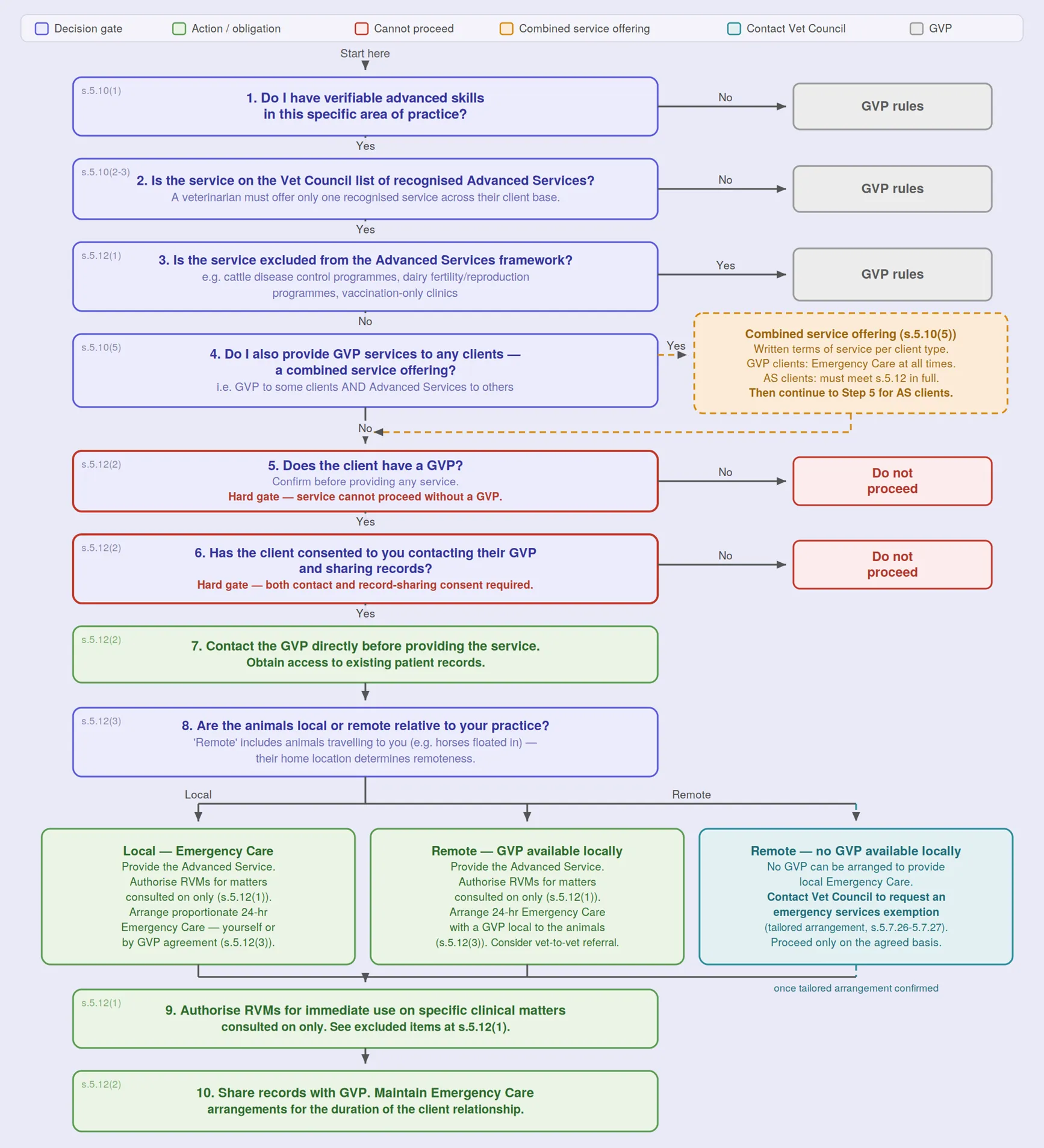
The decision tree in Part 2 is a practical self-assessment tool. Read the explanatory notes in Part 3 alongside it.
Transparency Statement: This document was prepared with the assistance of AI tools to support drafting and refinement. All content has been reviewed, edited, and is subject to Vet Council staff verification and approval before publication.
Part 1: Key definitions
The following terms are used consistently throughout this document and the decision tree.
Term | Meaning |
|---|---|
Advanced Services | One of three sub-types of a Specific and Limited Range of Veterinary Services under the April 2026 Code (section 5.12). Advanced Services are provided by a veterinarian with verifiable advanced skills in a specific and limited area of practice, who provides those services after confirming a GVP is involved and with the client’s consent to share records. The client must have a GVP — this is a non-negotiable. |
General Veterinary Practitioner (GVP) | The predominant veterinarian who a client chooses to provide the continuing and comprehensive primary veterinary care requirements for an animal or group of animals. |
Local (animals) | Animals situated within a reasonable distance of the Advanced Services veterinarian’s base — meaning the veterinarian can themselves provide proportionate Emergency Care in a reasonable timeframe. |
Remote (animals) | Animals situated at a distance where the Advanced Services veterinarian cannot personally attend in a reasonable timeframe. Importantly, animals that travel to the veterinarian for a service (e.g. horses floated to a clinic) are treated as remote — the animals’ home location is what determines remoteness. |
Combined service offering | A situation where a veterinarian provides GVP services to some clients and Advanced Services to others. Special conditions apply under section 5.10(5) — see Step 4 of the decision tree. |
RVM | Restricted Veterinary Medicine. Under an Advanced Services model, RVMs may only be authorised for immediate use on specific clinical matters the veterinarian has consulted on and is currently treating. A number of specific exclusions apply — see section 5.12(1) of the Code. |
Vet-to-vet referral | An arrangement where the Advanced Services veterinarian works in conjunction with the client’s GVP, who provides continuity of care and Emergency Care for the client. This is a practical model well-suited to the Advanced Services framework, particularly for remote clients. |
Part 2: Decision tree
Use the decision tree below to determine whether you qualify to provide Advanced Services and what obligations apply. Work through each step in sequence. Steps 5 and 6 are hard gates — the service cannot proceed if those conditions are not met.
Part 3: Recognised Advanced Services
A veterinarian can only operate under the Advanced Services framework if their service falls within the recognised list below. This list is indicative at this stage and is subject to further development by Vet Council.
Current recognised Advanced Services
If you are uncertain whether your service qualifies, contact Vet Council before proceeding. |
|---|
Importantly, a number of service types are specifically excluded from the Advanced Services framework. If a service falls within the following categories, GVP obligations apply regardless of the veterinarian’s skill level:
Services specifically excluded from Advanced Services (GVP rules apply)
Reference: section 5.12(1) of the Code |
|---|
Part 4: The decision tree — step by step
This section explains the reasoning behind each step of the decision tree and what the veterinarian must do.
Step 1: Do you have verifiable advanced skills? (s.5.10(1))
The starting point for any Advanced Services determination is whether the veterinarian has verifiable advanced skills in the specific area of practice. ‘Verifiable’ means the veterinarian must be able to demonstrate those skills if asked — for example, through recognised postgraduate qualifications, specialist accreditation, or a documented record of advanced training and experience.
A veterinarian who cannot demonstrate advanced skills is acting as a GVP in relation to that service, and GVP obligations apply in full.
Step 2: Is the service on the recognised Advanced Services list? (s.5.10(2)–3))
The service must fall within one of the eight currently recognised Advanced Services and must be genuinely limited in scope so as not to be confused with the services provided by a General Veterinary Practitioner (This list is indicative at this stage and is subject to further development).
A veterinarian may only operate under the Advanced Services framework if they offer a single recognised service across their client base. A veterinarian who offers more than one type of Advanced Service — whether to the same clients or to different clients — does not meet this requirement, and GVP rules apply to the full scope of their practice.
A different situation arises where a veterinarian provides one Advanced Service to some clients while also providing GVP services to others. This is a combined service offering, which is permitted under the Code but carries specific additional conditions under section 5.10(5). That scenario is addressed at Step 4. The veterinarian should continue through the decision tree rather than defaulting to GVP rules at this step.
Step 3: Is the service excluded from the framework? (s.5.12(1))
Even if the service appears to fall within the recognised list, certain RVM authorisation activities are specifically excluded from the Advanced Services model. The most significant exclusions are the dairy and beef cattle Disease Control Programmes listed in section 5.12(1). Where a veterinarian’s service involves any of these excluded activities, GVP obligations apply.
Step 4: Are you operating a combined service offering? (s.5.10(5))
A veterinarian who provides GVP services to some clients and Advanced Services to others — for example, GVP services to local clients and Advanced Services to remote clients — is operating a combined service offering. This is permitted but carries additional obligations:
- There must be explicit written terms of service with each client that clearly identify whether they are being provided with GVP services or Advanced Services.
- For Advanced Services clients: the veterinarian must confirm, before providing the service, that the client has a GVP and therefore by definition, access to 24/7 emergency care, and obtain consent to share records.
- For GVP clients: the veterinarian must be able to demonstrate that adequate Emergency Care is available for those clients at all times, including when the veterinarian is unavailable because they are providing Advanced Services to remote clients.
- The veterinarian must still meet the full requirements of section 5.12 for Advanced Services clients, even where a combined service offering arrangement is in place.
Practical note: combined service offering and the vet-to-vet referral model The vet-to-vet referral model is well-suited to a combined service offering arrangement. The Advanced Services veterinarian formally refers the client to a GVP for continuity of care and Emergency Care, while continuing to provide the specialist service. This model provides clarity for the client and reduces the risk of ambiguity about Emergency Care obligations. A formal written referral and documented Emergency Care arrangements with the receiving GVP are strongly recommended. |
|---|
Step 5: Does the client have a GVP? — non-negotiable (s.5.12(2))
non-negotiable — this step is not discretionary Under section 5.12(2) of the Code, an Advanced Service must not be provided if the client does not have a General Veterinary Practitioner. This is a non-negotiable. There is no discretion to proceed in the absence of a GVP. This differs from the Code in relation to when a veterinarian is acting as a GVP, in which case the absence of a GVP is treated as a matter for the veterinarian’s professional judgement. As an Advanced Service Practitioner under the Specific and Limited Framework, if the client does not have a GVP then under the April 2026 Code, the service cannot proceed. |
|---|
Before providing any Advanced Service, the veterinarian must ask the client who their GVP is and confirm that relationship. If the client does not have a GVP, or is unable to identify one, the Advanced Service must not proceed. This does not mean that the GVP must give permission for the advanced service to take place, just that they must be identified and records obtained (see below) in the interests of continuity of care, open communication and adequate emergency service provision.
Step 6: Has the client consented to contact with the GVP and sharing of records? — non-negotiable (s.5.12(2))
The client must consent to the Advanced Services veterinarian contacting their GVP and sharing the records relating to the treatment provided. Both elements are required. If the client declines consent to contact or to record sharing, the Advanced Service must not be provided.
The veterinarian should explain the purpose of this requirement to the client. Where consent is withheld, this should be documented in the client’s record.
Step 7: Contact the GVP directly (s.5.12(2))
Before providing the Advanced Service, the veterinarian must contact the GVP directly. Contact should include:
- Advising the GVP of the Advanced Services veterinarian’s involvement and the scope of the service to be provided.
- Requesting access to existing patient records.
- Discussing and confirming Emergency Care arrangements (see Step 8).
Step 8: Local or remote? Emergency Care obligations (s.5.12(3))
The veterinarian’s Emergency Care obligations differ depending on whether the animals are local or remote.
| Local animals | Remote animals |
|---|---|---|
Definition | Within a reasonable travel distance of the Advanced Services veterinarian’s base | At a distance where the Advanced Services veterinarian cannot personally attend in a reasonable timeframe. Includes animals that travel to the veterinarian for treatment. |
Emergency Care obligation | The Advanced Services veterinarian must arrange proportionate 24-hour Emergency Care in relation to the matters consulted on. This can be provided by the veterinarian themselves or, if agreed, by the GVP. | The Advanced Services veterinarian must arrange 24-hour Emergency Care with the client’s GVP, assuming that the veterinarian cannot personally provide 24-hour Emergency Care for remote animals. |
Recommended approach | Document the Emergency Care arrangement and communicate it to the client. | Establish a vet-to-vet referral arrangement with the client’s GVP. Formalise in writing and communicate to the client. |
The Emergency Care obligation is proportionate — it relates to the matters the Advanced Services veterinarian has consulted on, not to the full range of the animal’s veterinary needs. The GVP retains responsibility for comprehensive Emergency Care beyond the scope of the Advanced Service.
Step 9: Authorise RVMs within scope (s.5.12(1))
RVMs may only be authorised for immediate use on specific clinical matters consulted on and for the ongoing management of a specific condition. Refer to the exclusions at section 5.12(1) of the Code. Records of all RVM authorisations must be maintained and shared with the GVP.
Step 10: Ongoing obligations (s.5.10(3)–5))
Once an Advanced Services model is established, the veterinarian must continue to meet the following ongoing obligations:
- Provide only the scope of service agreed with the client and described in the terms of service.
- Not selectively offer different services to different clients unless the combined service offering conditions in section 5.10(5) are fully met (see Step 4).
- Not exceed the RVM authorisation scope permitted under section 5.12(1).
- Maintain Emergency Care arrangements for the duration of the client relationship.
- Keep and share records on an ongoing basis after each service episode.
Part 5: Illustrative examples
The following brief examples illustrate how the decision tree applies in practice. Extended work scenarios are being developed separately as a Phase 2 companion document.
Example A: Equine dentistry — Advanced Services only (including remote clients)
A veterinarian has specialist skills in equine dentistry. They do not provide any GVP services. Their clients are located throughout the North Island, and horses are floated to their clinic for treatment. Outcome: Equine dentistry is a recognised Advanced Service. Before each appointment, the veterinarian must confirm the horse’s GVP, obtain consent to contact and share records, communicate with the GVP, and document Emergency Care arrangements with a GVP local to each horse’s home location. The vet-to-vet referral model is well-suited to this service type. |
|---|
Example B: GVP providing equine dentistry to remote clients — combined service offering
A veterinarian provides GVP services to their local equine clients. They also want to offer specialist equine dentistry to remote clients on an Advanced Services basis. Outcome: This is a combined service offering arrangement. The veterinarian must: have written terms of service distinguishing GVP clients from Advanced Services clients; maintain comprehensive Emergency Care for GVP clients at all times (including when away providing Advanced Services); and meet all section 5.12 requirements for each remote Advanced Services client. Documenting Emergency Care arrangements and using a vet-to-vet referral model for remote clients is strongly recommended. |
|---|
Example C: Dairy reproduction synchronisation (not an Advanced Service)
A veterinarian wants to provide a dairy cattle synchronisation service, including authorisation of reproduction hormones, under an Advanced Services model. Outcome: Dairy cattle fertility programmes, including reproduction hormones, are specifically excluded from the Advanced Services framework under section 5.12.1.3.3. This service is a GVP-level service and comprehensive Emergency Care obligations apply. This type of service may be structured as a vet-to-vet referral consultancy, with a local GVP providing continuity and Emergency Care. |
|---|
Part 6: Code of Professional Conduct — key references
Code section | Relevance to this guidance |
|---|---|
s.5.7 | Core Emergency Care obligation for veterinarians in clinical practice |
s.5.10 | General conditions for all Specific and Limited Range of Veterinary Services |
s.5.10(5) | Additional conditions for a combined service offering (GVP and Advanced Services to different clients) |
s.5.11 | Unique Services (out of scope for this guidance — Phase 1 focuses on Advanced Services only) |
s.5.12 | Advanced Services — the primary section addressed in this guidance |
s.5.13 | Consultancy Services (out of scope for this guidance — Phase 1 focuses on Advanced Services only) |
This is a draft document only. It must be reviewed and approved by the Veterinary Council of New Zealand before being treated as official guidance.